Nutcracker novel giveaway!

Fellow book blogger Marian H is hosting a giveaway for her new book, Drosselmeyer’s Dream, a fantasy novel inspired by The Nutcracker. How perfect for Christmas! I haven’t visited this story since childhood, so I’m curious myself to see what it involves…

Posted in General | 3 Comments

You are not so smart, and animals are not so dumb: a science twofer

Last week I read You Are Not So Smart, an often interesting if sometimes trivial review of how mental shortcuts get us in trouble. My reading of Suspicious Minds led into this, and they shared some common ground. The shortcuts assayed are not as obvious as prejudice and logical fallacies, though those do pop up. All told, there are nearly fifty subjects covered, to varying length and skill — ranging from the genuinely interesting to the somewhat obnoxious. Think of the series, “Adam Ruins Everything” to get a sense of the tone of some of these. Some of the bright lights were the article on priming, or how we’re subconsciously manipulated , and the ever-worth-contemplating Dunning-Kreuger effect. I appreciated the collection on the whole, because no amount of reminders about our mental foibles is ever enough, whether we receive nudges through quotes and quips or in this case through pop-science articles. Here we are reminded of the fluidity of memory; of how rarely other people actually think about us, and the absurdity of constantly dwelling on how we’re perceived by others; and the ease in which we slip into conformity with the slightest pressure — conforming even when we attempt to rebel.

More generally engaging, but offering about the same amount of content in a different subject, was Peter Wohlleben’s Hidden Lives of Animals. Wohlleben is a German forester whose decades spent studying and working for the health of intact woodlands was put to excellent use in The Hidden Lives of Trees, probably my favorite science read of 2019. His take on animals’ interior lives — not just their emotions, but their sensations and the commonalities between our experiences — is not as stellar. There’s no shortage of interesting topics covered here, but there are so many and they’re dispatched with such haste that I left disappointed. While Wohleben is a talented writer and observer, that haste also resulted in anthropomorphizing his subjects here all too often, as when he suggested that dogs are modest and turn away when they poop so they can pretend you’re not watching them. (Or, perhaps since they’re in a vulnerable position, they’re turning their backs to an entity they’re sure won’t attack them to better monitor threats from other directions. This is my own guess, not that I’ve ever seen a dog turn away from me to poop.) Here contained are many entertaining stories about animals matching human expressions of emotion, and often shadows of purpose and intent; Wolhleben uses them to assert that emotions are the language of the unconscious, that instinct and will are not nearly as cleanly-cut as we’d like. I suspect this book will prompt me to read How Emotions are Made (one of my dust-gathering science TBR titles) sooner than later.

Forthcoming: a review for Spillover, and I’m hoping to add Frans de Waal’s book on animal emotions and Asimov’s book on the polar regions of the world to finish up my science reading for the year.

Posted in Reviews, science | Tagged , | 5 Comments

Christmas Tales and Counting Buzzards

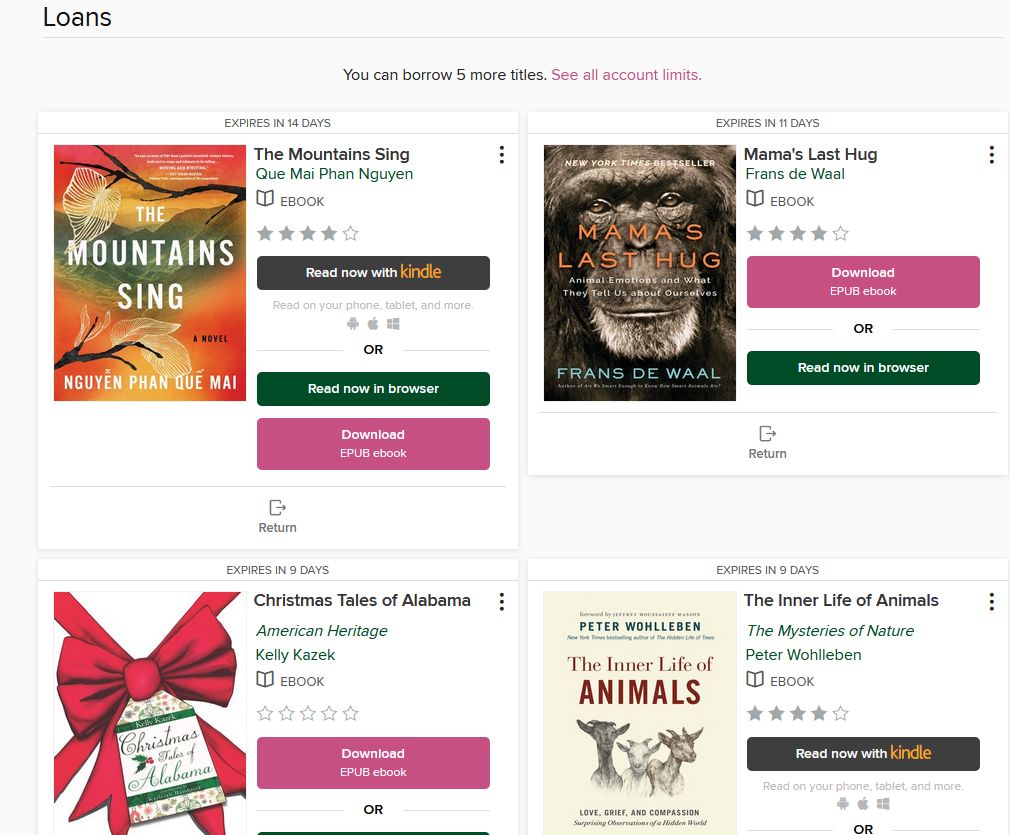
Christmas Tales collects various human interest stories around the State of Alabama that have a Christmas connection — though perhaps human interest isn’t the right word, seeing as many of these stories involve animals! The stories were collected by a journalist, Kelly Kazek, who traveled throughout the state who talk to those who remember certain figures and events. As one might expect from an Alabama collection, authors like Harper Lee, Truman Capote, and Fannie Flagg make appearances; but so do more unexpected celebs like Glenn Miller, and these are far outnumbered by the far more humble subjects. These include Walt Kagle, a rural weatherman who made preternaturally accurate predictions; a dog named Fred who became the town mascot, complete with a newspaper column; a ‘local’ reindeer that made a splash on the big screen when it starred in Prance; and numerous others. The stories are all on the sweet, sentimental side, often featuring the kindness of strangers towards one another. It made for cozy, light Christmas reading and gave me a few leads to pursue in a project I’m planning, to find and visit a point of interest in every one of Alabama’s 67 counties.

In a similar vein but far shorter was Kathryn Tucker Windham’s Count Those Buzzards, a small collection of folk superstitions. The title comes from a belief that one could tell one’s fortune by the number of buzzards flying around, in a he-loves-me-he-loves-me-not sort of fashion. I’ve never heard of the majority of these, and was amused by many of the beliefs, wondering where on earth they could have com from. Windham includes blank pages at the end of the collection for writing down other superstitions. I read this largely because Windham is a Selma luminary, very fondly remembered nearly ten years after her death. She was a journalist, photographer, keeper and teller of stories.

Tagged , , , | 6 Comments

Wisdom Wednesday: Now will never come again

This past month some friends and I have been sharing, anonymously, thoughts on the pandemic and its influence on our growth as people — reflecting on how it’s changed us, how we’ve risen to the challenge (or not). I ended my written reflection by commenting that I hoped 2020 had made me take to heart the lesson offered by Robert Merrick in the 17th century, a lesson that Jean-Luc Picard also offered in the 24th.

Gather ye rosebuds while ye may,
   Old Time is still a-flying;
And this same flower that smiles today
   Tomorrow will be dying.

The glorious lamp of heaven, the sun,
   The higher he’s a-getting,
The sooner will his race be run,
   And nearer he’s to setting.

That age is best which is the first,
   When youth and blood are warmer;
But being spent, the worse, and worst
   Times still succeed the former.

Then be not coy, but use your time,
   And while ye may, go marry;
For having lost but once your prime,
   You may forever tarry.

Posted in quotations | Tagged | Leave a comment

Silent Night: The Christmas Truce

Silent Night: The Remarkable Story of the Christmas Truce
© 2002 Stanley Weintraub
240 pages

One of the most extraordinary stories to come out of the Great War is that of the Christmas Truce, a spontaneous outbreak of caritas in which English, Scottish, and German soldiers decided to stop fighting in observance of the holiday. It’s a bit difficult to sing about peace on Earth, and goodwill towards men while lining up artillery shots on them. The peace was not one ordered or condoned by leadership, but one that stemmed from the fighting men’s own moral convictions, and recognition of the insanity of this conflict that was only a few months old. Why should an English machinist want to murder a German baker, or a German longshoreman do violence to a French carpenter, just because some old ass with a mustache said? Let the Asquiths and Wilhelms live in the mud and dodge rats and kill each other if they want war.

Silent Night is replete with heartwarming anecdotes about men recognizing one another as fellow Christians and laying down their arms, sometimes advancing into the unknown middle ground with gifts in hand and only sweet hope defending them from the other side’s bullets. As such, it makes splendid Christmas reading for those who enjoy history: as a history book in its own right, however, it’s short on context and general narrative. We just read about one instance after another until at the end, Weintraub goes into an interesting bit of alt-history speculation, pondering what might have happened if Christ had triumphed over Caesar and the Christmas Truce had led to a general armistice and peace talks. There’s no connections drawn to Christian pacifism or anything like that, just the record of instances. What I most appreciated about the history, though, was recognizing that the Christmas truce was spontaneous and bottom-up: fighting simply petered out, and as different sectors fell quiet and began to get chummy with the other side, other units took inspiration from that and observed the spirit of Christmas as well. (And observe they did, with singing, drinking, and gift-giving!)

Two titles exploring resistance to the war from the front:

Related:
Conscience: Two Pacifists, Two Soldiers, One Family
To End All Wars: A Story of Loyalty and Rebellion

Posted in history, Reviews | Tagged , | 5 Comments

Go Ask Alice

© 1971 Beatrice Sparks
271 pages

Go ask Alice / I think she’ll know / When logic and proportion have fallen sloppy dead

Recently, while doing some cleaning to the sounds of the Vietnam War, I heard a song urging me to “Go ask Alice.” So that’s where that comes from, I thought, suddenly remembering a novel I read in my youth — read repeatedly, because it was my first glimpse into a vision of the 1960s that wasn’t romantic and idealized, but based instead on darker imaginings. Presented as a diary, and allegedly based on a real teenager’s actual experiences, it’s the story of a young woman who falls into drug abuse through the late sixties, a coming of age story where the subject grows in depravity instead of maturity — in the end, struggling with own sanity. Although it’s dismissed as a fabrication now, to a sheltered teenager like myself it did an excellent job at depicting the drug culture as a horrific thing to be avoided.

I read this novel repeatedly in high school, in part because it was my keyhole glimpse to the ‘real’ world. I knew enough to know I was sheltered, and was curious about the lives other teenagers lived — my own was wrapped up in a HP Pavilion, whose 9 gigs of hard drive space somehow held more than enough to keep me distracted for those years. Go Ask Alice is fabulous as anti-drug propaganda literature: it certainly worked on me: I suspect it’s the root of my own wariness regarding drug use many years after high school. As a story, it’s compelling enough; we witness a young woman struggling with insecurity get exposed to LSD at party. The experience makes her feel alive and sociable, in tune with the universe, and she enthusiastically explores every other substance she can get her hands on. In short order she becomes jaded and retreats from old influences to get her life back together, but finds herself stuck in a cycle of abstinence > temptation > indulgence > decadence > disgust > abstinence until ultimately….well, it’s a tragic ending. I wasn’t a teen in the sixties, and I’ve never consumed anything more interesting than single malt Scotch, so I can’t speak to the realism of this at all. It’s fascinating reading for someone who’s completely outside this world, though, and I still appreciate it for its look into the tumultuous world of the late sixties.

Posted in Reviews | Tagged | 2 Comments

Must….read…..faster…..

Science is having a banner year and I expect 2021 will be very similar.
Posted in General | 5 Comments

Headlong Flight

Star Trek TNG: Headlong Flight
© 2017 Dayton Ward
251 pages

A mysterious nebula and a rogue planet bring together three ships across the gulf of time and space. In our universe, the Enterprise-E can’t resist data that indicates there are lifeforms in distress somewhere on the strange planet’s surface; in other universes, an Enterprise-D with Captain Riker at the helm is conducting its own investigation, glad to finally be given something to put its mind on besides Captain Picard’s untimely death at the hands of the Borg shortly after Wolf 359. Likewise curious are the crew of a 23rd century Romulan vessel, eager to exploit the nebula’s strange energy and weaponize it against the Federation — proving themselves just as able as the ship that destroyed the Enterprise after a border raid.

Headlong Flight has one of the hookiest premises I’ve ever seen in a Star Trek novel. Take the Primeverse Enterprise-E, with all the character development we’ve seen in the last twenty years of novel, and have her encounter an Enterprise-D from a subtly altered past. Many of the crew see themselves, aged or younger by twenty years; others can’t help but notice missing faces among the other crews, or feel bittersweet joy at seeing comrades long lost alive again. Each crew sees the effects of different choices made manifest, and the reader can only imagine what it would be like for Picard to step foot aboard the Enterprise-D again, or the alter-Riker to find himself again in the presence of his mentor. Caught in a dimension-hopping planet’s wake, the three crews must work together to find a way to escape its hold and return to their respective places.

Although the scientific plot has its interest, the main event here is the premise itself, the interactions between different versions of these characters. There’s a huge nostalgia factor here for the reader as well as the characters (Picard deliberately beams over to the Enterprise-D just so he can see it in person again), and I especially liked that the two realities the E-D and Romulan ship came from were seperate ones we’ve not seen before, and not just another borrowing of the ‘mirror universe’. Each of them had subtle alterations that may paying attention to worth it.

In short, a fantastic little standalone novel.

Posted in Reviews | Tagged , , | 3 Comments

Back to the Classics Challenge

Next year I’ll be restarting the Classics Club challenge, with a scheduled list set to go live on January 1st, but some bloggers whom I follow are enrolling in a mini-classics challenge, with twelve categories. My CC list fills all the categories easily, so I’m dovetailing it with Books and Chocolate’s challenge. Here’s my list, a preview of my second CC run..

  1. A 19th century classic: Rebecca, Daphne de Maurier
  2. A 20th century classic: Of Mice and Men, John Steinbeck
  3. A classic by a woman author: Persuasion, Jane Austen
  4. A classic in translation: Resurrection, Leo Tolstoy
  5. A classic by by a non-white author: The Shahnameh, Ferdowsi
  6. A classic by a new-to-you author: Go Tell it on the Mountain, James Baldwin
  7. New-to-you classic by a favorite author: A Day in the Life of Ivan Denisovich, Aleksandr Solzhenitsyn
  8. A classic about an animal, or with an animal in the title: Black Beauty, Anna Sewell
  9. A children’s classic: Alice’s Adventures in Wonderland, Lewis Carroll
  10. A humorous or satirical classic: Northanger Abbey, Jane Austen. (A satire of Gothic novels, I’m given to understand..)
  11. A travel or adventure classic (fiction or non-fiction). Captains Courageous, Rudyard Kipling
  12. A classic play. Plays will only count in this category: The Crucible, Arthur Miller

Posted in General | Tagged , | 18 Comments

Saxon Chronicles Index

Ten years ago, having just discovered Bernard Cornwell and gone absolutely mad over him, I made it my mission to read everything I could of him. That included a new series called the Saxon Chronicles, following some dude named Uhtred as he fought to reclaim his family land from the Vikings. I had no interest in Vikings or the Anglo-Saxon period whatsoever, but it was sort of medieval and that I could appreciate. Swords, horses, big castles: what more do you need? Uhtred won me over immediately, and through him I developed a new fascination with the North cultures and pre-Norman England. Although the series grew long in the tooth after a while, it’s reliably entertained me like few others.

  1. The Last Kingdom. Introduces the story, and introduces the reader to those lovable heathens, the Danes, who as Uhtred said, “are not afraid of life”.
  2. The Pale Horseman. The last Saxon kingdom, Wessex, has fallen to the Norse, though a defiant king Alfred retreats to the marshlands rather than surrender. Uhtred sees the future of England through one of its darkest, most vulnerable moments.
  3. The Lords of the North. Spurned by an ungrateful king, Uhtred leaves Alfred’s service to pursue his own quest of killing Kjarten the Cruel and retaking his homeland. Cornwell delivers one shock after another, delivering Uhtred into his own darkest hour that will give him a lifelong friend and begin forging a lord’s soul of of a restless, angry warrior. Probably my favorite novel in the series!
  4. Sword Song. Alfred’s star is on the rise, but newly-arriving invaders mean that Uhtred must reclaim Lundene for the English.
  5. The Burning Land. This is classic, quintessential Saxon Stories: Uhtred has killed a priest for calling his wife a whore, and forced into exile rather than accept humiliation at the hands of a king he has to serve despite not liking. His hopes of continuing his quest to reclaim the castle are delayed when a woman and friend who he’s sworn an oath to pleads for his help. (Uhtred’s castle quest delayed by his oath-loyalty to friends is going to become almost a running joke in this series.)
  6. Death of Kings. Alfred lies on his death bed and needs Uhtred’s help to keep the peace.
  7. The Pagan Lord. I just have to quote from my review: “[to] lead the Saxons to triumph will involve a ship,  borrowed children, and a dead priest on a stick. That’s life in Anglo-Saxon Britain, and the tale of The Pagan Lord.”
  8. The Empty Throne. Aethelflaed, for whose love Uhtred spends many books scheming and killing folk, needs some more schemin’ and killin’ done on her behalf.
  9. Warriors of the Storm. Uhtred is THIS close to invading Northumbria and taking back his damn castle when there’s an invasion.
  10. The Flame Bearer. Uhtred is THIS close to invading Northumbria and taking back his damn castle when one of his friend needs him.
  11. War of the Wolf. Wessex’s growing ambition makes it a threat to Uhtred’s well-deserved gains, but he is bound by oaths to take his place yet again in the battlefield on the southerners’ behalf.
  12. Sword of Kings. Uhtred finally has his castle back and deserves a break, but Alfred’s successor is dying and there’s something rotten going on in the city of Lundene. Sword saw the welcome return of naval action, and genuine threat to Uhtred.
  13. War Lord. One last time, Uhtred must choose which enemy he trusts more.

Posted in General | Tagged | 7 Comments