Re-tooling tech: a reading

From The Tech-Wise Family:

Technology is in its proper place when it helps us bond with the real people we have been given to love. It’s out of its proper place when we end up bonding with people at a distance, like celebrities, whom we will never meet.

Technology is in its proper place when it starts great conversations. It’s out of its proper place when it prevents us from talking with and listening to one another. Technology is in its proper place when it helps us take care of the fragile bodies we inhabit. It’s out of its proper place when it promises to help us escape the limits and vulnerabilities of those bodies altogether.

Technology is in its proper place when it helps us acquire skill and mastery of domains that are the glory of human culture (sports, music, the arts, cooking, writing, accounting; the list could go on and on). When we let technology replace the development of skill with passive consumption, something has gone wrong.

Technology is in its proper place when it helps us cultivate awe for the created world we are part of and responsible for stewarding (our family spent some joyful and awefilled hours when our children were in middle school watching the beautifully produced BBC series Planet Earth). It’s out of its proper place when it keeps us from engaging the wild and wonderful natural world with all our senses.

Technology is in its proper place only when we use it with intention and care. If there’s one thing I’ve discovered about technology, it’s that it doesn’t stay in its proper place on its own; much like my children’s toys and stuffed creatures and minor treasures, it finds its way underfoot all over the house and all over our lives. If we aren’t intentional and careful, we’ll end up with a quite extraordinary mess.

Posted in quotations | Tagged , | Leave a comment

From the horses’ mouth: Black Beauty and Traveller

This past week I’ve read two novels which feature a horse as the narrator, and I thought it might be fun to consider them together.

The first, Black Beauty by Anna Sewell, is something of a re-read for me: I read a Great Illustrated Classics edition of this several times as a child, finding the historical details I had to puzzle over just as interesting as imagining what it was like to be a horse. Beauty is a horse’s autobiography, from his foaling years to a happy retirement, with years of hardship and comfort in between. Growing up I didn’t know a blessed thing about horses or the care thereof, so this was an extremely educational story for me. Beauty passes from master to master, and some are ignorant to the point of cruelty. In every chapter the reader learns about the proper care and treatment of horses, but as this is a book written to edify youths, there are also more general moral lessons. When one character tries to excuse the damage done to two horses disabled by a reckless groom on the account of ignorance, another harrumphs that ignorance is just as good as wickedness.

Next was a new-to-me title in Richard Adams’ Traveller. I recognized the name of General Lee’s horse, of course – -what self-respecting Civil War buff wouldn’t? — and was so amused by the premise that I had to read it. Traveller is a memoir of the Civil War through the viewpoint of a horse, who Lee adopts early during the conflict. Traveller speaks in an obvious southern dialect, and provides a unique if limited perspective on the war; the memoir is delivered in musing memories to the barn cat that keeps Traveller company while Marse Robert is attending to his duties as a college president after the war. He doesn’t understand what the War thing is, or why men were so excited to attend it, and as a rule he prefers being well away from the bangs and booms. He endures them, though, because he loves General Lee, a man who he regards as being part horse: Marse Robert must be, to understand them so well. Traveller’s thoughts on the war are informed by what he overhears from men and horses talking; the book is peopled with an abundance of other equines, many reflecting their masters’ own personality. Speaking of, Traveller has his own dramatis personae, referring to Lee’s generals not by their names, but by the horse’s private name for them: Ol’ Pete, Cap-in-the-eyes, Jine-the-Cavalry. Although Adams occasionally inserts narrative at large milestones, the reader had better have some general idea as to the main battles of the Army of Northern Virginia, or he will be a bit confused. Traveller is only a horse and can’t tell you he’s just witnessed the Battle of Fredericksburg, but the moderately informed reader can figure out the when-and-where, and anticipate what is about to happen — as we do when “Cap-in-the-eyes” rides off into the dark, never to be seen alive again, at least not by Traveller. For the Civil War reader, this is a unique story, one especially of interest to those who cherish the memory of Lee and enjoy seeing his human side — the quiet man struggling with heart issues, faced with fighting an industrial army several times his size with enthusiastic but ragged country peasants, with little support from his own government, run as it is by feckless, self-absorbed patricians.

Taken together, I have to confess to liking Traveller a bit more, given its novelty and gregarious subject.

Posted in Reviews | Tagged , , | 2 Comments

Life is Suffering

“God, there’s reasons to be resentful about your existence. Everyone you know is going to die — you, too, and there’s going to be a fair bit of pain along the way. Lots of it’s going to be unfair. No wonder you’re resentful — but you act it out and make everything you’re complaining about infinitely worse.There’s this idea that Hell is a bottomless pit. That’s because no matter how bad it is, some stupid SOB like you can find a way to make it worse. Life is suffering. What do you do in the face of that suffering? Try to reduce it. Start with yourself. What good are you? Get yourself together. You know how to do that. You know what’s wrong with you. Don’t be a damn ‘victim’.”

A few months back I discovered a channel on youtube that does various remixes, including bits from Jordan Peterson‘s lectures and speeches. The more I listen and read Peterson the more invigorating I find him — he’s a welcome repast from the a culture that encourages us to be perpetual toddlers. There’s obvious links between some of his thinking and the ideas of both Stoicism and Buddhism.

Posted in quotations | 7 Comments

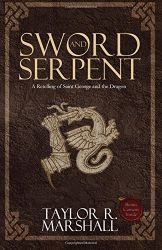
The Sword and the Serpent

Sword and Serpent
© 2014 Taylor R. Marshall
411 pages

A phoenix from the fire will rise
Unchain her and free the world
In Britannia will rise the eagle whose sign is the Cross
In Britannia will rise the chief dragon whose sign is the Sword
Take [Excalibur] to Britannia so from stone to be freed

Years ago I learned of a retelling of the St. George and the dragon myth, which attracted me because while I knew St. George is the patron saint of England (happy Feast of St. George, btw — it’s April 23rd, and the reason Read of England happens this particular month), I had no idea what the story really was or why it was connected to England. The Sword and the Serpent is a quasi-historical story stretching from Roman Libya to Anatolia, as the disparate lives of two young people, full of pain and suffering, drive them to Rome and to their destiny. Although the principal legend is that of St. George and the dragon, savvy readers may recognize St. Christopher and others. An engaging semi-fantastic adventure in its own right, the subtle mix of real-world legends and real-world historical detail is the first in a promising trilogy.

The Sword and the Serpent follows a young lad named Jurian, or Georgios, who with his sister has fled their home in Anatolia after an anti-Christian mob burned their house and murdered their mother. Jurian is taking his sister to Rome, hoping to join the Legion and work for his future. Across the Roman lake, in Libya, a tortured young priestess is summoning the will to sacrifice yet another of her village’s children to the Old God who lives in a mountainous cave, hating herself for what she does, but believing she must if the Old God’s rage is not to be kindled against them. Fate brings both to Rome, where Jurian — having been literally guided and guarded by saints along way — learns of his destiny. His path will take him to Libya, there to confront the dragon.

As an adventure story mixing historical detail and legend, this is a fun premise, especially when the Arthur myth is presaged. The problem with some Christian fiction, though, the likes of Lewis and Tolkien excepting, is that there’s a heavy use of semi-miraculous or outright miraculous events that drains away some of the challenge and makes the resolution a foregone conclusion. Marshall does not do this nearly to the same novel-sapping degree of Rosenberg’s Twelfth Imam or the Left Behind series, but it’s done enough to be noticeable. Jurian’s road to Rome is practically paved by coincidence, and his fight against the dragon is…er, anticlimactic, let’s say. Arguably, that’s scripturally appropriate, and the book even ends with an allusion to Revelation, but it’s not a particularly compelling end to a novel.

Posted in Reviews | Tagged , , , , | 3 Comments

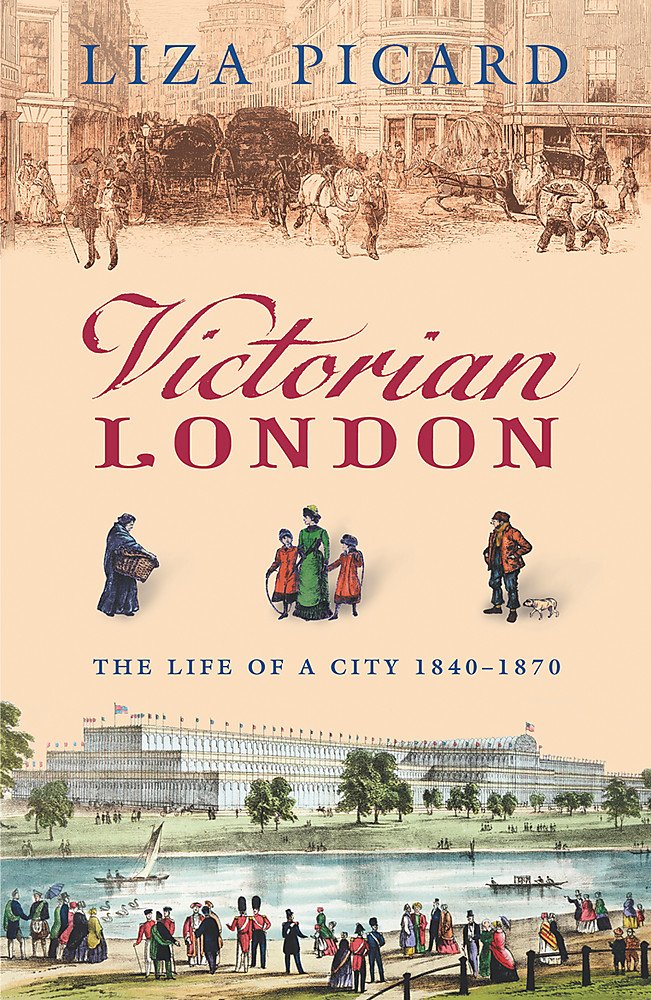
Victorian London

Victorian London: The Life of a City, 1840 – 1870
© 2013 Liza Picard
504 pages

As far as immersive English social histories go, I would heretofore have called Ian Mortimer the champion standing, but if Victorian London is any example, Liza Picard is serious competition. Her study of Victorian London delivers a full broadside of information about everyday life, presented in a very readable narrative that takes one back to a city that was on the verge of being the ‘capital of the world’. For those who want to learn more about London, or England in general during this age of transformation, Picard’s work is first rate.

Although Picard does not employ the literal time-tourist scheme favored by Mortimer and others, she does begin the book with what we’d notice first were we suddenly to find ourselves standing in the relatively new Trafalgar Square: the smells of a city brimming with millions of people, their animals, and their activities of life, served by a sewage-clogged river and cesspits that were often overflowing. We then begin to consider the physical lay of the land: the importance of the river itself to London’s fortunes and its people’s quality of life; the streets, buildings, and railways that gave the city its physical form, the utilities that made it work for its millions of residents, and then — the people themselves.

Picard’s work is comprehensive, addressing all levels of British society, from the penniless debtor in workhouses and prison hulks to the peers of the realm. Picard does not shy away from the underbelly of London, making the reader well aware that despite the stupendous technological progress of the age, many lived lives that even a medieval peasant would not envy. Picard offers details of life at every level, tastes of the Victorian age for any appetite: you may well on Dickens’ or Austens’ subjects at your leisure. The two often combine, as they do in the chapter on the abounding aid societies. We learn of how people dressed and ate at differing levels of society; how one did their banking (if they weren’t spending all of their cash on food, rent, and bawdy shows), where they went to be amused and how they got there, considering seemingly every facet of life (with a lingering pause at the Great Exhibition) until finally we arrive at the last chapter, death. Even within a given chapter there’s considerable variety, because the Victorian age was one of increasingly rapid change: London was being remade, with new utilities being integrated into its existing form, from plumbing to the Underground.

Picard directly quotes from her sources most of the time, revealing to the reader the staggering variety of books, letters, and official statistics she drew on to compose this narrative. I’m surprised some sources have even survived, like 1830s housewives’ guides to cleaning and the like. To canvass such an array of information and whip it into an immersive, fun narrative was no small challenge, but Picard succeeds with flying colors. I definitely be considering her work in the future.

Posted in history, Reviews | Tagged , , , , , | 4 Comments

Of Captains Courageous, dog-training, and walking amid mountain laurel

Late last week I finished Captains Courageous, a coming-of-age adventure story in which a spoiled brat named Harvey Cheyne falls overboard at sea and is rescued by a fishing boat, whereupon he must work for his living and matures rather nicely. Anthony Esolen mentioned it in his Defense of Boyhood (review on that eventually, I’m going to do either a Esolen week or a Of Boys and Men week), and it sounded so much like one of my favorite Jack London novels, The Sea Wolf, that I had to give it a go. As a boy’s adventure novel, it’s certainly fun enough; Harvey is an absolute git at the beginning, so part of the pleasure is seeing him get his comeuppance. There’s also the satisfaction of watching him grow, though, learning the ropes and skills of the men at sea, and earning their respect and his own — becoming, in the end, a young man his father can be proud of and even like, instead of irresponsibly tolerate and avoid. The Sea Wolf did better with the premise for adult readers, though, in part because of the psychological content, the debates between London’s effete intellectual Humpfrey and the Nietzsche-inspired uberman, Wolf Larsen, and how the reader witnesses Humfrey inner growth. With Harvey, we can witness this change from the outside, by how others treat him, but we don’t get much of a look into his head.

In other news, I am moving along through Victorian London, a large but very readable social history of the titular subject, but have been somewhat distracted by dog-training and hiking, sometimes at the same time. On February 14th I adopted a mixed-lab pup who I named Idgie, and she’s kept me busy, and will soon be teaching me new skills: she’s more or less housebroken now, but will soon be too big to live indoors, so I’m building her a nice big pen under one of my shade trees. I went to the trouble of housebreaking her so she can come inside on occasion, though, especially during the worst bits of summer and winter. We’ve been exploring different places on the weekends, making repeated excursions to Old Cahawba because of the lack of traffic. (It’s a grid of dirt roads in the woods, with meadows where buildings used to be, and the odd crumbling ruin. Very pleasant except in summer!) Pictures to come if she ever sits still for one.

I didn’t take her to the Deadening Alpine Trail Sunday though, because I’ve hiked at Lake Martin before and knew some of the trails could be technical. The Deadening Alpine Trail, which I was scouting to see if it would be good for a group hike, proved much more challenging than expected: according to the signage, it’s one of the most challenging at the lake! The first mile or was pleasant woodland hills, weaving among mountain laurel and the like, but then we hit 3 miles of climbs, crawls, and colorful oaths lobbed at strangers we’d never met, but who designed this trail to torture us. My coworker and I arrived around 3 and escaped the woods only after 7, as the sun was starting its evening slumber. After steak and coffee we managed to make the long drive home without slumbering off ourselves!

Posted in Classics and Literary, Reviews | Tagged , , , | 4 Comments

His Majesty’s Dragon

His Majesty’s Dragon
© 2006 Naomi Novik
384 pages

William Laurence’s career was all set: a ship of his own, a fair French prize in his sights, and fiance waiting for him at home.  But then, in the hold of the French ship, his men found a rare treasure: a dragon egg.  To have gotten it home to England would have netted him a fortune – but  now the thing’s hatched, and worse yet, bonded with him.   A dragon bond is unbreakable, and to raise the creature into His Majesty’s Service, Laurence must be its captain, putting aside his hopes of promotions and wedded bliss.  His life is now the dragon’s, who he names Temeraire after another French taking.  His Majesty’s Dragon introduces readers to an extraordinary setting, a mixture of fantasy and the Napoleonic wars,  in which human cultures have domesticated dragons and forged relationships with them,  and make heavy military use of them.    

Combat-wise,  there are scattered scenes in His Majesty’s Dragon,   in the last third of the work in which Laurence’s wing is stationed guarding the English channel  while another wing attempts to goad the French fleet into open battle   His Majesty’s Dragon is chiefly the story of Laurence and Temeraire’s bonding, of a naval officer unexpectedly and unhappily thrown into the secret world of the Aerial Corps learning to love his new friend. Temeraire has a personality all of his own;  dragons can communicate with humans, and some are remarkably intelligent. (Some are remarkably thick, too, especially if they’ve been bred for speed rather than intelligence.)  The author works in bits of dragon lore, like the attachment to shiny baubles, and as we learn of dragon species across the world, the savvy reader will realize they’re inspired by the differing interpretations of dragons in our own cultures –think of the ‘whiskers’ on Asian dragon-types.    Dragons place unique demands on their men which make traditional lives impossible: informality is the norm in the Aerial Corps, and some dragon species will only bond with women,   giving this Napoleonic story a decidedly interesting twist as the fairly formal Laurence attempts to figure  out how to handle himself fighting alongside women and girls. 

His Majesty’s Dragon didn’t have much in the way of historical plotting – it’s mostly about  the captain and his mount bonding – but  this series is definitely one to revisit, a winsome twist to a reliable fount of Napoleonic storytelling.   I’m looking forward to learning more about this world of dragons and men (and women!), and the unique flavor they’ll undoubtedly add to the drama of the Napoleonic wars.

Posted in Reviews | Tagged , , | 3 Comments

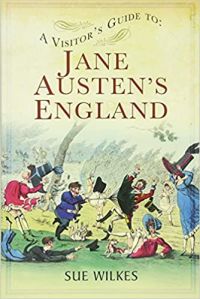
A Visitor’s Guide to Jane Austen’s England

A Visitor’s Guide to Jane Austen’s England
© 2014 Sue Wilkes
224 pages

Fancy a visit with Jane? Sue Wilkes has created here a light introduction to Austen’s society, the landed gentry of the mid-Georgian period. Although its approach reminds one of A Time Traveler’s Guide to Medieval England and the series that followed, Jane Austen’s England is far more restrictive in examining only Austen’s class, but has unique appeal for Austenites in how heavily it draws for illustrations from her letters and the books, in addition to steady support from period newspapers and letters. As a social history, it’s thus shallow — but as a work giving background for reading an Austen novel, it’s quite fitting and fun.

Leaning in to the framing device of her book, Wilke opens with information a traveler would be especially interested in: roads, lodging, and payment. We receive helpful tips, like sending our servants ahead of us with the baggage to secure lodging and stabling in advance, and are supplied with some of the better gentleman’s clubs and restaurants to support us on our travels. Some of the curiosities we may see along the way, like bodies hanging from gibbets, are also explained. We move then to the Georgian household, learning what “plucking a rose” means, and how to make sure the bedbugs don’t bite. We learn, too, of the social structure of the household, of the roles of the husband and wife and the importance placed on the eldest son for keeping the family estate intact. After an extensive section on fashion of the day — far more risque than one might imagine, what with the sheer material and the plunging necklines — we get a general introduction to the shopping and ‘dating’ scene. The book wraps up with a few odds and ends like Georgian medicine.

Although not nearly as substantial as Ian Mortimer’s similar works, I thoroughly enjoyed this dip into what life was life for the Georgian genteel, though as with the inspired source it completely ignores the servants & such. Wilkes is to be commended for her heavy integration of primary sources in way that doesn’t overhelp her narrative. If you’re into Austen and want to learn more about the background of her novels, A Visitor’s Guide reccommends itself: but as I’ve found this past week, there are numerous social histories of the Georgian period if you want to learn more than just the goings-on of the landed gentry.

Related:
A Time Travelers Guide to Medieval England, Ian Mortimer
A Time Traveler’s Guide to Elizabeathan England, Ian Mortimer
A Time Traveler’s Guide to Restoration England, Ian Mortimer

Posted in history, Reviews | Tagged , , , | 2 Comments

Wisdom for Wednesday: Take charge of your mind

“Occupy your mind with good thoughts, or the enemy will fill them with bad ones.” – attributed to St. Thomas More, Chancellor of England. Unfortunately, I can’t find a primary source for this, hence ‘attributed’.

“A gifted American psychologist has said, ‘Worry is a spasm of the emotion; the mind catches hold of something and will not let it go.’ It is useless to argue with the mind in this condition. The stronger the will, the more futile the task. One can only gently insinuate something else into its convulsive grasp. And if this something else is rightly chosen, if it is really attended by the illumination of another field of interest, gradually, and often quite swiftly, the old undue grip relaxes and the process of recuperation and repair begins. The cultivation of a hobby and new forms of interest is therefore a policy of first importance to a public man.” – Sir Winston Churchill, “Painting as a Pastime

Posted in quotations | Tagged | Leave a comment

The Blooding

Master of War: The Blooding
© 2013 David Gilman
512 pages

Thomas Blackstone is a free man, a stonemason who learned his trade alongside his deaf-mute brother Richard.  When Richard is accused of raping and killing a young woman,  the price for his freedom is the brothers’ service in the King’s army,  which is about to make good Edward’s claim over France.    Although Thomas expects to be at his brother’s side, firing the warbow their father taught them both to master, fate has other plans.  Women, mostly  — or as one character calls them, “Satan’s bait”. A woman drives the brothers apart, and a woman leads Thomas to an act of courage that impels the Black Prince to ennoble him on his deathbed. Fate also lands Thomas in the care of a French family of divided loyalties, who make it their mission to turn this jumped-up commoner into a knight worthy of the name.   A winsome mix of action,  relational drama, and political intrigue, The Blooding nevertheless disappoints in being only the introduction to a larger series.  

I was attracted to this first on the promise of it being an archer’s take on the Battle of Crecy,  which I knew from history to be an unexpectedly brutal loss for the French,  due in part to their own impatience. French knights mowed down their own bowmen in their haste to reach the English lines, something witnessed here by Thomas himself.  Although Thomas quickly proves himself in battle,  there’s a larger strategy at play here that Thomas is only playing  a role in:  being sundered from his brother and nearly mortally wounded just get him to the stage. The full drama will come in later books, and in the meantime what readers receive is politics and sex, as Thomas falls deeper into love & lust with the French woman whose life he saved, and who nursed him back to health in turn, and begins to realize that her guardians have plans for him  – plans which won’t begin to move until the next book. 

I leave The Blooding on an odd note of disappointment.  I enjoyed seeing Thomas grow from a simple stonemason, hesitant to kill, into a warrior accomplished in multiple weapons and in command of his own unit,  trying to learn to act as a gentleman after he’s given a deathbed knighthood by his prince.  The political side is promising;  by circumstance and by love Thomas is linked with a French family of mixed loyalties, who bleed for French but have little love for their king. I’m sure the machinations as developed in later books will be quite good, but I was annoyed that this book is merely an introduction. It doesn’t help that Thomas isn’t a terribly believable medieval stonemason: he has no hint of religiosity, for instance, something believable in a figure like Sharpe (19th century), but not so much the 14th. He’s improbably noble, for a character in history — but that’s par for the course with historical fiction. No one would bond with a racist Sharpe or a raping Uhtred, so it’s not surprising that Thomas doesn’t loot and is hesitant to get his hands blooded for the first time. Thomas is a little too ironed-out, though. He’s more like Thomas Branson, a commoner suddenly thrown into high society, but with a talent for strategy and killing rather than cars and farmland.  I may continue in the series, but we’ll see.  It had many strengths, but often felt like a romance novel with the odd massacre.

Posted in historical fiction, Reviews | Tagged , , | 4 Comments