The Every

The Every
© 2021 Dave Eggers
608 pages
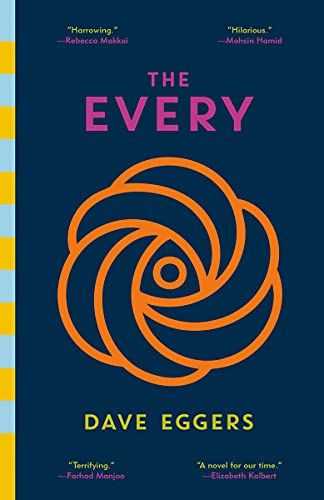
Nearly ten years ago, Dave Eggers published The Circle,   about the rise of an uber-corporation whose products had transformed not only the digital world, but were beginning to shape society as well.  Think of Google, but add to its influence that of facebook and Apple, and you have some idea of The Circle’s power – but that was only the beginning.  Having devoured a company that sounds an awful lot like Amazon , the Circle has further metastasized into something far larger,  more influential, and (to some) insidious: it is The Every.    To Delaney Wells, The Every is an architect of human tyranny that needs to be destroyed – but no legislator has the will, let alone the power, to break it. She needs to get inside and find some way to make it implode,  burying her aversion to Everything about this company long enough to subvert it.  The result is a novel far darker but just as humorous in its satire as The Circle,   targeting the technological prison we are building for itself as well as the culture of modern corporations in general. 

Delaney is not quite alone in her quest to destroy the beast; she’s aided and abetted by her roommate and friend Wes, who shares  her loathing of it in part, though he’s a techie who also occasionally mesmerized by the potential of new tools.   His ability to see and use the promise of tech makes him Delaney’s key ally:    their idea to destroy the Every is to feed it ideas that fit its appetites perfectly, but will be so obnoxious and invasive to most people that consumers will rise up in rebellion against the new Panopticon.  As a new employee, Delaney is rotated through departments to gain a concept of The Every’s scope of operations, and at nearly every stage she and Wes feed ideas into the beast. To their rising horror, though,   upping the ante doesn’t work:   the few consumers who resist the invasiness are quickly overwhelmed by popular opinion (which is God  in this hyperconnected world where thoughtcriminals can be shamed into oblivion and poverty)  or otherwise marginalized.  Delaney and Wes are expanding and perfecting the dystopia, not sowing the seed for its destruction  –  and because of its global scope, the goings-on of the Every have drastic repercussions for society.   That’s part of the problem, the sugar coating the poison of The Every’s command and control of most of the global market and most of the global populace:  its tyranny can make some things better, reducing waste, improving health, and eliminating violent crime. The only price is human flourishing. 

The Every succeeds as a tech thriller,  with few kinks in the narrative to keep things interesting. Having read Eggers before,  I had some suspicion of the ending,  but there were surprises enough to keep me wondering. Where’s it’s most effective, though, is where it doubles down on the growing horror of The Circle, in  slowly painting a picture of humans completely possessed by their own devices.   We saw in The Circle how experiences were completely reduced to sharable moments, newsfeed fodder:  everything became tragically shallow, yet was taken all the more seriously by the book’s hyperconsumer characters.  This has only increased in The Every, but is made far worse. Various Every apps constantly ping their users to  prompt them to pay attention to certainly daily goals,  so we witness characters stop in mid-conversation to start jogging in place (need those steps!), laughing randomly,  or shouting words to increase their vocabulary.   More unsettling is that this is regarded as normal behavior, at least within the Every’s campus  – an island unto itself, where skintight lycra is the norm,  and language is insipid and inoffensive when it’s not incomprehensible corporate jargon.   Although members of The Every are adapted to being nothing more than human rats in an elaborate digital Skinner box,    Delaney’s connections with those outside allow us to see more of the human costs, but more disturbingly, the ways people justify their rapidly decreasing agency by pointing to superficial material improvements. Sure,  I live in a home where every system is controlled by algorithms created by an company with its own agendas, but it’s a comfortable place and I never have to go shopping again.  It’s a new vision of Huxley. 

The Every is both amusing and deeply disturbing; amusing in the way it mocks corporate culture and demonstrates what fools we can make of ourselves, dancing to the tune played by algorithms and bowing before big data and its technocrat handlers — but profoundly disturbing in its depiction of how small and enfeebled technology and contemporary culture can and are making us. Unimaginable is the human of old, who strode across continents, enduring all kind of weather and who put his mind and muscle to work creating civilization: here we find oversized toddlers, incapable of navigating their world without the constant voice in their head telling them where to go. We find people who, at the least amount of friction, opposition, or stress, shut down and shrink into themselves — who are always plugged in, always striving to be at the center of attention and constantly fearing that they’re being left out. It’s sad because this is not fiction, merely an exaggeration of what we already witness on a daily basis, the subjugation of a given person’s humanity by the Matrix-jacked consumer-creature, his inner Gollum forever trying to find his precious among the endless newsfeed.

Related:
Optimal, J.M. Berger. A novel set in a world controlled by The System, in which every aspect of human life is provided and guided by algorithms.
The Warehouse, Rob Hart. Another technocorporate dystopia.
Posted in Reviews, science fiction | Tagged , , , , , , | 6 Comments

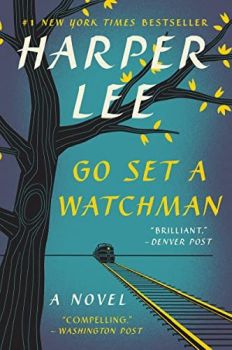
Go Set a Watchman

Go Set a Watchman
© 2015 Harper Lee
288 pages

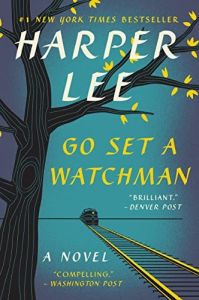
When it was announced that Harper Lee had published a sequel to her legendary book, Go Set a Watchman,  I was skeptical, as were many.  Given how close its author was to death,  the book’s sudden ‘discovery’ and publication appeared to be nothing more than rank opportunism from her lawyer. A recent lecture by Dr. Wayne Flynt, an Alabama historian who was friends with Lee for years prior to her death,  piqued my curiosity in the title: even if Lee didn’t initiate its late publication, Flynt indicated that she didn’t fight it, either. The moral questions explored in the book were interesting enough that I wanted to read it,  doubts about its legitimacy aside.   Although continuity issues discredit it from being regarded as a proper sequel,  Watchman is nonetheless thought provoking.

As most readers know, To Kill a Mockingbird was a racial & legal drama about a socially prominent southern attorney defending a black man accused of raping a young white woman,  going against the demands of respectability and squaring off against his peers and a would-be lynch mob for the sake of his conscience.  That man, Atticus Finch, became a moral icon, idealized by his young daughter Jean Louise, or ‘Scout’.In Go Set a Watchman, however, young Scout is older: Jean Louise has reached early adulthood, that charming period where the confidence of adolescence hasn’t yet been tempered by the burden of time and experience, and she has returned home for a two-week visit with her family and her part-time beau.  Jean Louise finds her hometown altered from her youth: the Civil Rights movement is sweeping the nation,  disrupting the old order and making tension in town palpable. She’s at first confused and distressed to experience cold distrust from blacks she’s known all of her life, but outright horrified when she finds her father Atticus and her suitor Hank attending a meeting of the White Citizens Council – the upright and respectable  sitting side by side of sleazy, corrupt demagogues. To see Atticus keeping company with that ilk, to see him giving an ear to the cause of resistant segregation –  voicing a distrust of a community he now viewed as Other even though he once defended the common humanity of all – breaks Jean Louise’s heart and destroys her world.  If her father, the paragon of virtue, could be compromised, what was left?

If Go Set a Watchman were merely a book about a young idealist discovering that her father is guilty of being human and preaching to him about the virtues he’s apparently forgotten, it would be sanctimonious and boring.  Instead, we find characters who are all riven with conflict. Scout fled Maycomb, but retains attachment to the world she knew: she’s dismayed to learn of property sold, of church hymns changed, and of the muted antagonism she witnesses between her town’s people, black and white.  In her great confrontation with her father,  she expresses her own reservations about the recent court decision (Brown vs. Board) on constitutional grounds –  reservations that make her father chuckle, for he declares she makes him look like a Roosevelt democrat by comparison.  Their shared attachment to what they know, though, and their shared concern over the steadily-ballooning power of DC only go so far.   Jean Louise has been absent from Maycomb and has no idea what’s been happening in the community, and neither she nor the reader are given details about the recent trouble — we only witness fragments of hostility. Whatever has been happening is enough to make Atticus and his brother Dr. Finch staunch opponents of the new activism, which they see as nothing more than the creation of outside pressure groups creating unnecessary strife. They’re particularly opposed to the insertion of the Federal government into local matters, which to them matters more than race, more than peace, or even a good name. It’s the reason that when Scout releases a sailor’s vocabulary of condemnation against her father that he sits peaceably and doesn’t twitch an eye: he can tolerate any kind of name-calling, he says afterwards, so long as it’s not true. He for one is square with his conscience. Although Scout and the reader may be prepared (or resigned) to dismiss the Finches as bigots, the back and forth arguments that constitute the second half of the book indicate that the truth is more complicated than reaction and impulse will admit.

Go Set a Watchman is a compelling book, though it’s unfinished; it begins in story then switches purely to back and forth dialogue, and there are details missing that make trying to understand Atticus’s obstinence more difficult. Whether the reader will find it worth reading varies on the reader: I was drawn in by the tension of a good man having to make stands in a more murky moral area — resisting good causes being advanced through bad means, for instance. While it’s very easy for contemporary people to assert that had they been living back then, they would have made The Right Choice, that’s extremely unlikely — and would have made for a much less interesting story. Personally, Watchman was worth reading just for the character of Dr. Finch, who in retirement has retreated into the Victorian era and is a perfect southern eccentric. It helps to know something of the novel’s history before reading it, though — the fact that it was Lee’s first idea for a novel, and that she was advised to refine the story to better advance its moral arguments. The result was To Kill a Mockingbird, which has inspired people for decades. It’s neither a prequel nor a sequel, but an interesting look into Harper Lee’s attempt to come to terms with the conflict between her community’s values as espoused and those same values as practiced.

Posted in Reviews | Tagged , , , , | Leave a comment

Teaser Tuesday: Every

Happy Tuesday! Teasing from Dave Eggers’ The Every today, the story of one woman’s quest to destroy an uber-corporation that’s Facebook/Google/Apple/Amazon rolled into one.

“Now I’m thinking if I can just kill emojis, that would be enough,” Delaney said. “You see the Secretary of State use a few today?” Wes asked. “He was celebrating the anniversary of glasnost, and he used a dancing rainbow. On the official state account. Our species has no dignity. No path to dignity.”

Well, sometimes I’ll text a friend—just something like a rainbow emoji followed by a two-way arrow and a question mark. You know, to let them know I’m happy and hope they’re happy.” “And then you wait,” Delaney said. “Right!” Shireen said. “And while I’m waiting…” “You wonder if they hate you and are plotting against you and will spread lies about you and ruin your life and you’ll want to die?” Delaney said. She expected a laugh, but the faces of Shireen and Carlo had gone gray. “I wouldn’t use those words, exactly,” Shireen said, “but—”

Capital-P Play was last year’s management theory, following multitasking, singletasking, grit, learning-from-failure, napping, cardioworking, saying no, saying yes, the wisdom of the crowd > trusting one’s gut, trusting one’s gut > the wisdom of the crowd, Viking management theory, Commissioner Gordon workflow theory, X-teams, B-teams, embracing simplicity, pursuing complexity, seeking zemblanity, creativity through radical individualism, creativity through groupthink, creativity through the rejection of groupthink, organizational mindfulness, organizational blindness, microwork, macrosloth, fear-based camaraderie, love-based terror, working while standing, working while ambulatory, learning while sleeping, and, most recently, limes.

Posted in General | Tagged , | 4 Comments

October 2022 in Review

Starting October, I had two things in mind: one, a nod to Mental Health Awareness Month; two, a nod to Halloween that would come in either some appropriate nonfiction (I have books on blood and skeletons) or in a look at the future-horror of the atomic age, both through nuclear testing and the rise of UFO mania. I also wanted to squeeze in something about German history if I could, in observance of Unification Day. I managed….Life and Death in the Third Reich, 2 books relating to mental health, and a scattering of randos.

Classics Club
I started reading Dune. It’s not grabbing me yet.

Mount Doom
Life and Death in the Third Reich, Peter Fritszche
Survival City: Adventures in the Ruins of Atomic America, Tom Vanderbilt

Hey, two books! That’s…something. Ignore the amount of books I bought last month and this month.

Science Survey 2022
The survey was fulfilled in September, but more fuel for the fire! An Immense World and The Skeptic’s Guide to the Future brought us up to 18 books so far. We’ll crack 20 easy, but I’d love to finish the year at 24.

Mental Health Awareness Month
Unstitched: My Journey to Understand Opioid Addiction
Hooked: The Pitfalls of Media, Technology, and Social Networking (review in progress)

Newly Acquired:
The Politically Incorrect Guide to the Civil War, H.W. Crocker II. From the author of Armstrong, the funny alt-history novel about Custer surviving Little Bighorn and becoming a gun for hire.
Adventures with Ed: A Portrait of Abbey
Postcards from Ed: Dispatches and Salvos from an American Iconoclast
Faces Along the Bar: Lore and Order in the Workingman’s Saloon
Sid Meier’s Memoir! A Life in Computer Games

The Every, Dave Eggers
8 Days in the Woods: The Making of the Blair Witch Project

Okay, new goal: make it to December without buying any books. If I do, I’ll reward myself with fried ice cream from my favorite Mexican place.

Posted in General | Tagged | 11 Comments

Teaser Tuesday: Go Set a Watchman

She walked down the steps and into the shade of a live oak. She put her arm out and leaned against the trunk. She looked at Maycomb, and her throat tightened: Maycomb was looking back at her. Go away, the old buildings said. There is no place for you here. You are not wanted. We have secrets.

“Remember this also: it’s always easy to look back and see what we were, yesterday, ten years ago. It is hard to see what we are. If you can master that trick, you’ll get along.”

“Very well, if you won’t let me tell you what Melbourne said I’ll put it in my own words: the time your friends need you is when they’re wrong, Jean Louise. They don’t need you when they’re right.”

Posted in General, quotations | Tagged , | Leave a comment

Afternoons with Harper Lee

Afternoons with Harper Lee
© 2022 Wayne Flynt
256 pages

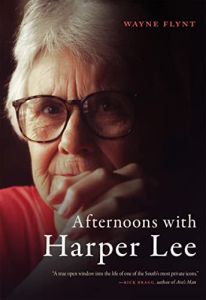
Recently I had the pleasure of listening to historian Dr. Wayne Flynt speak at my local library,  drawing from his new book, Afternoons with Harper Lee.   As with Mockingbird Songs, a collection of letters exchanged between himself and the famed author,  this memoir grows out of Flynt’s and his wife Dartie’s long friendship with the Monroeville native.  Afternoons takes its name from the Flynts’ afternoon visits with Lee in the care center she lived the last years of her life in following a stroke in her adopted city of New York.  The memoir combines a personable Harper Lee biography with a messy account of the Flynt-Lee friendship, along with musings on the meaning of  To Kill a Mockingbird and Go Set a Watchman.    Although I’ve been dubious about Watchman since its release and have never read it because of my suspicions that its publication was done over the head of its declining author,  Flynt’s conversations with Lee here indicate that she’d finished it in 1957, but that it simply hadn’t been published.  Even more interestingly, she penned a third work, a true crime piece about a Baptist preacher who was popularly regarded as a serial killer who’d only escaped justice through voodoo until he met a vigilante gunman. The manuscript, never submitted for publication because of fear of legal suits,  was lost over the years. Go Set a Watchman, Flynt suggests, depicted Lee’s own youthful innocence dying. Atticus Finch was the unparalleled hero of Mockingbird,  but in Watchman the young adult Scout has to witness her father making compromises to prevent worse evils. While Flynt’s lecture suggested Lee had come to terms with this, in the book itself she comes off as more permanently disaffected about her father, and  bitter about the South and Monroeville in general. Flynt reiterates although Lee often presented herself as a cantankerous recluse, she was warm and funny to those she admitted into her trust. She made for difficult company as a reader, but I was drawn to this out of interest in what it might reveal about Watchman and her friendship with the legendary oral historian Kathryn Tucker Windham. The book delivers substance about the former but only a brief mention of the latter.

Posted in Classics and Literary, Reviews | Tagged , , , , , , | 3 Comments

Spinning Atoms in the Desert

Bombast: Spinning Atoms in the Desert
© 2010 Michon Mackedon
236 pages

Which is more breathtaking, the power of the atom bomb or the hubris of governments that use it? Michon Mackedon’s Bombast will leave readers wondering. It reviews the approach of the Atomic Energy Commission to organizing and testing a succession of increasingly more powerful bombs from the Marshall Islands to Nevada, looking at the use of language in particular to frame this testing as innocuous and positive (“bigger bombs for a brighter tomorrow”, to borrow from another history related to this subject). Despite its small pagecount, the book has the heft of a textbook, and sometimes the prose quality of one: it’s not technical, but far more academic than ‘popular’, and will be of interest primarily to those obsessed with the early atomic age. It has much to say on the cold-blooded way the state treats those are in the way of its aims, as well as the means through which dissenters’ concerns are made to look ridiculous, ignorant, and unpatriotic.

There were legitimate fears in the 1940s that the initial test of the nuclear bomb might cause a chain reaction capable of igniting the atmosphere: that the test continued says much about the stakes and excitement around nuclear weaponry’s potential. During World War 2, bombing raids against cities like Hamburg, Berlin, and Schweinfurt would consisted of scores, hundreds, and (in the case of Cologne) a thousand bombers — but the Bomb promised to drastically reduce the number of airplanes and more valuable airmen at risk. Although Hiroshima and Nagasaki demonstrated the destructive potential of the bomb more than adequately to the world, these initial mechanisms were crude: more sophisticated and potent delivery systems were being created, and they needed to be tested — both their scope, and their array of effects. This could be as crude as dropping bombs into the middle of a fleet of obsolete ships, near islands with animals chained at various intervals to test the range of destruction of organic issue, or as elaborate as nuking fake villages in the desert to examine how architecture could deflect and protect against explosive energy. The tricky part, of course, was finding land. The initial Trinity test was conducted in the New Mexico desert near White Sands and Alamogordo, but there were concerns about radiation so close to human settlements. DC had assumed control of the Marshall Islands after evicting the Japanese, and initially that seemed a good candidate for testing — especially since the few hundred people who lived on Bikini Atoll believed DC’s sale pitch that their temporary evacuation of the islands would advance science, progress, and the interests of a lasting peace. They expected to return to the islands after the tests were concluded and the sites cleaned: it would be decades before any Marshallese returned, and they would find that parts of the atolls of sacred memory were simply gone, and that debris was everywhere. In the mid-fifties, the Atomic Energy Commission switched to areas of Nevada that were deemed ‘wasteland’, of no use to anyone. Mackdeon heavily scrutinizes the simplistic approach of the AEC in judging land as useless, and the self-serving way experts were trotted out to assure Nevadans that the tests were harmless. Oh, were there cows giving birth to dead or bizarrely mutated calves? Must be malnutrition. Incidents occurred with nearly every test, as sometimes the wind would shift and radioactive particles would drift into populated areas like Sacramento, or the new devices would have unexpected power. The state often played fast and loose with the tests, at one point ordering soldiers out of a shelter immediately after a detonation to test the soldiers’ ability to perform actions amid the explosion’s aftermath (severe winds and dissipating mushroom cloud).

Despite this, government’s new ally The Science was successful in selling regular explosions as largely innocuous, as pop culture began reflecting an enthusiasm for all things atomic: Las Vegas even hosted a “Miss Atomic Bomb” beauty contest. The creation of better bombs, the continued building of the nuclear arsenal of democracy, was sold as an absolute good. Misinformation wasn’t just a matter of forgetting to communicate inconvenient facts, or thoughtlessly interpreting data in the most positive way possible: when citizens expressed concern about more powerful thermonuclear devices being tested, President Eisenhower suggested keeping the public confused about the distinction between fission (Hiroshima-level bombs) and the far more powerful fusion bombs. Mackdeon argues that the government has continued to keep citizens largely in the dark about the dangers of radioactive byproducts, and ends the book by transitioning to the debate over creating a nuclear waste disposal site in Yucca Mountain.

Although Bombast certainly isn’t for everyone, it’s a fascinating look into the early culture of nuclear testing for the obsessed.

Posted in history, Reviews | Tagged , , , , , | 2 Comments

Teaser Tuesday: Bombast

…..wait a tic, it’s not Tuesday. Oh, well. Today’s teaser comes from Bombast: Spinning Atoms in the Desert, about the government’s efforts to convince Nevadans that dropping nukes on a regular basis a half-hour’s drive from their homes was hunky-dory.

“Ernest O. Lawrence was at first assigned the codename Ernest Lawson. When that code name was leaked, security officers assigned him the new name Oscar Wilde, because Wilde had written the play The Importance of Being Earnest.”

“During the second phase of Project Sunshine, cadavers were purchased from pathology labs so the bones might be tested for strontium-90 uptake. The AEC itself, in an internal memo, described the process as body-snatching: ‘Human samples are of great importance and if anyone knows how to do a good job of body snatching, they will really be serving their country.'”

Posted in General | Tagged , , | Leave a comment

America Walks into a Bar

America Walks into a Bar: A Spirited History of Taverns and Saloons, Speakeasies and Grog Shops
© 2014 Christine Sismondo
336 pages

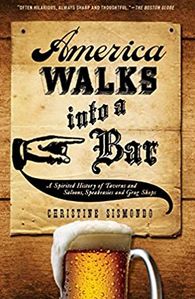
Welcome, friend. Pull up a stool.    You’ve come in at the tail end of a story, but it’s one worth hearing again. It’s the history of America, as told from the bar.   That doesn’t mean it’s a history of drunkenness in the United States, though that would certainly be worth reading.  Instead, Christine Sismondo  demonstrates how foundational taverns were to colonial and revolutionary history,   and how they’ve continued to sit at the crossroads of American history until the mid-late 20th century.   The story peaks with the 1930s,   soldiers through until the 1970s, and fade out shortly thereafter.   Sismondo combines amusing anecdotes and genuinely interesting history, albeit with some gaps.

In contemporary America, a bar is merely one option among a multitude that you might go on the weekend – -whether your purpose is having a drink with the boys, looking for a date, or  watching a game on the now-ubiquitous televisions.  In colonial America, though, it was the only place.  Taverns weren’t just places for spirits and food:   they were meeting halls and courthouses in the early years,  and were often the first building erected in a given community.  News collected there, and debates were had:   this function proved especially important during the years of the Revolution and the war for independence,    hosting political debates that sharpened colonial arguments about the tyranny of Parliament, and  allowing for direct action and other strikes to be planned. Still later, the taverns were recruiting  centers to enlist American men to fight for their liberty against the crown — and the spaces themselves were used to store supplies during the war effort. After the revolution,  taverns were also the center of patriotic rebellions against the new tax tyrants, the likes of Hamilton and company, but these (alas) met more effective reaction than Parliament could muster. 

  After an abrupt jump past the southern war for independence,  Sismondo covers the role of taverns in creating political machines,  something that would increase their profile as the 19th century wore on – and not in a good way.    Ardent spirits were cheap to come by in agricultural America, especially corn whiskey and gin,  leading to increasing rates of abuse –   and a growing alliance of wives and factory owners wanted to dry out the men of America, preferably at the source.   Not only were sober workers more productive (or, at least, less likely to stick their limbs in moving machinery to see if it tickled), but closing down taverns and the like would deny union organizers and other dissident voices a place to gather and plan.  Another strong component of the prohibition movement was the widespread unease with America’s surging immigrant population, as well as the mass arrival of blacks from the agricultural south to the industrial north – unease caused both by the usual human fear of those who are different, but also  of the influence immigrants had on local politics, ballooning political machines and pushing disruptive ideas like anarchism.    The Ku Klux Klan, the most ardent of prohibitionists,  were emblematic of many of prohibition’s motives.  The book loses steam after this,   in part because taverns played an increasingly smaller role in moving American society. They often became instead the platform to demonstrate change that was already happening, as when women began invading men’s space and imposing sit-ins in some  pastel imitation of the Civil Rights sit-ins.   The bar came less of a place for men to gather, drink, and debate, and more of a casual recreation spot, increasingly populated by strollers and dominated by the racket of televisions.  Post 1960s the only interesting politicized bar activity were the Stonewall riots, linked to Stonewall Inn that served as a gay bar,   and the resultant push for more toleration and rights for homosexuals.

America Walks into a Bar was great fun, a deft mix of social and more ‘serious’ history — focusing on the connection between them, and hinting at the importance of the built environment for civic and social health. The drift of the tavern from an encompassing community center to a dingy spot on the highway inviting drunk driving, or a loud, hypercommercialized sports bar, is a sad one, but this is nonetheless a fun introduction to the importance of bars to early American history — an a celebration of the places they once were.

Possibly to follow…Madelon Powers’ Faces along the Bar: Lore and Order in the Workingman’s Saloon, 1870-1920. I have it waiting but have been distracted by nuclear wessels.

Related:
The Great Good Places: Cafes, Coffee Shops, Bars, and the Other Hangouts at the Heart of a Community, Ray Oldenberg
Last Call: The Rise and Fall of Prohibition, Daniel Okrent
Drink: A Cultural History of Alcohol, Ian Gately

Posted in history, Reviews | Tagged , , , , , , | 2 Comments

Armstrong

Custer of the West: Armstrong
© 2018 H.W. Crocker III
264 pages


“Miss Johnson, I pledge to you my confederate here—who is actually a real Confederate—and I will not let this stand. Together with my troop of Chinese acrobats we will end the tyranny of the Largo Trading Company.”

History records that General George A. Custer was killed at the Battle of Little Bighorn, ending an illustrious and often dramatic career. History is wrong, for  we discover in Armstrong that the general in fact survived the ambush, being rescued by a white captive-wife of the Sioux,  who wanted to thank him for killing her husband   The two fled and hid among a traveling theatrical group,   and after a series of bloody and zany events, found themselves in an odd town that proved to have dark secrets.   The townsfolk had been effectively enslaved by a local trading company with a private army and Sioux allies.    Being a knight-errant in the service of Truth, Justice, and the American way, Custer promptly donned a new name – “Armstrong” – and commenced to a lot of derring-do.  The result is Armstrong, a comic western novel that draws on western stock characters and tropes while having a little fun at history (and especially Custer’s) expense. 

Armstrong’s first mission is to escape the Sioux, but the manner in which he does so (pretending to be a trick shooter in a theatrical group)  disrupts his original plan of clearing his name for the massacre at Little Big Horn. He was set up, you see, and he’s particularly suspicious of that drunk in the White House, Grant. After a little bloodbath ensues at Armstrong’s first show, he and the traveling show escape to a little town in a canyon, which seems like a peaceful sanctuary until he realizes there’s something rotten going on. He pledges himself to liberate the town from the government contractors who have imprisoned it, despite being woefully outmanned. His aides in this chivalrous quest include a former Confederate who is a dasher with the ladies; a multilingual Crow scout; a band of dancing girls, and a troop of Chinese acrobats who he trains as skirmishers. The western tropes start with the rebel-with-a-cause and the native ally and only grow from there, but Crocker employs them to have fun with them. The novel is a comic western, its plot warmed by absurdism as much as the Sonoran sun, and features a multitude of running jokes — from Armstrong having to frequently disguise himself, to fun with language. One of the sillier bits includes Armstrong relying on his hunch that all dogs know German using his…er, limited knowledge of Hochdeutsch to enlist a dog as his ally. (“Helpenzie me, bitte!”) It’s reminiscent of Mel Brooks, complete with elements that would no doubt drive some modern readers red with self-righteous rage, like Chinese acrobats whose knowledge of English is limited, or the Union and Confederate officers having a discussion about their respective causes that doesn’t end with the southerner beating his breast in repentance. Although this is intended as fantastical, humorous take on The Western, Crocker nonetheless works in real facts, aided by his having written a Custer biography. I was surprised to learn that Custer served as the groomsman in the wedding of a Confederate friend of his during the war — each man dressed in his uniform.

If you’re in the mood for a ‘light’ western that mixes humor and wild-west adventures, Armstrong is a lot of fun. I think I’ll try more in the series, and explore Crocker’s nonfiction as well.

Posted in Reviews | Tagged , | 6 Comments