It’s Tuesday! Quick, a tease!

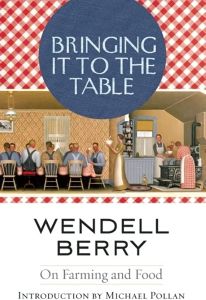
From Wendell Berry’s Bringing it to the Table..

One could argue that the great breakthrough of industrial agriculture occurred when most farmers became convinced that it would be better to own a neighbor’s farm than to have a neighbor, and when they became willing, necessarily at the same time, to borrow extravagant amounts of money. They thus violated the two fundamental laws of domestic or community economy: You must be thrifty and you must be generous; or, to put it in a more practical way, you must be (within reason) independent, and you must be neighborly. With that violation, farmers became vulnerable to everything that has intended their ruin.

You have got to farm with both plants and animals in as great a diversity as possible, you have got to conserve fertility, recycle wastes, keep the ground covered, and so on. Or, as J. Russell Smith put it seventy years ago, you have got to “fit the farming to the land”—not to the available technology or the market, as important as those considerations are, but to the land. It is necessary, in short, to maintain a proper connection between the domestic and the wild. The paramount standard by which the work is to be judged is the health of the place where the work is done.

Posted in General, quotations | Tagged | 1 Comment

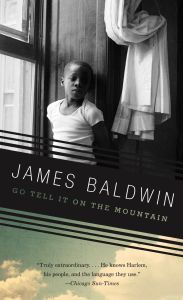
Go Tell it on the Mountain

Go Tell it on the Mountain
© 1953 James Baldwin
272 pages

A young man faces an enormous choice at a presumed-to-be-uneventful prayer meeting, and at this crossroads of his life,  the reader  experiences the choices of his kin whose lives brought him there.   Go Tell it on the Mountain is a semiautobigraphical novel by James Baldwin, which follows a family from the Deep South to Harlem, who are grounded, inspired, and dominated by fervent Pentecostalism.  It’s a story where the characters, not a predefined plot, dominate – in their personalities and in the intensity of their struggles.   The Baldwin figure, John Grimes, is coming of age  – newly distracted by women, at odds with his father (his stepfather, we later learn) over the patriarch’s strict religiosity,   and torn between the expectations demanded on him as the oldest son and what he wants to do. He is of age, and must begin to choose, for himself, whether he will follow the straight and narrow – or the winding, winsome Broadway down into hell.  This is is a choice faced by others before him and alongside him, and much of the novel shifts to telling the stories of John’s mother, father, stepfather, and aunt before returning to him again.  These characters are linked by race and religion,   frequently combining hatred for whites with burning religious zeal –  something decidedly odd for me to read,  having grown up in a mixed-race Pentecostal church.    Hypocrisy is a common element, especially in the life of John’s stepfather Gabriel,   who attempts to transform himself from a skirt-chasing drunk into a man of God – but is taunted by his sister, who declares that a man’s heart is never changed, but remains as it was.  As we’ll see, a zeal for preaching holiness doesn’t necessarily translate into living   I don’t know enough about Baldwin to understand fully what he’s driving at in his treatment of character, morality, and religion,  but anyone who has a few decades under their belt can appreciate that  the way of discipline and virtue has no guardrails: it is very easy to wander off the path, even for those who  want to stay on. I found Gabriel the most sympathetic character in the novel despite his mix of severity and moral cowardice. 

Kindle Highlights:

“Now you just remember,” Elder Peters said, as kindly as before, “you’s talking to your elders.”
“Then it seem to me,” he said, astonished at his boldness, “that if I got to look to you for a example, you ought to be a example.”

“Ain’t no such thing,” said Sister McCandless, “as a little fault or a big fault. Satan get his foot in the door, he ain’t going to rest till he’s in the room. You is in the Word or you ain’t—ain’t no halfway with God.”

“I thought I married a man with some get up and go to him, who didn’t just want to stay on the bottom all his life!”
“And what you want me to do, Florence? You want me to turn white?” This question always filled her with an ecstasy of hatred. She turned and faced him, and, forgetting that there was someone sitting in the parlor, shouted: “You ain’t got to be white to have some self-respect!”

“Deborah,” he asked, “what you been thinking all this time?” She smiled.
“I been thinking,” she said, “how you better commence to tremble when the Lord, He gives you your heart’s desire.”

And because it was stuck in my head the entire time I read this novel, here’s Mississippi John Hurt’s “You Got to Walk that Lonesome Valley”.

Now mother walked that lonesome valley
Now mother walked, she walked it by herself
Well there ain’t nobody else could ever walk it for her
She had to walk it, she had to walk it by herself

You’ve got to walk that lonesome valley
Well you gotta go by yourself
Well there ain’t nobody else gonna go there for you
You gotta go there by yourself
Posted in Classics and Literary, Reviews | Tagged , , , | 3 Comments

My Ántonia

My Ántonia
© 1918 Willa Cather
175 pages

An orphaned young boy and a young girl from another country  arrive together in the Nebraska prairie,   forging a friendship from their shared status as strangers in a new land despite their difficulties in communicating.   They will play and work together, often butting heads and eventually taking different paths – but the past, and their love for the land, bind them.   This is a story written from the rearview, as the adult boy – Jim Burden –  is looking back on his life after a recent visit back home to see what remained of his childhood.   Precious little, as it turns out: he grew up in a Nebraska so frontier that some of its homesteaders still live in sod homes, and the future city of Black Hawk was a far humbler town.  Burden’s memoir details the little stories that made up the lives of he and his friends  –   adventures involving snakes, and the quiet tragedy of suicide. These stories take place against a rich background, that of the prairies. Having never been to Nebraska,  I must admit that my mental imagining of it is fairly superficial, thing that resembles more an illustration on a milk carton than a place where people actually live. Cather, though, paints such beautiful descriptions of the land and changing skies that one has to read them several times – the first to know what’s there, the second and third time to savor the details.  Not as dramatic as Ed Abbey’s descriptions of the Southwest, but more intense in the smaller details.  One particularly powerful passage describes the Sun and Moon as two luminaries, hanging in opposition – making the personal drama happening at the same time, Jim engaged in earnest conversation with Antonia,  even more resonant. Although I found the first parts of the story interesting, it wasn’t until Jim drew closer toward adulthood, and the diverging paths of he and his friends became more important, that I was totally sucked into the story — and never more than when Jim made his return to Black Hawk to see his Ántonia one more time. Quite stirring on all fronts.

Related:
My Antonia at 100“, Front Porch Republic

Posted in Classics and Literary, Reviews | Tagged , , , | 6 Comments

Inside Biosphere-2 in 2021

Related to today’s posting of The Human Experiment. Biosphere-2 has been modified somewhat since the original eight did their two-year stint, but it’s mostly the same. Worth watching just for the “lungs”, the scale of boggles the mind. 40,000 lbs of metal rising and falling to allow the Biosphere to “breathe”…

Posted in General | Leave a comment

The Human Experiment

The Human Experiment: Two Years and 20 Minutes Inside Biosphere 2
© 2006 Jane Poynter
384 pages

From this patch of desert in sunny Oracle, Arizona, eight Americans are beginning the trip of a lifetime.  Divided into two tribes and locked into a 3-acre, hermetically sealed building, they must work together despite their differences to grow food, reintegrate their waste,  and overcome lethal challenges to survive.  Nothing goes in…nothing comes out! 730 days, eight people, One Survivor!

Well, not quite.  It’d make a heck of a TV show, though.  Jane Poynter  is one of eight people who took part in a two-year experiment, living in a self-contained project called ‘Biosphere 2’.    Designed to be a self-sustaining world,  the experiment set out to see if it was possible for humans to create an independent ecosystem that could sustain itself and them for a prolonged period time — something that would be necessary were we to move into space, or attempt to colonize other worlds. This was not an official government-created mission, but one that originated from the Ecotechnics Institute,  an…..interesting group of people who called themselves Synergists, and looked for ways to combine technological progress with natural systems of ecological maintenance.  Although that might sound like just a promising nonprofit, the Synergists were more complicated than that,living together on a ranch like a commune, and incorporating art heavily into their group projects. (“A hippy theater group” is one word used to described them: “Cult” is another.) Young Jane discovered this group while visiting an art gallery, and was soon sailing with them aboard the Heraclitus, conducting experiments at sea. Despite not having any formal training, when the Institute advanced the idea of creating a self-contained, self-sustaining Biosphere, she became one of its principal designers and a member of the two-year crew. The Human Experiment is her story of how she came to be involved, a history of the project and its creation, and then her recollection of those two troubled years themselves, when interior stress and outer drama created running conflict within the group.

I don’t know if there exists any experiment more interesting than this — a two year endeavor to see if humans could create a separate biosphere, in effect a self-contained world, and live in it for two years. I’m sure experiments performed at the Large Hadron Collider might reveal physics-changing information about life, the universe, and everything — but this is locking eight humans up for two years and seeing if they survive. The ambition of it is staggering, even thinking about the engineering required to maintain separate biomes, each with a distinct climate — nevermind the mountain of ecological variables, as a diverse array of animals , plants, soils, bacteria would need to be selected and integrated. In a sealed environment, the crew would need to be able to grow its own food, but not only that — they needed to be able to live off of the oxygen the project’s plants were creating, and find ways to recycle their urine and other waste projects to make the biosphere project a closed circuit. Although there were smaller-scaled experiments to see if a human in a sealed environment could live on the oxygen emitted by the plants sealed in with them, they always concluded in a matter of hours, at most a weekend. The jump to two years, and the added complication of having to grow food for a large crew, made things far more complicated. There was also the problem of the unknown. What ecological or environmental factors weren’t known about? What unforeseen problems might occur? Sure enough, there were: from El Niño oscillations drastically reducing the amount of sunlight the Biosphere received, to infections from a previously-unknown bacteria that destroyed the white potato crop, to the unexpectedly fecund soil bacteria that gobbled up far more oxygen than expected. (This lead to more C02, leading the crew to begin panic-modification of the vegetative environment, leading to additional problems.) This forced the crew to become subsistence farmers, who instead of reaping an easy boon and devoting free time to art, became fixated on finding enough food to get by. Those were merely the technical problems, to say nothing of the drama from outside the Biosphere — from the Institute’s internal politics — that split the increasingly malnourished and oxygen-starved crew into two fractious parties, who might enjoy one another’s company with booze on special occasions, but otherwise studiously avoided the others despite their mutual dependence. Part of the tension was dispute over how to proceed once they realized the Biosphere would become unlivable if the oxygen problem were not solved.

This is an absolutely fascinating story all around, from Poytner’s personal story — a well-heeled British young lady searching for purpose in her life, stumbling upon this group, sailing the world with them and then becoming a key member of an extraordinary project — to the challenges and sheer weirdness of life under glass that she documents. I’d seen clips of this on the news as a kid, and trailers for the Pauly Shore movie that used it as a backdrop, but never really dug into the project properly. Frankly, if it weren’t for the fact that I’m under a book-buying ban, I’d check out other crew memoirs — as it is, I’ll have to settle for watching Spaceship Earth, a recent documentary. If you’re at all interested in the Biosphere-2 project, this is definitely a solid read!

Related:
“Biosphere 2: The Once Infamous Live-in Terrarium is Transforming Climate Research“, Scientific American. Gives a history of the project and its challenges if you’re curious but don’t want to read a full book.
Eight Go Mad in Arizona“, The Guardian. A more in-depth history of the group and the project.

Posted in Reviews, science | Tagged , , , , | 12 Comments

Teaser Tuesday

Today’s tease comes from My Ántonia, by Willa Cather.

On the edge of the prairie, where the sun had gone down, the sky was turquoise blue, like a lake, with gold light throbbing in it. Higher up, in the utter clarity of the western slope, the evening star hung like a lamp suspended by silver chains — like the title page of old Latin texts, which is always appearing in new heavens, and waking new desires in men.

When I closed my eyes, I could hear them all laughing — the Danish laundry girls and the three Bohemian Marys. Lena had brought them all back to me. It came over me, as it had never done before ,the relation between girls like those and the poetry of Virgil. If there were no girls like them in the world, there would be no poetry.

“This old chap will be proposing to you some day, Lena.”
“Oh, he has — often!”
“What?! After you’ve refused him?”
“He doesn’t mind that. It seems to cheer them to mention the subject. Old men are like that, you know. It makes them feel important to think they’re in love with somebody.”

Posted in General | Tagged , , , | 2 Comments

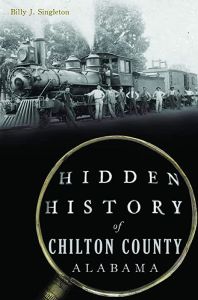
The Hidden History of Chilton County

The Hidden History of Chilton County
© 2022 Billy J. Singleton
144 pages

Forget Georgia peaches. The best to be had are in Chilton County, Alabama,  which has been so long proud of its peach orchards that the local water tower, visible from the interstate,   looks like a ripe peach ready to pluck.  The Hidden History of Chilton County uses  lesser-known excerpts from the county’s history to tell its story more generally: you will find no formal political chronicle here, no tables of changing demographic changes or economic production. Instead,  we are treated to little slices of interest, like the Battle of Ebneezer Church connected to Wilson’s Raid; to the creation of the first Peach Fest in Clanton (or as the locals call it, Clantern), to the still largely-unknown internment of German POWs in an old CCC camp;    of bridges to nowhere created by road routes shifting; and  why a field off of First Avenue is marked by three curious pillars.  This is obviously a bit of a niche history, of enormous interest to those who live in Chilton County or have a connection to it, but presumably of limited appeal outside of that despite its great readability. I have family connections here and a professional interest in the county (being a local history librarian), so I enjoyed it all around and learned a few things despite being fairly conversant with the of my county and its neighbors like Chilton. (For instance, the Big Peach is younger than me, and I’d never known about the German POW camp despite visiting another camp last year!) If you ever visit Chilton County, don’t miss Peach Park. Vanilla ice cream and blackberry cider are a delicious combination.

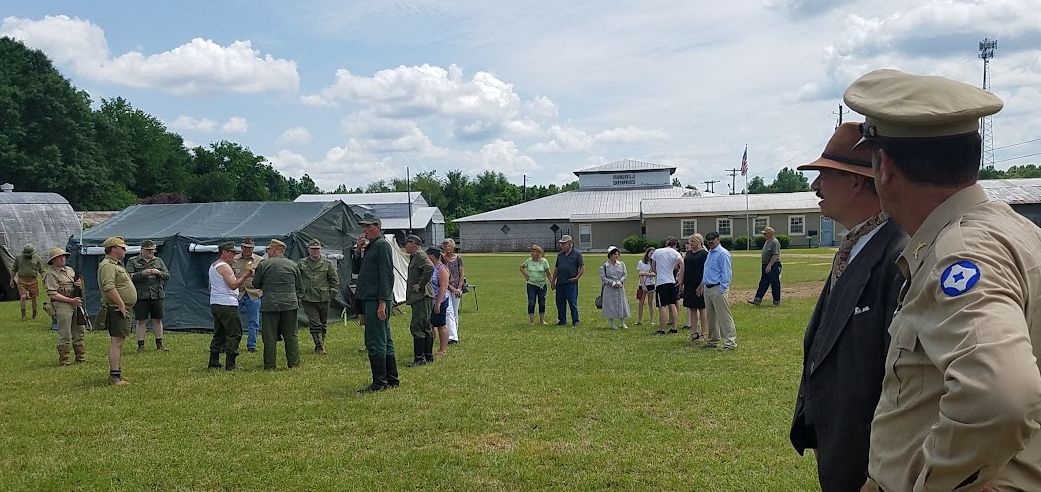
POW Reenactment at Aliceville, AL.
Posted in history, Reviews | Tagged , , | 4 Comments

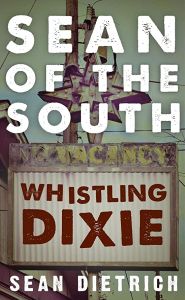
Whistling Dixie

Sean of the South: Whistling Dixie
© 2015 Sean Dietrich
198 pages

A few weeks back I read The South’s Okayest Writer, a collection of articles by Sean Dietrich. Whistling Dixie is very similar in content and in theme, as this also collects a few score of his short pieces.   Okayest Writer had a more intense theme of people creating beauty and connection despite of, or because of, their suffering.   While that theme echoes often here, there are more miscellaneous pieces as well,   some about the South in general – reflections on southern dialects and euphemisms, for instance.  As with his prior collection, this is fairly intimate:  the shadow cast over his life by his father’s suicide comes up quite a bit. One of the more touching stories in that vein is his recollection of how his boy self fled the funeral and retreated to the back,   taking off his father’s tie and throwing it away.  He was found by another of the men, who – removing his own tie –  ministered  to him in a way that only a man who has also lost his father can.  Several of the pieces are also written in loving tribute to his wife, Jamie, and to the Waffle House.  (He really likes the Waffle House.)   As a whole, the collection is perfectly sweet, though I shouldn’t have read it so close on the heels of The South’s Okayest Writer.

Kindle Highlights

“I look at things,” Jon said. “And I realize I take it all for granted. And then I say to myself, ‘This was it, Jonny boy, this was life, and you missed it. You were too busy paying bills, doing whatever everyone said you SHOULD be doing, instead of all the things that matter.’”
“Like what, Jon? What things matter?” Jon thought for a moment.
“I don’t know. People. Nature. Stars. I mean, look at that moon.” He nodded toward the sky. “It’s so pretty and far away. I never stop and look at it. But it’s right there. See it?” We both got quiet for a few minutes. I couldn’t hear anything but the sound of crickets coming from the woods behind the gas station. I thought about how quick a year goes by. About how fast wrinkles form on the corners of your eyes. About friends who’ve died. About those still alive. About my wife. About the moon.
“Well,” Jon said. “We’re really looking at it now, aren’t we?” Yes. And I think that counts for something.

“Jeezus, Bryant, and Saban,” said the man beside me. “What does my FryDaddy have to do with anything?”

Life is not about fame and fortune. Some folks crave it, but some of the saddest people you’ll ever meet are the ones who attain it. Don’t let that be you. You were made to help.

But if you want to touch something bigger, if you want to know what it means to taste gladness, or understand this thing we call life, well then start right now. To hell with success. Go love someone.

“Dating is about hugging and kissing, and stuff,” remarked five-year-old Bradley. “That’s what girls do, when they finally get boys alone.” And then he squirmed like he’d just eaten a live lizard.
“Have you ever kissed a girl?” I asked. Bradley wrinkled his face and shook his head.
“NO!”
“Why not?” He clutched his mouth.
“HEY!” shouted Beau, an eight-year-old wiseman in the back. “Girls only want your money, and for you to fix their stuff. My dad says all he ever does is fix stuff and lose money.”

Six-year-old Margaret, sneered. “Y’all are just being stupid…”
“Honey,” I interrupted. “We don’t say ‘stupid.’ It’s not nice.”
“Sorry,” said Margaret. “Y’all are being dumb asses.”

Hell is a remote-control away, you can see it any time you want. Which is probably why folks think there’s more hate out there than love. Well, who knows, maybe they’re right. But. I know a Labrador who believes otherwise.

You think about how happiness is a lot like a houseplant. No matter how much you water it, nothing lives forever. Everything is on temporary loan—that includes people.

My Sunday school teacher, Mrs. Reginald—whose beehive hairdo was tall enough to register on most air-traffic radars—had her own thoughts on God. “He’s all-knowing,” she said, looking straight into my eyes. “And he KNOWS who put those frogs in the girl’s restroom toilets.” Maybe he did. But it sure as hell wasn’t Bobby Davis, Robert Laurels, and Sean Dietrich. Because we put them in the sinks.

Posted in Reviews | Tagged , , , | Leave a comment

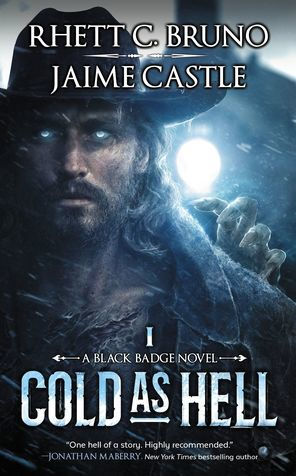
Cold as Hell

Cold as Hell: A Black Badge Novel
© 2022 Rhett C. Bruno, Jaime Castle
Audible narration provided by Arthur Morgan Roger Clark
419 pages | Audible edition ~13 hours

“T-they said you died,” he said. “Got buried. The rider in black who done chased off them outlaws. Saw your grave, I did. Y-y-you . . . was dead.”
“I got better.”

James Crowley was a notorious outlaw and gunman, riding with a band of bank-robbers and highwaymen known as the Scuttlers – until he met his end, and woke to find himself between death and life, with a black star seared onto his chest and a voice in his head. He had become a  Hand of God, a Black Badge,   his mission on Earth to hunt for demonic forces plaguing humanity and to send them back to the icy wastes of perdition.   A unique mix of western and dark fantasy, Cold as Hell mixes familiar scenes of the western (bar fights and stagecoach robberies) with  altered takes on werewolves, yeti,  and other nephilim. A story that begins with a bank robbery reeking ofthe demonic – the culprit having powers beyond mortals quickly escalates into a greater mystery, as the angel who handles Crowley believes that dark forces  are trying to create a direct opening between the world of mortal men, and that of the chaotic wastes of Hell. Its  Audible edition uses the distinctive voice of RDR2’s Roger Clark (better known as Arthur Morgan) to superb effect. 

I must say at the start that I’m incredibly biased to love this book, because I was drawn to it after discovering that Roger Clark – aka Red Dead Redemption II’s Arthur Morgan– did the Audible version,   using a very similar voice to his Morgan character. The attraction was made perfect by this not only being a western, but a western featuring a character with strong parallels to Arthur –  being a not-bad man who fell into a bad life,  drawn in by a charismatic figure he later came to loathe, forced into hiding by said figure developing an appetite for cold-blooded murder, and kept on the crooked path by want of any other skills other than shooting.  (His ex-gang even has minor members with the same names as RDR2’s Van der Lindes!)  There’s immediate appeal for an RDR2-loving reader, then, to imagine Crowley as Arthur, as a man spared Hell for some of his better decisions,  consigned to chase demonic bounties across the west.  Certainly the background is the same: small towns, trains, coaches,  the rapidly-civilizing frontier.  That this is saturated with fantasy –  Crowley having to answer to a mysterious but forceful angel who can speak to him through any mirrored surface,  his foes being more often supernatural creatures who hide in the margins and wide spaces of the west –   adds a thick layer of interest, especially because the authors don’t just drop werewolves de novo into the set of Gunsmoke,  but fuse them with native American mythology –  though the underlying basis is the Biblical declaration that angels ‘knew’ mortal women and began Nephilim, commonly translated as ‘giants’ but used as the source of all kinds of unpredictable beasts here. 

I was completely taken away by Cold as Hell. Yes,  the narration was probably the strongest selling point for me, and I did not help things by listening to this while playing RDR2.  I was so absorbed by the story, though, that I quickly switched to reading it on the Kindle, and despite having finished it I’m looking forward to returning to the story (and to Clark’s narration) by continuing in the audiobook. I will definitely be reading the sequel in May! (Also: Bram Stoker is a character in this.)

“W-w-what are you?” he stuttered.
“The Hand of God. How do you do?”
Posted in Reviews | Tagged , , , , , , | 4 Comments

January 2023 in Review

Well, so ends January — and it’s got the year off to a good start!

The Big Reads:

The Jewish Annotated New Testament: I’ve read through Matthew and began reading some of the accompanying essays, but no major strides just yet.
The Shahnameh. I looked at it several times.

The Science Survey

Chasing New Horizons: Inside the Epic First Mission to Pluto, Alan Stearns and David Grinspoon
Pests: How Humans Create Animal Villains, Bethany Brookshire
Buzz Sting Bite: Why We Need Insects, Anne Sverdrup-Thygeson
Origins: Fourteen Billion Years of Cosmic Evolution, Neil deGrasse Tyson
Dinner on Mars, Lenore Newman

The Classics Club Strikes Back : Year III

I read most of My Antonia and will finish it today.


Readin’ Dixie: 

The Incredible Winston Browne, Sean Dietrich
The South’s Okayest Writer, Sean Dietrich

Climbing Mount Doom  | The Unread Shelf Project  

Read:
People Habitat: 25 Ways To Think About Greener, Healthier Cities, F. Kaid Benfield
Chasing New Horizons: Inside the Epic First Mission to Pluto, Alan Stearns and David Grinspoon
Buzz Sting Bite: Why We Need Insects, Anne Sverdrup-Thygeson
Revolutionary Characters: What Made the Founders Different, Gordon S. Wood
Firefly: Better Days, Joss Whedon
Copenhagenize: The Definitive Guide to Global Bicycle Urbanism, Milhail Colville-Andersen

Posted in General | Tagged | 2 Comments