
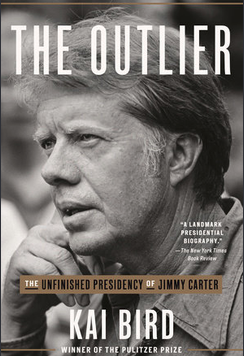
When I read the American Presidents treatment of Jimmy Carter, I knew right away I wanted more. Not because his presidency was hugely impactful, but he struck me as such an odd personality I wanted to ponder him more. I was particularly interested in his rise to power through Georgia politics, and wondered if The Outlier might fit the ticket. It doesn’t, as it focuses largely on Carter’s presidency, but still proved a useful and absorbing read.
Carter is unusual in that he was the first Southern president of the Civil Rights age. Carter brought a definite outsider perspective to Washington, surrounding himself with the “Georgia Boys”. While I was particularly interested in Carter’s early political career, there’s not a lot here on that subject: we briefly review Carter growing up in the Plains area, joining the Navy, slowly building a career there and then resigning after his father’s death to take care of the family business. Then one day, seemingly out of nowhere, he puts on a suit and announces he’s running for state office. Although Carter would later denounce class-based identity politics, Kai Bird offers that Carter’s edge in politics came from a class-oriented populism. He managed to pitch to both blacks and poor whites that he was on their side, telling a black official that while he might not like the way Carter ran his campaign, he would like the way he performed in office. Carter was an unusual mixture of socially liberal and fiscally conservative; there were a great many things he wanted the government to do for people, but he would not countenance runaway spending. This was especially important once he reached higher office, as Carter believed that deficit spending spurred on inflation, and that fiscal discipline was necessary. This put him increasingly at odds with New Deal and Great Society-type liberalism, which was far more comfortable with deficits and entitlement spending. (It would also put him at odds with the rising neo-cons: Reagan would reinstate the B-1 bomber program that Carter reviewed and cancelled on the grounds of being already obsolete.)
What I continue to appreciate and puzzle over is Carter the Man. He brought an informality to the White House –jeans and sweaters rather than suits – but he was definitely not some “Aw, Shucks, Rosalyn, you know they just went an’ e-lected me to the White House?” type. Bird records people who came expecting Uncle Jimmy and encountered instead Uncle June – a man who could be cold, supremely self-confident, and not at all amenable to glad-handing. Bird notes that Carter’s contempt for politics-as-usual was one of his weaknesses; he rarely went out for dinner, and when he played tennis with Congressional figures, that was all they did – play tennis. No after-match drinks, no relationship-building. Carter loved the tediousness of paperwork – he was apparently enthusiastic about reading and processing reams of briefs and notes that appeared on his desk – but not the work of slowly building relationships with lots of small talk.
The largest part of this book, as with Carter’s presidency, is consumed by foreign policy. Carter was keenly interested in negotiating peace between Israel and the Arabs, then led by Egypt; he was able to do so, though with less Israeli cooperation than he would like on the area of expanding settlements. Iran became a huge issue in the last two years of his administration, when the Shah was run out by an alliance of jihadists and leftists and the American embassy was taken by Iranian students. The new ruler of Iran, Big Beard the First, saw the captive Americans as useful leverage to get Carter to turn over the former government’s money and purchases still in the US. While Carter made steady progress getting the jihadis to the table, distractions arrived in the form of Russians invading Afghanistan and Iraq invading Iran.
Although I have issues with Bird as author (his ease in referring to Carter’s conservative antagonists as racist, for instance), he tells a compelling story about a unique man in American politics. I don’t think I’m done with Jimmy just yet, but revisiting – through his White House diary, for instance – will have to wait. There’s a large Texan glowering in the corner at me.
Quotes
In Egypt again some years later, [Carter] made a point of visiting Sadat’s widow Jehan, who after an elaborate Egyptian dinner one evening, turned to carter and explained that she had recently found a note written by Sadat shortly before his October 1981 assassination. Awkwardly clearly her throat, Jehan pulled out the note and read: “Jimmy Carter is my very best friend on Earth. He is the most honorable man I know. Brilliant and deeply religious, he has all the marvelous attributes that made him inept in dealing with the scoundrels who run the world.” Stunned for a moment, Carter then smiled and replied, “Well, maybe, but I’ll never change.”
“‘The scary part,’ noted Anatoly Chernyaev, a member of the Kremlin’s inner circle, ‘is that the final, sole decision [to invade Afghanistan] was made by someone who is completely senile…It was a terrifying sight. […] The Soviet apparatchiks knew what a disastrous mistake had been made — and yet many of Carter’s advisers were clueless about the disarray within the Kremlin.'”


