
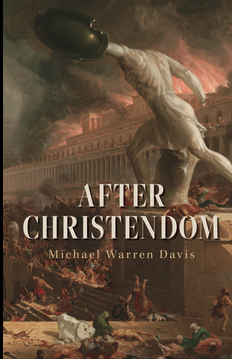
I no longer remember when I first encountered Michael Warren Davis, but his critique of modernity and his countercultural vision of Christianity appealed to me in much the same way that The Plain Reader and Rod Dreher’s Crunchy Conservatives did years ago.After Christendom is a book written for Christians in a West that is rapidly de-Christianizing, and challenges them to rethink what Christianity is. He cautions believers against trying to hold on to power through political ends, arguing that an emphasis on Christian politics often obscures way of Christ. This is something I am partially sympathetic to, especially as a reaction against people who are flocking to traditional Catholicism or Orthodoxy because they are “based” — the so-called Orthobros and tradbros. Regardless of where one stands on cultural or religious issues, I think it’s safe to say that someone who enters Christ’s door seeking anything other than Christ himself will find nothing but self-defeat.
Davis appears to believe that history is leading to a new phase in which Christianity will become culturally marginalized, but the faith of believers more purified and holy because of that. This makes sense to a large degree: people who are Christian simply for cultural cachet will drop it the moment it becomes ‘uncool’, and persecution has an interesting way of intensifying faith. (Think of Fear No Evil: the author was a secular Jew when he went into the Gulag, but became very observant the more the Soviets tried to punish him for his thought-crime.) Warren then shifts to ways that Christians can get more serious in their devotion, like using the Jesus prayer and avoiding things like smartphones that destroy our ability to ‘attend’ to what matters.
I found this a challenging little book, in part because Davis’s approach would appear to focus only on spirituality: Rod Dreher’s Benedict Option has been libeled as promoting withdrawal from society when he was in fact championing creating Christian institutions which would allow faithful Christians to support one another — but Davis appears to be closer to that attitude. Christ advocated turning the other cheek, yes, but would he truly damn Charles Martel for defending France against invading Muslims? If the sword was not taken up as well as the cross, would medieval Christendom’s hospitals and universities have ever flowered? Would we have cathedrals and hymns? More importantly, would Christians have a society where it is safe or even possible to be Christian? Yes, a marriage with power can easily corrupt the faith, and yes, a society that is ‘culturally Christian’ can allow someone to have an extremely shallow faith with no roots or substance whatsoever — but abandoning politics completely seems just the sort thing the Enemy would want. I’m afraid this book makes me feel like Peter in the garden, lopping off Malchus’ ear rather than giving up without a fight. I can’t help but think of another young man, though, the rich young ruler who was willing to follow Christ — but went away sad because he couldn’t give up what Christ asked him to. I will have to live with this book a while yet.
Related
The Reactionary Mind: Why ‘Conservative’ Isn’t Enough, Michael Warren Davis
Quotations
The Christian must take James Bond’s motto as his own. Orbis non sufficit: “the world is not enough”. Tragically, most Western Christians have lost their sense of xenitia. We don’t feel estranged from this world. We don’t want to feel estranged from this world.
We may not realize it, but so many of us today commit the same sin as the Pharisees. We believe that our God must be a conquering God. We would sacrifice the pure teachings of Christ on the altar of political power. We reject the role of the suffering servant. We refuse the Cross.
“Christ is the only exit from this world; all other exit — sexual rapture, political utopia, economic independence — are but blind alleys in which rot the corpses of the many who have tried them.” – Fr Seraphim Rose
“I feel that in another time of crisis and confusion we need to go back to our roots, both literal and spiritual. To flee from the civilized center that denies God and launches salvo after salvo daily against the human soul. To seek out a wild Christianity, which will see us praying for hours in the sea as the otters to play around us. To understand — to remember — that the Earth and the world are not the same thing.” – Paul Kingsnorth
If you read the Greek Fathers, you’ll notice that another word pops up over and over. The word is phronema, and it means “mentality” or “mindset”. The Eastern churches place a strong emphasis on developing a Christian phronema. It’s not enough, they say, simply to memorize Christ’s teaching. You have to learn how to think the way Christ thinks, to see as He sees, to feel as He feels. You have to put on “the mind of Christ”, as St. Paul calls it. Every part of our selves must be converted, baptized, and redeemed, our minds and our bodies, and hearts and our souls.
“If we fail to cultivate this relationship with Christ, we will not weather the coming storm. Saint Ignatius of Antioch made that much abundantly clear. We won’t fight for Christ unless we know Him. We don’t die for Christ unless we love Him.”
We exist in love, by love, through love, for love.
I think it’s good to remind ourselves periodically of the first rule of Scriptural exegesis: You are not Jesus. Whenever you read a story about Jesus’ life, you should not identify with Jesus. You should identify with the sinner whom He is healing, converting, forgiving, upbraiding, flagellating, or what have you.”
The Enemy only wants to lure us from the difficult path that leads to the Gate of Life. He doesn’t care if we stumble to the Left or to the Right. He doesn’t care if we become materialists or magicians. Both suit his purposes nicely.
Our little black rectangles are the essence of the ‘spot’ that sin leaves on our souls. My friend Michael Dominic Taylor, a brilliant young Catholic philosopher, calls them palantirs, portals through which the evils of the world flow into our homes and into our souls. We feed them our fears, ambitions, and desires; and a torrent of corruption and lies pours forth in a ceaseless, demonic whisper. The sensible thing to do would be to banish them from our lives.
Our duty as Christians is to surround ourselves with true and good and beautiful things. We have to purge everything fake and evil and vulgar from our lives. This may sound like an indulgence, but that’s only the world phronema talking. It’s not an indulgence: it’s a solemn Christian duty.


Our little black rectangles are the essence of the ‘spot’ that sin leaves on our souls.
That’s what people said about tv’s too, back in the day. And my answer to today’s smartphone is the same as my parents about the tv. Control to teach the children its proper place and then self-control once you were out of the house.
And if someone can’t or won’t control it, then that is on them, not the smart phone.
I think they are more absorbing than your comment admits to. TV was strictly passive; it supported one great sin (sloth/apathy/acedia) and offered inroads to others like envy and lust. Smartphones, however, are eight-lane interstates to EVERYTHING. Sloth, envy, lust, judgement, anger, etc. The algos are tweaked to fuel themselves on our worst natures, making us vicious even as they tempt us with things we think are “good” — like ‘connection with others’. These things can be overcome — I was raised without television and found I disliked TV once I tried living with one, and I’ve never cottoned to smartphones — but I don’t think it’s easy at all for most people. It seems like crack cocaine! I’m just glad I physically hate looking at a phone.