
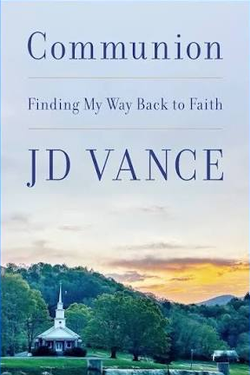
When J.D. Vance’s formidable grandmother died, his connection to Christianity went with it. Although he’d been raised going to church with her on occasion, the faith had never become internalized; as he deployed to Iraq, he was moving further and further away from the memory of it. Communion is the story of how a young man came to believe again, and a reflection on how Christianity’s eternal truths have inspired him as a father, husband, and public servant.
Although I’ve been sold on this book as a memoir of his coming to the Catholic church – an improbable decision given his origins in Protestant hill country – that is not strictly the case. The first half follows his faith’s decline and fall, but I noticed ambiguity. Even in the desert, he was reading Chronicles of Narnia and wishing Jesus was more like Aslan – and when he’s in college and identifying as an atheist, he still notices contempt for Christians as if he’s still connected to the faith. While pursuing the cursus Mammonae – law school, clerking for a judge, lucrative practice – Vance began having a crisis of meaning. What was all this for? His coworkers were seemingly married to their jobs, with no time left for their children or the simple enjoyment of life. He realized, with a Girard-esque start, that he was simply modeling the desires and ambitions of those around him, just as if he were in high school again. Around this time, he fell in love with a woman, Usha, who seemed destined for a great career in the law – but she had little interest in getting and spending and laying waste to all her powers. She wanted an interesting job, but she wanted a meaningful life – children to love, a husband to experience adventures with – not to be a girlboss. Her perspective, and his realization that he needed to be a worthier partner, put Vance on a quest for meaning. The more he read, the more interesting he found the wisdom of the Church – particularly its social doctrine, which places the human person and not GDP at the center of social, economic, and political thinking. After a quiet evening reflecting in a cathedral while his son slept, he made the choice to swim the Tiber.
Communion is an intimate work; conversion stories cannot help be. Part of the story is his learning to accept grace, to realize that as haunted as he may be by his past of violent, dysfunctional relatives, it needn’t – won’t – define him. It dovetails neatly with Christianity’s message of grace and redemption, of escaping sin’s power. The second half of the book is more of a reflection on Christianity’s place in the West, both historically and now, and he muses on ways that the Christian appreciation of the person can inform politics. This is not your granddaddy’s ‘moral majority’: while no doubt agreeing that much of what is tolerated in society is destructive, like pornography, Vance focuses his thinking on other issues, particularly labor and the family. Given how central becoming a husband and father was to Vance changing his life, making him assess the why of things, he unsurprisingly agrees with the social doctrine (and others, like Wendell Berry) that the economy exists for human needs, not the other way around. Corporations should not be allowed to keep wages miserly by relying on illegal migrant labor, nor should apps that allow for the complete commodification of labor – calling in workers only when The Algorithm suggests they’ll deliver the most bang for the buck – be tolerated. Human beings are persons made imago Dei, not cogs to be manipulated or resources to be managed. We know what happens when those resources are wasted or those cogs are worn down in materialist societies: they are disposed of.
I devoured this book, staying up until the early hours of the next day and then gnawing on it all day the next. Those of you who are familiar with what I tend to read and write about are probably not surprised – trying to figure out what the flourishing life is, and how to guide people towards it, has been my passion for twenty years now. I think it’s rare, though, for someone who have this itch, this bug, this desire to break out of going with the flow, and asking – what’s it all for? I think it’s especially rare for politicians, because as honorable as some of their intentions might be, it’s a field of human endeavour that attracts those who crave power, authority, influence, etc. Seneca aside, I don’t think the pursuit of gold and the pursuit of wisdom overlap overmuch. But Vance proves in this book to be an author deeply versed in Augustinian thought, and that’s not just this layman’s notion: Bishop Robert Barron, who presumably knows a thing about patristics, said as much in his own review. One thing Vance criticizes throughout the text is that economics increasingly displaces morality as our default language to evaluate matters of concern to the republic – and his rejection of that in his earnest defense of humanity against the machine, is a throughline. Unfortunately, I think this book will be judged by many simply because of Vance’s role in the Trump administration, which is doubly sad because Vance and progressives who are oriented toward family needs could have a conversation. The political parties are changing, in both good and unhinged ways, and those who genuinely care more about the body politic rather than an ideology, need to find one another instead of trolling for twitter cred. Vance, like Sasse before him, and Ralph Nader too, is raising questions that can and should be considered by everyone.
Related:
Bishop Barron’s review on First Things
Vance discussing the book in an interview at the Nixon Foundation recently
From Fire by Water, Sohrab Ahmari’s conversion
Quotations
And just as it is a sin to assume that we can control everything, so it is a sin to ignore that we can—with the help of grace—defeat the demons of the past and chart our own course. I might never escape my past. But by the grace of God, it would never consume me.
I saw one billionaire, who had nothing to do with the entertainment industry, laughing hysterically with Matt Damon and Denzel Washington. One of the minor celebrities I’d befriended at the bar turned to me and observed: “Look at them, man. It’s high school all over again. The awkward kid laughing too hard at the popular kid’s jokes. The girls floating around them. The dork paying them too much attention; the cool kid kind of ignoring them.” He was right.
“But,” he went on, giving voice to something I’d long pondered, “for most of us, grace is not something that happens in a moment. You don’t feel God’s presence and then change in an instant. Real grace comes through practice. This is why we demand that you live a sacramental life: going to church, taking Communion, doing confession. This is a process. You don’t accept Jesus into your heart—or get baptized—and fix everything. That’s not the promise of the Church. The promise of the Church is that you are lost, and the Church will provide you a road map to God.”
A college friend, Ethan, once remarked to me how easy it would be to believe in God if, like Peter the Apostle, he saw Christ walk on water and if Christ pulled him out of a lake when he was drowning. I acknowledged that, yes, everyone would believe if they saw a real live miracle. But the Christian argument is a bit more complicated: No matter what we see, we are all tempted by doubt. The Peter whom Jesus pulled out of the sea is the same Peter who denied Christ three times shortly before His crucifixion.
Indeed, one of the subtexts of the Trump rebellion in the Republican Party in 2016 was that the business elites found out the working-class members of their party cared far more about factory jobs than abstract libertarian economics.
But we now live in a society almost blinded to considerations outside of the economic. This way of thinking is inherently opposed to the Christian way, which demands more focus on people.
A Christian approach to economics would demand something different: concern for GDP, yes, but only insofar as it promotes human flourishing. The economy is a means—an important one—to enable people to live good lives. The point at which we see the economy as the end in itself is the point at which we dehumanize ourselves.
When I first made some money, I reached out to an eighty-year-old cousin to buy the family cemetery in Eastern Kentucky. I spoke about this cemetery—probably about a half acre—in my acceptance speech at the 2024 Republican National Convention. Even as vice president, I try to visit at least once a year. It’s a beautiful part of the country, my favorite part in many ways, and I still have relatives there whom I love to see. But I also visit because I find it oddly comforting to know that I’ll be buried among my ancestors. I walk in that ancient plot of land and speak to people long dead, some of them gone before my grandmother was even born. I’ve visited that cemetery before every major life decision, from proposing to Usha to running for the Senate. I listen to the birds chirp and watch the grasshoppers dance from grave to grave, and I remember that I used to chase the ancestors of those grasshoppers in these very mountains, when the people now buried were alive and breathing and watching over me. I talk to my grandparents and my great-grandparents, like patron saints of the episodes and emotions we all experience in the course of life. I talk to Mamaw when I need strength or focus and to Papaw when I need wisdom. I talk to Mamaw’s mother, Mamaw Blanton, when I need kindness or empathy and to her father, Papaw Blaine, whom I never met, when I need toughness. I bought the cemetery for selfless reasons. I wanted to preserve this outdoor temple of the dead for my family and the sake of those buried. But I bought it for selfish reasons, too: for the moments of quiet reflection I find only in this place, unique in all the world.


What I see of Vance’s political life doesn’t mesh with Christian or family values. From what you describe in this review, I can imagine perhaps he is a different man in his private life, but that doesn’t change his public life. You say in this book he rejects economics as our default language and defends humanity against the machine, but the way he approaches immigration, as well as US citizens who disagree with his policies and attitudes, doesn’t reflect that. He had the opportunity to remain a successful writer and grow a better American life through the pen, but he chose also to become the right-hand man for a political leader he previously lambasted. It doesn’t position him well to have conversations with progressives (or moderates, left or right), because his sincerity and where he actually stands on matters are under question.
As far as Catholicism goes, someone who criticizes the Pope in his official capacity is not submitting to the authority Catholics are supposed to uphold. A person doesn’t get to pick and choose the parts of Catholicism that they want; it’s designed to be taken as a whole, and it was that whole which formulated the tenets people admire about it and the historical longevity of its institutional power. That’s why I could never convert myself; it’s better to be a consistent Protestant than an inconsistent Catholic.
Couldn’t have said it better myself!
Agreeeee. I also read all the backlash *after* reading Hillbilly Elegy and decided I couldn’t stand the man!
I joked with Cyberkitten that the pope — not one man, but the office itself — is one reason I’ve never been seriously drawn toward the Tiber. Not simply for ‘historical’ reasons — I do think the Orthodox have a much stronger argument for church authority — but because of the principle of the thing, this idea of turning one human into the heir of Jesus or something.
Several things come to mind as a response…
(1) Looking for a Christian saint in a politician is an exercise in futility. There’s a reason Jesus did not come as a political revolutionary — and I find it telling that the first city in the Bible, the first polis and the originator of politics if you will, was founded by the murderer Cain. Cities, and politics, can be a blessing, but ultimately they’re an exercise in power over other creatures and can quickly descend into Augustine’s “lust for domination”.
As an addition to that: Even when their ‘public facing’ activities are ‘good’, politicians’ private behavior can be absolutely wretched. LBJ and JFK, both serial adulterers (and the former so vulgar he makes Trump look posh), are good examples to that given how much they’re hailed for civil rights and so on. Humans are messy creatures.
(2) I think people tend to judge “Christian politicians” as “Christian” depending on said person’s own politics. There are many Catholics who despise Biden and Pelosi, for instance, because they are pro-choice advocates, and given that the Church denounces abortion, Those attitudes have theological merit given that the Church has been against birth control and abortion for over a century. Does wanting to be ‘nice’ to illegal immigrants counterbalance their cottoning to what many would call murder? Vance has spoken on the immigration issue, and grounded his opinion in Augustinian thought:
” “There is a Christian concept that you love your family and then you love your neighbor, and then you love your community, and then you love your fellow citizens, and then after that, prioritize the rest of the world. ”
The Bible says love the stranger, but keep SCALE in mind. To the Hebrews, a stranger was a lone traveler — not an army of migrants, not drug cartels, and certainly not foreign actors using lax immigration enforcement to get into the US. I don’t think ANY politician is saintly enough to ask Americans to forgo their own economic futures for the sake of illegal immigrants, and frankly I don’t trust the ones who do. I think they are feeding their political machine in the name of humanity, just like Tammany Hall did when helping all the poor Irish immigrants over a century ago. Personally, I’d like to get back from war and go back to embracing, but when one party is advocating for the abolition of prisons, clearly we are not operating in the same moral universe.
(3) As far as someone criticizing the pope in his ‘official capacity’…I’m going to push back on that. The pope is the head of the Roman church; he is ONLY infallible when he is speaking ex cathedra, and that modality is reserved for only very serious affairs. The pope does not become a sage merely by virtue of being elected: That is why Francis and others frequently urge visitors to pray FOR him, because they know the weight of seriousness that lies in the alb they wear. The pope can opine on any issue he wants, politics included, but even for trad-Catholics that doesn’t mean his word on every issue is law. (Taylor Marshall and Bishop Barron are two trad figures who are both fairly critical of the Vatican’s political bent the last few decades, but Bishop Barron is FAR more circumspect in offering opinions on it as you might imagine.) As I mentioned to Cyberkitten the other day, popes in the media age have become far too much like celebrities rather than the ‘heirs of peter’: they are constantly questioned on their opinions on everything and they are increasingly used to being taken SERIOUSLY when they talk. They talk to much as a consequence.
As far as choosing the pen: I was just listening to Ecclesiastes today, and the reminder that there is a time for peace and a time to war — a time to embrace, and a time to refrain from embracing. COVID taught me, and many Americans, that we are living in a time when it is not enough to “live and let live”, because other powers will not leave us alone. They have to be resisted. There are things that have to be defended.
There are a lot of things you raised that warrant response, but I don’t want to start a debate, especially since it sounds like you’ve taken a firm position already.
The one observation I’ll make (in response to 1 & 2) is that Vance actively solicits scrutiny of his religious beliefs because of how he makes them so prominent in his personal brand/image. Again… he could have remained a cultural voice, a successful author, and stayed well out of politics, but he chose to join politics at the highest level while continuing to be very loud about his spirituality, as in this new book. He really wants us to see him as a knight fighting for Christian values, so that is the context in which I’m evaluating him. I don’t give much thought to Biden and Pelosi et al’s religion because they aren’t trying to helm Christian nationalism.
Even as an outsider (non-American/non-Christian) I see a distinct disconnect between the way Vance talks the talk and walks the walk. The *best* interpretation I can come up with is that he’s a fake… or possibly a fool.
I can understand that. I wouldn’t be surprised if he does want to be a knight — he’s a father. He has a ‘charge to keep’, to borrow from Bush’s book.
“Well, I wanna horse in the volunteer force that’s riding forth at dawn
Please save for me some gallantry that will echo when I’m gone
I beg of you sarge, let me lead the charge when the battle lines are drawn
Lemme at least leave a good hoof beat they’ll remember loud and long!”
You took the words… ! Thanks.
Pingback: Top Ten Books on Autumn 2026’s TBR | Reading Freely