Reflections on the Reading Life

As part of A Week with Jack, I’m going to respond to a few questions inspired by C.S. Lewis’ relationship with literature. These questions were presented to the reader at the end of The Reading Life, an anthology of Lewisian essays on literature, reading, and the meaning/value thereof. You are invited and welcome to participate, to whatever degree you feel comfortable.

List the ten books that have most shaped who you are today and write down a few sentences per book of how they have shaped you.

Neil Postman’s Technopoly has had a huge yet understated effect on my life and thought: it was the book that made me think about how our use of technology changes us, and it’s why despite being a tech geek, I’m also a quasi-luddite who only bought a smartphone in 2018, and then largely to serve as a camera. Erich Fromm’s essay “Ennui and Affluence”, included in For the Love of Life and then expanded into its own book, To Have or to Be? woke me up to the unhappiness caused by not just consumerism, but to material attachment, and along with Walden was the reason I began exploring voluntary simplicity and lived like a monk in college. The Meditations by Marcus Aurelius and The Consolations of Philosophy by Alain de Botton are must mentions, introducing me to a life inclined towards wisdom, and in Aurelius’ case, my engagement with his thinking made me realize and appreciate what religion felt like — the attempt to discern order in the Cosmos and then live by it. A Life of her Own by Emile Carles, which I read for a French history class, had a huge effect on my political thinking, introducing me to the libertarian left. The Death and Life of Great American Cities is one of the most important books I’ve ever read, introducing me to the concept of emergent order, and serving as the unwittingly catalyst for my transformation from a conflicted progressive into a conflicted libertarian. Robert Putnam’s Bowling Alone, like Kunstler’s Geography of Nowhere, brought into focus something I’d been aware of, but in a hazy, “can’t quite put my finger on it” sort of way, and it led to me engaging with conservative though, which I was starting to realize was more varied and substantive in quarters than I’d realized.

Lewis often describes the gift of reading as the opportunity to “see through others’ eyes.” Which books have you read that have revealed to you a very different view of the world from your own? How did these experiences change you? Which books should you read that would open up other worlds you are not familiar with—allowing that the differences could be cultural, racial, religious, historical, or something else?

This is a harder question to answer. given how many books I’ve read over the years — close to two thousand during this blog’s tenure. I’ve read books that would give me another perspective before — Destiny, Disrupted is a world history through Muslim eyes, for instance, and one of my favorite books in the for Dummies series is a British book whose history of the American Revolution allowed me to see the English perspective. I sometimes read war memoirs from different sides: Black Edelweiss remains one of the most chilling I’ve read, demonstrating how perfectly normal, middle-class Germans could willfully choose Hitler, not because they believed in him but because he was viewed as a necessary evil, a safeguard against worst fates like takeover by Communist gangs.

Lewis highly values re-reading old books, even books from childhood. Which books have you re-read, and why did you choose to re-read them?

I’ve re-read quite a few books from my youth, largely because I wanted to re-experience the stories again. Tom Sawyer and The Call of the Wild are books for me that will never grow old. Recently I re-read books from the 1990s, but not for any serious reason; it was more to dip into neon nostalgia for a little bit.

Which books have you read more than twice? How have these books affected you? Write down your earliest childhood memories of books that transported you and created in you a love of books? Have you re-read these titles lately? Were they still magical? How did these early experiences influence you?
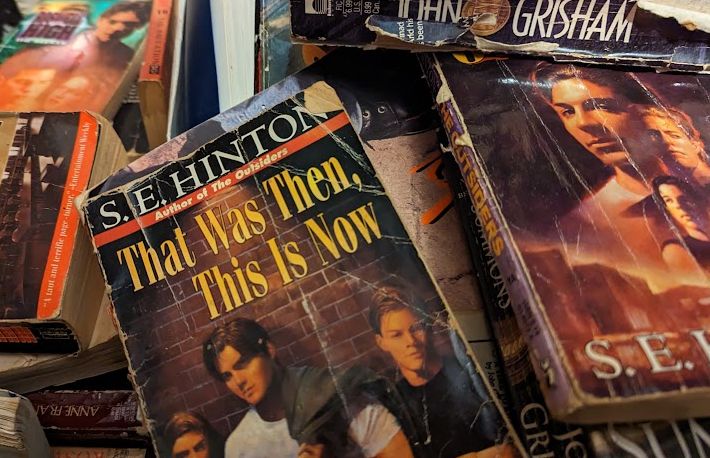
The few. The battered. The very, very well-read.

I’ve read many books more than once. Before I became a working adult, I’d chronically re-read the books I had, so much so that those titles are a….wee bit battered. Now, as an adult, I rarely re-read books, but there are exceptions. I regularly re-read C.S. Lewis’ Surprised by Joy and The Screwtape Letters, the former because I enjoy Jack’s company and the latter as a devotional exercise of sorts. Asimov, Bill Kauffman, and Anthony Esolen are also revisited on a regular basis. Ditto Wendell Berry: I love putting on a chapter of my Jayber Crow audiobook and revisiting Port William. As far as books that transport me some place else — oh, Robinson Crusoe! I don’t remember how old I was when I read it — eight, maybe. It was a child’s version, but I was absolutely fascinated by it, and still remember walking down the street reading it, unable to wait to get to my ‘spot’ –a little area between some huge mounds of sand and the woodline, where there were a multitude of blackberry bushes and honeysuckles. It was cool in the summer heat, no one could see me behind the sand, and I could lose myself in reading. I also had a private spot in the woods behind a swamp that I’d forged a path to using..um, “borrowed” cinder blocks. Alas, I lost it when the woods were logged.

List the “old books” you will commit to read as a break from reading all contemporary ones.

While I’m not going to take a break from new reads, there are a few books from 2013 I’d like to re-visit: Crunchy Cons, which I read as a progressive moving into libertarianism, but which was about the conservative counterculture; The Death and Life of Great American Cities, not only because it was brilliant and mind-blowing but because I never reviewed it; The Age of Absurdity, which I read in the same year and again failed to review; and several of those world-view changing titles like small is beautiful.

What do you think of the genre of books called fairy stories or books of fantasy and magic—of which Lewis had much to say? Which titles have influenced you most and what do you think they have taught you about the “real” world?

I have enjoyed them, but they’re not a staple. I think I resonate more with Narnia and Middleearth because of who the authors were, and from the fact that they were drawing deeply from Western and Christian culture/lore to create this stories. Likewise for Mercedes’ Lackey “500 Kingdoms” series, which takes as its premise that The Tradition (of stories) is always trying to recreate itself by pushing people who fit certain types (like a stepmother or an orphan) into tropish storylines. Aesthetically, I like the world of Tolkienseque fantasy very much – -the psuedo-medieval setting is always easy to understand.

Lewis writes movingly about the discovery of his favorite author, George MacDonald. Who would you say is your favorite author, and what role has he or she played in your life?

A few years ago I would have described Isaac Asimov as my favorite author, simply because I’d read so much of him. These days, though, I’m torn between Wendell Berry and Jack himself. I could write essays on either — on my appreciation of Berry’s unique critiques about the industrial state, the destruction of human communities and the human person in the modern age, his beautiful recreation of the same in his Port Williams books, etc. Lewis had similar critiques about modernity, though he wasn’t so much thinking of a shift from agriculture to industrialism, or the takeover by agriculture by the machine: not only did that presumably happen at a different scale in England, but it was only starting in earnest in the US when he died. I think I’ll say Lewis, not because I like Berry less but because I feel I know more of Lewis: I’ve read his biography, his letters, his diaries, countless essays. Lewis isn’t just an author to me, he feels like a friend, one whose company I frequently seek out.

Posted in General | Tagged | Leave a comment

Nonfiction November, Question 4: Recent TBR Additions

This month some bloggers have been participating in Nonfiction November, a series of queries hosted by “Based on a True Story“. The last question asks for nonfiction titles that have recently found themselves on our to-be-read pile. I think it’s supposed to be the last ten books or so, but I’m going to publicly shame myself in the hopes of doing better. Consider this my “Books I Have to Read Before I Can Buy Any More Books, At Least Until my Resolve Weakens and I Surrender Like the Craven Addict I am”. Those with a purchase date past six months (everything after High Price of Materialism) are technically old enough to be Mount Doom titles, and will be considered such in 2024.

America Calling: A Social History of the Telephone to 1940, Claude S. Fischer.

Hit Refresh: The Quest to Rediscover Microsoft’s Soul and Imagine a Better Future for Everyone, Satya Nadella

Goodbye, Darkness: A Memoir of the Pacific War, William Manchester. Technically a re-read.

Antisocial Media: How Facebook Disconnects us and Undermines Democracy. Purchased for class.

The Master Switch: The Rise and Fall of Information Empires. Purchased for class.

A Brief History of Nakedness, Philip Carr-Gomm. I was going to pair it with Naked at Lunch, but now it’s just standing awkwardly in the corner holding a magazine in front of itself.

The High Price of Materialism, Tim Kasser. Waiting for Advent so I can be all subversive and countercultural.

Plato, not Prozac: Applying Eternal Wisdom to Everyday Problems, Lou Marinoff

Live, From New York! An Uncensored History of Saturday Night Live, Tom Shales.

Sons of the Waves: The Common Seaman in the Heroic Age of Sail, Stephen Taylor. Purchased for Read of England.

The Stonemason: A History of Building Britain, Andrew Ziminski. Purchased for Read of England.

The Royal Society and the Invention of Modern Science, Adrian Tinniswood. Purchased for Read of England.

The Club: Johnson, Boswell, and the Friends Who Shaped an Age, Leo Damrosch. Purchased for Read of England.

The Vision: Reflections on the Way to the Soul, Kahlil Gibran

Human Scale Revisited: A New Look at the Classic Case for a Decentralist Future, Kirkpatrick Sale

Against the Machine: Being Human in the Age of the Electronic Mob, Lee Siegel

The Lost City: The Forgotten Virtues of Community in America, Alan Ehrenhalt

Grooming, Gossip, and the Evolution of Language, Robin Dunbar. Purchased for science survey/anthropology.

Posted in General | Tagged | Leave a comment

With Good Intentions? The Myth of Progress

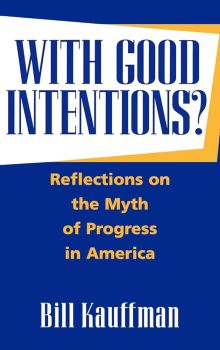
Wait, wait, wait. Before I comment on this book, I want to say first that patience is a virtue, and so is persistence. I stumbled on Bill Kauffman nine years ago, possibly via Front Porch Republic, and was immediately taken in by his charismatic contrariness and his beguiling command of archaic words and forgotten American literature. I immediately set my+ sights on reading Everything Bill Has Written, but was frustrated by not being able to find any copies of With Good Intentions? Reflections on the Myth of Progress for sale, or available via interlibrary loan. Disappointed but determined, I have for nine years kept an intermittent vigil, occasionally checking for used copies online that weren’t ridiculously priced — and finally, a couple of weeks ago, I saw one, and snatched it up immediately. (Current copies are selling for $55-$75. I purchased at $9. Ho, ho, ho.)

With Good Intentions is odd among Kauffman’s published works, appearing not as a monograph but as a collection of six essays of varying length linked by a theme, that of resistance to various ‘improvements’ of the 20th century, from women’s suffrage to the interstate system. Although progress tends to be a four-letter word in a Kauffman book, as he associates it with the destruction of cities to ‘save’ them and the ever-expanding growth of the beast on the Potomac, here not only does he include changes that he personally has no issue with, but he’s not the one arguing against them. Instead, Kauffman assays contemporary arguments and responses (for and against) and presents them to the reader with his own commentary — commentary which is more subdued than his usual style, and given that each piece ends with its own section of end-notes, the collection is more formal than one would expect from Batavia’s finest. To be sure, he’s still there: in quoting one person, he forewarns the reader that they use enough passive construction “to make Strunk turn White”. Kauffman is usually on the side of the opponents of change, especially of the interstate system and the standing military, but in the case of female suffrage he’s more fascinated by why some women opposed it: “Red Emma” Goldman, who no one would ever confuse with a traditionalist, despised it in part because she regarded the female sex as far more meddling and obnoxious, eager to interfere in the lives of others. (Readers who object should consider that pre-suffrage female activism was a huge part of the Temperance movement .) I was intrigued by Kauffman’s assertion in Ain’t my America that the standing military is enormously disruptive of the family, and thus anti-conservative, and here his commentary makes that case more forcefully. Presumably present readers would take most issue with the concept of child labor laws being opposed, but contemporaries make an excellent point that is not now sufficiently appreciated: this was when the State began asserting and assuming ownership of children, irrespective of the family’s interests or the parents desires — a road which has led to some places like the Inglorious People’s Republic of Californistan wanting to abduct children from parents who objected to their tweens wanting to chemically and surgically destroy their bodies under the influence of transmania. Good people often bad policy make, Kauffman remarks.

Fans of Kauffman will enjoy this on the off chance they can find it, but I wouldn’t use it to introduce Kauffman to anyone: he’s more restrained and formal here, and I only had to consult a dictionary once while reading

Posted in Politics and Civic Interest, Reviews | Tagged , , | Leave a comment

Make it ho, ho, ho!

When I saw that Audible had a version of “A Christmas Carol” performed by Patrick Stewart, there wasn’t a chance in the world I would not listen to it. I made myself wait until after Thanksgiving, though, because I’m a stickler about such things. If I lived in a universe in which Stewart had not delivered a singular performance of Scrooge in the movies, I would have still leapt at this given his marvelous vocal talent regardless. As I assume everyone reading this knows the gist of “A Christmas Carol”, I won’t bother rehashing the story. It’s enough to say that Stewart fully delivers here, performing all the characters and sound effects. I must say, listening to Patrick Stewart make clock and ringing bell noises was an interesting start to the Christmas season. Stewart gives all of the characters a distinct voice, playing a bit with different accents: they sounded fine to my American ears, but I imagine British listeners might have different opinions — just as I severely roll my eyes when I hear someone putting on a southern drawl. Because of Stewart’s involvement in a Christmas Carol movie as well as this, I couldn’t help but compare his performance of Scrooge proper — and this audiobook’s Scrooge is a bit different — Stewart delivers lines in a higher register, with a bit more timidity. I much prefer the movie version, but this was utterly enjoyable, and no more so than when I got to hear Stewart pretending to be a child singing a Christmas hymn.

Now, to versions of A Christmas Carol. I understand there are different partisans, but I’ll die on the hill that Stewart’s is the best — all of the acting is superb, and to it is added the wonderful music of Stephen Warbeck.

Twelve seconds of Patrick Stewart singing “God Rest Ye Merry Gentlemen”

The first time I ever attended the Christmas morning service at a liturgical church (an Episcopalian), we sang this and I was pleased beyond measure.

Fezziwg’s Party, one of my favorite scenes in the movie to watch.

Fran’s Theme, heart-rending in its wistfulness despite its shortness:

Posted in Classics and Literary, Reviews | Tagged , , | 4 Comments

Give thanks

Giving thanks is very meet and right, and just so to do, so — here’s one of my very favorite hymns in honor of the day.

Not here for high and holy things we render thanks to Thee
But for the common things of Earth, the purple pageantry
Of dawning and of dying days,
The splendor of the sea

The royal robes of autumn moors,
the golden gates of spring,
the velvet of soft summer nights,
the silver glistering
of all the million million stars,
the silent song they sing,

Of faith and hope and love undimmed,
undying still through death,
the resurrection of the world,
what time there comes the breath
of dawn that rustles through the trees,
and that clear voice that saith:

Awake, awake to love and work!
The lark is in the sky,
the fields are wet with diamond dew,
the worlds awake to cry
their blessings on the Lord of life,
as he goes meekly by.

Come, let thy voice be one with theirs,
shout with their shout of praise;
see how the giant sun soars up,
great lord of years and days!
So let the love of Jesus come
and set thy soul ablaze,

To give and give, and give again,
what God hath given thee;
to spend thyself nor count the cost;
to serve right gloriously
the God who gave all worlds that are,
and all that are to be.
Posted in General | Tagged | Leave a comment

Wednesday blogging prompt: bookish memes

Today’s prompt is memes that remind us of books, but when I opened Ye Olde Warehouse of Saved Memes, I found that I mostly save political, cultural, and Star Trek memes, so I’m just going to go with “memes that intersect with books, mostly”.

After a book buying spree..
This is one of my favorite meme formats of recent years.
My motivation for dispatching Mount Doom. That, and I didn’t want to die by “falling pile of books”.
It’s true. I can’t even go into a big-box bookstore without trying to straighten things.
“Oh, no, it’s him. That man with the long blonde hair who thinks he’s better than everyone else. I think his name is Lucius.”
“Actually, it’s Legolas.”
(Studio C: Lord of the Potter)
Posted in General | Tagged | 9 Comments

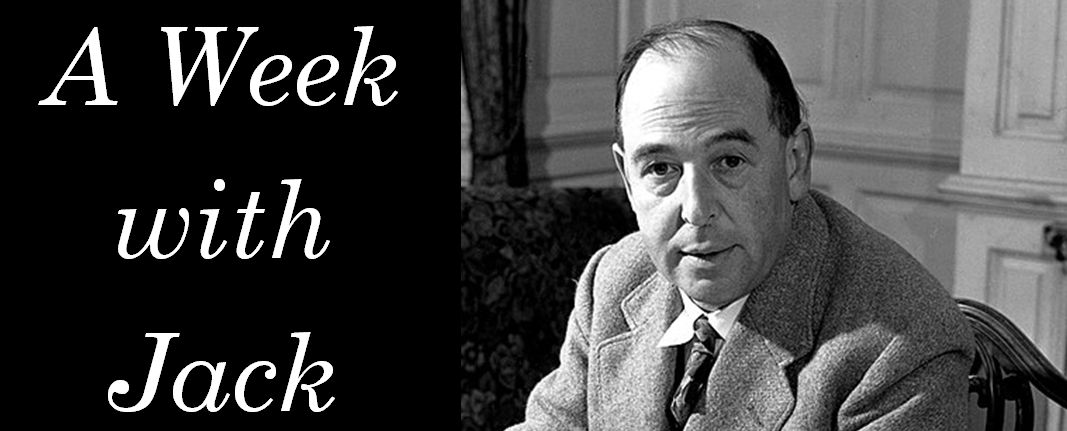
A Week with Jack

Pipes and brandy at the ready. It’s time to visit with Jack.

For the last few years I’ve had the Best of Intentions of doing a CS Lewis-themed week, set between November 22nd and November 29th, the anniversaries of his death and birth, respectively. That didn’t happen, but this year — it shall! I was given extra incentive this year because Pints with Jack, a Lewisian podcast I listen to, is hosting “C.S. Lewis Reading Day” on November 29th, Jack’s birthday. The current plan is to post 2-3 Lewis-related reviews between now and the 29th, and then on the 29th post some of my favorite Lewisian quotes. One of the reviews will be a new title (The Pilgrim’s Regress, from Mount Doom), and the other two are re-reads for me. I’ll also post some bookish reflections inspired by questions in The Reading Life, a collection of Jack’s essays on literature and reading. There’ll be other stuff mixed in, of course — a review for Feminism against Progress is in the works, I’m halfway through Hitler’s American Friends, and I’m steadily working on the ol’ TBR.

Posted in General | Tagged | Leave a comment

Racism, medieval feasting, and housing

Between work and school projects my list of read-but-unreviewed titles is growing, so…alas, it’s short rounds time.

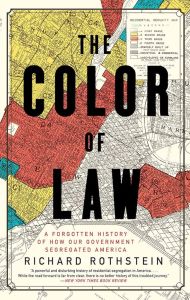
First up, The Color of Law, on how housing segregation was purposely pursued, not merely tolerated, by the federal government — primarily through zoning and redlining, but occasionally through more creative measures like “condemning” empty lots and declaring that the city was seizing them for use as parkland. I already knew the FHA is responsible for why the United States is eaten up with asphalty sprawl like a stage-5 cancer patient, but Color makes them even more hateable by demonstrating how explicit “no sales to blacks” rules were part of FHA and then VA policy. Rothstein also covers other ways federal policy has directly undermined black homeownership — by driving interstates through entire neighborhoods, for instance. Motives for creating and enforcing the segregated housing varied from the pretending-to-be-respectable claim that segregation avoided racial strife by avoiding racial mixing to the more honest self-interested fears about property values, to the good ol’ lizard brain fears of crime, especially rape. While Rothstein was presumably not writing to give an angry libertarian more fuel for the anti-FHA fire, I look forward to incorporating the racial aspects the next time I go Ron Swanson on someone.

Uhtred’s Feast by Bernard Cornwell and Suzanne Pollak, consists of three short stories about Uhtred of Bebbanberg bracketing a bunch of recipes for medieval Anglo-Saxon style cooking. I just read the short stories, being far removed from wild boars and mead. I enjoyed the stories, naturally, especially the one set during Uhtred’s youth, before he was captured by the Danes. Hard to recommend it generally, though, given the mixed content — people who are into stabbing, speech-making, and backhanding bureaucrats are not necessarily into cooking medieval style.

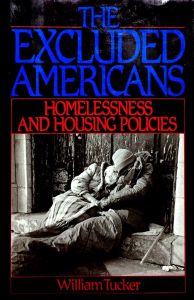
And wrapping up this short round is The Excluded Americans: Homelessness and Housing Policy, which is exactly as exciting as it sounds. It’s a 40-year old book brimming over with graphs, tables, and frightening words like “P-factor” and “regressive analysis”. William Tucker opens by reviewing factors that homelessness is commonly attributed to (poverty, joblessness, etc) and then looking for those that are most clearly and consistently tied to it. Although the book is extremely dated at this point as far as the data it employs, there are nonetheless some interesting lessons to be gleaned. Although it was common to attribute rising homelessness to the Reagan administration reducing housing assistance authorizations, Tucker points out that there is a difference between authorizations (which can take years to actually be used) and expenditures. While Reagan did dramatically reduce future authorizations, the actual outlays of funds for housing assistance increased during his administration. Tucker delves into the economics of the housing market, pointing out that historically, lower income citizens have always found housing in older buildings but the available stock of that has been greatly reduced by ‘urban renewal’, which destroyed wide swathes of housing stock which were insufficiently replaced — echoes of something that happened in the early Progressive movement, when residential hotels were attacked and closed on various grounds, ranging from the usual ‘Ew, poor people‘ to ‘Harrumph, harrumph, middle class people who live in hotels aren’t growing in responsibility the way real homeowners do’. The author is very critical of rent control, which — while sounding like a way to maintain affordable prices — privileges current owners and squelches new investment. Unfortunately, despite how dated the book’s data is, the core problems are still the same: despite issues with homelessness on the west coast, for instance, city leaders are still resisting permitting ADUs, microhomes, etc.

Posted in Politics and Civic Interest, Reviews | Tagged , , , | 4 Comments

Tuesday Thanking and Teasing

Today’s TTT is reasons we’re thankful for books, so I’m just going to go with books I’m thankful for for random reasons. But first, a tease. And yes, there are books reviews coming. Maybe in short round form, but they’re a-comin’.

Excessive perspiration was seen not as a sign of impending dehydration but as a social gaffe; ruling over all hot-weather activity was the dictum that horses-sweat–men-perspire–ladies-glow.

Cool: How Air Conditioning Changed Everything

The most potent theories, though, involve religion. This is as it should be because, at the deepest level, every human culture is religious—defined by what its inhabitants believe about some ultimate reality, and what they think that reality demands of them. The reality doesn’t have to be a personal God: It can be the iron laws of Marxism, the religion of blood and soil, the Gaia hypothesis, the church of the free market, the cult of the imperial self. But Bob Dylan had it right: You gotta serve somebody, and every culture does.

Bad Religion: How We Became a Nation of Heretics, Ross Douhat

This marketisation of sexual desire has been under way now since the 1960s. And digital culture has accelerated those ways we’re able to buy sexual stimulation, or sell ourselves as commodities. The resulting hellscape of sexual anomie is the true face of what calls itself ‘sex-positive’ feminism, a movement that doesn’t seem to have prevented Gen Z from slumping into a ‘sex recession’.

Feminism against Progress

And now, thanking!

(1) Isaac Asimov’s Black Widower series, a source of not only fun mysteries to muddle through, but vicarious dinner debate and discussion that I never grow tired of.

(2) P.G. Wodehouse, for his exquisitely playful use of the English language, and his stories which never fail to buoy my spirits.

(3) Bill “Fossicking about in Tramontane Sinkholes ” Kauffman, one of the very few authors who makes me consult a dictionary. This week I’ve extra reasons to be grateful — I spotted a used copy of his last book I’ve not read listed for sale and picked it up. Took ten years to find one that wasn’t priced beyond reasonable limits!

(4) For science writers like V.S. Ramachandran, Carl Sagan, Rob Dunn, and Ed Yong, whose gift for describing and explaining the natural world fills my mind with wonder and awe.

(5) For authors like J.K. Rowling, whose stories filled with charm and courage arrayed against darkness and fear have cheered me for nearly twenty years now.

(6) For authors like Michael Connelly, whose character details frequently lead me to try new music and movies. I only know “”Harlem Nocturne” because of Harry Bosch.

(7) For authors like Daniel Suarez, William Gibson, and Blake Crouch who can take a science or technical concept and expand it into a story that makes me believe for a few moments as though I’m experiencing the future.

(8) For authors like Alain de Botton and Anthony Esolen, who can articulate and express with eloquence feelings I have and can almost see, darting around in my psyche like some ocean fish, but never focus on.

I explained — with the excessive exposition of a man spending a lonely week at the airport — that I was looking for the sort of books in which a genial voice expresses emotions that the reader has long felt but never before really understood; those that convey the secret, everyday things that society at large prefers to leave unsaid; those that make one feel somehow less alone and strange.
Manishankar wondered if I might like a magazine instead.”

Alain de Botton, A Week at the Airport

(9) For authors like Michael Korda, Albert Marrin, Bernard Cornwell, and Robert Harris — whose nonfictional or fictional offerings make the past come alive again.

And finally,
(10) For authors from Buddha to Wendell Berry whose insights help me understand myself and society better.

Posted in General | Tagged , | 6 Comments

Nonfiction November, Part II

I forgot about Nonfiction November’s weekly prompts, so here’s another twofer!

Week 3 (11/13-11/17) Book Pairings:

This week, pair up a nonfiction book with a fiction title. Maybe it’s a historical novel and the real history in a nonfiction version, or a memoir and a novel, or a fiction book you’ve read and you would like recommendations for background reading. You can be as creative as you like! (Liz)

The Four Winds (fiction) and The Worst Hard Time (nonfiction) are an obvious pair, both dealing with the Dust Bowl. American Dirt (fiction) and The Beast (nonfiction) both address why people are attempting to flee Mexico, and the violent horrors they face trying to make their way into the United States.

Week 4 (11/20-11/24) Worldview Shapers

One of the greatest things about reading nonfiction is learning all kinds of things about our world which you never would have known without it. There’s the intriguing, the beautiful, the appalling, and the profound. What nonfiction book or books have impacted the way you see the world in a powerful way? Is there one book that made you rethink everything? Do you think there is a book that should be required reading for everyone?

I’m writing a reflection on this to be posted later in the week for a special theme that will run Nov 22 to Nov 29 (guesses welcome on what connects those dates), so I won’t say too much here. Many books have had a huge effect on my thinking and worldview, and because I’ve been “reading in public” here since May 2007, I can go back and see my initial reactions to most of them. A few of the heavy hitters off the top of my head: Neil Postman’s Technopoly made me begin thinking critically about technology in my early twenties, helping me dodge the phone-addict bullet’; Erich Fromm’s To Have or to Be? was my first blush with anti-consumerism; Jim Kunstler’s Geography of Nowhere gave me the vocabulary to understand why I hated some cities and loved others, and gave me an obsession with understanding how the built environment impacts human flourishing; Marcus Aurelius’ Meditations gave me a love for living philosophically; and The Death and Life of Great American Cities introduced me to emergent order and unwittingly served to push me from “conflicted progressive” to “conflicted libertarian”. It did this not by itself, but by adding a match to the growing pile of doubts I’d accumulated from college forward.

Posted in General | Tagged | 3 Comments