Today’s TTT is about books that provoked a strong reaction. I’m going to try to focus on books from the first ten years of the blog. First, though, Ye Olde Tuesday Tease.
For [Antipater], the human being in action is best understood as an archer. We train and practice, We draw back the arrow and aim it to the best of our abilities. But we know full well that despite our training and our aim, many factors outside our control will influence where the arrow hits the target — or if it falls short entirely.(Lives of the Stoics, Ryan Holiday)
(1) The Good Guy, Dean Koontz. I don’t remember the plot of this novel as much, only that one of its viewpoint characters was a serial killer, and Koontz was effective at creeping me the heck out.
(2) Gone Girl, Gillian Flynn. Again, disturbing enough that I never revisited Flynn.
(3) Most of Phillip Kerr, but especially The Lady from Zagreb. Although Kerr’s German mystery novels were always masterful thrillers, I had to limit myself to one a year because they were frequently depressing, despite the main character’s Berlin humor.
(4) The Art of Living, a translation of Epictetus by Sharon Lebell. After quotations from Marcus Aurelius prompted me to read The Meditations, I wanted to read more of the Stoics and discovered this volume in my university library back in 2008. I vividly remember copying passage after passage from the book into a notebook. Unfortunately, I lost that college commonplace book in a move — how I would love to see the stuff I was thinking about back then! I later bought my own copy of this as well as The Meditations.
(6)The Four Agreements. One of the first books I ever one-starred on Shelfari (anyone remember that?) and Goodreads.
(7) The Sea Wolf, Jack London. My favorite London novel, it follows a young academic who is lost at sea and rescued by a whaler. The whaler is captained by a beast of a man — strong, intelligent, dominating, and the academic must learn to function as a man in full (adding physical strength and courage to his mental gifts and moral core) to overcome his captor. Invigorating!
(8) Jayber Crow, Wendell Berry. I regard this as my favorite novel, and it’s one I didn’t just “read”: I have both as a physical book and an audiobook, and I frequently re-listen to chapters from the audio book whem I’m trying to relax. There are many unforgettable moments in this book for me — Jayber standing up to Troy, Jayber’s realization that “She said ‘we'”, etc.
(9) Angels and Demons, Dan Brown. I would have thrown this book across the room if it wasn’t a library title.
(10) Enemy of God, Bernard Cornwell. The middle volume of his Arthur trilogy, which set Arthur as a Celtic lord fighting against the Saxons. However, this isn’t straight historical fiction: because Arthur is such a legend, Cornwell departed from his usual style and gave this the slightest grazing of the ethereal — not making it fantasy, but taking the book to the very edge, to the liminal space between history and myth. Enemy of God was especially close to that edge, and set during Samhain it has a scene that borders on horror. Really effective.
I’ve been dogsitting away from my PC, hence the delay in posting this…
Sweet and Lowdown, 1999. Sean Penn plays a rival to Django Reinhardt. Unfortunately, I liked All the King’s Men so much that Sean Pean is now indistinguishable from Willy Stark/Huey Long.
El Mariachi. 1992. A guitarist is confused for a gang-banger. Many homicides ensue. There is an attractive woman.
The Unlikely Pilgrimage of Harold Fry, 2023. A man receives a letter from a former coworker and embarks on a walking trek across the whole of England, which is simultaneously a journey through his past as he comes to terms with regrets and meaning. Definitely tear-jerky and heart-warmy. Probably my favorite movie all year.
Diva, 1981. French film in which a postman with an obsessive interest in an American opera singer gets caught up in a crime drama after a potential witness drops a cassette tape in his mailbag shortly before she’s knocked off. Beautiful music.
Do Not Expect Too Much from the End of the World. Lady taxi driver drives around swearing and shooting Tiktok videos using a filter that make her look like Andrew Tate. Romanian. I fell asleep watching it. My friend likes this director and has made me watch several shorts by them. So many, in fact, that he felt apologetic and later introduced me to Spring Breakers as an apology.
Trees Lounge, 1996. Steve Buscemi plays a mechanic who was recently fired, who spends his time hanging out in a bar with a few characters who we get to know over the progress of the movie. After his uncle dies he starts driving the uncle’s ice cream truck to earn some money, but gets in trouble after his ex-girlfriend’s niece starts hanging out with him. It’s not a story that gets wrapped up nice and neat, but the viewer gets interested in the characters, and that’s what matters. Definitely enjoyed it. Michael Imperioloi, who played Christuhpuh in The Sopranoes (where Buscemi also played a character, thatanimal Blundetto!) appears. His accent is stronger in Sopranoes. My introduction to Chloe Sevigny, who I definitely want to see more of.
Married to the Mob, 1988. Alec Baldwin plays a mobster who dies fairly early and the rest of the movie is about AB’s boss trying to seduce AB’s widow. Love the late eighties hair and fashion.
All about my Mother, Pablo Almodóvar.I’ve seen him before (Women on the Verge of a Nervous Breaktown) and absolutely loved his use of color. That appears here again, though not as prominent. I was especially interested in this film because the main character is a transplant coordinator, and 2.5 years ago I was nearly killed by an autoimmune disorder that led to my being put on dialysis, and then having a kidney transplant after a few months on dialysis. In the film, a woman’s son dies on his 18th birthday, and she — distraught — goes to find his father to tell him. I don’t want to go into the plot too much, but his father is a transvestite, as we discover. Anyway, the main character’s search for the father leads to her life intersecting with an an accomplished but aging actress and her junkie lover, as well as a young nun who works with the least of us and who is both pregnant and HIV-positive. Although there’s a lot of tragedy in this story, it’s beautiful in its way — and not just for the visuals or Penelope Cruz! Considering how HUGE a role A Streetcar Named Desire played in this, I need to watch it soon-ish. Oh, and great soundtrack Almodovar is apparently a fan of the noir-jazz sound.
Back in Black, 2024. Full disclosure: I’ve been an Amy Winehouse fan since Frank hit the US. so when this film was announced I was prepared to hate it. I was….very pleasantly surprised. Abela got the accent pretty well, at least to my American ears, and the costuming and on-stage presences were great. I’ve watched a LOT of Winehouse video over the years and recognized the recordings some shots were based on. Although Winehouse fans tend to take the universal line that Blake was The Worst Thing Ever, the film does a good job of making him attractive (especially in the intro pool hall scene, where his love of the Shangri-Las results in an endearing performance), and defending him to some extent from the idea that he and he alone pushed her into harder drugs and self-destruction. The ending was….beautifully tragic. From the moment the pararazzi asked her what she thought of her ex-hubs and his child by his new girlfriend, I knew exactly what was about to happen, and that last shot…the directors take a lovely direction with it. We are not forced to see what happens, but there’s another shot that links to previous shots and it’s apparent to the viewer what happens next. Going to read Amy Winehouse in Her Own Words before the month is out.
Bernie, 2011. Jack Black plays a real-life mortician and community pillar who, apparently, shot an old lady in the back 4 times because she was just making his life a living hell. Bernie was a real man, as was his victim, and as were all the townspeople — who appear in the movie!! — defending him. Matthew McConaughey does a solid job as a D.A.. My fifth Linklater film.
The Garden of Words, 2013. Anime movie in which two lonely people who keep encountering one another on rainy days in the park developing a friendship. Liked the music, loved the art. I haven’t watched much anime,but this had a visual richness not found in say, Pokemon or Bludgeoning Angel. The art was “warm” and felt like it had dimension, unlike the flat depictions of those other anime offerings.
Paper Moon, 1973. Set in the 1930s, filmed in the 1970s. A father and daughter team play a con man who is transporting a girl who proves to be a useful asset in his scheming. The girl was Tatum O’Neil, who played in Bad News Bears. Great music.
Bronson, 2008. Tom Hardy is Michael Peterson, aka Charlie Bronson, an absolutely violent but weirdly charismatic serial offender who has spent 30+ years in solitary. The film is framed as Charlie giving a one-man show about his life.
Spring Breakers, 2013. Four college women go to spring break, funded by a little robbery that three of them committed immediately prior. They all get drunk and wild and wind up in prison, and are then bailed out by a very skeezy white rapper who gives Selena Gomez the willies, so she’s put on a bus. (She’s one of the aforementioned coeds, in one of her first ‘adult’ films.) The three remaining girls (The Beautiful Blondes and The Girl With Pink Hair) hang around a bit, but then the rapper gets into a feud with another gangsta wannabe and Pink Hair is shot in the arm. The Beautiful Blondes stick around. Watched this with a friend with no idea of the plot or premise and found it…..interesting, hilarious, and horrifying at the same time.Think I may watch Beezus and Ramona to revisit Selena Gomez in an utterly wholesome role.
Will Success Spoil Rock Hunter?, 1957. Fun comedy that stars Jane Mansfield as a Hollywood bombshell who makes an ad man a star after she agrees to endorse his product — but only if he helps her create some drama by pretending to be her new boyfriend, making her old mimbo boyfriend jealous and generating publicity. Tony Randall proved to be a solid comedic actor, and he’s not alone. I liked this better than my previous Mansfield title, The Girl Can’t Help It — though that one was enjoyable.
The Imitation Game, 2014. Tempted to watch it because Alan Turing is the father of computing, and I’m an IT geek; sold because Matthew Goode was involved and I’ve been a fan of his since Chasing Liberty and Imagine Me and You. (Also liked him in Downton, but he was just a supporting character much overshadowed by the family.) Icing on the cake: Allen Leech, who played Tom/Mr Branson in Downton Abbey, is a supporting character. Alan Turing beats the Engima machine but commits suicide after being persecuted for homosexuality.
One Flew Over the Cuckoo’s Nest, 1975. Jack Nicholson is sent to a mental institution to be evaluated: his refusal to surrender to institutionalization creates fun chaos in the asylum, until The Powers that Be decide he’s pushed things too far. Tragic ending. Nice seeing Louise Fletcher here, who I know as Kai Winn from Deep Space Nine.
May proved to be a charming and busy month for reading, and continued the strange trend of my reading more novels than nonfiction, possibly because grad school and a major work project. I did make some progress on the Science Survey, though, and oddly enough one of the remaining sections is usually the low-hanging fruit of biology. I have the summer off of school, though, so my reading might start trending more toward the usual stuff.
The Month’s Favorite: The Unlikely Voyage of Harold Fry. May will be remembered for discovering Rachel Joyce in general.
Classics Club: I picked up Resurrection several times and even glanced at The Shahnameh.
The Science Survey The Big Backyard, Ron Miller The Milky Way: An Autobiography, Moiya McTier OMFG Bees! Matt Kracht. Unreviewed because it was a short title: casual, vulgar, but informative. The author reviews different families of bees, informs the reader about their ecological importance, and argues for rewilding yard to better support bee populations. There’s also an amusing section in which he presents several pieces of art that could be improved by bees.
Readin’ Dixie:
Nothing this month, but I’m ahead for the year so not concerned.
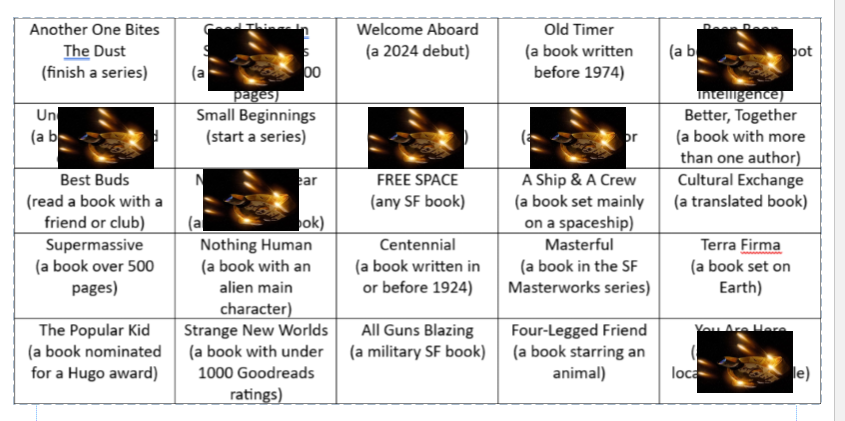
Small Beginnings: Start a series. The Eighth Continent, Bruno & Castle. May use this one for Better Together, actually. Beep Boop: A book with a robot or AI: Shelli, David Brode. Good Things Come in Small Packages. The Downloaded, Robert Sawyer. 183 pages. All Tied Up: a tie-in novel. Plan 9 from Outer Space. You are Here: A book with a location in the title. Lunar Missile Crisis. Bits and Pieces: a collection or anthology. Solar Flare. Under the Radar: a book you head of in 2024. Growing Seeds from Stones.
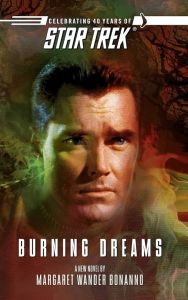
I can technically stick Burning Dreams under several of these, but I’ve already uploaded the graphic so it can just wait a month to show up.
What’s coming up in June: I’m going to make a push at the science survey with an eye towards ending it in July, and really need to attend to the Classics Club.
Decades ago, then-Commander Spock risked a court martial to bring his former captain, Christopher Pike, to Talos IV, in hopes that it would allow Pike to escape his body, so ruined by delta radiation. Now Spock is returning, called to Talos for reasons unknown beyond his loyalty to Pike. In Burning Dreams, Margaret Bonanno offers readers a chance to get to know the man who inspired so much loyalty and devotion from Spock and others. We meet him as a young lad on a frontier planet, grooming horses on a volcano-based homestead, and follow him through adversity and tragedy — growing through his pain to become Starfleet’s finest. Although I was predisposed to like this because Anson Mount’s performance of Pike has thoroughly impressed me, Bonanno’s ending added a wonderful final flourish that does real justice to the character of Pike as a whole. Although this was written a decade before Strange New Worlds was created around Anson Mount’s masterful interpretation of Pike, SNW fans as well as classic Trek fans will find it a great read, as it establishes certain aspects of his background later used by other authors, and creates a version of Pike quite consistent with SNW’s character.
Most of the story is framed in Pike & Vina’s growing relationship upon his original return to Talos IV: now, he is a guest rather than a captive, and the two humans — both suffering from ruined bodies, both freed from them by the Talosians’ telepathic abilities — can now begin to get to know one another, no longer distracted by Pike’s need to find a way to escape the Talosians’ cage. They both begin sharing their pasts, though in this narrative we’re mostly hearing from Pike. We learn that his mother was an architect and his stepfather a geoengineer, making a home for themselves near the base of a volcano. Theirs was a frontier world, a colony world, peopled by a mix of Federation normies as well as neo-Luddites. One character, a horse groomer, proves to be a vital character in Pike’s life after disaster befalls– and it is he who puts Pike on the path to Starfleet. From here, we witness Pike’s growth as a young officer, standing fast on principle and growing in the estimation and affection of his peers. One of the longer section involves Pike being surprised and captured by some reptilian aliens, which cements Spock’s affection for him. Although my estimation of this book is partially inflated because of how much I’ve grown to like Pike, this was a solid story and the ending was superb.
Recently I encountered the word ‘solarpunk’, and learned that it was a subgenre of science fiction that attacks the pessimism of cyberpunk by creating futures that are its opposite. In solarpunk settings, humanity has learned to grow with nature — using technology to harmonize with it instead of conquering it. I like the aesthetics of it, though its economic literacy is…questionable. Anyway, I wanted to try some fiction in that category.
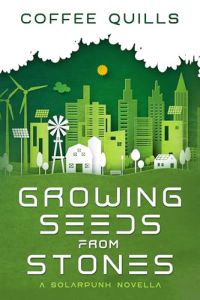
First up was a Kindle Unlimited piece called Growing Seeds from Stones. This is a short beginning of a story set in a future where there’s been an ecological/environmental/economic collapse. Our main character, Moss, is a member of a new community built from the remnants of the old world: the city is closed to outsiders, and only those who can fulfill are a useful function or have skills to contribute are allowed in. Jobs are assigned based on the community’s needs, not anyone’s desires, and there’s stagnation and latent dissatisfaction as a result. Sandy and her best friend Moss are two such frustrated young people. When Sandy makes the radical choice to secretly leave the community in the middle of the night, Moss is inspired to get involved in the community’s politics — and that’s where it leads off. The setting is interesting, but the ending was jarring, as if the second half of the book is simply not there.
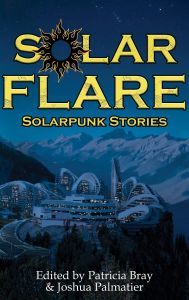
Next up was Solar Flare, a collection of solarpunk-inspired short stories from various authors. There’s a bit of a range, timewise: some are set a few decades away, others centuries. Unlike Metatropolis, they don’t share a same imagined future, though concepts are the same in both. There’s a good variety in the stories, all exploring different adaptations humans are making to worth with nature rather than ride roughshod over it, and these range from engineering to culture. In one story, for instance, we visit a team of women (“Umbrella Men”) who are tasked with repairing and re-orienting kilometer-sized veils in the upper atmosphere. These ‘umbrellas’ refract from sunlight, but also convey it into power that’s beamed down to Earth. The strangest one for me was “Lumen”, about a solar-based community in 1898 being persecuted by oil and gas interests: this seemed implausibly anachronistic, in part because I only associate solar power with conversion cells, and the means by which this town was employing solar power were not explained. Easily the most interesting story for me was “The Palmdale Community Newsletter”, in which a journalist tracks down an independent journalist who keeps writing articles about life in The Other America, a place that this indie journalist can see if he walks down a certain street: in this Other America, the United States took a very different turn after World War 2, pursuing sustainable energy and urban development instead of covering the good earth with oil-soaked parking lots and suburbs dominated by bee-hostile grass monocultures. The stories set closer to us tend to look at the consequences of our actions (like “Drips of Hope”, in which government agents try to persuade some towns people to relocate because there is no more water) , as well as “The Race on Dry Mississippi”, in which solar-powered vehicles race down the empty channel of the Mighty Missisippi. I was glad there was stories like “Drips of Hope” which examined environmental issues other than climate change. The biggest disappoint was “The Astronaut”, which had a fun premise (an astronaut put in stasis finds herself crash-landing on Earth in the late 24th century), but it ended very pompous lecture-y, as the Greenlanders (all Hispanic, interestingly) arrest the astronaut for possessing rocket fuel and go on and on and on about her ignorance and sin. All told, though, I liked the variety of the stories, and the central message about hope, human resilience, and ‘biophilic design’, which is something I want to read more about. It sounds a bit like permaculture on on a different scale.
This week’s triple-T is books we were over the moon to buy, but….haven’t gotten around to reading. But first, teases!
Volcanoes, then, can be sites of encounter and performance, where history is made. Sometimes their eruptions are so dramatic they make history themselves – the Indonesian volcano, Krakatau, which exploded violently in 1883 claiming 36,000 lives, comes to mind.And volcanoes are accomplished scribes – they write their history, in the folios of pumice and ash from which they are built. Pare back the layers of the archive and you might find ancient soils, agricultural land, towns, footprints, bodies and all traces of once-vibrant life whose chance exhumation connects us across millennia with fleeting seconds of peril. (Mountains of Fire, Clive Oppenheimer)
I propose that we view the late 1980s as the beginning of the transition from a “play-based childhood” to a “phone-based childhood,” a transition that was not complete until the mid-2010s, when most adolescents had their own smartphone. I use “phone-based” broadly to include all of the internet-connected personal electronics that came to fill young people’s time, including laptop computers, tablets, internet-connected video game consoles, and, most important, smartphones with millions of apps. (The Anxious Generation, Jonathan Haidt)
So…I can’t do much for this topic, since I haven’t been buying many books lately. Let’s take a gander at my Amazon order history and see…
The Anxious Generation certainly counts, as it was a preorder that arrived in the middle of Read of England and was so shelved.
There’s The Atlas of Beauty, a photo collection of women’s stories from around the world
Oh, and America Calling: A Social History of the Telephone! Bought that one last year.
Goodbye, Darkness: A Memoir of the Pacific War, William Manchester. Read this back in high school 20+ years ago (…criminy…) and wanted to revisit it.
Earthings, by Sayuka Marata.
Cool: How Air Conditioning Changed Everything
Unraveling: What I Learned About Life While Shearing Sheep, Peggy Orenstein. This one should be interesting, considering that I found it while looking for works like Orenstein’sCinderella Ate My Daughter.
A Brief History of Nakedness. I’d bought this one to read with Naked at Lunch, but got distracted.
Powers and Thrones: A New History of the Middle Ages, Dan Jones
Star Trek: Burning Dreams. A Captain Pike novel (pre-Strange New Worlds, sorry) by Margaret Bonanno.
“We took the fight to them, Kirk! We truly did! I haven’t felt this exhilarated since Trafalgar.” “Sir, you died there.”
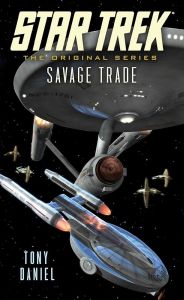
When Captain James Kirk ordered the Enterprise to find out what happened to the crew of a science outpost that had gone missing, doubtless he never expected to help George Washington with a political revolution, or fight at the side of Admiral Lord Nelson. These things do have a way of happening aboard Kirk’s ship. Those familiar with the original series may remember a certain episode called “The Savage Curtain”, which I’d describe as particularly weird episode if not for the fact that TOS excelled in absolutely inexplicable plots by our standards. Remember the time Apollo grabbed the Enterprise and tried to get the crew to worship him? Or the time Kirk and company found a planet where a conquered people regarded Freedom as a worship word and had both the Declaration of Independence and an American flag? Anyhoo, in “The Savage Curtain” we met a race called the Excalibans, and they recreated heroes and villains from Earth’s past in an effort to understand morality; here, a small number of them are attempting to flee their collective, and had taken refuge at the science center where they were being studied, at least until the space pirates showed up and ruined everyone’s day. Savage Trade is that story, and while it’s not a serious or intense, it’s absurd fun that might hit a reader’s sweet spot in the right mood.
The Excalibans have some interesting quirks: for one, these ‘refugees’ as they describe themselves can no longer shift into their original forms, and the more they spend time as the historic personages, the more human they feel. Their bodies continually maintain themselves as their historic appearances, and if they remain in living quarters for some time then those quarters themselves will become appropriate to the character: quills appearing in George Washington’s room, for instance, woolen curtains over a viewport elsewhere. After Kirk rescues everyone and returns back to the station, he finds a Vulcan diplomatic figure waiting for him — someone from Starfleet Command who has been given authority over all Federation and Starfleet activity in this system. Turns out the Excalibans hadn’t just found the station: they were deliberately put there so they could be studied and their appeal for Federation citizenship evaluated, and there’s a careful game being played because the other Excalibans are rather nasty creatures. It’s generally fun, featuring Spock and Galileo talking in Latin, Scotty drinking Scotch with James Watts, and Admiral Lord Nelson entertaining Kirk’s crew with stories of the old days. I enjoyed it for the most part, especially for absurd sentences that I’d never expect to read, but I must re-iterate that this is a mood kind of book: if you go into it looking for a serious science thriller like Christopher L Bennett’s, or an intense political and character drama like David Mack’s, you’ll be disappointed. This is more “Sometimes, Number One, you just have to embrace the absurd” kind of storytelling. As it happened, I was in just the mood for it.
Highlights:
The man straightened up, stared a crystal-clear, gray-eyed stare at Kirk, and removed his hat. He made a partial bow. “I am George Washington.” “The George Washington.” “I am the president of the United States of America.” “Former president,” Kirk replied. “For me it does not seem that way,” the other replied. “In my own perception, I am president still.” “ We’re talking about the George Washington from the American Revolutionary War?” “Captain, we both know that is an impossibility.” “Then who or what are you?” “Perhaps we should discuss this another time, outside of this accursed nebula, and face-to-face—”
When Benjamin Franklin spoke to Spock, he could tell his first officer was quite intrigued.
Also, that’s why poor Marcel Proust is no more. He became incensed during a card game and attempted to draw a weapon on Bill Hickok. Hickok had equipped himself with a phaser in addition to his Colt 1851 revolver. He swears it was merely for defensive purposes.
Wisdom and mercy are the fruits of logic. When there is discord, you will find irrationality at the bottom of it.
“Quantum physics, she is whimsical,” Galileo replied. “Effervescent and beautiful, with a smile like the Mona Lisa. Leonardo, he senses this. His true mistress is the universe, you know!”
“Vulcans gossip?” “It is logical to provide oneself with as much information as possible.”
“We took the fight to them, Kirk! We truly did! I haven’t felt this exhilarated since Trafalgar.” “Sir, you died there.”
This week has seen a little action on the Science Survey, as I read titles for the Local Astronomy and Cosmology & Astrophysics sections.
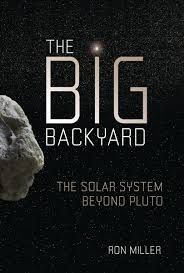
First up, The Big Backyard is a short look at the outer reaches of our own solar system, drawing on the New Horizons mission to offer a new look at Pluto, the Kupiter Belt, and the Oort Cloud after a preliminary section on the solar system’s formation that explains why the distant backyard of the solar system is the way it is. Most of the interest for me came in the Pluto information, because it’s a seriously interesting little ice-ball in space. The author refers to it as a binary planet along with Charon, in a brazen dismissal of IAU orthodoxy. Pluto has a lot more going on than previously expected: it evidently still has an active core, one that’s possibly creating new mountains, and there’s reason to believe that a layer of liquid water exists under its crust. When it’s close to the sun, as it is now, it has a bit of atmosphere — enough for haze and winds. It’s presently moving further away from the Sun, and as it does its atmosphere will become frozen ice on the surface. All very interesting stuff! If you’re interested in the New Horizons mission itself, last year I read Chasing New Horizons, on the decades-long process of getting a proper Pluto survey done. Interestingly, the volume is illustrated with art, not photographs.
After this I read The Milky Way: An Autobiography of Our Galaxy, by Moiya McTier. This is a history of the Milky Way delivered in a personal voice, with mixed levels of anthropomorphizing: Milky describes neighboring galaxies in the local groups as if they were friends, rivals, or barely tolerable neighbors, but also reiterates she doesn’t have eyes to roll, that sort of thing. There’s more anthropomorphizing than not: Milky relates to the stars as children, and talks about black holes as though they were pockmarks or scars: the big one at her center as a source of great internal trauma. (There’s even a little suicide intervention footnote at the end of that chapter.) McTier, who is pursuing an interesting speciality of combining science and folklore, deserves credit for approaching this field in a unique way: instead of an imposing text with tables and graphs and the like, this is a very approachable way to learn about the formation of the galaxy, the importance of dark matter in the same, why galaxies take different shapes, the life cycle of different kinds of stars, and so on. She also highlights a number of astronomers who have gotten overlooked by pop-history approaches to astronomy that hit a few big names. The limit of the personal approach, though, is the person: Milky struck me as frequently vain and conceited, generally deriding humans unless we were telling stories or studying her. (I was reminded a little bit of the version of Joan Crawford in Mommy Dearest…) Of course, people are a matter of taste: what I regard as obnoxious others might find charming. I’ve certainly been friends with my share of boors! This is certainly a novel approach to science: if you’re curious about the stars but spooked by straight-edge approaches, An Autobiography may be just the ticket for you. Personally, I enjoyed the referesher but think I’ll just re-watch the original Cosmos again. (…I was listening to its soundtrack while reading both of these, so I’m in the mood.)
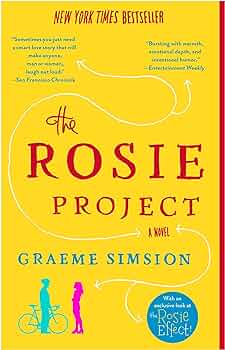
Imagine if Sheldon Cooper wrote a memoir about falling in love, and you’ll have something like The Rosie Project. Don Tillman is a genetics professor with a rigorously scientific approach to life, who has standardized even his meals to simplify shopping. He has difficulties navigating social situations, however, and reading people’s emotions. Despite this, he’s developed a few close friendships, and one casual remark from an aging friend — the observation that he would make a great husband — launches him on a new goal, The Wife Project. It will change his life, though not in the way he expects. Being a man of science, he proceeds in a logical matter — by establishing parameters, creating a questionnaire that will determine if a woman falls outside of those parameters (if she smokes, for instance, or can’t perform basic arithmetic), and then distribute said questionnaires to interested parties. Then a woman appears in his office who he mistakingly believes is an applicant, and life begins taking him in unexpected directions. The Wife Project is soon sidelined by another one altogether, a hunt inspired by his new friend Rosie that will take the pair of them across the world. The Rosie Project is a sweet but fun novel, in which there’s a steady stream of accidental humor caused by Don’s unusual take on situations, and complications created by his often-unexpected responses. The novel is largely one of personal growth, as his friendship with Rosie and the joint project they’re working on force him out of his very comfortable routines and structure — and Don’s perspectives on others as he grows, coupled with his readiness to share his pointed opinions, also forces growth and change from the other characters. The novel illustrates how we can deprive ourselves by not being open to new experiences, or by boxing ourselves in with labels and judgment, and Rosie herself is unpredictable enough that the reader has almost as much fun getting to know her as Don does. What I most appreciated, though, was that this isn’t some Grease-esque story in which Don transforms himself to be loved: while he does change a bit (getting out of ruts and such), he finds joy in using his quirks and pecuilar strengths to connect meaningfully to others. Rather tempted to continue the trilogy, but I’ve a serious NF deficit to remedy first.
Coming up: SPACE!
Highlights:
“So, did you have fun?” asked Gene. I informed him that his question was irrelevant: my goal was to find a partner and Rosie was patently unsuitable. Gene had caused me to waste an evening. “But did you have fun?” he repeated.
Hurtling back to town, in a red Porsche driven by a beautiful woman, with the song playing, I had the sense of standing on the brink of another world. I recognized the feeling, which, if anything, became stronger as the rain started falling and the convertible roof malfunctioned so we were unable to raise it. It was the same feeling that I had experienced looking over the city after the Balcony Meal, and again after Rosie had written down her phone number. Another world, another life, proximate but inaccessible.
“Overview, overview. Sunday to Wednesday. One sentence per day. Leave out eating, sleeping, and travel.” That made it easy. “Sunday, Museum of Natural History; Monday, Museum of Natural History; Tuesday, Museum of Natural History; Wednesday—” “Stop, wait! Don’t tell me Wednesday. Keep it as a surprise.”
By the time Rosie came back, I had performed a brain reboot, an exercise requiring a considerable effort of will. But I was now configured for adaptability.
Rosie put her arms around me and kissed me. I think it is likely that my brain is wired in a nonstandard configuration, but my ancestors would not have succeeded in breeding without understanding and responding to basic sexual signals. That aptitude was hardwired in. I kissed Rosie back. She responded.
Walking back to the hotel, I realized that I had behaved in stereotypical male fashion, drinking beer in a bar, watching television, and talking about sports. It is generally known that women have a negative attitude to such behavior. I asked Rosie if I had offended her. “Not at all. I had fun watching you being a guy—fitting in.” I told her that this was a highly unusual response from a feminist but that it would make her a very attractive partner to conventional men. “If I was interested in conventional men.”
I was relieved. The basic male-male tough advice protocol had been effective. It had not been necessary to slug him.
WWW Wednesday is a meme hosted by Taking on a World of Words, in which participants must answer these questions three: WHAT is your name? WHAT is your quest? WHAT –
…..Oh, sorry. It’s about reading. The questions:
What are you currently reading? What did you recently finish reading? What do you think you’ll read next?
I’m currently reading The Rosie Project, in which a man with Aspergers attempts to find Ms. Right. It’s a bit like a romantic memoir penned by Sheldon Cooper; just swap out the string theory for genetics. I’m also reading Solarflare, a collection of solarpunk stories. I recently finished reading SHELLI and The Shadow of War, one a new SF release with an android detective, and the other a novel depicting the Cuban missile crisis. I’m not positive about my next read, but I’ve been neglecting nonfiction for a bit (this is very unusual, nonfiction is usually 70% of my reading) so probably something in that direction. Perhaps Haidt’s The Anxious Generation, on the mental health of Gen Z & Gen Alphas.



 Reading Freely