WHAT have you finished reading recently? The Last Man in Europe, a fictional biography of George Orwell.
WHAT are you reading now? Real England: Battle Against the Bland, Paul Kingsnorth. On the commercial homogenization of England and those who are resisting it. Or were, twenty years ago. I hope they did better than we did across the pond.
WHAT are you reading next? Um…Mr. Wilson, what do you think?
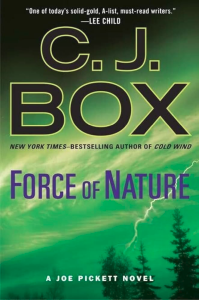
One of Joe Pickett’s few friends and allies is a federal fugitive named Nate Romanowski. To be fair, Joe didn’t know Nate was a fugitive when they became friends, only that he had a shady past as a member of a special forces team that Nate dropped out of society to escape from. Nate is the most interesting of Box’s characters: a former commando who has become a mountain man of sorts, someone given to sunbathing au natural when he’s not using his raptors to hunt. He’s previously alluded to being in touch with a compound in Idaho who we gather are anti-government types, but in Force of Nature the full story about Nate’s background and the incident that drove him from being a commando into becoming a libertarian one-with-nature come into play. Unfortunately, we learn the details as Nate is in a battle for his life against his former comrades, whose cruelty is as deep and vast as their government’s hubris – and they see nothing wrong with targeting people like Joe and his family who might flush Nate out of hiding.
Most of the books in the Pickett series have been serviceable as standalones, but this one is definitely more of a ‘series’ book: Joe nearly takes a back seat to Nate, who readers will know and appreciate because of how often he’s featured in the past. This is more of a suspense thriller than previous books, which generally included forensics and game-warden business. The action is driven by the looming showdown between Nate and his former group, who – he discovers – have been killing their way to him, disguising murders as accidents and using secret government means to squelch the news. Some of the suspense comes from the reader wondering what will happen and how the plot will pull Joe along for the ride, but more intense is the reader knowing or at least suspecting that the operatives have someone inside Joe or Nate’s trust circles who may ambush them at a critical moment. There’s also the fact that this trial is pushing Nate into harder and harder territory: the softer aspects of his character become overshadowed by the former operator, cold and calculating out of necessity. A philosophy of falconry comes into play, as well.
The ultimate revelation of Nate’s shadowy past was a surprise, and personally felt a bit underwhelming: I know if Box had it in mind from the beginning of the series, or if he decided to create it for this arc of the series, as it were. The book itself was not disappointing, though, with its emphasis on the Joe/Nate friendship, the compelling action, and the occasional splash of humor for relief. (At one point Joe’s new trainee asks at what point they’re going to do game warden stuff, a funny remark for readers who have read most of the series and realize how infrequently Joe appears to do his job when he is in Cowboy Detective mode.)
And now, I’m going to very hard to pause this series so I can focus on England, baseball, and grad school. I’m literally halfway through the series. I’m currently reading Paul Kingsnorth’s Real England: Battle against the Bland.
Today’s TTT is a nod to April Fools, so I’m going to spotlight some books I’ve tagged as humor. But first, teases!
In May 2013, The Guardian reported that a 60-year-old fisherman had died in Belarus after being bitten by a beaver that severed his femoral artery. Although the circumstances of this exceptional event are unclear, it is believed that he may have been drinking more than a little vodka before attempting to pick it up and kiss it. (Bringing Back the Beaver)
As we step out of our car to an empty parking lot, we are met by the local guides and the factory manager. It’s then that Older Handler tells me the shocking news: A mere five minutes earlier, the factory unexpectedly lost power, forcing it to close and send all 5,000 employees home. We will still be allowed inside, but there will be no people to see and nothing working. A group of Brits who happen to be visiting the factory at the same time seem to enjoy peppering their handlers with questions they must know will result in inane answers: BRIT: So, all 5,000 people have just left the building five minutes ago and gone home then, or are they all waiting in the lunchroom for the power to come back on? LOCAL GUIDE: Yes. (My Holiday in North Korea, Wendy Simmons)
(3) The Best Cook in the World. My introduction to Bragg’s writing, ruminating on his mother’s cooking traditions. She does not cook chitlins, he informs us, because she knows that God made them to do.
I perceived that his trouble was not physical, but mental. “Why do you want a raccoon coat?” “I should have known it,” he cried, pounding his temples. “I should have known they’d come back when the Charleston came back. Like a fool I spent all my money for textbooks, and now I can’t get a raccoon coat.” “Can you mean,” I said incredulously, “that people are actually wearing raccoon coats again?” “All the Big Men on Campus are wearing them. Where’ve you been?” “In the library,” I said, naming a place not frequented by Big Men on Campus.
5. Anything by PG Wodehouse. I’ve said it before and I’ll say it again, you don’t know how fun the English language can be unless you’ve experienced Wodehouse.
“I can never forget Augustus, but my love for him is dead. I will be your wife.” Well, one has to be civil. “Right ho,” I said. “Thanks awfully.”
For my tenth birthday, Pop presented me with a Remington 12-gauge pump. “This gun right here can kill a grown man,” he said, which made it sound like we’d been trying to kill grown men for many years without success.
Boredom, I knew, was a dangerous thing. For some children, it led to experiments with sex, and drugs, and alcohol, and lighting one another on fire, sometimes with the alcohol. For some of us, the never-ending rural ennui led to destructive habits with literature.
9. Most anything by Sean Dietrich, but keep in mind with him that humor and tragedy go together like the strokes of a bicycle. From Kinfolk:
The two deputies looked at each other. “Anything you can tell us might be helpful,” said Burke. “Okay. Deer mice are the most common mammal in North America.”
10. The Old Man and the Boy, Robert Ruark. One of my very favorite books; it’s a fictionalized collection of Ruark’s memories growing up in the 1920s, mentored by his grandfather. The stories are superficially about hunting, fishing, or generally running around outdoors, but the Old Man is always teaching lessons, often in a funny-grump manner.
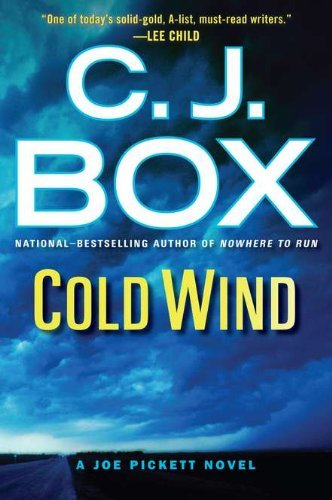
Joe Pickett, Game Warden, is not a fan of his mother-in-law, but he wouldn’t figure her for murder. One morning while making his rounds and checking herds, he notices something odd about the wind turbines being installed on the far ridges of Mommy Dearest’s property: one of them has a body attached to it, that of her latest husband. Missy is soon clapped in irons by the swaggering Sheriff McClanahan, but there’s something odd and improbable about all this. So, Joe takes off his Game Warden hat and puts on his private investigator hat and goes to work. At the same time, Nate Romanowski, the wild man with a secret commando past, thinks he is being hunted by some of his former colleagues, especially after a personal tragedy befalls him and he begins looking for blood. These two cases, intriguingly, aren’t as separate as they seem. Cold Wind is a fun Pickett mystery-thriller, though largely removed from outdoors action.
Missy, the mother-in-law, has been a thorn in Joe’s side for the entire series: she is an ambitious human predator, always sizing up men to see if it’s possible for her to dump her current husband and marry into a better clas, and through her social and business machinations she’s made herself the queen of quite the little empire — even calling herself Duchess Alden from time to time. Even before she was a land magnate, she looked down imperiously on Joe, declaring that her brilliant daughter deserved more than marriage to a ‘park ranger’. Whatever their differences, though, Joe has no interest in seeing his girls’ grandmother imprisoned, especially after his initial investigation indicates that Earl Alden, the deceased, was up to all kinds of speculation and fraud that might’ve made him the target of hundreds of people. Along the way readers are treated to a discussion of wind turbine politics and economics in Box’s customary from-both-sides fashion. The ending was unusual and a bit of a surprise, but compelling all the same.
I’ve already started the next book, where it looks like the Romanowski thread from this book will loom front and center.
Well, there’s no doubt about what March will be remembered for: my discovering CJ Box’s “Joe Pickett” series and instantly becoming hooked on it. I started the month in a mild funk, burned out a little by some of the nonfiction I’d been reading, and roaming the wildlands of Wyoming with Joe and his horse was just the ticket. After reading the first book, I just couldn’t stop — something I think has only happened with two other authors, Isaac Asimov and Bernard Cornwell. They just happen to be my two most-read authors. The Pickett obsession bled over into electronic entertainment, as I also watched the first season of Joe Pickett on Paramount Plus. Since I didn’t do much anything in any of my challenges this month, and I didn’t do a lot of movies, I’m going to include Moviewatch in this post. Reviews for another Box book and The Innovators to come today or tomorrow if I have power. I’m also posting this early, because — not to sound like I’m repeating myself — but we’re in for another night and day of potential tornadoes. Schools across the state closing in anticipation. Ah, spring.
Coming up in April
April is always Read of England here at Reading Freely, a celebration of English history and literature. I’m staring down the barrel of a finals project, though, so I sadly expect this one to be a bit muted. (Plus, there will be competition from Box and baseball. Is there such a thing as a British cowboy? ‘I say old boy, this is a bit of a sticky wicket, but I think if you ride on and cut them off at the pass, we’ll have them nicked!”) I do have a read in progress, though, and I’m hoping I can use it as a science read.
Moviewatch: March 2025
I Saw the Light, 2015. Hank Williams biopic. I enjoyed the movie well enough but not nearly as much as the Johnny Cash biopic I Walk the Line. Hiddlleson’s acting was great, I just didn’t get into the story.
It Happens Every Spring, 1949. A baseball crashing into a chemistry set creates a new substance, and the unwitting creator goes pro, playing for St. Louis so he can do some fund-raising and marry his girl.
The Conversation, 1974. It has Gene Hackman: he’s a private investigator whose audio surveillance hears something more serious than he bargained for, and he’s thrust into a moral quandry.
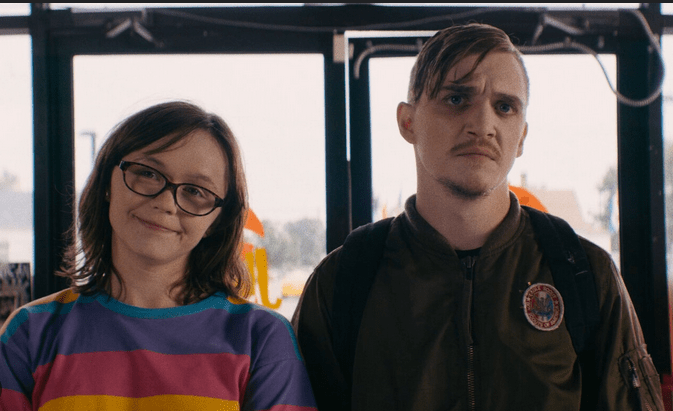
Dinner in America, a….comedy-drama-romance from 2022 about a criminal punk rocker in the mid-eighties (based on tech and the mention of the DARE program) who is saved from the police by an awkward store clerk. He uses her for shelter but then discovers her to be a really promising punk songwriter. Also? She happens to be a HUGE fan of his band and his stage persona. John Q, though she doesn’t realize this moody abusive dude she just let into her life is him. The rocker is an unlikable jerk for most of the film, but the relationship is believable and I liked seeing the awkward girl blossom into a confident songwriter. The picture above links to a song the two of them compose together; it’s an absolute ear-worm, but the refrain is obscene.
Rule Breakers, 2025, about a group of four Afghan teenage girls who overcome cultural pressure, financial difficulties, and their own self-doubts to begin competing with teenagers across the world in robotics competitions. Based in some degree on a true story; beautiful music, solid acting, satisfying ending.
Quadrophenia, 1979. Rock opera about some doofuses wearing suits and scooters (“Mods”) improbably beating up a bunch of Rockers on proper bikes in the 1960s. Music by The Who.
The Straight Story, 1999. Excellent film about an old retired farmer who, upon learning his brother had a stroke, decides their ten-year silence after a bitter argument needs to be ended. Since he is old and prideful, he decides to visit said brother on….a lawnmower. Phenom acting.
10 Cloverfield Lane. Horror-suspense film. A young woman is hit in a car wreck and wakes up chained in a basement, and soon meets her captor, John Goodman, who alleges that the United States has been attacked and that the outside air is now toxic. Although she’s dubious and tries to escape, she becomes convinced after seeing evidence of an attack outside – but that doesn’t mean Goodman’s character still isn’t unhinged and and dangerous. Very effective.
All About Eve, 1950. A young woman who loves the The Theater lands a job helping her idol, a Betty Davis who has just turned 40 and is insecure about her future in The Theater. (“The Theater” is pronounced with audible capital letters in this book: it’s set during a time when the stage was still king and Hollywood was something thespians looked down on.) Fascinating character study, both Davis’ struggle to work out her feelings toward the future, and the ingenue (Anne Baxter)’s rise to fame and what she’s willing to do to achieve it. Interestingly, the musical theme reminded me and my movie buddy strongly of a theme used in Gone with the Wind, and I wondered — given that Davis and Baxter’s careers are both tied to the role of a southern belle in a play, and given Baxter’s combination of innocent charm and cold-blooded machinations — if it wasn’t a reference to Scarlett O’Hara herself.
WHAT is the last thing you finished reading? Images of America: Fenway Park, various authors.
WHAT are you reading now? The Innovaters, Walter Isaacson; Fenway 1912, Glenn Stout; and Cold Wind, CJ box.
WHAT are you reading next? I’m focusing my attention on Isaacson because we’re discussing the book in class on Thursday, and then after that I’ll probably finish Cold Wind because I’m at third of the way through it despite saying I was going to resist Joe Pickett until I was done with class.
Today’s prompt from Long & Short Reviews is “favorite comfort foods”. Chili would be number one, of course: when it’s fall or winter I can eat chili all day long. Sweet potatoes are another favorite, as is blackberry cobbler. Fried okra and fried green tomatoes are summer go-tos, though the green tomatoes need to be cooked right out of the garden: out of season FGT’s do not fly.
On a side note, I am in Birmingham today, having driven here last night to attend a screening of a documentary series about totalitarianism in Eastern Europe based in part on Rod Dreher’s book, Live Not by Lies. I’m going to do a proper write-up about it, but I’m writing this at 10 pm on Tuesday night and will be spending a full day tomorrow with the ladyfriend, visiting botanical gardens and American Village and all sorts of fun things, so I will probably be tardy in replying to comments.
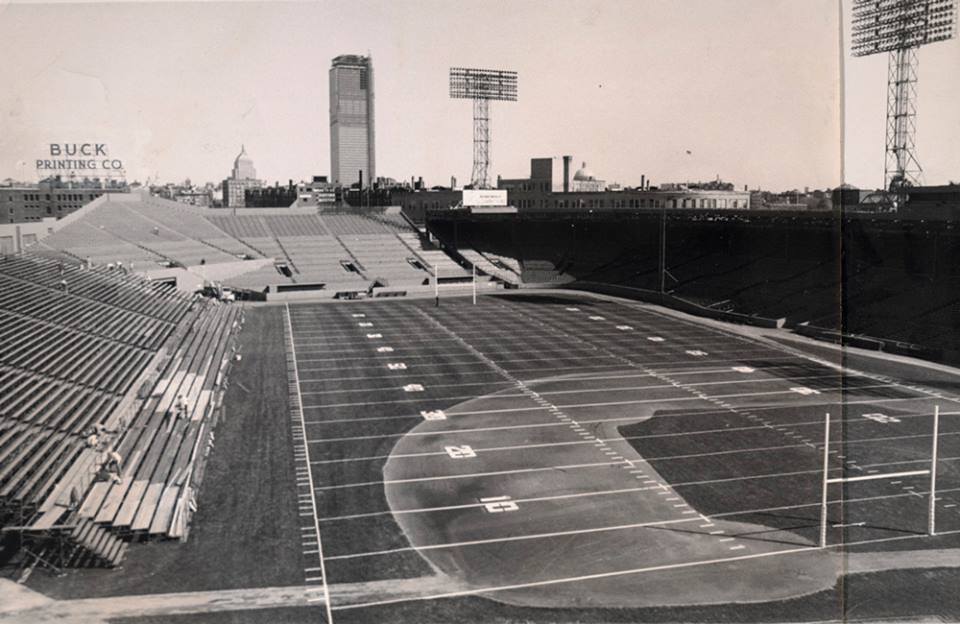
I’ve read three previous entries in the Images of America cities, but this is the first that takes me out of state, deep into the heart of Yankeedom: Boston’s own Fenway Park, home of the Red Sox. Fenway is the oldest continually-operating major league ballpark in the nation, though Birmingham’s Rickwood Field (older by two years) is used by a minor-league team at least once a year when the Barons play a game there in honor of their Negro League namesakes. As a Red Sox fan I’m familiar with Fenway, of course, despite having never been: it features prominently in my gallery of rotating PC wallpapers, and has had a lock on my Pixel’s wallpaper for two years. Even so, this slim photo-history of the park served up surprise after surprise. I had no idea that Fenway was used by the Boston Braves (later the Atlanta Braves), as well, or that it hosted numerous football teams, including the Patriots as well as another set of Boston Braves who later became the Washington Redskins. A soccer club also called Fenway home for a few seasons. Evidently the mid-century fad of building stadiums that could accommodate multiple sports was not sui generis. Fenway has been renovated several times over the last century, of course, the most notable alteration being the arrival of the “Green Monster”. There were other changes I’d forgotten about or never heard of, like the removal of a grassy mound in one corner of the field that was known as “Duffy’s Cliff” because of an outfielder’s ability to race up it in pursuit of hit balls. There are a lot of player shots here, both posed and in-game action. One interesting one is Babe Ruth being carried off the field in his Yankee colors, having succumbed to muscle cramps, and another of two Red Sox players during World War 2 visiting their team on leave and watching the Sox beat the Yankees while in full Army uniform. I have a full history of Fenway I’m going to read next.
Today’s TTT is about DNF’s, but I don’t DNF that often and am going to share the last ten books I ordered a Kindle preview for, instead. But first, the Tuesday tease!
“Please remove your weapon. Civilized people don’t eat breakfast wearing guns.”
COLD WIND, CJ Box
However, during the visit she began to suspect that her husband’s friendship with Augusta went beyond the fraternal, especially after he lay on a sofa and asked them both to take turns kissing him. The marriage started to unravel. THE INNOVATORS, Walter Isaacson.
Cavalry: A Global History, Jeremy Black
India’s War: World War II and the Making of Modern South Asia, Srinath Raghavan
Semiosis, Sue Burke. I….don’t even remember what inspired this one. It’s a SF title about humans settling on another planet and having to contend with plant intelligence. Possibly linked to that book on plant intelligence I read a few weeks back.
A Burning: A Novel. Megha Majumdar. Not sure where this one came from. A novel about social stratification and political violence in India.
Growth of the Soil, Knut Hamsun. I forget what inspired this one, too, but Wikipedia says it’s about a man repulsed by modernity and drawn toward primitivism, so I’d lay odds it was inspired by Kingsnorth.
Voices of Protest: Huey Long, Father Coughlin, and the Great Depression, Alan Brinkey.
The Impossible Community: Realizing Communitarian Anarchism, John P. Clark
We Who Wrestle with God, Jordan Peterson
The Night Watchman, Louise Erdrich. A novel about a man who inspired native Americans to resist “Indian termination policies of the 1940s-1960s”.
Orthodox Worship: A Living Continuity with the Synagogue, the Temple, and the Early Church. Benjamin Williams
Warning: this review contains partial spoilers for Winterkill and Below Zero.
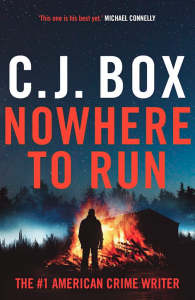
Joe Pickett is finally about to go home to Saddlestring after an exile in Baggs, where the governor sent him to keep a low profile – but there’s something odd going on on the mountain, and Joe wants to get to the bottom of it before he turns in his keys and it becomes someone else’s problem. During the investigation, Joe loses both of his horses and very nearly his life to a set of twins with the last name Grim, and despite barely getting away he wakes in a hospital to find that no one believes his story, especially the bit about seeing a young woman with the twins who matched the description of a missing Olympic athlete. There’s no dead horses on the mountain, no burned-out cabin, nothing to corroborate his report of the last few days. When Joe arrives home to Marybeth, she can see that look in his eye, his desire to return to the mountain with Nate and find the men who attacked him – and bring them to justice, western or otherwise. She begs him to resist the urge, though, for his family: their foster daughter April has returned, but after kidnapping and six years spent bouncing around an unofficial foster system, she’s not the girl she once was – even without puberty aggravating her hostility to those around her. Although Joe makes his promise, another mother arrives at his door weeping and asking for help: the missing Olympian is her daughter, and this is the first lead that’s surfaced in months. What’s more, the governor’s people heard Joe’s testimony and it’s brought up connections to a pair of brothers involved in a politically explosive issue a few years back, and he wants Joe to follow up. Fortunately, Joe is going up the mountain again with Nate, his fugitive outlaw buddy who is both a skilled outdoorsman and a man fearsome in combat.
Nowhere to Run is a return to the real outdoors action that Below Zero’s helicopter antics and power plant showdowns took us away from, putting Joe in such isolation that he’s often in a state of cold dread. Despite the claims of one local who caught sight of them, the men are not ‘Wendigos’, or malevolent spirits; they’re men, men who obviously know how to survive in the mountains despite the best attempts of Wyoming blizzards, encroaching hunters, and the most dangerous of them all: Government Men. Although Joe can appreciate someone wanting to be left alone, and earnestly working to achieve it, he’s the game warden, by gosh, and those men were fishing without a license and harvesting other people’s elk. (Also, they shot his horses, and even a cranky libertarian like myself would be out for blood.) Plus there’s the mystery of the woman, and Joe’s own desire to come back with his head held high. Joe is no Walker, Texas Ranger type fella: he’s an average Joe who’s a poor pistol shot and someone who has been on the losing end of a fight more than one occasions in these books. He doesn’t like waking up in a hospital room with a sneering sheriff mocking his story about two mountain men and a girl on the mountain, so pride joins duty to bring him into the dark forest and the rough slopes of the forest.
I don’t want to say too much about the plot because of spoilers, but the west’s attraction to people who want to drop out of society and escape the grasping fingers of The Man is well on display here. The brothers are even more intense in their hatred of the government than the survivalists of Winterkill: they embody the philosophy of VONU, or structuring one’s life to be ungovernable by dropping out of society all together. There’s some discussion of Ayn Rand in this, though it’s so cursory that I don’t think Box has read her, and it’s almost completely removed from the terror-twins. The drama is all around good here: the suspense & thriller aspects of it are on point, and I liked the conflict between Joe and Nate arising from their shared attitudes toward the state.
Okay, now I seriously need to commit to The Innovators because we’re discussing it in class Thursday. Fenway review will go up tomorrow, but I wanted Box to get all five of the “most recent posts” entries. Pretty sure that’s not happened since I binged the Series of Unfortunate Events back in 2009.
Quotes/Higlights:
He felt oddly disengaged, like he was watching a movie of a guy who looked a lot like him, but slower. It was as if it weren’t really him limping through the trees with holes in his leg and his best horse bleeding to death on the side of an unfamiliar mountain. Joe seemed to be floating above the treetops, between the crown of the pines and the sky, looking down at the man in the red shirt moving toward what any rational observer would view as certain death.
“The easiest way to eat crow is while it’s warm. The colder it gets, the harder it is to swaller.” Joe said, “It’s hard to believe the West was won with stupid sayings like that.”
“I feel like I died and went to heaven,” Farkus said. “I been hunting up here all my life just hoping to see something like this. D’you suppose she’s alone?” “Don’t let her see you,” Parnell said. “There’s something oddly sirenlike about this situation.” “Sirenlike?” Farkus said. “You talk in code, Parnell.” “Shut up, Dave,” Smith said. “You obviously don’t know your classics.”
“‘Murder’ is not the right word,” Coon interjected. “She was killed, yes. But it happened in a firefight at the Cline compound in the UP. There is some dispute whether she was killed by law enforcement or by her own family.” Nate said, “No, there isn’t.” He shook his head, said, “It always amuses me how a family home or small business suddenly becomes a ‘compound’ when you folks decide to attack it.”
Joe said, “You are a good man.” Coon smiled. “I’m a bad bureaucrat, though.” “That makes two of us.”
“Sheriff,” Joe said, “you’ve got an arrow sticking out of your butt.” “Why, thanks, Joe. I was wondering what it was bothering me back there.”
“We used to have a pretty good country. At least I think we did. Then something happened. It’s our fault ’cause we let it. We used to be a people who had a government,” he said, looking up, his eyes fierce again. “Now it’s the other way around.”
Warning: this review contains spoilers for Winterkill, #2 in the Joe Pickett series by CJ Box.
Joe Pickett is cooling his heels in the hind quarters of Wyoming, thanks to ….uh, well, let’s just say repeated acts of insubordination in pursuit of justice, like cold-cocking a petty traffic cop who was about to ruin a federal investigation by doing an extensive search of Joe’s truck (making him miss a one-in-a-lifetime contact with a confidential informant) and refusing to listen to reason. Joe’s staying busy, though, pursuing such miscreants like The Mad Archer, some nut who keeps going around shooting animals with a bow & arrow and leaving them to suffer. But then he gets a call from Marybeth: their daughter Sheridan is getting texts from…well, someone who died six years ago. Someone whose death haunts Joe and Marybeth to this day: their foster daughter April, who was kidnapped by her survivalist birth-mom and then killed when adrenaline-junky goonie boys with FBI badges decided to attack a community of anti-government types for camping for more than two weeks in a national park..Below Zero is an odd entry in the Pickett series, in part because it involves very little game-wardening: instead, when the texts between Sheridan and “April” indicate that she’s in the company of men who are committing a series of grievous crimes in the name of….uh, carbon….credits? …..Sheridan’s phone becomes a lynchpin that unites both Joe’s personal sense of duty with the state’s desire for justice vengeance, only with him trying to balance things so he knows more than they know so they don’t kill innocents in the pursuit of justice as the goonie boys are wont to do.
*sigh* Okay, so…..Below Zero has a title that has no connection to the plot whatsoever, a hook that is utterly compelling, and a general premise that performs about as well as a Ford Edsel. Imagine you have a Chicago criminal authority who, having been diagnosed with terminal cancer, decides he wants to do some good in the world, so he seeks out his estranged son who is an anti-CO2 jihadist and funds a road trip across America to …knock off people who are being very naughty and leaving Bigfoot-size carbon footprints, and he also takes a random girl he rescued from a brothel along. But since the girl is texting the daughter of a warden who is disturbed by the idea that his foster daughter he thought was dead is actually alive and riding shotgun for two criminals, the book turns into a big manhunt, culminating in helicopters and spray-and-pray-esque gunfights , along with the customary twist ending. The daughter connection is what makes this novel, because the criminals were both absurd and obnoxious, especially the jihadist who is such a whiny manchild I was hoping his father would go all Buford T. Justice on his petulant behind. I kept reading the book because the April premise was such a hook: otherwise, the criminals in this were completely ignnorable, positively absurd given Box’s previous abilities to deliver complex stories with criminals whose motives were understandable if not sympathetic. Still, I can’t deny that Box knows how to set and bait a hook, and the only reason I’m not reading the next one right now owes to graduate school.
Coming up, Fenway Pahk, because I did managed to read little nonfiction last week.