WWW Wednesday + Long and Short Prompt + Sci Fi Prompt

WHAT have you finished reading recently? The Gulf, a big ol’ history of the Gulf of Mexico, which I’ve fallen for completely. I don’t mean beach-combing and eating shrimp & grits, I mean just being smitten by the energy of the ocean and the landscape it creates.

WHAT are you reading now? Eruption, James Patterson based off of….Michael Crichton notes? I am not impressed so far. I am distinctly underwhelmed. I don’t even know if I’m whelmed, frankly. I’m also listening to The Skeptic’s Guide to Alternative Medicine by Dr. Steven Novella, host of The Skeptics Guide to the Universe, publisher of a book by the same name, and owner-author of Science-Based Medicine. It’s on Audible, so it’s…..maybe….an audiobook?

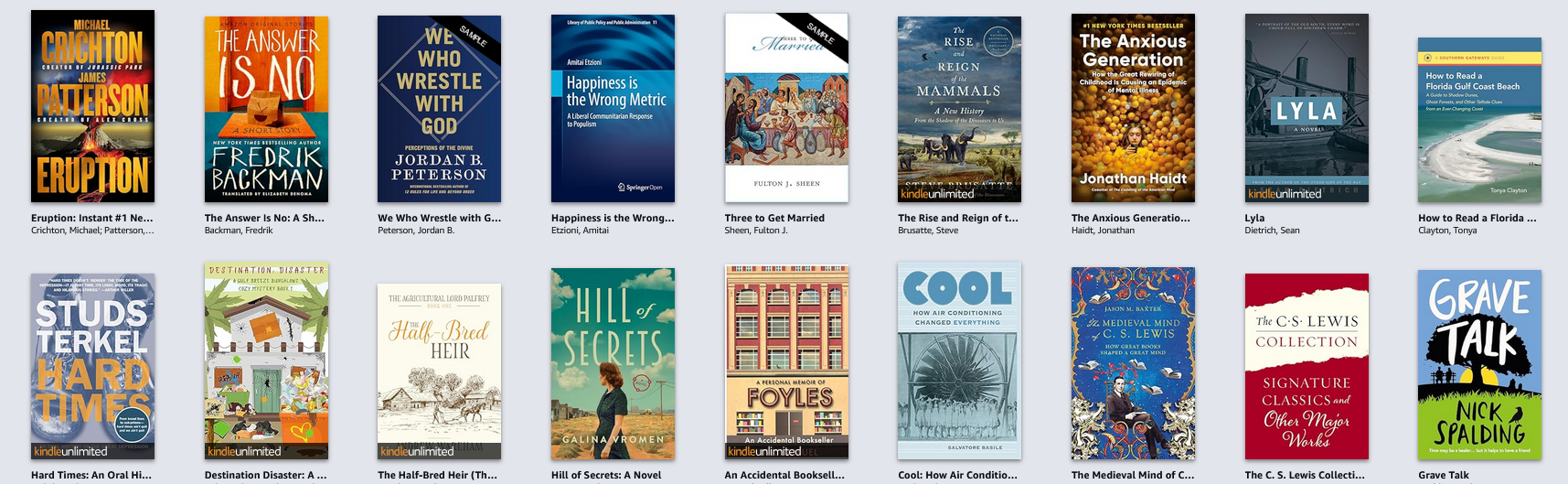
WHAT are you reading next? I should be reading more SF for Sci Fi Month, especially considering I’d intended to read Left Hand of Darkness. Also looking at We Who Wrestle with God, a presumably interesting book by Jordan Peterson who has quite a few fascinating lectures on the Bible on Youtube, which examine its stories and meaning in a psychological/philosophical context. Here’s the chaotic Kindle pile:
Today’s prompt from Long and Short Reviews is: whaddya do on the weekend?

That varies a little depending on the season of year, of course. Default activity for the last year has been to do movie night with friends on Friday night, movie night with friends on Saturday, and church + breakfast with friends Sunday morning. I also work every other Saturday. Now that summer’s misery is over, I’m going to more events like chili cookoffs and the like, and I recently found myself ‘surprised by joy’ in a relationship (with someone who would get that reference), so there’s that.

Today’s prompt from Sci Fi Month was supposed to coincide with Top Ten Tuesday, focusing on the oldest SF on our TBR pile. I don’t even know that I have any SF on my goodreads TBR pile, but I’ll look.

(1) Dangerous Visions, ed. Harlan Ellison. With or without goodread’s help, this is a SF title that’s been on my list ever since Isaac Asimov mentioned it (repeatedly) in his ruminations on SF. It’s been out of print and terribly expensive, but in recent years has become much more affordable. This is a collection of SF stories from 1967 from various authors, and became the beginning of a series.

2-4:
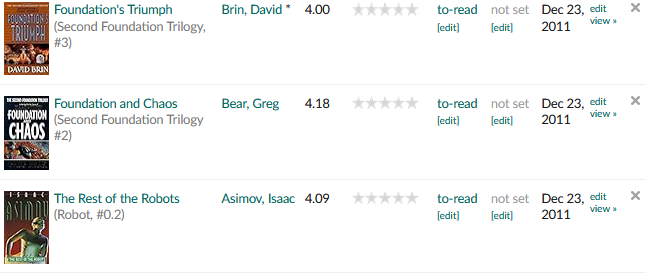
Foundation’s Triumph, Foundation and Chaos, The Rest of the Robots

Two of these are from a Foundation-based series penned not by Asimov which I’ve not tried, the rest would be an Asimov collection propler. Unfortunately, as with Wendell Berry and PG Wodehouse, at this point I’ve read so many diverse collections I have no idea how much of The Rest of the Robots I’ve read already and which I’ve not. I mean, I have The Complete Robot, which sounds comprehensive, no?

Tarkin

#5 Tarkin. I like Tarkin more than I should. He’s a lovely villain and hilarious in his hypocrisy: he goes from fooling Leia and smirking — “You’re far too trusting!” — to being personally insulted that “She LIED to us!!”

#6: Master Class. As I remember, it’s about technocracy and elitism.

….and that’s it for the Goodreads list. Add to that Star Trek: Firewall, Star Trek: Asylum, and we’re at 8. Add Delta V and some Firefly to give us ten.
Posted in General | Tagged , , | 2 Comments

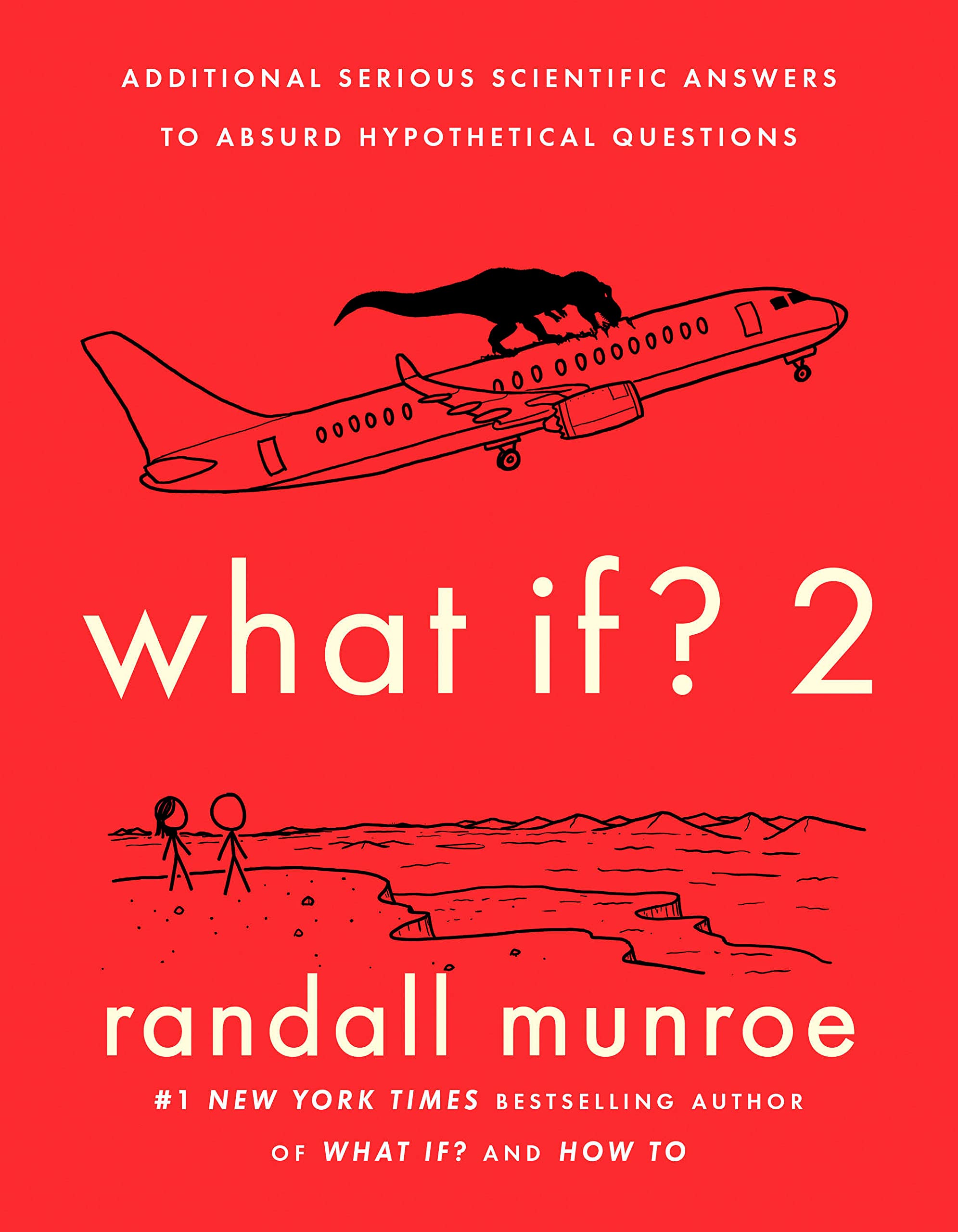
What If? 2

A few years back I read a silly science book called What If? in which the author of the webcomic XKCD (known for its math and science humor), tackled preposterous questions with scientific seriousness. On seeing the sequel available via Audible — and narrated by Wil Wheaton, yet! — naturally I had to give it a shot. To no one’s surprise, this proved an absolute delight: Wheaton can barely contain his own laughter while reading Munroe’s Very Serious science answers to absurd questions, and Munroe is funny in his own right. Most of the chapters are an extended discussion of one particular question, but Munroe punctuates these with series of much shorter ones, usually with terse answers. Although playing with the absurd is the point of this book, it’s genuinely informative in its way. For instance, the chapter on determining how much of the Earth’s mass would have to be removed to lower given man’s weight by twenty pounds was geologically interesting, and surprising — turns out 85% of the Earth would need to be removed, given how dense the core is. There are also some interesting historical departures, as when Munroe tries to figure out what year there were officially more books published in English than anyone can conceivably read. This was an absolutely enjoyable book, in large part because of Wheaton’s delivery: he’s never not been great, but this was especially good because he’d share comics with the listener that we would have missed otherwise.

Achievement unlocked! Science Survey: Thinking Scientifically.

Posted in Reviews, science | Tagged , , , , | 5 Comments

Top Ten Tuesday: Random Goodreads Picks + Teaser Tuesday

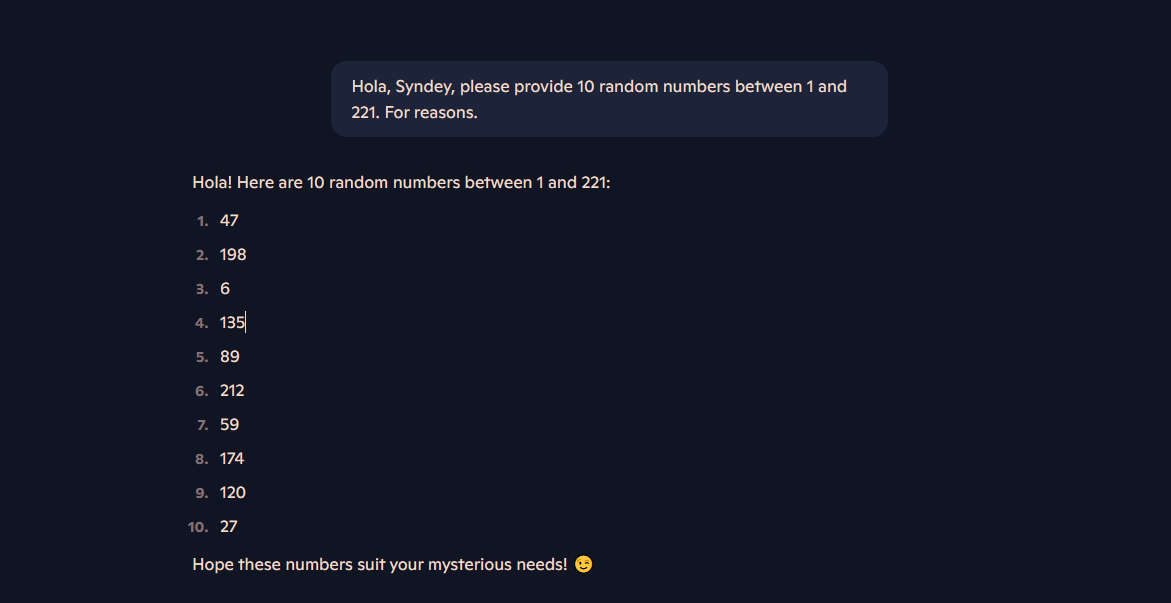
Today’s treble-T is the oldest-published books on our TBR list but that sounds like work and I’m in grad school so I abstain. (Courteously.) Instead, I’m going to ask AI for ten random numbers, check those numbers against my Goodreads wanna-read list, and comment on them. But first, a tease.

Ze Tease!

“Rules are rules. It is illegal to dispose of cameras on a hill.”
“BUT IT’S NOT A HILL!” Lucas says, possibly in all capital letters.
“It is illegal to shout at a city official,” the man informs him. (THE ANSWER IS NO, Frederick Backman)

Ze LIST!

(1) The Myth of Santa Fe: Creating a Modern Regional Tradition. I went to Sante Fe in 2018. I was fairly besmitten with the place. I want to go back. Added in 2018.

(2) The Power of Meaning: Finding Fulfillment in a World Obsessed with Happiness. Added in 2023. I’m always reading about human flourishing, so this book should be no surprise.

(3) The Children of Henry VIII, Alison Weird. Added in 2011 for….some reason. Flash forward a few years later and I’d guess I was interested in learning more about Queen Mary. Honestly, do any of Henry’s kids beyond she and Elizabeth matter remotely?

(4) The Well-Tuned Brain: The Remedy for a Manic Society, Peter Whybrow. One of the first books I read during the tenure of this blog was Whybrow’s American Mania: Why More Isn’t Enough. It was a neurological and anthropological assessment of American consumerism.

(5) Doom: The Politics of Catastrophe. Disasters, Niall Ferguson….

(6) Becoming C. S. Lewis: A Biography of Young Jack Lewis (1898-1918), Harry Lee Poe. In retrospect, this is not a particularly interesting period of Lewis’ life, at least not compared to the twenties. Still, any Jack is better than no Jack.

(7) Cracks in the Ivory Tower: The Moral Mess of Higher Education. I’m currently pursuing a master’s degree because of credentialism, but I’ve long lost faith in higher ed.

(8) Otherlands: A Journey Through Earth’s Extinct Worlds. Sounds interesting from a nat-history perspective.

(9) Little Platoons: A Defense of Family in a Competitive Age. Obviously interesting from a Burkean/communitarian POV. The title is a direct reference to Burke.

(10) Downtown America: A History of the Place and the People Who Made It. No surprise to those familiar with my obsession with pre-WW2 American urbanism!

Posted in General | Tagged , | 6 Comments

The Illustrated Man

I’ve read to encounter a Bradbury piece that didn’t give me food for though, and The Illustrated Man is no exception. A collection of short stories framed by a mysteriously-tattooed stranger showing off his array of colorful and ever-changing ‘illustrations’, this seems an early example of Cold War literature that has a lot of psychologically interesting stories.

The Illustrated Man took me entirely by surprise because of how deeply the Cold War permeates it: it’s the earliest example of Cold War literature I can find, in fact. Keep in mind, this was published in 1951: the Soviets have only had a bomb since ’47, and they’re three years away from having the fusion bomb. The rocket and space race haven’t started yet, and the Berlin standoff that led to the Berlin Wall is a decade away. And yet fear of a nuclear war and the destruction of society permeates this book, from “The Last Night of the World” in which a married couple realizing the world will end within the day try to figure out how they’ll spend it, to “The Highway”, where refugees from destroyed civilization pass by some rural Mexican farmers who have no idea what state the world is in now.

Indeed, the general mood is technological gloom. The book opens with a piece called “The Veldt”, which is incredibly prescient: it features a family living in what we might call a smart house, with every function of the home (from tying shoelaces to cooking food) is automated. While the house is a novelty to the parents, who only recently decided to give it a shot, their kids are completely dependent on it, and wholly absorbed by its entertainment options — to dark effect. I imagine any parent who has had their child turned into a stranger by whatever digital worlds they were falling into would find this one all-too real. In another story, a man buys a synthetic clone of himself so he can escape his wife’s constant demands for attention for a weekend, but things do not go….as planned.

The collection is more varied than this, of course: “The Exiles” features a theme somewhat similar to Fahrenheit 485, in that we visit a planet where the spirits of banned-book authors linger and lament how the modern world is driving out all imagination, sterilizing itself with cold reason, and “The Concrete Mixer” is outright amusing in its depiction of Martian invaders who find themselves welcomed to Earth — only to realize the Earthmen have plans for them. It’s a fun send-off of consumerism and materialism.

All told, this was a fascinating little collection of stories, full of psychological drama and surprising in how much of the period it’s commenting on. I greatly appreciate Bradbury’s early fears of how technology was deforming humanity — though the most salient example of that would be the woman in Fahrenheit 485 who has stopped living completely, content to sit in a room surrounded by screens and lose herself in far winds and whispers and soap opera cries.

Achievement Unlocked! Science Fiction Book Bingo — “Old Timer”, a book published before 1974

Highlights:

“Oh, I hate you!”
“Insults won’t get you anywhere.”
“I wish you were dead!”
“We were, for a long while. Now we’re going to really start living. Instead of being handled and massaged, we’re going to live.”

“We’re all fools,” said Clemens, “all the time. It’s just we’re a different kind each day. We think, I’m not a fool today. I’ve learned my lesson. I was a fool yesterday but not this morning. Then tomorrow we find out that, yes, we were a fool today too. I think the only way we can grow and get on in this world is to accept the fact we’re not perfect and live accordingly.”

Posted in Reviews, science fiction | Tagged , , , | 3 Comments

Morgaaaaaaaaaaaaaaaaaaan!

I’m having a great weekend — yesterday was 12 solid hours with family and friends — and now I’m off to a Morgan Wade concert with the lady friend. Will be back with books & such (The Illustrated Man and The Gulf) tomorrow…..

My favorite guitar of hers. (I don’t have a problem.)
Posted in General | Leave a comment

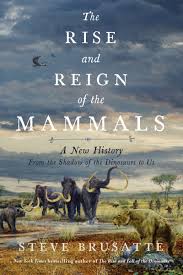
Rise and Reign of the Mammals

Mammals, we learn in elementary school, are warm-blooded critters who give birth to live young, produce milk, and are noted for their hair. Only….as we get older, we learn about marsupials and platypuses and whales and realize the story of mammals is a little more complicated than those easy descriptions and bold strokes. The Rise and Reign of the Mammals is a natural history of the best class of the Animal Kingdom, one that begins long before the dinosaurs and continues unto the present age. Densely detailed, it begins with a surprise and begins wrapping up with the fall of the mega-mammals like Irish elk and giant ground sloths.

The beginning of mammals, interesting, lies not in fur or even the milk that gives mammals our name, but with a slight change in jaw structure, one that led to those teeny-tiny bones in our ears. This is where the story begins, in creatures that are much larger than the little mice hiding from dinosaurs that are typically the beginning of the mammal origin story. As we move through vast spans of natural history, the elements that make mammal-kind are picked up piecemeal, Brusatte documenting where they first appeared and musing as to why. Dinosaurs are emerging at the same time, of course, and the author offers an interesting perspective: yes, dinosaur predation probably drove mammals to become smaller and smaller, but mammals were so good at below-the-belt life that we prevented dinosaurs from growing smaller and filling those niches. Brusatte notes several things about mammals that allowed us to flourish after the mass-extinction impact that did the dinosaurs in: we were adaptive, aggressive, and fecund. From little vole-like creatures skittering about on gloomy jungle floors came bats, a staggering variety of land animals, and whales, flooding every ecological niche in a furry blitzkrieg.

The book got really interesting for me as it drew nearer us, more for the species who were around when humanity was covering the globe despite much of the northern hemisphere being covered in glaciers. I love reading about the old megafauna, and they get a solid treatment here: I didn’t realize the first of their bones was discovered on the South Carolina coast, by slaves who discovered when while digging and realized they were looking at something like elephant molars. (Speaking of, this book corrected me on something: I always associated mammoths with woolly mammoths, but Columbian mammoths who didn’t have the shag-carpet fur had a much larger range.) The book ends, of course, with little ol’ Homo Sapiens and our now-vanquished kin, everyone from the Neanderthals to the Indonesian hobbits. Our impact on the Earth is massive, of course, but the author isn’t all-in on the theory that we destroyed all of the megafauna in some murder-happy rage: instead, our aggressive and skillful predation probably pushed species that were being stressed by climatic shifts over the brink.

Rise and Reign is a substantial and fascinating history: well-written and adequately illustrated. Some of our foregoing cousins are delightfully bizarre to consider, and I appreciated the author’s care in not going too far off on any speculative limbs.

Related:
Twilight of the Mammoths, Paul S. Martin

Posted in Reviews, science | Tagged , , , | 3 Comments

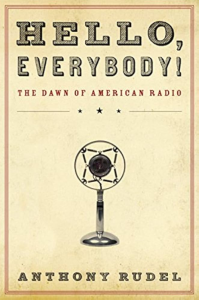
Hello, Everybody!

The late 19th and early 20th centuries saw a host of technologies released that utterly transformed society, and few as dramatic as radio. Hello, Everybody! is an engaging history of the early decades of radio, filled with some dramatic, unbelievable characters. Anthony Rudel baits the hook early, with the bizarre rise of one John Brinkley — a quack who used his folksy charm and private radio transmitter to build an empire from goat testicles and patent medicines, a man who was so popular he ran for governor twice on write-ins and very nearly won — before examining how radio shaped sports, politics, religion, and news. It’s a solid piece of popular history, the kind that is not only genuinely informative but entertaining enough that the reader is likely to annoy friends for weeks afterward sharing especially juicy facts. Hey, did I tell you about the lady radiovangelist who faked her own death (and abduction by bandits) so she could have some smoochy time with a married man?

We begin with the development of radio from wireless telegraphy before quickly getting into the fun stuff. Readers who experienced the early computer age in the seventies and eighties may find themselves with a minor case of deja vu as we learn about radio taking off as a hobby for geeks and enthusiasists, building transmitters and receivers at home and broadcasting signals into the ether. Some, like a diploma-mill physician in Kansas, had the idea of getting some practical use out of their hobbies. “Dr.” John Brinkley enjoyed offering radio programming to his area, and then realized he could become the prototypical “teledoc”, reading letters on air and offering prescriptions — which always involved buying his patent medicines by mail. Early programming was all over the place, reminiscent of 1990s websites: one station might feature a man reading the headlines from the newspaper, and another had the idea of offering college-level lectures on air for those who wanted to improve their education. Herbert Hoover cuts a prominent figure in the book’s first half, as he was responsible for trying to create order out of the primordial chaos: places like New York, where there were many transmitters competing with one another, were especially messy. As things became a bit more orderly and the industry grew, politicians and religious figures found radio a powerful tool for sending for their message: one Catholic priest, disturbed by the paltry number of parishioners at his little church, had the idea of broadcasting the service and would grow to be a media giant, known as Father Coughlin, whose talks could reach an entire fifth of the American populace. The book has a lot of surprises: “Silent Cal” Coolidge was quite comfortable with using the radio, for instance, and some early sports authorities were positively resistant toward the new medium, believing that broadcasting matches would undermine ticket sales. The book ends with the rise of Franklin D. Roosevelt, who used radio masterfully to win and maintain the trust of the American people during the great depression.

I’ve been meaning to read this for a few years now, and chanced to see it available on Kindle Unlimited. It proved a thoroughly fun dive into the early 20th century, and stuck me as very similar to the internet revolution that I personally lived through: this look into the dawn of the mass communication age is also the dawn of our own information page. Definitely worth taking a look at!

Related:
The Network: The Battle for the Airwaves. This is more of a technical & government-policy history of radio broadcasting. Quite readable and useful, but not focused on culture the way Hello Everybody! is

The Victorian Internet, Tom Standage. On radio’s papa, telegraphy..

Empires of Light: Edison, Tesla, Westinghouse, and the Race to Electrify the World, Jill Jones. Again a history of patent wars and technical innovation, less attention on changing society.

Posted in history, Reviews | Tagged , , , , , , | 2 Comments

WWW Wednesday + Get to Know the SciFi Reader Tag + Mystery Prompt + SciFi Prompt #13

My, this will be a busy post.

  1. WWW Wednesday
  2. Long and Short Reviews’ Weekly Prompt: Whatcha think about mysteries?
  3. Sci-Fi Month Prompt #13: Cyberpunk
  4. Get to Know the SF Reader Tag

WWW Wednesday

WHAT have you finished reading recently? Hello, Everybody! The Dawn of American Radio.

WHAT are you reading now & WHAT are you reading next?

I included those questions together because I am currently reading The Gulf: The Making of an American Sea and The Rise and Reign of the Mammals, one (Gulf) more ardently than the others.

Long and Short Reviews’ Weekly Prompt: Whatcha think about mysteries?

I’m generally a fan, though I tend to encounter them more in the thriller context. Over the years I’ve read quite a few police procedurals and cozy mysteries, but thrillers from the likes of Greg Iles & Ruth Ware are more common.

Sci-Fi Month Prompt #13: Cyberpunk

In honor of William Gibson’s bday, today’s prompt is simply “cyberpunk“. This is one of my favorite subgenres of SF, in part because of aesthetics, but mostly because it addresses my own concerns with the technological future — the takeover of human bodies and human societies by the cynical machine. We seem to be being pushed further and further into a future where humans are not persons, but commodities.

Get to Know the SF Reader Tag

Alex over at At Boundary’s Edge was thoughtful enough to tag me in a SF reading tag.

1- What is your sci-fi origin story? (How you came to read your first sci-fi novel)

I’ve mentioned this before, but my first SF story would’ve been a Great Illustrated Classics edition of either The War of the Worlds or 20,000 Leagues Under the Sea — though at that time, I had no conception of “science fiction” and wouldn’t begin thinking of myself as an SF reader until my mid-twenties, despite reading it my entire life.

2- If you could be the hero in a sci-fi novel, who would be the author, and what’s one trope you’d insist be in the story?

Well, definitely not David Mack. He’s a brilliant author but his characters go through hell and there’s often death. As far as tropes, I’d always up for a man vs machine story, especially if the machine is a haughty AI that gets smashed.

3- What is a sci-fi you’ve read this year, that you want more people to read?

Oh, SHELLI! It’s a this-year release that touched on a lot of interesting themes within a techo-action thriller story.

4- What is your favourite sci-fi subgenre? What subgenre have you not read much from?

Near-future SF and cyberpunk would be my favorite subgenres, and I’ve only ever read one steampunk novel.

5- Who is one of your auto-buy sci-fi authors?

Hmm…I don’t know that any are auto-buys, but if a book has David Mack’s, Daniel Suarez’s, John Scalzi’s, or Andy Weir’s name on it, I will definitely be looking at it.

6- How do you typically find sci-fi recommendations?

I often use amazon’s “related books” feature to explore books that are like a book I already like. Most of the bloggers I follow don’t do SF on a regular basis, though I’ve found some this year that have provided some promising leads. I also search GoodReads for lists of particular themes — novels with AI, near-future SF, etc.

7- What is one upcoming sci-fi release you’re looking forward to?

Star Trek: Strange New Worlds : Asylum just released last week, and I’m looking forward to checking it out. It appears to go into the Pike-Una backstory.

8- What is one sci-fi misconception you’d like to lay to rest?

I suppose most people associate SF with space, aliens, that sort of thing. A lot of my favorite SF, like Daniel Suarez’s DAEMON, or Blake Crouch’s Upgrade, has nothing to do with that at all.

9- If someone had never read a sci-fi book before and asked you to recommend the first 3 books that came to mind as places to start, what would your recommendations be?

I’d have to know the person, really, but I think I’d go with a cross-section:

The Circle, Dave Eggers. Very near-future SF that addresses the power of Amazon/Google/Apple/Facebook on our lives and society.

The Moon is a Harsh Mistress, Robert Heinlein. More intermediate SF (not near-future, not far-out future) and a book that showcases SF’s ability to provide political commentary.

Foundation, Isaac Asimov. Not only would this be a taste of the ‘golden age of SF’, but it’s an example of what Asimov regarded as the third stage of SF – the ‘sociological’ commentary.

10- Who is the most recent sci-fi reading content creator you’ve come across that you’d like to shoutout?

Earlier in the year I encountered a SF “visual novel” that unfolds like a video game, and I really like its soundtrack. So, cheers to “Obfusc”, or Joseph X. Burke, for creating music that was perfect for cruising around a Blade Runner type city at night.

Oh! And I’m supposed to tag people, so I hereby dub Cyberkitten (Seeking a little Truth) and Vero (Dark Shelf of Wonders)!

Posted in General | Tagged , | 11 Comments

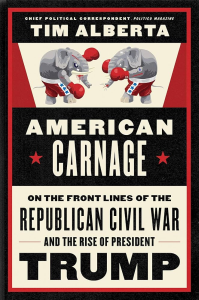
American Carnage

I fell out with both wings of the old uniparty in the mid-2000s over the war on terror and its attendant police state, which both parties supported despite some gum-flapping on the part of the Dems during the Bush years. Consequently, I wasn’t tuned in to what was happening with the GOP until Trump swept the Republican convention in 2016, knocking both establishment honchos like Jeb and the rising “Tea Party” champions like Cruz aside. American Carnage is an extremely detailed history of how the Republican party changed in recognition that its base was becoming more primed towards belligerent anti-state populism, rather than a defined ideological disposition like Reaganism. Although it’s written with a distinct animosity towards the populists, Carnage doesn’t demonize them. It recognizes that legitimate concerns and fears were fueling the animosity towards the establishment, principally the toll that NAFTA had taken on American industry and the communities it sustained. Given how fine-grained the reportage is here (meetings, interviews, meetings secret meetings, interviews, meetings), this is probably written more for wonks, but I enjoyed it all the same. I was particularly fascinated by Thomas Massie’s disappointed realization that voters were supporting liberty iconoclasts like himself, Amash, and Rand not necessarily out of libertarian principles, but because those voters wanted “the craziest SOB in the race” to attack the establishment. This is how the same populism that fueled the fiscal-conservative-oriented Tea Party could also fuel Trump: raging against the machine was more important than policy, and the new era of social media allowed populists to bypass gatekeeping media and gatekeeping party infrastructure that controlled funding. For readers already familiar, this book is also an interesting character study into Boehner and Ryan in their attempts to be responsible to the people and the party, while also having to deal with Trump’s unpredictability and the disruptive energy of the populists who were now not only pushing for increasingly challenging candidates, but sometimes taking office themselves. Unfortunately, this book doesn’t really address the sources of the populist energy– economics, the power elite’s increasingly transparent contempt for flyover country, etc — but just looks at how that energy disrupted the GOP. Fascinating stuff for wonks, I’m sure.

Palin’s resonance with Republican voters was, above all, an indictment of the party’s tone-deaf arrogance. Having catered to the aristocrat caste atop the GOP for decades, winning far more elections than they lost along the way, Republicans were blissfully ignorant of the discontent simmering below the surface. When it boiled over, the defensiveness of the elites—reproaching Palin, for example—only made things worse.

Boehner and McCarthy agreed to attend the Bakersfield Tea Party event on the condition that they not give any remarks. Boehner suspected with some justification that these crowds would be just as hostile to Republican politicians, especially leadership officials, as they were to Democrats. “We’re at this event, and there’s some people who are really happy that we showed up,” Boehner recalls. “But there were others that just looked at us with more disdain than you could ever imagine. They thought we were the enemy.”

He recalls wondering how, if Republicans took back the House, Boehner would handle a mob of rookie revolutionaries. When they met in Washington, shortly before Election Day, Boehner’s answer was simple: They would fall in line. Freshmen always fall in line. But the party chairman was not convinced. “These guys are out there blowing up Republicans as much as they’re blowing up Democrats,” Steele told Boehner. “You mean to tell me you can’t see that?”

As people watched their jobs disappearing, their communities hollowing out, and their national character changing, they wanted a brawler—not a bookkeeper.

[Cruz] had spent his teenage years touring the state of Texas delivering the Constitution from memory as part of a free-market troupe and had also been involved in drama club, briefly considering a career as a thespian. (On the Bush campaign, he was known to launch into various recitations of his favorite film, The Princess Bride, capturing every line and every character’s accent with precision.)

What Bush and his Republican peers failed to understand was the degree to which Putin had become an appealing figure for many on the American right—not for the particulars of his government’s cruelty, necessarily, but rather, for the masculinity he radiated in such sharp contrast to his U.S. counterpart.

Trump did not suffer from a lack of teachability; he simply preferred to dictate the flow of information, rather than be dictated to. Lengthy briefings and conference calls were never a staple of his executive style. He favored an aggressive, inquisitive approach, learning about issues, and about people, with rapid-fire questioning, consuming what he needed from the answers and discarding the rest.

“I was elected to represent the citizens of Pittsburgh, not Paris,” he decreed.

That summer, having breakfast with a blissfully retired Boehner, I asked him whether the Republican Party could survive Trumpism. “There is no Rep—” He stopped himself. There is no Republican Party? He shrugged. “There is. But what does it even mean? Donald Trump’s not a Republican. He’s not a Democrat. He’s a populist.”

“Twenty years ago, you and I might disagree strongly on politics, but we’re on the board of the same PTA, and our kids go to the same school, they play on the same sports teams, and we go to the same church on Sunday. I knew you as a whole person,” Rubio says. “Today, we increasingly know people only by their political views—or we just don’t know people unlike [us] at all.

A lot of people think Trump is a footnote, that he’s just here for four or eight years, and then it goes back to normal. But I think that’s wrong. I think the party is changed for good,” she says. “And it won’t be sustainable. We’re in a period of incredible change as a country where the extremes of the left and right are going to converge, and you’re going to wind up with a third party. Over the next two or four years? No. But in the next twenty? For sure.”

Posted in Politics and Civic Interest, Reviews | Tagged , , , | 2 Comments

Teeezer Toozday

“Who in tarnation are you?” said Jayne. He still had a hand clamped over his forearm, to try to stem the blood flow from the savaging he had received. “You’re no grizzly, that’s for damn sure.”
“Of course I’m not a grizzly,” said the bear. (Firefly: Life Signs)

“The wireless music box has no imaginable commercial value. Who would pay for a message sent to nobody in particular?” (Hello Everybody! The Dawn of American Radio)

But even more fascinating are some of the extinct mammals that have never quite made it into pop culture stardom. There were once wee mammals that glided over the heads of dinosaurs and others that ate baby dinosaurs for breakfast, armadillos the size of Volkswagens, sloths so tall they could dunk a basketball, and “thunder beasts” with three-foot-long battering-ram horns. There were oddballs called chalicotheres that looked like an unholy horse-gorilla hybrid, which walked on their knuckles and pulled down tree branches with their stretched claws. Before it docked with North America, South America was an island continent for tens of millions of years, and hosted a whole family of wacky hoofed species whose Frankenstein mashup of anatomical features flummoxed Charles Darwin—and whose true relationships to other mammals has only just been revealed by the shocking discovery of ancient DNA. Elephants were once the size of miniature poodles, camels and horses and rhinos once galloped across an American savanna, and whales once had legs and could walk. (The Rise and Reign of the Mammals)

Posted in General | Tagged , | Leave a comment