Anthropology for Dummies

Anthropology for Dummies: From Archaeology to Linguistics — Your Plain-English Guide to the Study of Humankind

© 2008 Cameron Smith with Evan T. Davies
360 pages
“The human species has found many ways to be human.” – p. 259
I don’t think I’ve commented on a for Dummies or Complete Idiot’s Guide book on here before, although I posses perhaps a dozen of them, all history-related. I’ve found them to be useful guides for finding out general information and they serve nicely as introductions to subjects I know little about. Although some people do not take them seriously, the television show Jeopardy! has shelves of them in their library: take that as you will.
This book follows the pattern of most for Dummies books: it is highly organized for readers looking for specific chapters and sections, written in an informal matter (the author referring to himself with “I” and to the reader with “you”) that incorporates joking statements and witty section titles (“My Career is in Ruins” covers archaeology, for instance), and ends with two “Top Ten” chapters. One contains the top ten things the reader must remember about anthropology if nothing else, and the other contains the top ten movies and books with an anthropological theme, including one of my favorites, Carl Sagan’s Shadows of Forgotten Ancestors. The impersonal and simple language make the book easy to read through, although some readers may object to the author offering personal opinions that may not be warranted. (A case can be made for the author referring to the most probable of hypothetical situations, but there were other instances in which I didn’t think his opinions had place in the text. This may be personal taste, however.)
Given the book’s subject – anthropology being the study of humankind here — there’s a lot to cover. Anthropology and the book incorporate history, linguistics, biology and evolution specifically, sociology, sociological theory, economics, agriculture, religion, and more. Dr. Smith’s own speciality seems to have been archaeology, but he explains the other disciplines well, too. Before “The Part of Tens”, which is a hallmark of the for Dummies book, Smith ends the book proper with a chapter on how anthropology can be used to inform and plan public policy. I enjoyed the experience, found it helpful to read about the development of the field itself, and may purchase it in the future for my own library. It’s a recommendation to those interested in the included subjects or humanity in general.
Posted in Reviews, science | Tagged , , | Leave a comment

In the Footprints of God

In the Footprints of God

© 2003 Greg Iles
459 pages
The saying Deus ex machina, literally translated as “god from the machine”, refers to a plot device in which a superman power is used to suddenly resolve the conflict that drives plot. This could refer to all manner of things, but by extension it happens when the characters suddenly reveal something that stops the plot cold. In a way, it renders the entire story preceding it pointless. But literally, “god from the machine” — that’s an interesting phrase.
David Tennant is in quite a situation. He’s been asked by the President of the United States, a friend of his brother’s, to provide ethical oversight to a government program that will dwarf the Manhattan Project in importance if its goals are realized. The Trinity project seeks to create artificial — nay, super-intelligence. By combing the reasoning and imaginative powers of the human mind with the processing speed of a supercomputer functioning at quantum levels, the Trinity program intends to create a computer that will make existing computers look like like abacuses in comparison. Given the controversy over the Manhattan Project about the use of nuclear weapons, the US President has decided to cover his posterior here by having ethical oversight.
So what happens when people start dying for trying to suspend the project so that problems of a serious nature can be investigated? You end up with a classic Hollywood movie plot: the compassionate doctor who knows too much being chased through the country, hounded by an amoral Government Agency and nearly killed by German mercenaries who only show emotion when they want to terrify you. If that sounds typical or even generic, keep reading: that isn’t the end of the story. That only sets up the bulk of the novel, and it will bring Deus ex machina to mind — but not yet.
David Tennant’s story is told through the first-person, and his voice tells most of the story — although curiously enough Iles does switch to third-person limited and focuses on the amoral government agency’s security chief to tell the first part of the story from the vantage point of both pursued and pursuer. Later, she will fade, but the third-person will be used for two other characters. Tennant and his friend Dr. Fielding are responsible for stopping one of the most expensive government programs to date (save for wars) on the basis that scanning equipment related to the plot is causing brain dysfunctions among test subjects, including our own David Tennant — who frequently dreams that he is seeing the history of the world through the eyes of God, and the history of Jesus through the eyes of Jesus. What makes this interesting is that Tennant is nonreligious: he’s an atheist who would probably attach the humanist label to himself in the same way that Penn Cage did in The Quiet Game and Turning Angel.
This and the potential of the planned supercomputer (Deus ex machina) make a science fiction novel address metaphysics, but not in a “New Age” way. In Turning Angel I was impressed by Iles‘ ability to render characters of various skeptical bents and religious affiliations believable, and this continues here. Although Iles‘ characters do talk about God and the God-idea does feature in the plot, it is close to Contact. While I’ve never read The Tao of Physics, I’ve gotten a sense of its reputation from skeptics and my own skeptical sensibilities were not offended.
The book is quite strong: Iles has rendered another thriller, this one most interesting in touching on metaphysical issues. Unlike some of his previous works (Turning Angel again), violence and elaborate descriptions of sex are fairly absent. Although Iles could have easily shot himself in the foot writing about sensitive issues such as these — religion, namely — I don’t think he does. This may be his most riveting book yet.
Posted in Reviews, science fiction | Tagged , , , | Leave a comment

Aristotle’s Children

Aristotle’s Children: How Christians, Muslims, and Jews Rediscovered Ancient Wisdom and illuminated the Dark Ages

© 2003 Richard Rubenstein
368 pages
That title is a touch misleading. While Rubenstein will mention Christians, Muslims, and Jews rediscovering ancient wisdom, he only does so in one chapter. What this book is really about is the growth of intellectual life in western Europe after Aristotle’s works begin filtering into the continent — and subsequently, the development of Catholic theology as it resists, co-opts, and is finally changed by Aristotelian thinking. This is presented in a very readable narrative, often focusing on key individuals whose names are typically well-known, with some exceptions. Peter Abelard and Thomas Aquinas are two examples of characters who feature prominently.
Much of the book concerns the growing intellectual life of the Catholic church. Some readers may find it unusual that the Catholic Church served to make Aristotle a part of the culture, but as far as I know, the church was the only way any intellectual idea could have made its way into the culture. The universities themselves developed from cathedral schools: for a long while, the Church was the only culture-producing entity in Europe. As a result, the Church is the subject throughout the bulk of the book with the exceptions of its first and final chapters. Rubenstein keeps the narrative grounded in more material history, weaving political and economic stories in with the intellectual history.
Rubenstein uses the last chapter — in which Aristotle’s logic is used to disprove his ideas about the geocentric universe — to call readers to question traditional narratives written about science and religion that pit the two always against one another, as well as to recognize that modern science, despite its depth of knowledge, does not have what Aristotle had in a unified view in which science, ethics, and metaphysics were one. That’s a discussion for another time, I think. As said, the book reads well and if you’re interested in the influence of Aristotle or the growth of intellectual life in the Church during the time period of the opening centuries of the second millennium, this is for you and you’ll find it a worthy read, I think.
Posted in history, Reviews | Tagged , , | Leave a comment

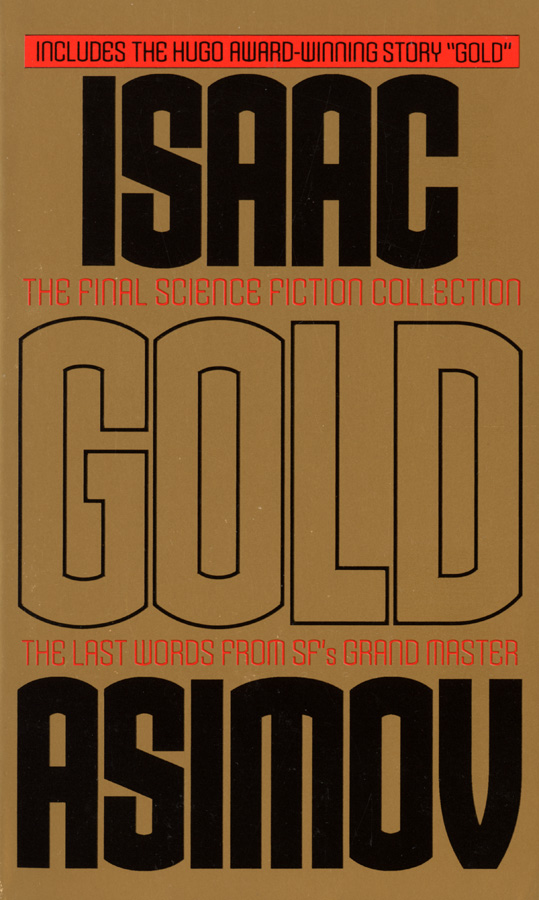
Gold

Gold

© Nightfall, Inc. / The Isaac Asimov Estate
345 pages
“At present, when there are a great many writers attempting to scale the mountainside of science fiction, it must be rather annoying for them to see the peak occupied by elderly has-beens who cling to it with their arthritic paws and simply won’t get off. Even death, it seems, won’t stop us, since Heinlein has already published a posthumous book and reissues of his old novels are in the works.” – p. 146, from “Inventing a Universe”.
Frequent readers know how big a fan I am of Isaac Asimov, and how much I especially love his short-story collections, so I was very much looking forward this to collection of previously uncollected work. The book is possibly a companion piece to Magic, as both were published in the same year, both share the same format, and both have similar cover art. Like Magic, Gold is a collection of short stories and essays by the late and great Isaac Asimov. Like Magic, Gold is devided into three sections: stories, essays, and more essays. The difference here is that the first set of essays deal with science fiction in general while the second set of essays deals with writing, and writing science fiction in particular.
The stories rate as some of the best I’ve read from Asimov so far, although to be fair my enjoyment may have been heightened by anticipation. The titular piece, “Gold”, is especially good: Asimov tells the story of an artist in the future who composes “compudramas” — works of art that seems to be somewhere between Pixar-type animated works that are serious, IMAX experiences involving both music and etheral images, and a holodeck. The artist is best known for bringing King Lear to life for his “modern” audience despite the cultural gap, and is approached by a relatively unknown science fiction writer who wishes our artists to create a compu-drama based on a very esoteric work of “hard” science fiction where the lead characters are so far from normality that the artist has to push his creative boundaries to make them alien yet relatable to the human audience. Asimov takes us through the artist’s process — something that seemed to me would be difficult to do even for a seasoned author such as Asimov. Some of the stories are elaborate pun setups, and one of them in particular — “Cal” — features a robot who discovers something greater than the Laws of Robotics.
The second section consists of essays on science fiction as a genre and seems to pull from anthologies that Asimov edited, using his introductory essays. These are unedited, meaning the reader will experience Asimov referring to volumes of stories they have no access to. At first this seemed clumsily done — why not edit the references out? — but it doesn’t retract from the essays too much. Some essay topics include the problems with proposed ways to travel the galaxy, robots, women and science fiction, psychohistory, “golden ages”, flying saucer literature, and the influence of science fiction. The third and final section seems to consists of editorials from one of Asimov’s magazines in which he writes in response to readers’ questions (as he does in “Religion and Science Fiction”) or muses on his own subject. These concern the writing process — plot, use of metaphor, and the importance of dialouge.
The collection was a true joy to read: Asimov is as ever funny, lovable, intelligent, and inspirational. Here was a man who loved life, loved his craft, and loved his readers. Gold is a a fitting tribute to him.
Posted in Reviews, science fiction | Tagged , , , | Leave a comment

This Week at the Library (5/8)

Books this Update:
  • Lemony Snicket’s The Carniverous Carnival, The Grim Grotto, The Slippery Slope, The Penultimate Peril, and The End.
  • Walden, Henry David Thoreau
  • To Have or To Be?, Erich Fromm
This week I finished Lemony Snicket’s series of unfortunate events. By this point the children have decided to strike out on their own and find answers — why does Olaf keep chasing them? Who is VFD, and what do they have to do with Count Olaf? And where is that mysterious ticking noise coming from? * Even Count Olaf will be overshadowed by plot elements as the books draw near series’ end. Rather than repeating what I said in the series comments, I shall simply link to it.
Next I read Henry David Thoreau’s Walden, his account of a year spent living on the shores of Walden Pond, living off of six weeks’ worth of labor and spending much time communing with nature. Although the book is dominated by Thoreau’s accounts of watching the seasons pass and the forest-dwellers live their lives, there is considerable social criticism and philosophical musings. Those familiar with Thoreau’s transcendentalism will see it here. Many of his criticisms seem perfectly valid, particularly those endorsing simple living. The effect was somewhat subdued for me, having read excerpts from his journals beforehand.
Lastly I read Erich Fromm’s To Have or To Be?, which is a straight work of social criticism. Fromm sees humanity as having trapped itself in a “having mode” of existence: according to him, we build our sense of identity on what we have. This is not limited to material possessions: it extends the way we view relationships, religion, and intellectual ideas. Although this leads to psychological distress, Fromm writes out of a sense of greater urgency — for he believes this problem will lead to utter disaster for humanity and the planet. The problems caused by this having-mode of existence cannot be remedied through government legislation or the adoption of ideologies: only a change in the human character can save us. Fromm proposes a way to change our characters, deliberately modeling it on the Four Noble Truths (and perhaps to an extent the eight-fold path) of Buddhism. The book does not go into as much detail in the “offering a solution” phase as The Sane Society, but I think it will serve to make those who read it think.
Pick of the Week: The End for fiction, To Have or to Be? for nonfiction.
Books Next Week:
  • Gold, Isaac Asimov.
  • Securing Democracy: Why We Have an Electoral College, ed. Gary Gregg. This is a book of essays on the electoral college system in the United States. I don’t understand where “delegates” fit into the system, although I get its function well enough.
  • Anthropology for Dummies, Cameron Smith. I’ve found the for Dummies books to be adequate introductions to their subjects, and I’m enduring a science drought.
  • The Footprints of God, Greg Iles. The novel appears to be a thriller set in the context of what happens when scientists attempt to create a computer that is superior to the human brain in all respects — not just processing speed.
  • Brave New World, Aldous Huxley.
  • Aristotle’s Children: How Christians, Muslims, and Jews rediscovered Ancient Wisdom and illuminated the Dark Ages, Richard E. Rubenstein.
It’s doubtful that I’ll get to all of these, but you never know.
Posted in Reviews | Tagged | 3 Comments

To Have or To Be?

To Have or to Be?
© 1976 Erich Fromm
215 pages
Society was sick when Erich Fromm penned The Sane Society in the fifties, and it hadn’t gotten any better by the 1970s when he was asked to participate in a series of books called “World Perspectives”. Back in the fall of 2008, I think, I read his For the Love of Life, containing an essay on “Ennui and Affluence in Our Society”. Fromm believes that human beings today have trapped themselves in “having” mode: they define their sense of self based on what they own. This sense of ownership is not limited to the mindset of consumerism: according to Fromm, we also try to posses other people and ideas. That this leads to unhappy boredom and psychological distress is not bad enough: Fromm believes that if this continues, humanity will destroy itself. It could be through nuclear war or ecological collapse, but one way or another the desire to consume and possess for ourselves will destroy us in a physical as well as psychological sense.
At first, Fromm explores how the having-mode effects so much of human experience, including religion. Fromm is a humanist in a slightly more classical sense of the word: he ties Karl Marx, Albert Schweitzer, Jesus, and Buddha together. (Fromm’s For the Love of Life drew from Marx, Freud, and Zen Buddhism just for starters.) After comparing this to the being-mode — which isn’t as well defined, but which he refers to as attempting to be fully human, cultivating ourselves through art and literature, and enjoying life — he then looks as “New Man” and “The New Society”. It is Fromm’s opinion that having-mode cannot be remedied by legislation: to ensure our happiness and livelihood, the character of humanity must be changed itself. That’s a tall order, but his outline for effecting this in our lives is a deliberate echo of the Four Noble Truths.
The book doesn’t go into as much detail as The Sane Society, but I don’t think it is meant to. It was published a part of a series of books perhaps meant to make people think about their lives and if the way things are now is a way we can be satisfied with. Although I was familiar with the essence of this from “Affluence and Ennui”, he builds on it a great deal here. It’s worth the read if you can find it, but that may be hard to. It’s something of a miracle that my local library has it.
Posted in Reviews | Tagged , , , | 4 Comments

Walden

Walden
© 1854 Henry David Thoreau

I remember staring up at Walden on my high school library’s bookshelf, wondering if I should check it out. I knew it was famous: it was one of those books I’d heard of in the light of being a classic. I didn’t check it out, but some years later I decided to try Thoreau out based on his WikiQuote page and found him to be enjoyable and exceedingly thought-provoking. Having read his essay on civil disobedience and portions of his journals, I decided this past week to read the work for which he may be best-known: Walden.

Walden is Thoreau’s account of his first year spent living at Walden Pond, just outside of Concord. From what I’ve read, Thoreau seemed ill at ease living in society — which to him is unnatural, with people obsessing over trivial matters and ignoring the more important ones, like the cultivation of the inner spirit. In order to think about things and to pursue a life of simple living — in which he was able to live off of six weeks’ labor — he travelled into the woods and began making a home for himself. Although I had expected social criticism, philosophical musings, and a journalistic account, I was not expecting the latter to dominate the former. The bulk of his criticism is contained within the opening chapters, in which he explains why he left. Although musings (mostly related to transcendentalism) are woven throughout, the book is mostly a straightforward account of his life spent in the woods. He writes about building his home, seeing the seasons changes, and working in his bean-field. A friend warned me that Thoreau spent a lot of time writing about the details of his life — details like the width between lines of his bean crop — but I didn’t expect quite so much. Then again, based on such a warning I might have focused more on the details when they occurred.
Thoreau is poetic at times, and quotes often from the Hindu scriptures as well as from his own tradition’s text of the bible. The book is littered with 19th century references (helpfully explained by my book’s editor), giving the impression that Thoreau is a very well-read man. This might be emblematic of the print culture that Neil Postman and Susan Jacoby are so enamored of, or it may point to the fact that Thoreau delighted in gleaning wisdom and inspiration from the products of the human spirit. He saw philosophy as using wisdom to live one’s life well. His style has the vague formality you might expect of 19th-century work.
I suspect the book may have been spoiled for me by his journals: first-time readers to Thoreau may find it more enjoyable than I did. I didn’t dislike reading it, but it didn’t grip me the way I expected Thoreau to. He has a droll wit about him: at times he seems like a man who could fascinate you with his ramblings at the same time he annoys you by constantly complaining. Although I didn’t expect it — but should have — is that this book offers a look into a different time — a time in which people come to Walden Pond to cut blocks out of ice to use in icehouses. (The first three or four times Thoreau mentioned ice-cutters, I thought they were cutting holes in the ice to fish. Only later did it occur to me that this is the mid-19th century and people use icehouses for refrigeration.)
Although the details could get wearisome at times, I am glad I read it and would like to discuss it further with people who have likewise read it.
Posted in Reviews | Tagged , , | 3 Comments

The End (and series comments)

The End
© 2006 Lemony Snicket
324 pages
The End of the Series of Unfortunate Events begins on the open ocean, with the Baudelaires and Count Olaf in the same boat — having escaped a burning hotel and an angry mob. Here is where the story that began with the untimely demise of the Baudelaire parents comes to its end — and it is quite an end. In due time, a storm destroys Olaf’s yacht and the four wash up on an island with white sandy beaches — one that appears to be a safe haven occupied by a community of people who are committed to simple living who aren’t fooled for a second by Count Olaf. That they aren’t fooled by Count Olaf like every other adult in this book is surprising and dramatic: it renders Olaf powerless and changes the balance of power completely.
Unfortunately for Violet, Klaus, and Sunny, things are not always as they seem. The island is safe, but utterly boring and controlled by an old man named Ishmael (“Call me Ish,” he always says). Ishmael does not pretend to be king, like Olaf does — he simply possesses a strong power of suggestion and an unlimited supply of coconut juice that acts as an opiate. The kids realized straightaway that Ishmael isn’t the kindly old “facilitator” he seems to be: he knew who Count Olaf was, and he knew that the Baudelaires were orphans. Clearly there’s more going on here than meets the eye, and indeed they find that the island — where “everything washes up, eventually” — is not isolated from the world of their past, but is indeed very connected with it. Its story is their parents’ story, and Olaf’s story, and the Snickets‘ story — and it is a story the Baudelaires are now caught up in and will fulfill.
The End is dramatically different from the twelve books preceding in that Count Olaf is utterly out of his element. No one believes him: he has no power. His and the kids’ arrival has stirred up the past and will destroy the community on the island, but he will not gain from it. Surprisingly, he gains dimensions: he communicates with the children as people, not just as his victims — conveying sympathy to them while the reader feels sympathy for Olaf. It’s not what I had expected. What happens in The End I will not tell in full: I think I may have been more engrossed in this one than in any other. It was…well, moving. I think Snicket is at his best here.
The series as a whole has been enjoyable: there’s a reason I can plow through five books in a few days and not feel tired of it. Frankly, I’m tempted to watch the movie again. It has a number of strengths. It takes its audience seriously, for one. The children who I expect constitute the bulk of the audience are talked to directly: Snicket connects with them. I think it is true that most kids feel a sense of alienation from adults when they get older — treated as if they aren’t the intelligent and feeling humans that adults are supposed to be. Snicket acknowledges that sense, and he plays with it using the Baudelaire’s complete inability to get through to any adults. It is in this way that he is slightly “subversive”, because he does talk to children frankly, and he tells them that some of the stories they hear from adults are utterly asinine (not in those words) and not worth listening to — stories like the Boy Who Cried Wolf and the Little Engine that Could.
But Snicket’s entire audience isn’t children: I expect parents, librarians, and other adults who aren’t too embarrassed to go into the children’s section of the library are reading as well, and Snicket writes to us. I’ve lost track of the number of little jokes written into the text for the benefit of adults or very well-read children. (Speaking of which, the books are educational in that they are constantly building vocabulary for readers: some of the words Snicket uses even I haven’t heard of.) Generally speaking, the narrative style should be enjoyable by most everyone. Snicket is dryly hilarious, and a joy to read even though the series is very dark indeed. Topping all of this off is the fact that the series isn’t shallow: it’s not just something to be read and forgotten. It convey important messages to children — messages like that the world can be a very dark and dangerous place, but that people can show “moral stamina” and stay true to themselves — that giving in won’t work.
I would suggest that those who are in the position of recommending books to children read a few of these to see what they’re like — and that those of you who are not in a position of recommend books to children try one or two anyway, because they’re funny and more than a little dark.
Posted in Reviews | Tagged , , , | Leave a comment

The Penultimate Peril

The Penultimate Peril

© 2005 Lemony Snicket
353 pages
As its name suggests, we are nearing The End. Following clues left for them by VFD members, the children arrive back where the series began — at Briny Beach, where Sunny echoes her past self and says “Look at that mysterious figure coming out of the fog!”. They soon arrive at the Hotel Denouement, where they meet many of their old “guardians” as well as many VFD comrades. Rather than allowing the children to rest in light of their many perilous adventures — escaping multiple fires, a hurricane, idiot guardians, a lynch mob, being thrown down an elevator shaft, and falling down a mountain among many others, their VFD contact asks them to infiltrate the hotel and spy on various persons to find some answers and resolve the plot. This does not go too well, and the arrival of Count Olaf makes matters worse, leading to a trial where everyone by the judges are blind-folded (as “Justice is blind”) after a harpoon accident. The children engage in even more morally questionable acts, and by book’s end, the only person who isn’t questioning their moral integrity is Count Olaf — as he writes them off as being just like him. Very little is resolved aside from some questions about VFD, but then everything goes up in flames — as it were.
Posted in Reviews | Tagged , , , | Leave a comment

The Grim Grotto

The Grim Grotto
© 2004 Lemony Snicket
323 pages
I continue the Series of Unfortunate Events. By this point in the series, the format has completely changed. The Baudelaire orphans are no longer being protected by the system and ushered from place to place: having lost communication with Mr. Poe after he dropped them off at the Vile Village, the orphans are taking care of themselves as best they can. While trying to find answers to why their parents were killed, and why their friends’ parents were killed, and why a dozen other things, they are competing with Count Olaf and occasionally running into people who are part of the overall story: the story of VFD and its fight against the likes of Count Olaf. One of those people is Captain Widdershins, who pops up out of the water unexpectedly in his submarine and invites the Baudelaire Orphans in. Fortunately for the children, Widdershins is not a friend of Count Olaf, and does not try to kill them. He worked with their parents and feeds them some information while constantly blabbering. His personal philosophy is “He who hesitates is lost”, and this extends to thinking about what you want to say. He and his stepdaughter Fiona come friends and allies of the orphans, although like most Baudelaire friends they won’t be around for long. The novel is dominated by the orphans’ search for an artifact from the VFD headquarters that is apparently quite important. Count Olaf does make an appearance, but with the usual courage the Baudelaires thwart his evil schemes. Interestingly, by this point villains have been introduced that cow even Olaf into staring at his shoes and laughing nervously — and they feature in the plot.
The main story seems to be shaping up nicely: although I’m pretty sure the great mystery of VFD has been spoiled for me by a single line in the movie*, I’m still very much interested in what happens.
*”Sgdqd Aqd svn jhmcr ne odnokd hm sgd vnqkcsgnrd vgn rsAqs sgd ehqdr, Amc sgnrd vgn ots sgdl nts.”
Because blogger has no “spoiler” language to hide that sort of statement, I coded the line. It’s rather easy: B is A and A is A — because it can’t really be Z.
Posted in Reviews | Tagged , , , | Leave a comment