
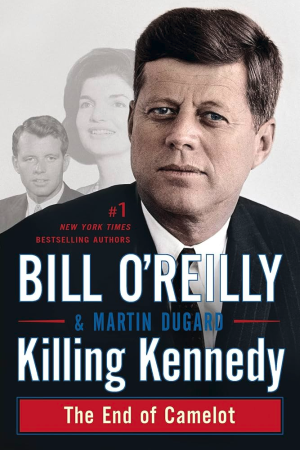
A black convertible slows around a turn in Dallas, showing off a handsome couple in the backseat. Shots are fired, and suddenly a woman in pink is climbing across the trunk of the convertible as it now speeds away. These are images that have haunted the United States for decades: the reigning Boomer generation was then in grade school when Kennedy was shot, and have doubtless carried the shock and grief of that with them the way adults of my age carry the images of 9/11 — the blue skies, the towers, the sudden explosion of impact. Bill O’Reilly was one of those shaken schoolchildren, and in Killing Kennedy he delivers a light history of the Kennedy assassination that primes readers to admire the president, then be properly horrified when he’s shot in cold blood by a disturbed Communist sympathizer. I say light history because it doesn’t try to go into deep details like Case Closed or a similar work: this is simply a narrative of who JFK was, his issues in office leading up to the assassination, and coverage of the day itself. The perspective is almost always intimate: even when writing about larger affairs like the Cuban Missile Crisis, O’Reilly and Dugard put us into the ‘room where it happened’, so to speak, with details like conversations, reactions, etc. This makes for a very novel-like experience, though it did give me pause — especially when the subject was Lee Harvey Oswald, who was shot fairly quickly after being arrested. He wasn’t giving testimony, so I’m leery about taking statements about his emotional state, motives, etc: O’Reilly paints him as a disturbed individual who wanted to do something big. The immersion can almost be distracting if the reader is intent on learning about the assassination , especially when we’re learning about JFK’s philandering or his relationship with Frank Sinatra — but arguably for casual readers, it develops the background of the men and women we’re spending time with. I’ve never read a book on the Kennedy assassination proper, but this struck me as a good introduction to it: it’s an easy read that has enough detail to feel like one can see these events, and offers emotional context to make the reader want to pursue more of the story.
Random sidebar: reading the section on Sinatra and Kennedy made me realize why I have such animus against Bobby Kennedy. I used to be obsessed with Frank Sinatra, and in high school and community college I read every book I could find on him. Sinatra was a huge JFK fanboy and completely renovated his Palm Springs house so that JFK could stay there: Sinatra added a helipad, cottages for the secret service, a new telecommunications system, etc — all for Bobby Kennedy to suggest that when JFK went to Hollywood to cheat on his wife with Marilyn Monroe, he shouldn’t do it in a bed that mobsters had probably slept in. JFK had to do his philandering at Bing Crosby’s house, instead. Poor Frankie was devastated.


