Teaser Tuesday (18-5)

And lo! The Tuesday time for teasing is upon us again, from Should be Reading.

According to The Gospel of Judas, then, the fundamental problem is that “the twelve” — here, stand-ins for church leaders — do not know who Jesus is and do not understand who God is, either. They wrongly think that God requires suffering and sacrifice. But the author of The Gospel of Judas — and others within the early movement as well — was asking question like this: What does such teaching make of God?


Page 66, Reading Judas: the Gospel of Judas and the Shaping of Christianity. Elaine Pagels and Karen L. King.

Posted in General | Tagged | 2 Comments

The Lady Elizabeth

The Lady Elizabeth
© 2008 Alison Weir
480 pages

“Can you do what you like when you are king? [Elizabeth] asked, a whole new vista of freedom opening up in her mind.

“Of course I can,” her father replied. “People have to do my will.” There was an edge to his voice that, young as she was, she missed.

“Then,” she told him, “I am going to be king when I grow up.” (p. 19)

I have long been taken with the personality of Elizabeth the First, the storied ‘Virgin Queen of England’ who ruled long and well, setting England’s course away from the Roman Church and continental wars, and towards Anglo-Scottish union and the New World.  Alison Weir’s biography of Elizabeth came highly reccommended to me, but I do not have access to it: I do, however, have access to Weir’s biographical novel of Elizabeth. Weir’s account begins with the death of Anne Boleyn, Elizabeth’s mother, and the royal decree that Elizabeth and her older half-sister Mary are cut off from the line of succession. Weir tells Elizabeth’s story beginning with this loss of favor, following the future queen’s trials and triumphs until she is at last crowned Queen at the age of twenty-five.

Elizabeth, for me, is an almost-larger-than-life character, and her depiction in this book pays homage to her irrepresible indivduality and strength of will. “Precocius” is nearly an understatement, for even as a toddler Elizabeth is startlingly bold and mature, sounding at times like an adult. This may be due to the inherent difficult of an adult rendering how a young child might think and speak, to the tendecy for royal children to be raised as adults in miniature, or to the fact that Weir’s sources — letters penned by the young Elizabeth and recollections of her by her guardians — depict a child with supreme self-collection.

Elizabeth’s earliest memories are the blizzard of new stepmothers, for her father would marry four more times in his life, having done so six times in all.  Mary and Elizabeth are both bewildered by this quick succession, but their respective responses to their own mothers’ fates define their characters: while Mary is partially broken by the humiliation of her mother (Katherine of Aragon) and lives her life forever dependent on others and weeping for the loss of what she loves, Elizabeth is determined not to endure her mother’s fate. She develops inner strength, demanding independence and self-effected security for herself. The primary actor in Elizabeth’s life is Elizabeth. She steels herself with philosophy — being especially fond of Cicero — and meets challenges with bristling defiance.

Elizabeth will need that strength of character to withstand her adolescence: when the king dies, she and her siblings become the pawns of ambitious nobles who seek to increase their fortunes and influence England’s course during times of political and religious turmoil. Elizabeth must also resist the advances of lusty suitors, struggling against her body’s innate desire to propagate. She scorns marriage, for her father’s string of wives proved how little the status of wife is worth, and she distrusts the power her emotions have over her when encouraged.  Early adulthood is no easier, as rebellions against the Sovereign ensnare Elizabeth and send her to the Tower of London, where she occupies the very apartments her mother occupied before her own beheading. Her path to the throne takes her through a vast minefield of religious, political, diplomatic, and personal problems.

Weir took me by surprise: although my interest in the subject character played a part, The Lady Elizabeth was for me a genuine page-turner. Although I kept putting it down in order to read another book, it continually appeared in my hands again. I’m always pleased when authors comment on their sources and discuss how they used (or took liberty with) them, and Weir is generous in providing disclosure. I look forward to reading more of her fiction and nonfiction and recommend this with ease.

Posted in historical fiction, Reviews | Tagged , , , , | 2 Comments

Teaser Tuesday (11-5)

Sunday, Monday, Happy Days
Teaser Tuesdays, happy days.

“And in the day that we sweep to victory at the ballot-box, and you refuse to turn over to us the government we have constitutionally and peacefully captured, and you demand what we are going to do about it — in that day, I say, we shall answer you; and in the roar of shell and shrapnel and in whine of machine-guns shall our answer be couched. You cannot escape us.” 

From Jack London’s The Iron Heel. Ernest Everhard, London’s hero, is responding to the Oligarchy’s intention to maintain their control of the government through brute force. He’s deliberately echoing their previous statement, with which the trusts revealed their true nature. That is below.
————————————————————————————–
This, then, is our answer. We have no words to waste on you. When you reach out your vaunted strong hands for our palaces and purpled ease, we will show you what strength is. In roar of shell and shrapnel and in whine of machine-guns will our answer be couched. We will grind you revolutionists down under our heel, and we shall walk upon your faces. The world is ours, we are its lords, and ours it shall remain.”  […]

“I am answered,” Ernest said quietly. “It is the only answer that could be given. Power. It is what we of the working class preach. We know, and well we know by bitter experience, that no appeal for the right, for justice, for humanity, can ever touch you. Your hearts are hard as your heels with which you tread upon the faces of the poor. So we have preached power. By the power of our ballots on election day will we take your government away from you –“

“What if you do get a majority, a sweeping majority, on election day?” Mr. Wickson broke in to demand. “Suppose we refuse to turn the government over to you after you have captured it at the ballot-box?”

“That, also, have we considered,” Ernest replied. “And we shall give you an answer in terms of lead. Power, you have proclaimed the king of words. Very good. Power it shall be. And in the day […]
There the teaser picked up.
Posted in General | Tagged | 4 Comments

The Iron Heel

The Iron Heel
© 1907 Jack London
354 pages

(Mysteriously, my public library’s 1907 copy of this book has survived a century of use, although its tattered pages testify that the years have been harsh on it. If it ever had a colorful dustcover of some kind, that has long vanished. My copy is a straight hardback, so this is lifted from Google Images.)

Jack London was the first serious author I ever read, my first novel being his The Call of the Wild. I’ve been meaning to read something else by him for years, and when I heard of The Iron Heel I knew I wanted to experience it.

The first thirty-three years of the 20th century witnessed the ultimate downfall of Europe’s old aristocratic order and the rise of fascism, replacing the old monarchies with a terrifying new form of totalitarianism in light of liberal democracy’s apparant failure to maintain prosperity. Cultural pessimism had become the order of the day, allowing sweeping new approaches that claimed to be rooted in older principles.

Imagine if aristocracy and classically liberal democracy fell to authoritarian states, but not to fascism. Imagine if the capitalist nations, rather than having their institutions infinitely maintained as liberal democracies aspired to do or being overthrown as socialists and fascists wanted, had simply been realized in full. Imagine that decades of the “hands-off” approach to economics, coupled with the tendecies of capitalism to magnify wealth expotentially and concentrate that wealth in the hands of fewer and fewer hands through competition, has resulted in the overwhelming majority of the United States’ economy being owned by five large trusts who work together for mutual benefit. These trusts own the political machines that control the government, which might — through “trust-busting” politicians and regulation — by otherwise hinder their increasing power. These economic potentates control the resources of the land through the businesses and government, and as they grow they destroy the increasingly marginalized middle class and turn the general populace into industrial serfs, serving long hours for pitiful wages and utterly dependent on their masters for sustenance.

Penguin Classics cover.

This is the world of Jack London’s Iron Heel, framed as a historical document complete with an introduction and running commentary from a historian centuries in the future. (Margaret Atwood may have borrowed this device for her The Handmaid’s Tale.) The fictional author of the text is Avis Everhard, wife of Ernest Everhard: the man who predicts the coming of the Oligarchy and leads the revolution against it. At first he speaks only for members of the Socialist Party, but when his confrontations with the economic masters force them to abandon subtly in favor of outright tyranny — using the state militias and private armies to oppress dissent and cause opponents to ‘vanish’ — he becomes the leader of a nationwide proletarian revolution against the rule of the Iron Heel. He is martyred in the cause (as our historian informs us in the introduction), and the “Everhard manuscript” is Avis’ tribute to him, written so that his role in routing the Oligarchy will not be forgotten. He is her idol, her “Eagle”: a hero of humanity, full of passion and might. She writes with hope on the eve of a planned Second Revolt against the Oligarchy, although the framing device makes it clear to the reader that the Second Revolt is an even greater failure, resulting in the Oligarchy’s global domination until its eventual downfall.

The Iron Heel is an interesting novel. It predates other dystopian works and introduces devices and themes used in the works* that followed, as is the case with the Atwood example. Like other dystopian novels, it functions as social criticism and as a warning to its reading audience of what may come if trends continue. London, writing in the Gilded Age — the age of robber-barons and industrial slums — warns against the possible total tyanny on the part of vast commercial interests.  London’s flawless protagonist and the tone of the book’s opening give it the feel of an author tract: the first 150 pages follow Everhard’s rise as a socialist spokesperson, and through him London outlines his own grievances with the world of 1907 and why he believes in the socialist answer. Everhard addresses every class of society — urging labor to defend itself, attempting to convince the waning small businessmen that they cannot turn back the clock of progress  Still, those pages caught my attention given my own political values and beliefs. Although this book is more than a century old, it grabbed my attention and did not let go, for I see London’s concerns as still valid today. What would he make of the ‘military-industrial complex’, of media monoliths and their role in politics?

While the book is an interesting future/alternate history work in its own right and possibly the progenitor of a genre of fiction, it also serves to advocate for a vision of a better future, London’s socialist vision in which conflicts of interests that lead to violence and hatred are removed completely. It’s almost the Communist Manifesto for a mass audience, using the dialouge approach between Everhard and various audiences to explain Marxist criticism and socialist politics. It comments on London’s world and ours in a decidely interesting way: definitely a book to  remember, revisit, and reccommend.

*The phrase “the iron heel” brings to mind George Orwell’s 1984 quotation summarizing his dystopian world: “If you want a vision of the human future, imagine a boot stamping on a human face — forever.”

Posted in Reviews | Tagged , , , , , | 1 Comment

Plato’s Podcasts

Plato’s Podcasts: the Ancients’ Guide to Modern Living
© 2009 Mark Vernon
215 pages

I encountered this book a  few weeks ago while enjoying a virtual photo-tour of ancient Athens hosted by an Greek philosophy enthusiast. The title immediately drew my attention, and had I spotted this in a library, the cover would have caught my eye regardless. Mark Vernon’s approach is similar to Alain de Botton’s The Consolations of Philosophy in that Vernon devotes each chapter to introduce a single philosopher’s approach toward various subjects. The titles are straightforward, examples being “Epicures on why less is more” and “Socrates on being towards death”. Vernon’s chapters are more numerous and less detailed than de Botton’s, concerned only with a particular facet of a philosopher’s life or works. Some philosophies, most notably for me Stoicism, appear multiple times.This helps counter the risk of misrepresentation. Vernon also limits himself to the classical world, not going beyond Hypatia.

Vernon’s central idea is that the problems of the contemporary world are not dissimilar at their roots from the problems faced by the ancients: people still ask the same questions and are vulnerable to the same outside influences. The themes in this book are universally human: the search for meaning, living amid violent times, free will, love and marriage, understanding laughter and sorrow. He believes that the approaches taken by the classical world’s many varied personalities who not only taught, but practiced philosophy to live life more fully are still valid, and he draws some connections between ancient and modern approaches — between Epicures, the Stoics, and the Slow Movement, for instance. He also references similarities between the Greek philosophers and  Buddhists, as well as between the philosophers themselves. Vernon is an informal author, sometimes joking with the reader, but seems to take the philosophical approach to life seriously. Although his faceted approach runs the risk of misrepresenting a school of though to the lay reader, he introduced me to an abundance of previously unheard names with interesting ideas to ponder. I enjoyed reading this through the weekend, and can easily recommend it to those interested in the philosophical life.

Related:

Posted in Reviews | Tagged , , | 1 Comment

This Week at the Library (6/5)

Once more, I have kept my head above the water and am finished with term papers and finals for this semester. I had the good luck to do research on topics I enjoyed (history of science, the Great War, and Robert G. Ingersoll), but unfortunately I was unable to give many of the very interesting books I used in the process of reading their full due here. Still, there are a few titles I’d like to pass along…

  • From the Dreadnought to Scapa Flow: the Royal Navy in the Fisher Era is a five-volume set covering British navy history during the Great War. I used it while writing on Germany’s use of submarines in that period. The book is incredibly detailed (there’s a reason it consists of five volumes of books, each near four hundred pages), but not dry in the way I initially suspected. I used three volumes of it (1-3) in my research. The set I had access to included generaous sea-maps in the back, tucked inside the back cover. 
  • The U-Boat Wars by Edwin P. Hoyt served me well when researching Germany’s U-boat use in the second war. The book posesses a curious format: while Hoyt generally sticks to a historical narrative, his style when recording specific battles reads like historial fiction. It’s aimed at lay readers, and included many useful tables recording the damage done by U-boats (and the damage done unto them in return). I learned that the U-boat fleet remained active throughout the war, although by ’45 technological improvements and the widespread use of destroyers implementing those improvements turned them into an irritant rather than a menace. 

In writing on the maturation of heliocentrism and its role in demythologizing the western worldview (following the contributions of Copernicus, Tycho Brahe, Kepler, and Galileo), I drew from a few books including those I’ve read here in the past:

  • Ray Spangenburg and Diane Kit Moser’s The History of Science from the Ancient Greeks to the Scientific Revolution, which I read two years ago. While re-reading it for background on a general “history of science” paper, I realized heliocentrism and its naturalistic implications were steadily developed through a course of contributors, and made a thesis out of that.
  • Theories for Everything, one of my first reads here.At the time, I said that it was one of those books I wish I had in my private library. It is now. 
  • Spotting It All Started with Copernicus: how Turning the World Inside Out Led to the Scientific Revolution by Howard Margolis justified my idea. I used it for tracking the astronomical models taught in universities: it fell right in line with my thesis, but I was too exhausted from note-taking by the time I spotted this book to give it a full scan. 

While I wrote on submarines, heliocentrism, Robert Ingersoll, and did two final exam papers for my History of Europe (1914-1945) and Gilded Age classes, I somehow got some leisure reading done. This past week, I read….

  • The Last Juror, an old favorite by John Grisham that uses the perspective of a newspaper writer and owner to track the history of a small southern town during the 1970s, ten years occupied by  Vietnam, the Civil Rights Movement,  the rise of marijuana trafficking in the US, and a heinous murder. Easily the most interesting of Grisham’s works, for me.
  • Next I read another book in the Hornblower series, this time Commodore Hornblower. The good captain is forced to navigate the Baltic Sea, maintaining and building England’s anti-Napoleonic alliance. The book sees Hornblower fight on both land and sea when Napoleon invades Russia. 
  • I finally finished Hard Contact, a Star Wars novel focused on the trials of four Clone Commandos and a young padawan, who invade a planet occupied by a tyrannical overlord in an attempt to destroy a genetic virus that could be used against the Grand Army of the Republic’s clone troopers. The book maintans the humor of the video game that inspired it.
  • Lastly I read David Attenborough’s the Trials of Life, a book documenting the life of animals as they bear young, feed, grow and fight, court mates, build shelters, and work together. The book is completely fascinating and full of wonderous pictures.

Next week:

  • Plato’s Podcasts: the Ancients’ Guide to Modern Living by Mark Vernon. Has a fun title, right?
  • The Iron Heel, Jack London 
  • The Art of Happiness in a Troubled World, Tenzin Gyatsao
  • Iron Coffins, Herbert Werner. 
Posted in history, Reviews | Tagged , , | Leave a comment

The Trials of Life

The Trials of Life: a Natural History of Animal Behavior
© 1990 Sir David Attenborough
320 pages

Following up on last week’s The Private Life of Plants, I enjoyed another of Attenborough’s books documenting the extraordinary natural world: this with a focus on the lives of animals, with chapters devoted to various elements of animals’ lives. After two initial chapters on birth and childhood, the book covers navigation, courtship, feeding, hunting, and home-making among others, not to mention separate chapters exploring the way animals interact with one enough. All sorts of beasts have their time in this book, from the smallest ants to mighty elephants. I learned that there is a caterpillar that appears to be a viper, why termite skyscrapers are neatly oriented along with the poles, that they are often home to a host of other animals besides termites, and that antlers are only temporary. Like The Private Life of Plants,  Trials of Life is replete with astonishing pictures. This is an easy recommendation.

This is a caterpillar with a tank-like shell invading the tree nest of ants. The ants can’t get under the shell, and the caterpillar uses that advantage to navigate to the ant nursery, where he lifts the shell up a bit and uses it to capture eggs. Then it feeds on the eggs while pupating.

These are honeypot ants: the little black specks are their limbs. This species uses some of its individuals to store food for hard times later on: these individuals gorge themselves on honey and swell up, spending their time hanging from the ceiling. When food is scarce, other ants will force the gorged individuals to burp up little droplets of honey.

This is a caterpillar. 
Posted in Reviews, science | Tagged , , | Leave a comment

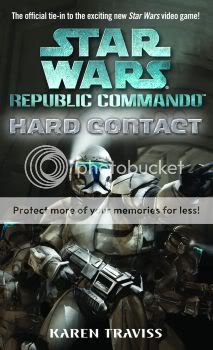
Hard Contact

Star Wars Republic Commando: Hard Contact
© 2004 Karen Traviss
293 pages

A few weekends ago I finished Star Wars: Republic Commando, a particularly fun first-person shooter set during the Clone Wars, placing the character as the lead of “Delta Squad”, a band of elite soldiers tasked with the Clone Wars’ toughest assignments. I enjoyed the game immensely for its humor and style, and decided when I found that book series had been written to tie into the game that I’d like to read part of it. That’s what brought me to Hard Contact, a straightforward military science fiction story about the misson of four Clone Commandos. They are not, alas, the four Commandos I became familar with in the game, being a different squad of troops.

The commandos are tasked with eliminating a planetary despot who controls a biogenetic agent targeting the Republic’s clone army, the potential of which earned that despot a place in the Confederacy of Independent Systems’ hierarchy. Succeeding in destroying his labs and freeing the planet from his rule will earn the Republic a new planet: failure might well see the annihilation of the entire Grand Army.  The four soldiers are seperated when infiltrating the planet, and the Jedi master with whom they expected to join forces with was killed: they are left only with his woefully inexperienced and somewhat disgraced Padawan, who is on the verge of being expelled from the Jedi Order for her ineptitude. The squad must rally together against great difficulty to accomplish their goal.

Books that are purely combat rarely resonate with me and given that I didn’t see the characters I had hoped to see, this wasn’t an exception. I generally enjoyed the book, and understand the series’ appeal to other readers. I understand Delta Squad is in other books of the series: I may like those better if I’m able to gain access to them.

Photobucket

A shot from Republic Commando. (Click for full-size.) Delta 07, or “Sev”, finds Wookie architecture peculiar. 
Posted in Reviews | Tagged | 1 Comment

Teaser Tuesday (4/5)

Teaser Tuesdays will be with you. Always. (Obi-Wan Kenobi, A New Hope. May the Fourth be with you, as it is with Should Be Reading)

Philosophy was about what you ate, how you had sex, where you lived. Get those choices right and think less squiffily, too, and it promised the good life. 

xxi, Plato’s Podcasts: the Ancients’ Guide to Modern Living, by Mark Vernon

(I was writing an essay on the English Reformation for my Renaissance and Reformation final during my usual T/T time. ;-))

Posted in General | Tagged | Leave a comment

Commodore Hornblower

Commodore Hornblower
© 1945 C.S. Forester
384 pages

My previous reads in the Hornblower series have been through collections of the shorter works, but Commodore Hornblower is a standard novel set shortly after Captain Hornblower. Hornblower has by now distinguished himself as one of the most capable and celebrated officers in the Royal Navy through a life of service punctuated by imaginative and bold approaches to problems. Fittingly, he is promoted to commodore and given a flotilla to take into the dangerous waters of the Baltic Sea — dangerous not just for  the French ships and pirates prowling about, but for Hornblower’s nebulous mission that will certainty involve diplomacy. Napoleon Bonaparte is nearly emperor of Europe, having composed a Grand Army filled with soldiers from subject nations. Only Britain’s navy and Spain’s guerrillas oppose the Corsican’s ambitions, and he is now moving that army in the direction of Russia to effect its coercion. The loyalty of the Baltic nations may shift suddenly as Napoleon presses on, and Hornblower is tasked with responding to potentially changing diplomatic conditions on behalf of the British empire.

While he isn’t attempting to prevent Britain from becoming wholly diplomatically isolated, Hornblower must still fight the French along the coasts. When Napoleon makes good his threat and invades Russia, Hornblower and his men must lend succor to the besieged city of Riga and do all they can to bolster resistance against the continent’s would-be master. I didn’t enjoy this book quite as much as I have previous Hornblower novels, with the exception of the novel’s beginning and its diplomatic intrigue. Being a history student, I enjoyed seeing Forester’s foreshadowing. He also alludes to the world of 1945, using characters’ backstories relating to Napoleon’s rise to hint to readers that history is repeating itself.

Posted in historical fiction, Reviews | Tagged , , , , , , | Leave a comment