Dynasty

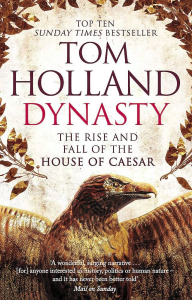
The names Caesar and Augustus have been known to me for as long as I can remember,   from the Bible’s Christmas story to early world history texts with colorful illustrations of the Forum. Despite the long history of Rome,  the Augustan family still retains its most colorful characters like Caligula and Nero:   only relatively few emperors since them, like Marcus Aurelius and Constantine, have any name recognition at all for the general public.  Dynasty is a history of this most colorful lineup of men: Caesar, his nephew Octavian (Augustus);   Tiberius,  Caligula, Claudius, and Nero.  Through them we see a slide from the rule of law and moral authority (supposed or otherwise) into military junta and rank decadence.  No stranger to Tom Holland’s pen,  I found Dynasty compelling and informative reading.

Instead of presenting the familiar narrative of a slow, steady erosion from Republic to Empire, Holland lets the men’s lives speak for themselves. We see that the transformation was not gradual at all, but began to lurch dramatically in the last days of Tiberius. Caesar and Augustus both saw themselves as saviors of the old order, which had in fact already partially collapsed during the days of the civil wars between Marius and Sulla, and the unorthodox triumvirate.  Tiberius’ reign appears to mark a crucial point: he was a creature of duty, almost slavishly so. He divorced when told to divorce, he married when Augustus told him to marry, and he looked after several sets of heirs who might one day replace Augustus at the expense of his own happiness and glory.  He was an aristocrat in both the best and worst senses of the word: he shared Marcus Aurelius’s later sense of noblesse oblige, but not his Stoic cosmopolitanism — that regard for all men as fellow creatures. Instead, Tiberius viewed the plebes in a more patronizing way: he would take care of them, but they were unwashed masses who merited no say in government. Despite his attempts to favor the senatorial class and the senate himself, Tiberius was dismayed and angered that the nobles were more than happy to let him carry the full burden of Empire.  Hating Rome and its people, he withdrew like Achilles into his tent,  slipping into his own private decadence and allowing Rome to be led – after his death – by a “viper”.   Caligula and Nero these days are bywords for cruelty and decadence,  and they are bridged by an old man who came to power at the tip of a gladius – not his own, but the praetorian guard.  The guard would become far more active in the political life of Rome after the last subject of this book is dispatched at their hands, leading to the year of four emperors.

The House of Caesar was an extremely dangerous family to be born into, given the pitilessness of Roman politics. Children were hardly safe, either from intrigue or outright murder. They didn’t need to be remotely suspected of being involved in a ruler’s either, either: Caligula’s daughter was murdered immediately after his own assassination purely to get wipe out his family line, and not in a nice way. Brutality is endemic here, even in peacetime with good rulers. Holland does not spare the reader’s sensibilities by shying away from graphic details like the normalization of rape and brutal violence: this is especially apparent with Caligula and Nero, who appeared to worship transgression for its own sake. It gets a bit lurid at times, but made me more appreciative how revolutionary Christianity would be once it swept the Empire — condemning the easy and abusive divorces of the Romans, declaring the humanity of slaves, and asserting a new moral order. Away from the salacious detail, I greatly enjoyed Holland’s writing in general. He appears to have written another work, Pax, that makes this and Rubicon into a trilogy: don’t be surprised to see it in the future, though not immediately.

Quotes

‘Nature produced [Caligula], in my opinion, to demonstrate just how far unlimited vice can go when combined with unlimited power.’

‘These are the objects of my prayers. A plot of land – not so very large. A garden, a spring beside the house, its water ever-flowing, and a small wood on a slope.’as the obituary delivered on him by Seneca, a philosopher who had known him well.

Whether cheering on boxers in back streets, sporting a battered sunhat or roaring with laughter at the sight of a hunchback, Imperator Caesar Augustus retained just a hint of the provincial. None of which did him any harm among the mass of the Roman people. It gratified them to think of the Princeps as a man without airs and graces. Intimate personal details, carefully leaked, helped to cast him as a citizen of honest, simple tastes.

A man as promiscuous as Augustus was reputed to be seemed to many citizens to lack the self-control that was properly the mark of a Roman. Unchecked sexual appetites, while only to be expected in a woman – or, of course, a Greek – were hardly appropriate to a citizen steeled in the noblest traditions of the city. Energies devoted to sleeping around were better suited to serving the glory of the Roman people.

Scolded for not emulating her father’s ostentatious frugality, she only laughed. ‘While he may forget that he is Caesar, I never forget that I am Caesar’s daughter.’

The kingdom of Armenia, a land of icy mountains, thick forests and notoriously effective poisons, lay sandwiched uncomfortably between the rival empires: too indigestible to be swallowed, too tasty to be left alone.

What they adored most of all, however, was the sheer blaze of his glamour. He might be prematurely balding, and possessed of large feet and his father’s spindly legs, yet Caligula knew how to thrill a crowd. The Roman people were bored of grim old men. Now at last they had an emperor who seemed to glory in living the dream. That summer, opening a new temple to Augustus, Caligula rode to the inauguration in a gilded triumphal chariot. Six horses pulled him. ‘This,’ so it was noted, ‘was something wholly cutting edge.’

For decades, secure within its chrysalis, protected by the cunningly crafted hypocrisies of Augustus and the superseded traditions so valued by Tiberius, a monarchy had been pupating; now, with the return of Caligula from war, it was ready to emerge at last, to unfurl its wings, to dazzle the world with its glory. No longer was there to be any place for the pretensions of the Senate – only for the bond between Princeps and people.

As for Caligula himself, he remained on the pontoon; and when he had eaten and drunk enough, he amused himself by treating some of his companions much as he had done his uncle, and pushing them into the sea. Finally, determined that the celebrations not end in anticlimax, he ordered that some of the vessels where his men lay feasting be rammed. And as he watched the action, ‘so his mood was all elation’.

Seneca, when he imagined Roman ships powering their way to as yet undiscovered continents, did not necessarily approve. As a philosopher, he saw nothing to celebrate in perpetual motion. The prosperity that was the mark of a great empire was, in his opinion, a treacherous and soul-destroying thing, characterised by perpetual restlessness, and destined only to torment itself.

‘What an artist perishes with me.’ So Nero, with his customary lack of modesty, had declared as he steeled himself to commit suicide. He had not exaggerated. He had indeed been an artist – he and his predecessors too. Augustus and Tiberius, Caligula and Claudius: each, in his own way, had succeeded in fashioning out of his rule of the world a legend that would for ever afterwards mark the House of Caesar as something eerie and more than mortal. Painted in blood and gold, its record would never cease to haunt the Roman people as a thing of mingled wonder and horror. If not necessarily divine, then it had at any rate become immortal.
Posted in history, Reviews | Tagged , , | 3 Comments

WWW Wednesday + Book Series We’ll Never Read

WHAT have you finished reading recently? The Iron Dream, a satire of pulp fiction that uses the premise that Adolf Hitler left Germany in 1919 and later became a prominent sword-and-sorcery writer during the golden age of pulp fiction. It’s….all kinds of weird.

WHAT are you currently reading? Dynasty, by Tom Holland, is my fun read; it’s a history of the house of Caesar. Against the Machine when I’m focused and ready for more reflective and serious reading.

WHAT are you reading next? Most likely Caesar by Adrian Goldsworthy; it’s waiting at the post office for me now.

Today’s prompt from Long and Short Reviews is “Book Series We Will Never Read and Why“. The easiest answer, of course, is romantic or erotic fiction, whether that’s 50 Shades of Grey or anything in the apparently rapid-growing ocean that is romantic fantasy. I suppose there are also huge series like Robert Jordan’s Wheel of Time, simply because they’re so enormous. Additionally, if sex and violence mark Game of Thrones the way they’re supposed to, that’s also something I’m not terribly interested in pursuing.

Posted in General | Tagged , | 9 Comments

The Iron Dream

You know how I mentioned October would have a nod to German history, and maybe combine it with horror? …this is not now I expected that to happen. This will surely be my strangest book read for 2025.

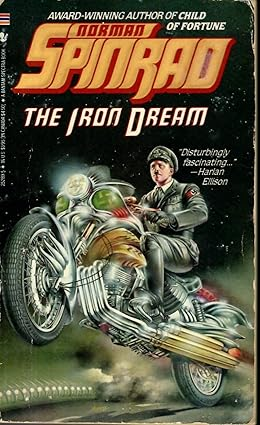
There I was, innocently browsing Substack, when lo! I spotted an outlandish title: WHEN ADOLF HITLER WROTE SCIENCE FICTION. Well, color me clickbaited! The post was about this book, The Iron Dream, which contains a satire of pulp-fiction action-fantasy bookended by a fictional academic analyzing it from a literary perspective. The academic and the satire are both composed in an alternate history: the framing scenario is one in which Adolf Hitler immigrated to the United States after World War 1 and developed a career for himself as a pulp writer, something in the realm of Robert E. Howard. His Hero is larger than life, his antagonists grotesque monsters who are as revolting as cockroaches. Hitler’s most famous work, the one that inspired his following, was Lord of the Swastika.

There, a man (Ferric Jagger) in a post-apocalyptic landscape secures a future for humanity by joining a bicycle gang and creating an army to destroy all the mutant half-men races lumbering around. This task is made considerably easier once the Hero discovers The Steel Commander, a magic truncheon that has been waiting for the Heir of Slytherin to show up and claim it. I haven’t read much, if any of the fantasy-adventure pulps — a bit of John Carter of Mars, but that’s it — so I don’t know how successful this book is in aping the style. It’s certainly delivers enough risible bombast, but with ubiquitous Nazi imagery (swastikas and heavy use of red/black) to unsettle the reader. Feric’s “Sons of the Swastika” are even more flamboyant than the IRL Nazis: Feric, the Commander, wears an SS uniform with a red cape, and SS boots all have lightening bolts emblazoned on them.

Spinrad also weaves in some more subtle Hitler references, like the Hero’s preference for a vegetarian diet: contagions from the Fire that destroyed civilization are more concentrated the higher one moves up the food chain. There are also possible historical connections, with an evil empire obviously modeled after the Soviet Union, and another race who play the same antagonistic role in the story that Jews did for Nazis in real life .As morbidly amusing as the premise and execution are, they go on for far too long: half the book is a long, unbroken chain of ogre-slaughtering and bombastic speeches delivered atop piles of bodies. The ending was not what I expected, though. It’s hard to recommend this book on anything other than the absurd premise, though fans of the pulp styles might find additional interest, particularly since Spinrad was allegedly attacking the power fantasies of those works and labeling them as fascistic.

I’m Stag Stopa, and we’re the Black Avengers, and if you don’t know what that means, you’re about to find out. We like riding our bikes and getting drunk and wenching and a good fight and stomping mutants and big mouths and not much else.

Related:
Ursula LeGuin’s review

Posted in Reviews | Tagged , , | 9 Comments

Top Ten Satisfying Series + Teaser

Today’s TTT is “satisfying book series”. But first, a tease…

When scolded for not emulating her father’s ostentatious frugality, she only laughed. ‘While he may forget that he is Caesar, I never forget that I am [Augustus] Caesar’s daughter.’ Caesar himself, unsurprisingly, was not amused. When the Princeps declared that he had ‘two wayward daughters to put up with, Julia and the Roman Republic’, his tetchiness was laid revealingly bare. (DYNASTY, Tom Holland)

(1) Star Trek: Millennium. This trilogy knocked my socks off when I read it first in the early 2000s, and I enjoyed it just as much when I re-read it here in 2011. The trilogy begins as a simple mystery aboard Deep Space Nine — the discovery of two bodies fused into the hull of the station, their uniforms some 20 years dated — and turns into a universe-threatening thriller. It has the singular acclaim of having inspired a video game, The Fallen.

(2) Star Trek: Destiny, David Mack. This trilogy took a lot of characters and storylines in the Star Trek Relaunch series and incorporated them into an epic story that both concluded the great Borg War storyline, and shed light into the Borg’s origins. When I started getting pack into Treklit in the 2010s, people would not shut up about Destiny, and I quickly understood why.

(3) The Arthur trilogy, Bernard Cornwell. This outstanding trilogy features all of Cornwell’s usual strengths with the added appeal of playing with Arthurian lore: the mythic aura that hangs around any Arthur story manifests itself here, especially in the second volume where there’s the slightest whiff of the otherworldly and fantastical. I think it’s the only book I’ve read in my 18 years of blogging that I referred to as “magnificent”.

(4) The Chronicles of Narnia, C.S. Lewis. I only read The Lion, the Witch, and the Wardrobe as a child, but a few years back I decided to read the entire series and delighted in almost every one. (The Magician’s Nephew is still my least favorite, but I enjoy it well enough.) I was especially blown away by the last books, The Silver Chair and The Last Battle. Two favorite quotes from Silver Chair:

“We’ve got to start by finding a ruined city of giants,” said Jill. “Aslan said so.”
“Got to start by finding it, have we?” answered Puddleglum. “Not allowed to start by looking for it, I suppose?”

“I’m on Aslan’s side even if there isn’t any Aslan to lead it. I’m going to live as like a Narnian as I can even if there isn’t any Narnia. So, thanking you kindly for our supper, if these two gentlemen and the young lady are ready, we’re leaving your court at once and setting out in the dark to spend our lives looking for Overland. Not that our lives will be very long, I should think; but that’s a small loss if the world’s as dull a place as you say.”

(5) The Joe Pickett series. This is straying a bit from my definition of “finished” series, especially seeing as a new book is scheduled for next year already, but I do find the books deeply enjoyable. Between the outdoor setting and the strength of the various characters, it’s the standout of the year for me.

(6) Sharpe, of course. I’ve been marching with the rifleman for….fifteen years and haven’t gotten tired of him since.

(7) Port William. There is nothing quite like visiting Wendell Berry’s farming town, whose story has been told by multiple characters across the decades. Speaking of, Marce Catlett is being released today!

(8) California Diaries, Ann M. Martin. This was a middle-school series following five friends’ lives across the course of a year via their journals that I loved so much I revisited it last year.

(9) The Black Widowers series. Every month, several professional men get together in a New York restaurant in a private room to enjoy dinner, conversation, and — a mystery, presented them by the guest of the month. While I enjoy these for their puzzle elements, frankly I delight in the conversation and argument between the memorable guests.

(10) Ben Kane’s Richard the Lionheart series.

Posted in General | Tagged , | 26 Comments

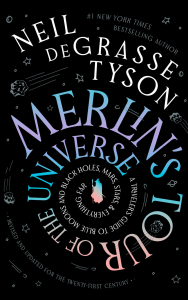
Merlin’s Tour of the Universe

This is a book I’ve been meaning to read for years, though the only thing I knew about it was that it was authored by Neil deGrasse Tyson. Tyson is the director of the Hayden Planetarium and a public advocate for science, with a podcast. Merlin’s Tour of the Universe isn’t a regular monograph, but rather a collection of questions and answers via newspaper. Tyson answers through his alter-ego Merlin, who is evidently quite old. The book is rather dated on some facts, of course, and some views: Merlin sees no threat to Pluto’s planetary status at all, while NDT himself caused a stir by removing Pluto from the hall of planets even before the astronomy cabal had exiled it into the outermost darkness of “dwarf planets”. The book was published in 1989, so this is no surprise — though realizing there were no identified planets outside of our solar system at this time was a bit weird for me. Generally, I enjoyed the format and the content, though there were some oddities like Merlin declaring that Earth should not be capitalized because it wasn’t named after anyone, unlike the other planets. Merlin may be a space wizard, but as far as English grammar goes, he’s an orc: proper names don’t need to have a person involved! The variety of questions was good, and gets better the more it moves away from Earth: I especially enjoyed Merlin’s attempt to explain why people can “see” the Milky Way while still living within the Milky Way via blueberry pancakes. (I am very partisan towards blueberry pancakes, however.) There are many perspective-rattling questions here, and some amusingly dated, like debates over when the Millennium began. Ah, for a world when 2001 was thought of as only the “real” date the New Millennium began. Now we live in one in which when Tyson proposes readers get together at a certain spot in New York City at a certain date in 2018, I had to Google Maps it to see if the place still existed or had been removed by jihadis. Despite this book’s age, it has its charms, especially Merlin’s penchant for responding in poetry..

Here is one such poem:

Mercury has no moon, and
Venus does not, it is true.
But Earth, of course, has one, while Planet Mars, take note, has two.
Mighty Jupiter, by jove,
Displays sixteen moons—what gall!
But Saturn sets the record
With seventeen —large and small.
Uranus has quite a few
With its fifteen moons in thrall.
Neptune’s eight, and Pluto’s one
Tallies sixty moons in all

I had ChatGPT “update” the poem thusly:

Mercury has no moon, and
Venus none as well, it’s true.
But Earth, of course, has only one,
While Mars holds tightly two.

Mighty Jupiter, by Jove,
Parades ninety-five in all!
Yet Saturn tops the table—
One-forty-six, large and small.

Uranus has twenty-eight,
In Neptune’s thrall are sixteen.
And Pluto, classed a dwarf, has five—
Its family can be seen.

So tally them together,
This grand celestial run:
Nearly three-hundred moons we know—
And still we’ve just begun!

Quotes:


Dear Merlin,
I don’t understand how a black hole could become so dense that
it could be the size of an atom
Erin French
Lansing. Michigan

Dear Erin:
Neither does anybody else.


Posted in General, Reviews, science | Tagged , , , | 8 Comments

The Best of Oct ’24 – Oct ’25’s Teases

Three years ago, I started posting Tuesday Teasers after a long period of dormancy — so long, in fact, that the original host of it from 2009 was no longer around. After a year of consistent teases, I shared my top ten favorites; I forgot to do that last year, but this year I’m on top of things! So, here are ten of my favorite teases from October 3rd, 2024, til today.

“Imagine it — to be the King-Emperor of nearly five hundred million subjects and to be able to locate the twelve dullest, then gather them together around one table. It takes a special kind of genius.” (Precipice, Robert Harris)

“I’m guessing you didn’t slip a sedative into my drink and drag me all the
way out into the boondocks and drape me from a tree just to discuss, I don’t
know, philosophy. ’Less you have, in which case I apologize for misreadin’
the situation. It’s just, you don’t look the philosophy type.” (Firefly: Life Signs)

[Our friend] arrived late because he’d been arguing with a man selling red T-shirts with pictures of Stalin on them.
“Do you realize,” he had said, pointing at the merchandise, that this is the greatest mass-murderer of the twentieth century?”
“Don’t blame me,” said the man, “I just sell T-shirts.” – Paul Kingsnorth, One No, Many Yeses

Observation can tell more about the observer than about the environment being observed. It reflects the values, beliefs, and worldview of the witness. We see through the lens of our interests, and understanding. […] Hiking with a birdwatcher is quite a different experience than hiking with a geologist — one points out the flicking wings of a Ruby-crowned Kingler, the other notes the lavender glint of Lepidolite mica. Neither may notice the changing cloud formations that spell tomorrow’s snow. […] What we see is largely who we are and what we have learned to see. There is no such thing as an objective observer.” – “Eyes Wide Open”, What We See: Advancing the Observations of Jane Jacobs

“Do you have a birth certificate?”
“No.”
“May I ask why not?”
“I was a baby. I wasn’t in charge of the paperwork.” (Camino Ghosts, John Grisham)

“When you’re sneaking up on somebody, you might consider keeping your voice low,” Wacey hissed as McLanahan approached. “It’s an old, sly Indian trick.” – OPEN SEASON, C.J. Box

“What do you mean you shot him and then HIT HIM WITH A FISH?!” THE DISAPPEARED, CJ Box.

“Harris dashed forward only to have another mine shred his abdomen and legs; after flicking grenades into a line of pillboxes, he sprinkled sulfa powder onto his protruding intestines, cinched his web melt to keep the innards in, and wandered down to the beach to find a medic.” THE DAY OF BATTLE, Rick Atkinson

“You don’t want to get mixed up with them,” Joe said. “They’re bitter and they’re well armed and they hate the feds.”
“They sound like my kind of guys,” Nate said. THREE INCH TEETH, C.J. Box

“The way they tell is, the whole place is full of intransigent locals who don’t respect their authority.”
“Probably just me,” Joe said. THREE INCH TEETH, C.J. Box

There’s a reason I read the entire Joe Pickett series through in two months!

Posted in General | Tagged , | 2 Comments

WWW Wednesday

WHAT have you finished reading recently? The Day of Battle, a girthy history of the Anglo-American invasion of Sicily and Italy in World War 2.

WHAT are you reading now? Against the Machine, Paul Kingsnorth. I’m also looking through Starry Messenger, which I picked up a few months back but have yet to dive into.

This, then, is the Machine. It is not simply the sum total of various individual technologies we have cleverly managed to rustle up—cars, laptops, robot mowers and the rest. In fact, such ‘technics’, as Mumford calls them, are the product of the Machine, not its essence. The Machine is, rather, a tendency within us, made concrete by power and circumstance, which coalesces in a huge agglomeration of power, control and ambition. The Machine manifests today as an intersection of money power, state power and increasingly coercive and manipulative technologies, which constitute an ongoing war against roots and against limits. Its momentum is always forward, and it will not stop until it has conquered and transformed the world.

WHAT are you reading next? I’m trying to knock out my remaining Science Survey entries. Biology should be a doddle (historically, it’s one of the fields that monopolized my science reading and led to me CREATING the Survey to keep things more broad), but chemistry and cosmology are always harder.

Posted in General | Tagged , | 8 Comments

American Orthodox

A few months back, I happened to hear one of my favorite Orthodox pieces of music, the Paschal Troparion, put to the tune of an Appalachian folk melody. As it happens, I adore folk music: I spend time actively memorizing English, Scottish, Irish, and American folk melodies and their varied lyrics. I was instantly smitten, and wondered what such cultural adaptation said about the future of Eastern Orthodoxy in the United States. To date, from what I’ve read, Orthodoxy has been hindered by the fact that its patriarchates tend to be ethnically oriented, so that a visitor to a Greek or Russian Orthodox church may feel like a tourist in a foreign culture. The Orthodox Church in America is trying to overcome that by offering a “native” Orthodoxy, but despite the number of young men who are attracted to it, it hasn’t gone quite mainstream yet. While searching for something on this subject, I encountered American Orthodox — which has a promising title, but struggles to find a cohesive message.

American Orthodox is a curious little book,  more of a collection of pieces than a focused monograph. It opens with the stories of several people who had encounters with St. Peter the Aleut in Alaska and California,, including a woman who discovered an icon of Peter which had washed up on the beach.  St. Peter was an early Aleut convert to Russian Orthodoxy who the Spanish made a martyr of in San Francisco from a mix of ethnic and religious acrimony.  The number of people who have felt a connection to St Peter include the author, who threw an icon into the ocean in some attempt at finding closure in his life.   The book then shifts into reflections on Orthodoxy in general, including the role of beauty and particularly icons in guiding people to God.  This includes a physical description of how the interior of a purpose-built Orthodox church is structured, with emphasis on the iconostasis. As someone who has visited an Orthodox church   but didn’t know names of these particular elements, I found this helpful – despite having read other books on Orthodoxy by Ware and Mathews-Green!  This reflection on beauty is immediately followed by an epilogue, and a timeline of Orthodoxy in America.  As someone who finds Orthodoxy fascinating  – especially its music and the homilies I’ve found on youtube, which are more biting and insightful than most – I enjoyed it, but I imagine many readers who might pick it up would wonder what its mission was meant to be. 

Posted in Religion and Philosophy, Reviews | Tagged , , , | 3 Comments

September 2025 in Review + Tuesday Tease

‘Twenty years ago’, said Mark, toying with his knight, ‘we were fighting to save wilderness from destruction. Now it seems like we’re just fighting to keep ourselves off screens twenty-four hours a day.’ AGAINST THE MACHINE, Paul Kingsnorth

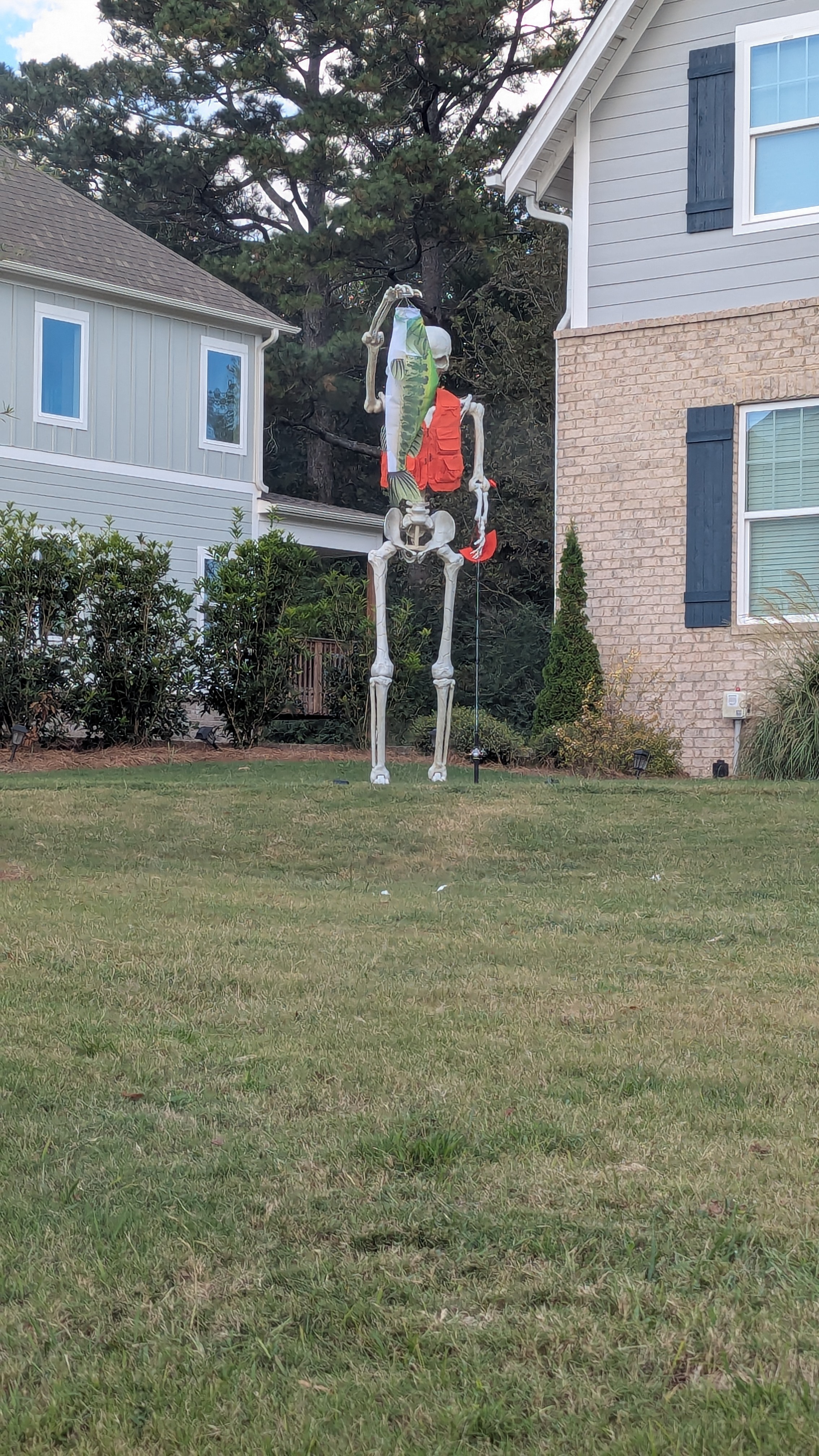
September was, without a doubt, a month of history. If you’ve followed me a long time, you know that history is my mainstay here, but the sheer-exclusive focus I had on it this month was still unusual. Also happily unusual was the lack of hurricanes: September is usually the peak season for them down here, with no close rival. (Unlike April and March, who squabble over who has the most tornadoes.) We even had two potentials brewing, and then one bumped into the other and away they both went! It was a warm and largely dry month here in the Heart of Dixie, aside from some occasional showers. Enormous yard skeletons are evidently in vogue this year, as I’ve spotted no less than five houses sporting them.

Moviewatch Sept 2025

It was probably a consequence of 4.5 weeks of back-to-back dogsitting at 5 different houses, but I watched almost nothing this month — at least, not movies. I’ve been watching Roger Clark play Red Dead Redemption 2, which provides both his behind-the-scenes commentary and the weird feeling of knowing a game better than ‘the main character’ does. I’ve also been binging on police bodycam videos, mostly because of Frank Sloup. (“If you get another citation like this, you can trade in all three for a bicycle — because we’re going to suspend your license and you won’t be able to drive.”) He often introduces motorists to Stoicism.

Patton,  1970.  George C. Marshall’s most-known role, here he plays George Patton during World War 2.  Despite frequently reading about WW2, I know little of Patton besides his reputation for being..gung-ho, shall we say, and his role in D-Day prep by being put in charge of a fake army to confuse the Germans.    This had some great depictions of tank battles, and one of my favorite-ever line deliveries:  “Rommel, you magnificent bastard, I read your BOOK!”   Sprinkled with humor – some intentional, some not. 

Rush Hour, 1998. A rewatch for me. Chris Tucker  and Jackie Chan star in this comedic buddy-cop movie:  Chan is a Chinese national whose former boss’s daughter is kidnapped by baddies in Los Angeles.  Former Boss has the full cooperation of the FBI, but wants to bring in Chan to have someone familiar on the case. The FBI doesn’t want any interference, so they tap an LAPD detective who is known for being disruptive and useless to keep Chan busy. Hilarity ensues.   This may be the only film to ever show realistic Los Angeles traffic, in that it’s at a complete standstill. 

Fire Birds, 1990. Apache helicopter action? Check. Tommy Lee Jones? Check. Score by David Newman, who also did Streets of Fire? Checkity check check. “This warbird is agile, mobile, and hostile!” The acting and writing are….not good: this is the worst performance I’ve ever seen by Nicholas Cage. They’re as impactful as the scene where Tommy Lee Jones is giving the punching bag little “I got your nose!” boops. The plot is 2/3rds Nicolas Cage trying to get used to the new Apaches, one third using said helos to deliver death from above to drug cartels.

Coming up in October…

Wendell Berry is releasing a new Port William novel on October 7, so I’m probably going to be all over that. October also means a nod to German history, inspired by Reunification Day (October 3rd), and maybe some horror if I get in the mood for it. That’s unlikely. I also really need to get cracking on some more science reading: I have four categories outstanding in the Science Survey.

Posted in General | Tagged , , | 3 Comments

The Day of Battle

Although I’ve been reading about World War 2 for most of my life at this point, beginning in middle school, the scope of my reading has never broached the Italian campaign. This is probably due to the huge role D-Day plays in the imaginations of Americans thinking about the war in Europe: it was a deadly drama like no other. Or…was it? Turns out, Operation Shingle and the resulting battles of Anzio and Rapido also featured surprise landings and a brutal reception, with intensive fighting over the course of months. I suppose it’s a tribute to how much death and spectacle there was in World War 2 that something like Anzio gets short-shifted. The Day of Battle is a well-written and grimly detailed account of the Allies’ push into Sicily and Italy, suffering only from a want of more maps when appropriate.

One surprising aspect of Day of Battle is how uncertain the Allies were about moving this direction to begin with. Neither Sicily nor Italy were attractive landscapes for offensives, riven as they were with hills and mountains, and the Alps themselves were a formidable barrier between Italy and the tank country of western Europe. Mussolini was removed from office during the capture of Sicily, and surely a bombing campaign could remove Italy from the war. Problem was…there were Germans in Italy, too, and they weren’t going to march home singing of Erika and Lore and their little Marlene. They were going to stand and fight, and delay any attempt at a push toward Germany in their front. Delay they did, too: Allied forces had been pushing up from Salerno but ran into stubborn resistance well south of Rome. Operation Shingle deposited three divisions of troops behind the lines in the hopes of using that in conjunction with an attack on the Rapido River to force an advance. Instead, the troops on the Rapido were cut down like some grim mini-reenactment of the Battle of the Somme, and the divisions who landed near Anzio were bottled up for four months, this time recreating something like Gallipoli. Although General John Lucas was initially castigated for not being more aggressive about spreading away from the beaches, Atkinson remarks that other military minds — then and now — regard Lucas’ action as prudent.

Regardless, both he and his fellow commanders were in for months of hell, shelling, and mutual slaughter: while the men at Anzio fought desperately to maintain their foothold in Italy, the bulk of Allied forces were crashing against the Gustav Line, anchored at Monte Cassino, across four distinct battles. Men on both sides were pushed to the limits of endurance — physical and otherwise. Because fronts were stationary, carnage mounted — literally, with some soldiers being shaken by stacks of corpses and bags of dismembered bodyparts. Supplies ran low: when breakthrough happened later on, Allied soldiers discovered that the German wounded were being treated with paper, bandages having been exhausted.The Gustav Line front moved at such a sluggish pace to remind its generals of the Great War, and the Germans used it for propaganda — producing a poster that suggested that based on the Allies’ rate of movement from September ’43 to February ’44, that they should arrive in Berlin in spring 1952. (German radio also referred to the Anzio beachhead as the largest prisoner-of-war-camp in history, something the grunts who defended their stake for months on end might not have argued with.) This continued until May 1944, when a massive offensive kicked off that would eventually result in the capture of Rome only two days before another massive invasion of Europe happened — a one-two punch like nothing since Vickburg fell and Lee’s army faltered at the Angle in Gettysburg.

This was quite the read. It helped, of course, that I had virtually no idea of what the Italian front was like, so that everything came as a surprise. Even if I had been familiar with the broad outlines of the campaign, though, I think I would have still been surprised by the role played by Polish and Indian troops, and the meatgrinding aspects of the bloody scrum. While I figured moving through mountains was no picnic, I didn’t realize how effective and costly the German defense was, and Atkinson heaps on the details to drive the butcher’s bill home in a visceral fashion. I cannot recommend that readers read this at lunch, which was my practice. The book well drives home the adage that no plan survives contact with the enemy, or that everyone has a plan until they get punched in the face: despite all the preparation on other side, not until battle was engaged and forces set loose that could not be suddenly recalled did either party start seeing what was going to happen. I’d also never heard of the outrages committed by African colonial troops against Italian populace — with so many deliberate rapes that American troops confessed they’d rather shoot the Goumiers than the Germans. One sixteen year old girl was raped four times by France’s colonials. Interestingly, although Hitler later wanted Paris burned rather than ceded to the Allies, Atkinson records here that the Bavarian insisted that there be no “battle of Rome”: he valued its architecture too much. I also enjoyed the section in the epilogue that weighed military criticisms of the value of the Italian campaign against one another — comparing the men and material lost against the bombing advantages and greater sea & air control gained. (The German general Kesselring also weighs in, stating that the Allies’ invasion of Normandy showed clear knowledge gained at great cost on the beaches at Anzio.)

I will most likely finish this trilogy, though having been marching through Italy for nearly three weeks now, I need a breather.

All documents that disclosed the invasion destination were stamped with the classified code word Bigot, and sentries at the Husky planning headquarters in Algiers determined whether visitors held appropriate security clearances by asking if they were ‘bigoted.’ (‘I was frequently partisan,’ one puzzled naval officer replied, ‘but had never considered my mind closed.’)

By any reckoning, two U.S. infantry regiments had been gutted in one of the worst drubbings of the war; the losses were comparable to those suffered six months later at Omaha Beach, except that that storied assault succeeded. “I had 184 men,” a company commander in the 143rd Infantry said. “Forty-eight hours later I had 17. If that’s not mass murder, I don’t know what is.”

“I will do what I am ordered to do, but these Battles of the Little Big Horn aren’t much fun.”

Each yard, whether won or lost, pared away American strength. In a two-acre field diced by German artillery, survivors counted ninety bodies. Six new lieutenants arrived in the 2nd Battalion of the 135th Infantry; a day later just two remained standing.”

“Sir,” a major said, “I guess you will relieve me for losing my battalion?” Darby smiled. “Cheer up, son,” he replied. “I just lost three of them, but the war must go on.”

A Forceman whose leg was blown off rode to the aid station atop a tank. “Hey, doc,” he yelled to the battalion surgeon, “you got an extra foot around this place?”

“Are we beasts? Are we taking this too far?” Churchill wondered aloud. Later the prime minister, who had ardently pressed for some of the most ruinous raids, would voice regret “that the human race ever learned to fly.”

Only one in four Eighth Air Force bomber crews flying in early 1944 could expect to complete the minimum quota of twenty-five missions required for reassignment to the United States; those not dead or missing would be undone by accidents, fatigue, or other misadventures. Bomber Command casualties were comparable to those of British infantrymen in World War I. Here was a pretty irony: airpower, which was supposed to preserve Allied ground forces from another Western Front abattoir, simply supplemented the butchery.

Crewmen sang a parody of the theme song from Casablanca: “You must remember this / The flak can’t always miss / Somebody’s gotta die.”

For every boxcar destroyed, ten replaced it: the Germans owned two million in Europe. Extravagant camouflage, such as the threading of new bridge spans across the Po River through the wreckage of the old, made targets harder to find.

A study of four infantry divisions in Italy found that a soldier typically no longer wondered “whether he will be hit, but when and how bad.” The Army surgeon general concluded that “practically all men in rifle battalions who were not otherwise disabled ultimately became psychiatric casualties,” typically after 200 to 240 cumulative days in combat. “There aren’t any iron men,” wrote Brigadier General William C. Menninger, a prominent psychiatrist. “The strongest personality, subjected to sufficient stress a
sufficient length of time, is going to disintegrate.”

“A corporal came and stood among the wounded…. Through his torn tunic I saw a wound the size of two hands, the shoulder-bone bared.” The corporal told him, “I shan’t let you evacuate me until I’ve thrown all my grenades.”

“Mark Clark has laid 4–1 against our crossing the Rapido,” Leese wrote. “As they say at a private school, ‘Sucks to be him.’”

After contributing so much to Allied success in DIADEM, some colonial troops now disgraced themselves, their army, and France. Hundreds of atrocities—allegedly committed mostly by African soldiers—stained the Italian countryside in the last two weeks of May, including murders and gang rapes. “All day long our men observed them scouring the area for women,” an American chaplain wrote Clark on May “Our men are sick at heart, and are commenting that they would rather shoot the Moroccan Goums than the Germans…. They say we have lost that for which we fight if this is allowed to continue.”

“We suffered more during the 24 hours of contact with the Moroccans than in the eight months under the Germans,” one Italian complained.

A message to the Combined Chiefs in Washington and London formally announced, “The Allies are in Rome.” How long it had taken to proclaim those five words; how much heartbreak had been required to make it so.

Related:
The White War, on the Italo-Austrian war during WW1.

Posted in history, Reviews | Tagged , , , , | 3 Comments