Today’s TTT celebrates authors we discovered in 2024. But first, teases!
Fifteen miles in from Guadalcanal’s north coast, up a mountain trail that teases the climber with an apparently endless succession of hillocks, there stands a ridge that offers a magnificent view of the coast and sea. At the edge of this ridge lie the remains of an old kerosene-run refrigerator. (Lonely Vigil: Coastwatchers of the Solomons)
Thinking about this, I am reminded of the concepts of yang and yin, the philosophy of opposing forces. We know that the forces that shape life are in constant flux. The moth that pollinates the flower of a plant is the same species that devours the plants’ leaves when it is still a caterpillar. It is not, then, in the plant’s interest to completely destroy the grazing caterpillars that will metamorphose into the very creatures it relies on to spread its pollen. (The Light Eaters)
Local party officials found themselves between Stalin’s hammer and the grim reaper’s sickle. The problems they saw were objective and not soluble through ideology or rhetoric: lack of seed grain, late sowing, poor weather, machinery insufficient to replace animal labor, chaos from the final push toward collectivization in late 1931, and hungry peasants unable to work. (Bloodlands: Europe Between Hitler and Stalin)
And now, for discovered authors in 2024!
Rachel Joyce, Toshikazu Kagwaguchi, Harrison Scott Key, and Becky Chambers
(1) Rachel Joyce gets pride of place, of course: her Music Shop took me wholly by surprise, and she became a “stalk and read all her things” author.
(2) Ruth Ware, who lured me in with an IT-type novel and then kept me entertained with varied thrillers throughout the year.
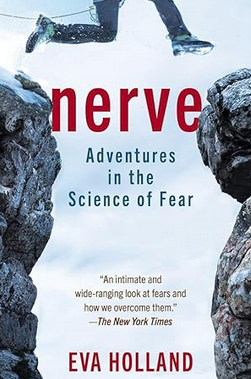
Nerve is an odd little title, a memoir of a woman trying to overcome some specific fears — falling from heights, and driving — occasionally interspersed dips into psychology and neurology. Eva Holland’s fear of heights is enough that she tries multiple avenues to address it: controlled exposure, “EMDR” treatment, specialized clinics, eta. Though she’s writing about her fear and panic attacks, Holland strikes me as a courageous person: her body may quake, but her will is strong: she continues trying to push herself by rock climbing and jumping from a plane. (It was….not a pleasant experience.) Although this isn’t a science book proper, as she reviewed literature on fear-studies she passes on much of interest for the common reader: the fact that our brains parse fear-sweat differently than exercise-sweat, for instance, and the powerful role intuition can play in creating the sense of fear. Our brains can recognize clues that throw up red flags long before our rational, conscious mind. We learn, too, of the value of fear: one woman had a brain disease that destroyed her ability to experience fear, for the most part, and it led to her into one bad life choice after another, and made it difficult to maintain relationships because she had no fear of offending or stepping on toes. The book is an interesting read, aided by having such a determined and resilent author who does in fact make serious strides into mitigating some of her more irrational or overactive fears.
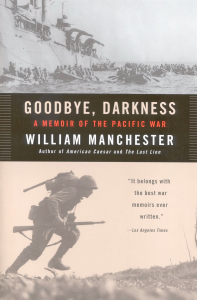
Haunted by disturbing dreams that evoke the bloody days of his youth, William Manchester decided to confront his memories directly. Retracing his steps in the Pacific War, returning again to the jungle-covered rocks wherin he suffered, and where so many of his brother Marines perished long before their time. Goodbye, Darkness is his memoir of that trek, combining history, personal memoir, and brooding travel ruminations. Or…..that’s what it’s written as, anyway: what eighth grade me didn’t know reading this for the first time back in ’98 or ’99 is that Manchester’s boots didn’t hit the ground until Okinawa, so much of this history is….borrowed or perhaps invented, making this a curious mix of history, memoir, and fiction. And I do mean curious: the chapter on Tarawa features Manchester talking about “our” experience in the botched landings, the intense resistance from the Japanese, etc, and even has himself in place arguing with an officer that a frontal assault on a particular objective is suicide until the flanking squads have finished their work; a section later, he notes that his ’78 visit was his first time visiting the island itself. The result is a fascinating if sometimes conflicting work.
Whatever its nonfiction versus fiction status, it is absorbing: as with re-reading Sam Stavisky’s Marine Combat Correspondent, I found myself surprised at the sheer amount of phrases and descriptions from this book that have sunk their way deep into my head, so deep that I didn’t even remember their origin until I saw them here. Many scenes described here have etched themselves into my head, be they fictional or nay – – like Manchester bursting into a hut and making his first kill, then going into shock, soiling himself as he wept. Manchester gets into personal details here, and not just about the war: he documents his attempts to ‘get laid’ before he ships out, not wanting to die a virgin, and — well, much awkwardness ensues, as it does when a psychologically traumatized Manchester begins having delusions of a rotting Japanese seductress trying to tempt him into enemy lines so they can couple. Psychological drama is pervasive here, not surprising given the impetus for Manchester’s “trip”: he’s constantly ruminating on who he was going to war, who he became during the war, what he was fighting for, and the way the world has gone. Manchester, a man who came of age in the early forties, is not impressed by student protestors and the like, and while respecting his former adversaries resents the way Japanese commercial interests have expanded into places where their military forebears had been repulsed at great cost. His feelings about the sites he visits vary widely: in some places, the war’s scars remain in the form of old pillboxes and rotting tanks, whereas he’s absolutely dismayed to arrive at Okinawa and find it covered in neon and asphalt.
Although I soured on Manchester as an historian after Frances and Joseph Gies’ medieval historiesthroughly destroyed his notion of the Middle Ages, I must say I enjoy him as a writer: even after realizing that this wasn’t a straight memoir, but a mix composed by a man who admits to receiving multiple head wounds and having a memory that’s rather hazy, I was pulled totally into his story. It helps, I think, that I read Manchester at a formative age and don’t find his annoyance and discomfort with the postwar (especially post-Vietnam) world as bothersome as a lot of modern readers. This book is full of visceral details that made the Pacific War come alive when I was reading it in middle school, and I still find it compelling reading despite knowing it’s not Manchester’s experience in full.
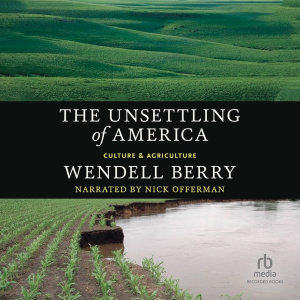
It was twelve years ago that I met a man named Jayber Crow, and met too, his author — Wendell Berry. Berry is one of my very favorite living authors, and would probably still make the list of favorite authors in general. For those who don’t know, Berry is first and foremost farmer and husband, hailing from Port Royal, Kentucky. Port Royal is loosely the basis of his Port William novels, which are both superb character dramas and all part of a longer story that is Port William’s decline as industrialism takes over agriculture, with both social and personal consequences. Those personal and social consequences are the subject of this treatise, which is a deeply thoughtful reflection on how industrialism has not only destroyed agriculture, but American culture in general. It’s a landmark work, and I was tickled to see that Audible offered it in their library, performed by Nick Offerman — whose steady, thoughtful tone was perfect for the subject.
Unsettling of America is a remarkable work, demonstrating in full Berry’s holistic or integrated worldview. It is a view in which all the aspects of human life are bound up together, inseparable, just as we are inseparable from the creation. We are engaged together in a ‘membership;, one of his favorite words. Change man’s relationship to the land, and the effects ripple into everything: personal meaning, relations between the sexes, etc. Berry opines industrialism is exploitative — a one-sided exchange in which humanity consumes that which it did not, and cannot create or nurture. (Compare this to agriculture, in which we have a relationship with the land and pay attention to and even nurture it so that it might in turn nurture us.) The essential rapaciousness, he continues, colors all that follows: the husbandman who becomes a common laborer is reduced to a cog in machine, performing the same rote action a thousand times a day. This is not only demeaning and unpleasant, but an absolute smothering of what we are capable of.The industrial system, when applied to farming, has a similarly desecrating and destructive role, both to the land and to those who are farming. Farmers who take loans out to buy new equipment often find themselves trapped in a circulating spiral of debt, and this is debt often imposed on them by food wholesalers like Tyson who demand they upgrade their machinery for their contracts to be renewed. Thus, even big operators can become, at the bottom of the balance-sheet, little better than tenant farmers. There is no stability, no harmony — only the desire for more growth, more consumption, bigger factories, vaster acreages — consumption by appetite.
Like a plowman drawing lines across rich earth, back and forth creating a pattern that will, in time and with care, produce food fit for eating, so too does Berry explore his general theme through multiple lines — history, economics, politics, etc. In addition to big picture reviews like the general theme of exploitation and abuse that industrialism engenders, he also looks at smaller topics like continuing experiments with horse-based agriculture, still practiced by the Amish and a few private practitioners who have recognized the toll that multi-ton machines take on the land, compacting the soil. But as much as Berry writes on the land — his love of land, of building and protecting it permeates this — the book is as mentioned holistic. Berry is critical of our obsession with convenience and ease, for instance, and argues that labor is part of what makes us whole: a more recent book, Shop Class as Soulcraft, has also argued for that, and its author has since written on the importance of staying grounded in the material world.
Unsettling was in turns insightful, inspiring, and disturbing — disturbing because of how far we have gone since this book was originally published, further and further away from an economy in which human needs could be squared with what the land can bear. No only have we become more rapacious in what we consume individually — see the ever growing number of self-storage enterprises popping up — but agriculture has continued being devoured by corporate-agribiz. The good news is that resistance has also grown, and today there are younger voices like Joel Salatin and Paul Kingsnorth continuing the line of argument Berry began.
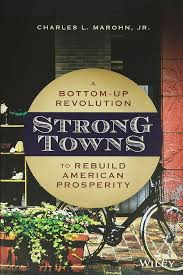
Years ago I heard an engineer being interviewed on a podcast about urbanism, castigating his fellow planners and engineers for supporting an approach to urbanism that was dishonest and financially ruinous. This engineer, Chuck Marohn, had recently started a blog to write about his concerns with his combined profession, and the implications those concerns had for the future of American towns. He wrote not just as an engineer and planner concerned about poor workmanship, but as a citizen and dad who was thinking about the world his daughters would live in. Nearly twenty years later, that dad with a blog is now the head of Strong Towns, a nonprofit organization that advises government officials and citizens alike on how urbanism goes wrong and what rational responses we can undertake to build more fiscally sustainable urban places. Strong Towns, the book, takes some of the core pieces of the organization’s journal and consolidates them into a stronger, more cohesive argument: if Thoughts on Building Strong Towns was a college thesis, this is the book proper, and it’s a fitting introduction for understanding not only why post-WW2 American urbanism looks so different from anything that proceeded, but the financial problems that urbanism poses in the long term.
There are two key points in this book worth noting: first, the departure from incremental and organic urban growth to more prescriptive and speculative “build it and they will come” growth; and second, what Chuck calls the “Suburban Ponzi Scheme”. Chuck frequently opens his lectures to city councils and groups by giving a history of his hometown, Brainerd – not because Brainerd is something special in urbanism, but because its story is that of most: it began simply, with people creating rough shacks along a trail. As economic activity increased, so too did investment in the city form itself: shacks were replaced by sturdier wooden structures, and then by still sturdier and ornamented brick buildings. City services developed as the growing tax base permitted them. Economic growth and urban growth proceeded together, hand in hand. After World War 2, though, planners being creating huge developments, and building them to a finished form – putting the cart before the horse, in a sense, and gambling that future growth would pay the bills. Sight problem, though: the new auto-oriented developments were fantasticallyless productive per acre than traditional urbanism – so much so that by the time they generated tax income to pay for their infrastructure, like roads and water pipes, the roads and water pipes would have already gone past their lifecycle and needed replacing. Many places have been able to push the bill down the road by financing yet still more developments, and using the money invested there to service hold debt – a bit like a ponzi scheme in which new marks’ money are paying off the marks further up the pyramid. This has become the norm, and it’s very much enabled by the federal government, which offers grants to help build infrastructure to facilitate “growth” – nevermind that maintaining infrastructure can be financially ruinous.
Ultimately, Chuck advises that cities get real about the maintenance backlog and admit that some things can’t be sustained: cities will contract, purely out of triage: it’s that, or go bankrupt, as Detroit did and as Jefferson County, Alabama did. Detroit, he warns, is not an exception: it is the harbringer. Detroit threw itself into auto orientation earlier than most American cities, and its bills came due earlier as a consequence. For those who are interested in learning more, StrongTowns abounds in articles on both the problem and rational responses. I can’t pretend to offer an objective review of the work given my fondess for the author and the fact that I’ve been reading Strong Towns’ articles for at least fifteen years. Strong Towns takes some of its best observations and integrates them together, to good effect in my (biased) opinion. I will note that the audiobook is not read by Chuck, which is a disappointment. Chuck has a very pleasant speaking voice, so much so that I’ve actually dropped in on zoom calls where he was briefing a city council.
I woke up Wednesday morning and my brand-new superduper gaming rig with nine colorful fans and a hum like a small airplane was unresponsive. No idea why, as it was working fine the night before — and into Wednesday, since the ladyfriend and I were binging Little Mosque on the Prairie. I tested outlets, switches, cords, etc. Anyhoo, I’m without my beast until at least Sunday (it’s two months old, so still under warranty), and given the “snow holiday” I didn’t have access to computers at work, either. Oh, I have my chromebook and phone, but It’s really not the same, Anyhoo, while trying to post the TTT list, I managed to overwrite a prior post from this year, and was too busy waiting for snow that was promised but never came. Montgomery got inches, but we got nothin’. The weather apps continued to promise snow all day, which was both amusing and exasperating. Here’s the tease:
The Buddhist point of view takes the function of work to be at least threefold: to give a man a chance to utilize his and develop his faculties;to enable him to overcome his ego-centredness by joining with other people to bring forth the goods and services needed for a becoming assistance. (small is beautiful, E.F. Schumacher)
And now, WWW Wednesday!
WHAT have you finished reading recently? Nothing, actually — I’ve been preoccupied researching integrated library systems / library service platforms for class. Last week, though, I did finish Unsettling America and Strong Towns: The Book.
WHAT are you currently reading? small is beautiful, E.F. Schmuacher. Part of my re-reading project for this year
WHAT are you reading next? Possibly Goodbye, Darkness, William Manchester. Another re-read, but it’s been over twenty years since I read this memoir of the Pacific War. I also have several library books checked out, including Nerve: Adventures in the Science of Fear and Light-Eaters, the latter being about plants.
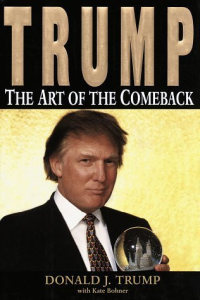
This business history / memoir is not something I’d ordinarily read, given that when my reading brushes business it’s usually in connection with something like food, energy, or IT. Howeverrrrrrr, since Trump went out of office and now he’s going back in, I couldn’t resist. Well, I could have, but that’d be less fun and missing a once-in-a-lifetime joke-post opportunity. The Art of the Comeback is essentially a memoir about Trump’s business dealings in the late 1980s and early-mid 1990s — mostly involving real estate, but also touching on other enterprises like his airline shuttle as well as as random things like his chapter on prenups. I would classify this as more of a memoir than a business book, frankly, because Trump doesn’t introduce principles and then illustrate them with scenes from his past: rather, he’s writing about his deals, his brawls with New York red tape, his relationships, etc and occasionally throwing out an observation. Some of these are universally applicable, and some….not. (“Get your zoning in a bad economic climate, and begin building in a good one.”) The book is replete with photos of architecture, which he appears to take very seriously, himself with celebrities, and — interestingly — cartoons mocking him taken from newspapers of the period. I’m sure it will astound and appall readers, but the memoir is frequently self-congratulating, as are some of the photos. (Possibly my favorite caption: “Oh, that’s Kissinger and me walking off the plane after a serious discussion of geopolitical security. He hung on my every word.”)
I can’t say this has much, if anything for readers looking for business insights, except perhaps for some inspiration that comebacks are possible. Anyone reading this now is presumably reading it for the personality of the author — and while he has a ghostwriter, this book sounds like Donald Trump, “believe me”. While much of the content didn’t interest me, I was surprised by his actual passion for architecture: I tend to associate him with the Atlantic City properties, which I regard as garish, but he sounded positively scandalized that 40 Wall Street’s then-owners wanted to gut it to make an atrium of the bottom levels. (It’s now his.) I enjoyed this, but not for the intended reasons: seeing Trump chumming it up with the Clintons and making comments that he wouldn’t do well in politics because he’s too controversial and blunt are hilarious 25 years on.
“The problem is, I think I’m too honest, and perhaps too controversial, to be a politician. I always say it like it is, and I’m not sure that a politician can do that, although I might just be able to get away with it because people tend to like me. Honesty causes controversy, and therefore, despite all the polls that say I should run, I would probably not be a very successful politician.”
2:00 P.M. People from B’nai B’rith come in. I have agreed to give a speech to their organization that night at a major hotel. They tell me the place is going to be packed, and they want to go over what I’ll be saying. I tell them I really couldn’t tell them what I’ll be saying because I haven’t given the speech any thought yet, but that I will start thinking about it —approximately five minutes before I speak!
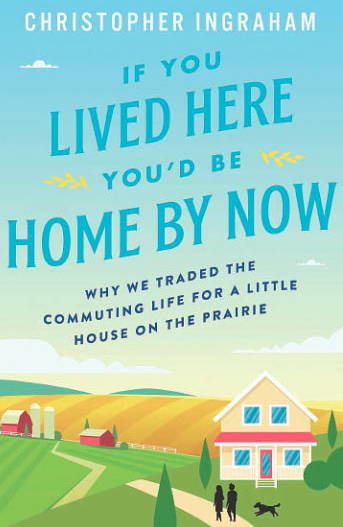
It was just another day at the office when Chris Ingraham wrote a piece about the prettiest and ugliest places to live in the United States and declared Red Lake Falls, Minnesota, as the worst. He received lots of angry tweets and the like afterwards, but it had been a one-off, so he expected nothing else. Then he received a letter cordially inviting him to visit Red Lake Falls. Figuring it would make for a fun follow-up story, Ingraham cleared it with his bosses at the Washington Post and sallied forth. He found the town of Red Lake Falls to be absolutely charming, and even friendly despite his casual abuse lobbied at them from the Post. Not long after, when Chris and his wife Briana were stressing over their ninety-minute commute and the cost of living on the East Coast, a wild suggestion floated up: why not move to Red Lake Falls? Chris’s work at the Post involved internet research and statistical analysis, not wandering the halls of power asking congresscritter’s aides for soundbytes: he could work from anywhere with an internet connection, after all. f You Lived Here is a memoir of the Ingrahams picking up and starting life over in a radically new spot, one that’s amusing on its own merits but also reflects on what people need and want out of life, and how sometimes flyover country can feed the soul more readily than high density metroplexes.
Ingraham readily admits from the start that the best parts of small town or rural living are those not capable of being witnessed through a tourist drive-by window. What he grew to appreciate most about living in Red Lake Falls was the stuff that took a while to observe: the way the landscape changed dramatically throughout the year, for instance, or intimacy he found in becoming part of of a tight-knit community — one in which there weren’t bureaucracies and institutions mediating everything. This was something he started becoming aware of almost immediately: alarmed by the lack of real estate listings, he talked to the man who invited him to visit the first time, and was immediately connected with all kinds of offers from people who were perfectly wiling to sell to an interested buyer, but didn’t see any point in having formal listings. The low cost of living was a key factor in moving, since the reporting job that wouldn’t have even paid rent on the East Coast was enough to cover a family of four — and then five — in the country. Ingraham reflects on the differences between the country and the commuter life, savoring the fact that he’s not losing three hours of his life every day staring at lights, time he can spend with his twin boys during their formative years. There’s something to be said, too, for the slower pace in general — even if he has to drive an hour to get to the nearest substantial hospital.
The most entertaining parts of this book are the fish-out-of-water scenes as Ingraham, long a beltway metroplex denizen, tries to accommodate himself to the local culture with varying degrees of success. He has nothing good to say about food in the Minnesota hinterlands, especially the Scandinavian specialties like lefse still popular with the area’s Swedish settlers, and the less said about local variants on pizza, the better. A few local men adopt him, though, taking him on excursions like hunting and ice-fishing. While he’s reluctant to actually shoot a deer, he regards it as both a rite-of-passage to be accepted, and something that he wants to prove he’s capable of doing. The book struggles a bit when it tries to be very serious, as when he decides to go to town after election day to answer WaPo’s question of “How did this happen” and can only find Clinton voters, resulting in him throwing up his hands and saying well, by golly, the more ya think ya know the less ya do. The one Trump voter he finds only did so because he really disliked Clinton. The Minnesota winter was interesting to learn about, though given that I’ve become an obsessive Charlie Berens and Myles “The You Betcha Guy” fan over the last few years, I’ve gotten some taste of it through their winter sketches. (Who knew windshield wiper fluid could freeze? Or that there was such a product as an engine block warmer?)
On the whole this was a fun memoir, sometimes unintentionally: Ingraham never quite loses his “You are sixteen, going on seventeen” -esque patronizing air, even as he’s repeatedly confronted with the limits of his knowledge: decorative corn stalks that freeze in place and remain there until late spring, leaves that don’t rot but instead just keep piling up because it’s too cold for microbes to microbe, and election results that defy the pollsters he’s so confident in – – but he does grow to accept the place on its own merits and not his expectations. While admitting that he’s something of an outlier in that he’s able to have his big-city job while living in a smaller town, in general the move appear to have agreed with him.
In the end, it seems that city life is slowly driving many of us mad. That was the case, at least, for me. Urban life is hazardous to your personal safety, your physical health, and your mental health. Why do we do it? In a word: jobs. We move to cities that wear us down because that’s where the jobs are. Happiness, health, safety—nice things to have, but you need to have a roof over your head before you can even start worrying about them. Historically, city residents have tended to be “well compensated for their joylessness,” as one team of economists put it. “The desires for happiness and life satisfaction do not uniquely drive human ambitions,” they rather dryly conclude. “Humans are quite understandably willing to sacrifice both happiness and life satisfaction if the price is right.”
We exchanged no words. If you’re a FedEx driver, you probably try to avoid conversations with the types of people who order boxes full of insects from the internet.
There were crickets in the kitchen closet. Crickets in a pile of shoes. Crickets making their way downstairs to the kids’ playroom. The cats were in a state of high alert, having what I can only imagine was the greatest day of their lives. I tried to collect all of them. It was like the world’s [worst] game of Pokémon.
“You sure this is legal?” I said. “I mean there’s houses right over there.” “We’re just outside town limits; anything goes out here,” Jason said. “Pull that trigger, find out what freedom feels like.”
Today’s topic from Long and Short Reviews is “Favorite Thing to do in Winter”. In Alabama, we don’t get snow (not usually, northern Alabama just got a few inches last week), so I’m not skiing or sledding or anything. It’s usually business as usual, just with more clothes on. Winter does provide unique photo opportunities, since the lack of foliage allows for sights I wouldn’t otherwise see. It’s also a time to think about the spring garden (which I’m hoping to bring back for the first time since it got overgrown while I was recovering from the transplant back in ’22). I need to break out my bush axe and attack some overgrowth! It’s also good hiking season since there’s less heat, snakes, and bugs to worry about.
WHAT have you finished reading recently? If You Lived Here, You’d be Home Already, a memoir of a big city boy moving to rural Minnesota; and a sort of re-read of The Unsettling of America by Wendell Berry. I say sort of re-read because while I’ve read the book, this time I listened to the audio version read by Nick Offerman, also known as Ron Swanson. Offerman is a big fan of Berry’s writing, and it’s nice to inaugurate the Great Re-Read this year with one of my very favorite authors.
WHAT are you reading now? I’ll finish Along came Google shortly — it’s a read for library science class, and is a brief history of digitization — and am also nosing into Movement, a critique of urban planning and transportation policy in the US.
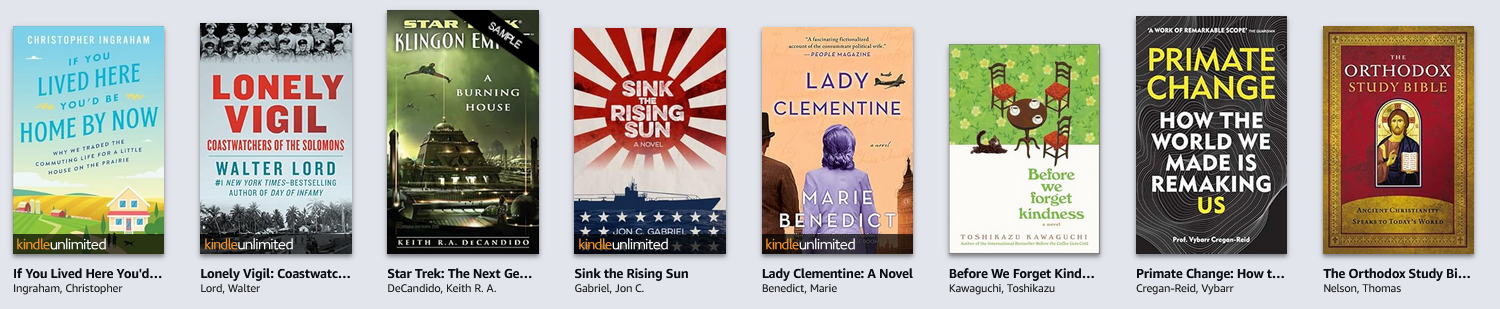
WHAT are you reading next? Oh, who knows! This is the Kindle shelf:
Today’s TTT is books recently added to our TBR list. I’ve got a few reviews lined up, but foist: here’s a tease!
The Buddhist point of view takes the function of work to be at least threefold: to give a man a chance to utilize his and develop his faculties;to enable him to overcome his ego-centredness by joining with other people to bring forth the goods and services needed for a becoming assistance. (small is beautiful, E.F. Schumacher)
And now, my lazy list.
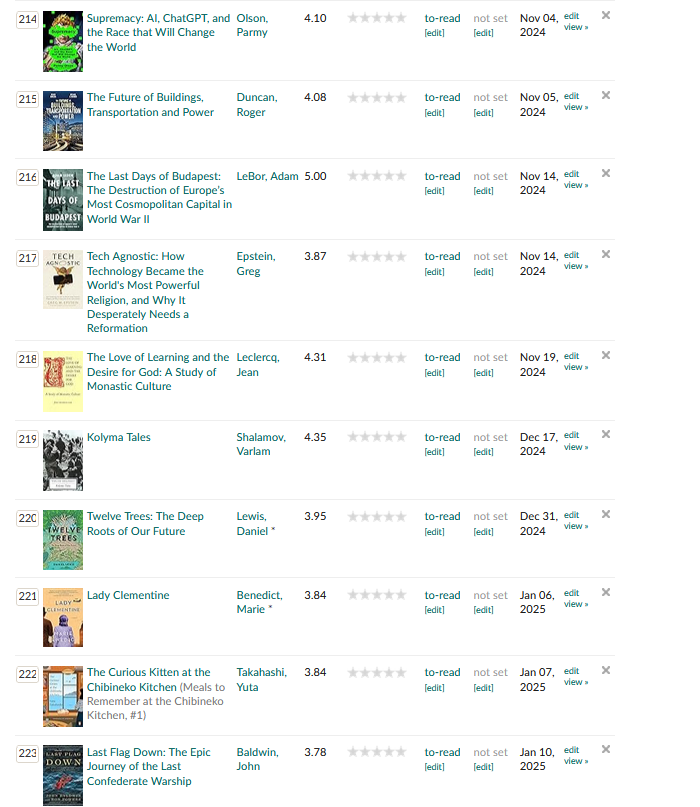
Surpremacy: AI, ChatGPT, and the Race that Will Chang the World; The Future of Buildings, Transportation, and Power; The Last Days of Budapest; Tech Agnostic; The Love of Learning and the Desire for God; Kolyma Tales; Twelve Trees; Lady Clementine; The Curious Catton at the Cibenko Kitchen; Last Flag Down



 Reading Freely