First Family

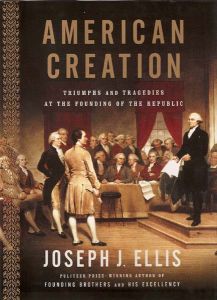
First Family: Abigail and John Adams
© 2010 Joseph Ellis
320 pages

‘Til then, ’til then, I am, as I ever was….yours, yours, yours. 

1776, a musical film which celebrates the Declaration of Independence, is an absolutely delightful movie, as funny as it is inspiring. But increasingly I enjoy it for the tender way it portrays the relationship between John Adams and his distant wife, Abigail.  Committed whole-heartedly to the Revolution, Adams is its most ardent advocate. He struggles throughout the film against the cautious  conservatism of his fellow congressmen, and even his marginal successes seem ruined by the compromises that were necessary to achieve them. In times of crisis, Adams retreats and finds a place to himself….where he finds consolation in the thought of his wife. Throughout the movie, Abigail appears in his thoughts and the two sing and comfort one another, the lyrics and dialogue being taken from their letters. It is those letters that provide the source of this, Joseph Ellis’ lovely biography of the Adams family.

Ellis proved in Founding Brothers that he’s a gifted storyteller, and the same strength is at play here. It helps that he has such extraordinary characters to write about. Abigail is no prim and proper personality stifled by petticoats: she’s strong, vibrant, and independence, giving as good as she gets in terms of political and philosophical conversations as well as sly innuendo  that no one would expect from a couple living in Puritan country.  She is in the truest sense of the word, Adams’s partner; his dearest friend and most constant source of intellectual stimulation. Her interest in politics influences his career directly,  and she takes an active hand in his personal and political relationships with men like Thomas Jefferson.  The affection these two feel for one another — the strength and power of their relationship — is abundantly evident in their letters, especially when they are estranged during Adams’ time as an diplomat in Europe.  Abigail’s role as confidant allows the reader to see inside Adams’ mind, and the man revealed is endearing for his faults and fascinating in his beliefs.  Adams’ progressive realism contrasts with Jefferson’s conservative idealism, and demonstrates the frailty of the false liberal-conservative divide. No man is so easy to box up.  Although politics plays a large role given Adams’ place in history as revolutionary leader and president,  John and Abigail’s family is never far from sight, and the losses they endure can’t help but inspire sympathy.

I thoroughly enjoyed First Family. To be sure, it does have the weakness of maintaining a one-sided view of the Revolution that sees Britain as entirely in the wrong; here, Britain is taxing America to pay for its empire just because it’s fun to be oppressive like that.  It’s also not quite as varied as Founding Brothers, but even so I couldn’t stop reading it. (The story of John and Abigail fairly well enraptures me: even though the Fourth is long past, the taste I had of their relationship in Sacred Honor and Founding Brothers only gave me an appetite for more, and I may wind up having to find and purchase a collection of their letters to find satisfaction!).  It’s a story of romance, family, and politics — one which reveals the mind-boggling insanity of the Adams White House, where the second president is beset by friend and foe alike. Not only does his vice president conspire with the French and instruct them not to pay Adams any attention, but a member of his own party has Bonaparte-esque delusions of grandeur and tries not only to run the presidential cabinet in secret, but put himself at the head of an army he can use to root out spies and traitors….like the vice president. If nothing else, First Family demonstrates the remarkable pillar of contrarianism that was Adams more easily than David McCullough’ denser biography might.

Related:

Posted in Reviews | Tagged , , , | 1 Comment

This Week at the Library (24 July)

I’ve spent this last week recovering from over-doing it on the French front, zipping through no less than three Star Trek novels for relaxation while working on a science read I received in the post a week or so ago. I’ve just finished that one (“just”, as in no less than ten minutes ago), and comments should follow within a day or two. I plan to focus on science for the next few weeks, and The Ghosts of Evolution was a great start.  There’ll be a delay before that reading starts, though, because I just ordered the books. Among their ranks…..THE TELL-TALE BRAIN, by V.S. Ramachandran. Yes, after…two years of waiting, I’m finally going to revisit a man whose first work absolutely astonished me.  In the meantime  look for a little history (The Artificial River: The Erie Canal and the Paradox of Progress) and maybe some fiction.

=============T=H=E===W=E=E=K===I=N===Q=U=O=T=E=S===========
 Grocery stores are excellent places to encounter ghosts. They lurk in the fruit section, feasting on anachronisms.

p. 7, Ghosts of Evolution: Nonsense Fruit, Missing Partners, and Other Ecological Anachronisms, Connie Barlow


Logically, Abigail should have felt torn between her two sides as a traditional New England woman and a fiercely independent personality. But she did not. The apparent contradiction felt to her like a seamless continuity. She could mend a  hem while engaging you in a discussion of Macbeth’s fatal flaw. If that caused trouble for some people, that was their problem.

p. 14, First Family: Abigail and John Adams, Joseph Ellis

“It appears that the mother of your untaken road will be joining us,” sighed Picard, “Lwaxana Troi is being sent by Betazed to be their representative at the joining of the houses of Graziunas and Nistral aboard the U.S.S. Enterprise.”
“Do they ever miss an opportunity to send her off planet?” Riker wondered.
Picard glanced at him. “Would you?”

p. 28, Q-in-Law. Peter David

“Why would Sehra of Graziunas give you a naked young woman?”
“She didn’t know my shirt size? I don’t know!”

p. 122, Q-in-Law. Peter David.

“I’ll get you some tea. Just the way you like it.” Riker snapped out of his relationship with the numbers and turned to the replicator. “Tea, Earl Grey, hot.”
“Sounds funny with you saying it,” Picard remarked.

p. 81, Ship of the Line, Diane Carey

Posted in Reviews | Leave a comment

A People’s History of the Civil War

A People’s History of the Civil War: Struggles for the Meaning of Freedom
594 pages
© 2005 David Williams

No war has left such an impression on the American character as its civil war. That conflict (1861-1865) claimed more American lives than either World War 2 or Vietnam, and remains the only great war to have taken place on American soil. (The war of independence took place here, but didn’t occupy or ravage the landscape to any comparable degree.) The memory of it lives on, especially in the south where people fly Confederate flags from their yards and speak still of states’ rights and the Cause. Despite its human and material costs, when the war is spoken of it is usually romanticized, depicted a battle between good and evil — though whether the good was the Union fighting to destroy slavery or the South fighting to defend its rights varies on who is involved in the discussion. Enter A People’s History of the Civil War,  a merciless and fascinating treatment that exposes the weaknesses of traditional narratives and butchers illusions. It is both dynamite and bitter medicine — powerful, necessary, and sometimes painful.

No serious historian would maintain that the Union invaded the South to free the slaves, or that the South severed ties with the Union purely in the defense of principle: anyone with an ounce of integrity would acknowledge contributing economic and material influences. At the very least one might say that the war was simply the violent expression of an conflict between two economic systems, that of the industrial and commercial north versus the traditional, agrarian south.  Williams’ account is more direct: the war was about money and power, just the same as any war. Even the abolitionists were motived in part by greed: northern businessmen didn’t want their expansion into the west having to compete with the free labor of southern powers.  Although Brooks’ work is organized more thematically than chronologically (containing distinct sections on the role of women, labor,  the lives of soldiers, reaction to conscription, the governments’ treatment of women etc) he jumps in feet first by critically examining the legitimacy of secession. Contrary to popular belief — the Confederate government is more loved now than it was when it actually existed — secession was not a popular mandate. Brooks reveals how election on the question of secession were rigged, stolen, or done away with outright by the planters who saw the election of Lincoln as a threat to their way of life.  Not only was the cutting of ties unpopular: so was the war that followed.  Economic powers in the north were patently unwillingly to allow the south’s resources to simply walk away from the union. Following Lincoln’s call to arms, support for the two governments’ cause rallied briefly, but soon fell away, leading to conscription acts in both parts of the country and fostering popular resentment against the government.  Why did the South lose? The conventional answer of our usual narrative is that the South’s lack of material resources doomed her against the industrious north…but Brooks notes on several occasions that the South never lost a battle for want of arms or ammunition: time and again, its weakness was the faltering support of the people for an uninspiring government and a cause not their own: Davis and Lee noted with urgent concern the rising deseration rates in their ranks as early as 1862.

The American Civil War was in short a rich man’s war and a poor man’s fight: not only was it created by the economic rivalry of competeing business interests, but these same men declined to take part in the fight once it was begun. When the initial emotional spasm of patriotism subsided and the volunteers fell away, both sides instituted conscription acts…but the wealthy were functionally exempt, either for practical reasons (because they could purchase substitutes) or by law (planters with more than twenty slaves were exempt from the draft).  At least the northern elites contributed to the war effort through industrial production: in the south, planters took advantage of increased wartime prices for cotton and shifted emphasis to producing it instead of food, leading to mass and chronic starvation that endured throughout the war.  The producers of war materials also looted soldiers and the government for all they were worth in selling supplies; a practice evidently a staple of American warmaking, for this was a principle complaint of Major General Smedley Butler’s War is a Racket, dated 1935 and drawing on suppliers’ behavior in the Great War.  The soldiers’ experience was generally one of misery:  Brooks documents the inferior food, ghastly medical practices, harsh disicpline (promoted by the contempt of the wealthy officer class for the proles under their command), and the obscene misuse of soldiers using traditional tactics against modern weapons.  A massed body of men in bright uniform makes a marvelous target for the gunners, a fact that Europe learned in 1914. Little wonder that the soldiers and their families at home protested so mightily; little wonder that they deserted. The loyalty they had, Brooks wrote, was to their comrades: though “The Cause” rung hollow after the first year of conflict, few soldiers were willing to simply abandon their friends and comrades to the dangers of war.  They fought on not for the country, but for each other.

Alas, such solidarity is not to be found outside the soldiers’ ranks. The war was a truly a civil war, not because it pit Americans from the north and south against one another but because it pit the common people against one another. They’re horrifyingly fickle, “the people”, first lyching one another for not supporting the war, then for supporting it;  while the tale has a reliable villain in southern planters, there are precious few heroes to be found here in this text where the abolitionists are viciously anti-labor;  the rich abuse the poor, men abuse the women, governments mistreat the Indians, and everybody hates the blacks.   The usual strength of the People’s History series is that its infuriating and saddening accounts of exploitation are redeemed by inspiring feats when the people rally together and overcome their oppressors. That never happens here: the people are continually set against one another, and as the bodycount rises one looks for a small sliver of hope in the fact that at least the slaves were freed and the south was forced to modernize. No such luck:  freedmen were trapped in slavery by another name, tenancy-farming, or migrated northward to be abused in the factories by men who were just as fearful and prejudiced as planters of the south.  This is no account for the faint of heart: it will force those who believe in popular sovereignty to face hard questions.  How can a just and peaceful government be possible when people are so easy to set against one another? Such is the question posed to us by the legacy of the Civil War.

A People’s History of the Civil War is a mighty contribution to American Civil War literature. It asks questions no other account would, explores facets of the conflict that would otherwise have gone hidden: it ignores military campaigns and politics to look at the lives of the people who were forced to fight and endure through the war. I read about the war obsessively during my high school years, and still time and again Brooks’ work left me reeling.   As powerful as it is, it has its weaknesses — the editing is rough around the edges, and as much as the pages are saturated with primary sources protesting the war or bewailing the rich,  it’s easy to cherry pick —  but what it reveals is worth considering for anyone with an interest in the war.

Posted in Reviews | Tagged , , , , , , , | 5 Comments

Ship of the Line

Ship of the Line
© 1997 Diane Carey
320 pages

Two captains, each without a ship. The first, Captain Picard, lost his when it plowed into the surface of Viridian III while he struggled to prevent a grief-stricken madman from destroying a world. The other’s, Captain Bateson’s, became a historical artifact when he was thrust into the future in the midst of a battle against a Klingon cruiser. His attempt at self-sacrifice saved a starbase from destruction and prevented a war, but his legendary ship is still not viable against the Federation’s modern foes, like the Dominion and the Borg. After running into one another (dozens of times) in “Cause and Effect”, Bateson and Picard’s fates are again linked with the creation of the USS Enterprise-E. While Picard questions his future as ship’s captain, Bateson is eager to earn the captaincy of the not-yet-commissioned Enterprise despite being ninety years behind the times. While Picard is dispatched on a secret mission inside Cardassian lines, Bateson sees cracks in the Khitomer Accords and is eager to prove himself against an old enemy. Thus the two captains struggle for their reputations at the brink of war.

Ship of the Line is a strikingly odd but fun book. Diane Carey seems to have wanted to write a classic naval adventure novel.  Not only do the characters speak and think as though they’re living in the Romantic period, but Captain Bateson is a walking anachronism, a man who seems to live in the heyday of the age of “iron ships and wooden men”. His ship is a “clipper”, and when he’s not cheerfully pointing out the etymology of a given expression, he’s musing on naval traditions. This combined with his status as a temporal refugee plays off well, though, because Picard relates to this man the way we would relate to someone from the 18th or 19th century.  References to the Horatio Hornblower series abound: not only do quotations from various Hornblower stories start off each section, but  at least two characters seem to have been named after members of Hornblower’s crew, which actually spoiled part of the book for me because I knew straightaway  who the turncoat in Bateson’s crew was.

TNG fans in general will find a lot to appreciate it here, for Carey gives us a story of Picard and his people after they were off the air, connecting their stories to those of the then-contemporary Star Trek universe.  going for it, giving TNG readers a look at their captain and his crew between ships and connecting their stories  (post “All Good Things…”) to Deep Space Nine’s Klingon story arc. The novel takes place at the same approximate time as DS9’s “Way of the Warrior”:  Commander Wof has already accepted a position onboard the station, but the Klingons have not yet invaded Cardassia nor revoked the Khitomer Accorrds. The Federation and the Klingon Empire are thus at peace, but Klingon belligerence strains relations.The Klingon captain whose invasion Bateson thwarted ninety years ago is enraged and humiliated that his ‘vanquished’ foe is alive and well, and both he and Bateson are easy for a rematch. Relations between the UFP and Klingon Empire are already strained, and the feud may be the firestarter for war. Picard is also engaged with an old enemy — Gul Madred, the man who tortured him in “Chain of Command”. He gets some marvelous comeuppance.

Carey is an efficient writer, never wasting time with extensive transitions or letting a conclusion drag out. The pace is fast, but not hurried, and there are scenes of rich, thoughtful dialogue that allow for a break in the action and give the reader a chance to savor  the interplay between characters — particularly between Picard and Captain Kirk, who Picard visits in holographic form as a way of searching his own soul. It captures an opportunity that wasn’t quite taken advantage of fully in Generations.

Although I’ve had this novel for years, I shied away from reading it at first because I found the idea of anyone but Picard manning the Enterprise-E to be distasteful. I’m glad I gave it a chance:  its quaintness ensnared my interest, and it fleshes out a hole in the TNG timeline rather nicely with a dandy ‘good show’.

Posted in Reviews | Tagged , , , , | Leave a comment

Sixty Million Frenchmen Can’t Be Wrong

Sixty Million Frenchmen Can’t Be Wrong: Why We Love France (But Not the French)
© 2003 Jean-Benoît Nadeau & Julie Barlow
351 pages

France stymies Americans. They eat what they want, but seemingly don’t get fat. Their government is happily involved in health, education, industry, and business, but they have one of the most robust economies in the world. How do they do it? What makes them tick?  Jean-Benoît Nadreau and Julie Barlow were dispatched by a government foundation to find out just that very thing. Having lived in France for several years and made a study of it, they represent their findings in  the fascinating Sixty Million Frenchmen Can’t Be Wrong: Why We Love France but Not the French

All of Gaul, Julius Caesar wrote, is divided into three parts — and so is this book. The first examines the personal aspects of French culture:  notions of privacy,  the importance of language,  the art of cuisine, the deep connection the French have with their land. Part II, “Structure”, examines the culture of civics and governance,  and part three demonstrates how those elements of French culture are adapting to the future.  Although it covers a wide range of topics, the editing is such that the three parts fit neatly together to present a solid and comprehensive picture.  That picture is formed in part by the centrality of the State. Although Americans might interpret a central state as a an overwhelming powerful central government, the State is more fundamental in France. It is not an outside thing that people relate to: it is the environment. France is the state: its very creation, a pillar of order erected from the chaos of feudalism.  The French republic is not a federation of provinces and cities it is the Public Thing in itself, wielding enormous power and expressing that through a strong military or money but through the way it enmeshes itself in the lives of the French, creating in part the French culture itself. Most striking for me was the use of language:

When French mayors talk about their constituents, they never use the word ‘citizens’. No one talks about the ‘citizens of Lyon’ or ‘the citizens of Toulouse’ Mayors speak of their administrés, (literally, their ‘administereds’). The French can only be citizens of one thing, the one and indivisible Republic, and that entity ‘adinisters’ them at the local level through mayors.” p. 146

Although in America the state mostly exists as an apparatus for economic interests, in France it seems to exist more for the public welfare, not just business. The idea is at least easy to take seriously, as the French government takes an interest in the lives of its people, providing plenty of support for new parents.  What a delightfully exotic idea to American ears, that the state is there to enhance the quality of life!  Quality is another strong theme — the opening sections address the French fondness for grandeur and eloquence. Life is to be savored, not merely purchased. Another choice quotation:

‎”The way the French see it, the economy should serve the social well-being of the country, not the other way around. Former prime minister Lionel Jospin is famous for having said “Oui à l’économie de marché, non à la société de marché” (Yes to a market economy, no to a market society).” (p. 276)

The powerful State and the emphasis on quality are joined in the French attitude toward education: there exist in France several academies which exist just to produce an elite caste of people to ensure that this powerful state is being run correctly. The civil service is fashioned along the lines of an army, and this elite is its officer corps. Americans who see higher education as elitist would be positively scandalized by the idea that the French seek to create it deliberately, but in France governance is too important not to be taken seriously.

In general,  the French way is presented as neither better nor worse than the English and American systems, but simply different. I for one am both attracted and disturbed by the aspects of French culture revealed here because of the varying attitudes I have for individualism and the role of the state. One can’t deny the results, though, and after reading this and various other works about French culture I can’t help but think they have better priorities.

And with that, my reading and reviews for Bastille Day is finally done. Until next year, anyway!

Posted in Reviews | Tagged , , , , | 2 Comments

This Week at the Library (16 July)

So, last week was fun. I think I may have overdone it with no less than five reads for Bastille Day, but they certainly put me in the mood for celebrating France. I think it will be a few weeks before I can go somewhere without having accordion strains lingering in my mind!  Food was a pervasive theme, but as I haven’t had lunch yet I don’t think I should dwell on that!  As fun as last week was,  I’m anticipating more variety for the next few weeks. I’ve got a science book waiting for me at present — The Ghosts of Evolution: Nonsensical Fruit, Missing Partners, and Other Ecological Anachronisms.  I also have Food, Inc, but I think I’ll let it keep for a while, as I’m burned out on criticism for a while  I’m also well versed with the material from previous readings of Eric Schlosser and Michael Pollan, so I will enjoy it more as a refresher later. Reviews are still pending for A People’s History of the Civil War and Sixty Million Frenchmen Can’t Be Wrong.  I’d figured to post those yesterday, but wound up playing a game of Civilization III as the French instead. (The French focus bled over into everything last week: I wound up watching movies set in Paris, listening to the “Edith Piaf” station on Pandora, and playing French scenario in my various games..)

Books in the news….today’s EconTalk features an interview with Gary Taubes on the book, Why We Get Fat.  His interview on Good Calories, Bad Calories absolutely fascinated me, so I’m looking forward to this one.

Posted in Reviews | 4 Comments

Q in Law

Star Trek TNG #18: Q-in-Law
1991 Peter David
252 pages

A feud  between two families of space gypsies is about to end in marriage, as their children have decided to tie the knot and give Captain Picard the honor of marrying them. Although this species never been heard of before, and indeed never will be again, the ceremony is attracting guests from throughout the Federation, including…Lwaxana Troi. That certainly puts a damper on Picard’s spirits, but then Q decides to invite himself to the festivities to explore the age-old question: what is love?  Poor Picard. Poor, poor, Picard.  If surviving a week of tense relations and petty bickering between future in-laws weren’t bad enough, he has to do it in the company of the two people in the universe who drive him absolutely mental.

It’s the setup for what is easily the funniest Star Trek novel I’ve ever read. Although the premise isn’t stellar (aliens wanting to know about human love is rather tired), the execution was perfect. Lwaxana and Q are powerful, prickly characters — a lot of potential, but they’re easy to misuse. In David’s hands, they’re dynamite together, even when Q isn’t sniping at Worf (“Oh, you’ll all have to forgive Worf. He’s just discovered opposable thumbs, and he’s feeling overly confident.”) and neither of them is giving the good captain fits. David also weaves in a couple of running gags and throws a  very earnest and very naked young woman in Wesley Crusher’s quarters.  Even his mother can’t help but laugh.

Were I in the mood for an adventure or some poignant comments about the human condition, Q-in-Law might not have been appropriate. But I wanted to relax, and it delivered magnificently. I’ve never enjoyed Peter David this much before: small wonder he was asked to write other Q books. If you like Star Trek TNG in the slightest, look for a used copy of this. It’s nothing less than a riot.

Posted in Reviews | Tagged , , | Leave a comment

The Age of Napoleon

The Age of Napoleon
© 2004 Alistair Horne
218 pages

Napoleon Bonaparte cast a long shadow over history, considering the relative slightness of his origins. Who would expect a boy from a conquered island to rise to the height of power and command one of the greatest empires in history, and leave a legacy even grander?  Alistair Horne’s contribution to the Modern Library Chronicles series discusses that legacy in part, although it is a mere sample of what one might say about the Emperor. Horne himself has written larger, more exhaustive works on the same subject, but this series consists of compact introductions. Horne’s account focuses on life in the empire away from the war,  treating military affairs in general as background material only to be referenced occasionally.  A story told in eleven short chapters (including an epilogue), Horne  discusses Napoleon’s rise to power, his ambitious vision for both France and Europe (unified and modern),  how society responded to him both at home and abroad, the corrupting effects of hubris as his influence grew, and eventually his downfall.  Other books on the Modern Library Chronicles series have succeeded in meaningful summaries of broad subjects by focusing on a few key points, like Karen Armstrong’s treatment of ummah (political-spiritual community) in Islam. Horne’s reach is more broad, and not quite as potent.  Even so, I don’t know if the emphasis on society and culture in the Napoleon era is one covered by many other books, which would tend to focus more on politics and military games.  On the whole, The Age of Napoleon is a short but  enjoyable read, its ideal audience being lay persons who are faintly curious about Napoleon but who have little interest in reading about military maneuvers.

Related:
“Paris”, from The City in Mind by James Howard Kunstler, in which Napoleon’s architectural legacy is discussed more thoroughly.

Posted in history, Reviews | Tagged , , , | 5 Comments

Bringing up Bébé

Bringing up Bébé: One Mother Discovers the Wisdom of French Parenting
© 2012 Pamela Druckerman
304 pages

When Pamela Druckerman moved to Paris to start a life with her new husband, she noticed something rather odd about French children: they behaved. Long accustomed to the whining, shrieking, squirming, picky eaters in the United States, she couldn’t help but wonder how the French did it…especially seeing as they didn’t seem to be harsh disciplinarians. Indeed, the children seemed to enjoy a fair bit of leeway…but then again, they also seemed to merit it. Druckerman flinched when a group of children ran ahead of their teacher on a busy sidewalk, but the teacher wasn’t bothered in the least – nor should she have been, since the children stopped at the crosswalk to wait for her, just as the teacher knew they would. The French and their children seem to have made a golden peace with one another…but how?  When Druckerman’s own marriage produced a baby, she began finding out how. Bringing up Bebe is the delightful result of Druckerman’s observations and direct experience with childhood and parenting in France, reflections with a lot of offer parents wondering what kind of approach to take with their own bébés.

Although at times Bringing up Bebe seems like a straightforward story of what happens when an American woman raises a child in France (Druckermen comments on her daughter Bean’s early bilingualism, freely mixing English and French in the same sentence), the chapters are organized more by subject, following Druckerman’s move to Paris and her following pregnancies.  The chapter titles (“paris is burping”) establish Druckerman as a storyteller with a quirky sense of humor, ever entertaining to read. The sections cover diet, disicipline, daycare, food culture, language, and so on, but there are at least two concepts which emerge as a foundation of French parenting and are reference throughout. The first is that of ‘éducation:   according to Druckerman, the French treat babies not as angry and hostile things that need to be tamed, but as little tiny people who simply need to be taught what is right. They communicate constantly with babies in the belief that the infants can understand them. (This seems dubious to me, but given that humans are social creatures, such communication can’t help but be healthy.)  What’s interesting is that since babies are regarded as people in their own right, they’re expected from the start to conform to certain conventions of society, like the idea that you are just one person among many and are not the center of the universe, even if the only thing you can do is lie in your crib, wait for your cells to divide, and ocassionally fill your diaper. One parenting trick Druckerman learns early on is “The Pause”: instead of running every time a baby cries, French parents wait a few seconds to see what happens. Often, the baby will go back to sleep (or was merely making noises in her sleep in the first place), and it is believed the delay between the baby crying and the parents responding establishes in the baby’s mind that she is not the center of the universe.  Although children are granted certain indulgences for being young, in general they are expected to conduct themselves in a civilized manner, and are constantly groomed in this direction in every aspect of their lives. “The Pause” also teaches babies patience, and patience is emphasized so consistently that it allows children to dine with their parents in an adult restaurant, sitting for hours and behaving themselves.  ‘Education’ is constantly enforced, not by punishment but by communication.

Children respond to this, partially through a second concept —  the cadre, or framework.  This establishes a few firm rules that are never to be violated, while giving children a free hand everywhere else. For instance, French parents teach their children that adults must have time to themselves, so the children are made to go to their bedrooms at a certain hour…but they are not forced to go to bed if they are not sleepy. The children thus learn to entertain themselves instead of constanting demanding their parents’ attention.) The cadre allows children to explore and learn about the  world on their own, but within certain safe limits.  They are treated like adults who simply need to be taught the right thing, and they grow into adults who do it.

Although I’m not a parent, nor do I anticipate becoming one at this point in my life, I found much to appreciate here. The French parenting approach is in line with my own values, and seems quite sensible.  Definitely entertaining and nicely written: those who are interested in considering it as parenting advice might want to read customer reviews at Amazon or some other place to get an idea for how successful the approach has been in other people’s lives. I bought this book to start off my Bastille Day reading set, and it’s definitely a keeper.

Posted in Reviews | Tagged , , , , , , , | 1 Comment

French Lessons

French Lessons: Adventures with the Knife, Fork, and Corkscrew
© 2001 Peter Mayle
227 pages

Peter Mayle is to be envied. Some people’s work involves overseeing hundreds of people and managing the affairs of a business that skirts bankruptcy other day. Some put their life in peril, fighting fires or confronting criminals. Some are pushed to their physical limits putting in long hours on the factory floor.  Mayle, on the other hand, must roam France and subject himself to its most extraordinary pleasures, then regale readers with stories of  this most dreadful task. Mayle is an author who loves France, and after dining with him vicariously through French Lessons, it’s easy to understand why. How can one resist a people who love food this much? A retired barfly refers to cuisine as the religion of France, and it’s a religion that’s quite robust. Mayle visits festival after festival celebrating local delicacies — truffles, snails, vintage wine — and immerses himself fully in the traditional celebrations of these foodstuffs. It’s either the French gift for cooking or Mayle’s for writing, but he does manage to make the task of delivering a slug from its shell sound not only fun, but appetizing. Part of the fun of the book is that Mayle always finds someone passionate to dine with, and they both drink themselves silly.  Although the book seems written mostly to entertain,  Mayle’s emphasis on eating quality food for pleasure supported the principles Mireille Guiliano demonstrated in French Women Don’t Get Fat.  This is a quick, zesty, and entertaining read.

Posted in Reviews | Tagged , , , , , , | Leave a comment