Toward a Truly Free Market

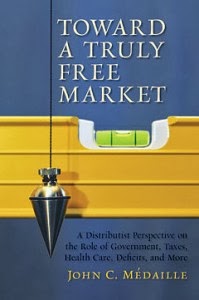
Toward a Truly Free Market: A Distributist Perspective on the Role of Government, Taxes, Health Care, Deficits, and More
© 2011 John C. Medaille 
282 pages
 “I been a-wonderin’ why we can’t do that all over. All work together for our own thing, all farm our own lan’.[…] I been thinking about us, too, about our people living like pigs and good rich land layin’ fallow. Or maybe one guy with a million acres and a hundred thousand farmers starvin’. And I been wonderin’ if all our folks got together and yelled…”

(Tom Joad, The Grapes of Wrath)

Toward a Truly Free Market argues for an economic system based on neither an unmoderated free market nor an authoritarian command structure, but on  moral principles that put human needs, not ideological purity, at the center. At the heart of these principles is the concept of distributive justice. After sketching out the general problems of conventional economics, Medaille claims that capitalism and socialism are more alike than different. The constant lack of equilibrium in a capitalist economy, the fact that labor is never paid enough to ‘clear the markets’, dooms capitalism to a series of booms and busts, and it is that cycle that distributive justice is intended to remedy, because attempts to ‘fix’ capitalism through intervention have only led,  to increased economic and political power in the hands of a few. Toward a Truly Free Market offers a fairly comprehensible ‘third way’ to economics, one that defies partisan labels and offers a humane vision for the future.

The distrubist worldview envisions a society in which both political power and the ownership of production (on which political power depends) are as widely distributed as possible. In this society, no one is an employee; almost everyone has an owner’s stake in society, whether in the form of a family farm, a small business, or membership in a cooperative. The idea doesn’t originate with Medaille; although aspects of it have been imagined since modernity began (Thomas Jefferson’s agrarianism, for instance),  it was argued for under the name Distributism beginning in the 19th century — as part of the Roman Catholic church’s social doctrine. Then, Catholic authors like G.K. Chesterton argued for it as a moral alternative. as a system that would protect the integrity and autonomy of the family against both the ravages of factory dependence and state socialism; now, with distributist ideas  developing a life of their own outside the Church, Medaille takes an economic tack by first examining the weakness of economics without justice, which attempts to reduce land, people, and money to commodities, and then explaining the principles of distributive justice, moving from the general to the particular.

While classical economics begins with the material (“Economics is the study of how scarce resources with alternative uses are distributed”),  distributist economics begins with people: Medaille describes an economy as how a society is provisioned.  His criticisms of socialism and capitalism bear out that provisioning isn’t necessarily material; he laments over the destruction of local economies, the brokenness of families, working long hours at jobs which offer no meaningful compensation, only a paycheck, and the fact that people at all levels of society, from the family up through the neighborhood, city, and state become increasingly dependent on the national government, leading to the death of civic society as Citizens become clients and case numbers.  This is true whether the system chosen is capitalism or socialism,  Medaille’s solution includes “remoralizing the market, relocalizing the economy, recapitalizing the poor, and reinvigorating local politics”.  Operating principles of distributism include solidarity, or the belief that political decisions should be handled by the smallest capable agent; thus, a city would be responsible for its schools, and a state for its highways. Medaille elaborates on how distributive ideas can inform taxation, industry, healthcare, and government policy.  Although he sees a place for government (keeping the currency sound, pricing in externalities, national defense),  distributism rejects a top-heavy state. Politics, like a house,  must work from the ground up, from civic participation to tax funding.  That funding comes not from income or property, but on the land itself. Decentralization is a recurring theme; Medaille’s idea on fixing healthcare includes having a range of licenses, beginning with the quasi-medical and progressing to  doctors of medicine) not only would this allow more people to enter the medical field, as they could more easily move between study and practice (a given person might take a license as a midwife, and then use that to pay for more advanced training in obtstritcs or general medicine), but it would result in better healthcare over all, as seasoned and highly-trained doctors would only see problems that could not be resolved at the lower levels.  He advocates for an end to “supply-push” economics, in which companies produce a given number of goods and then use advertising to gin up interest in them, when general-purpose machinery that can adapt to produce anything that is needed by the local economy (“demand-pull”) is a more intelligent and just use of finite resources. Otherwise we are merely producing landfill.  

Toward a Truly Free Market is a fascinating book. The beginning  is the most challenging,with the discussion of the ‘distributive’ and ‘corrective’ aspects of justice, and  the difference between use-values and exchange values, but understanding what the author means by justice is rewarding once he begins writing about a system that is based on it. Although distributism proper began in the Catholic church, being developed in papal encyclicals, I’ve encountered its ideas in various and sundry places:  James Howard Kunstler wrote on the virtue of Georgist taxation in The Geography of Nowhere, Chuck Marohn of Thoughts on Building Strong Towns is a firm believer in subsidarity, and the push for local economies, especially local food movements, is gaining serious traction in the environmental and health movements.  Although some aspects were more harder to imagine, like the revival of guilds or the practicality of cooperatives,  Medaille includes sections on communities like the Mondragon Cooperation which put these principles to work. Although there’s some economics to digest, the book picks up steam as it moves toward public policy. A fly in the ointment is that Medaille assumes readers have heard of distributism; he doesn’t elaborate on it at the start. He develops the idea throughout the book, so strangers won’t be lost, but they have to be willing to jump in. This is perhaps explainable given the book’s Catholic publisher; since distributism is part of the Church’s social doctrine, it almost has a ready-made audience. The claim that capitalism and the state have an unavoidably symbiotic relationship with one another could have used further development; I’ve heard the same claim from hard-left circles, too, and would be interested in understanding the full reason why. Medaille operates on the idea that the state is necessary to keep capitalism from destroying itself, but Hayekians believe capitalism would have worked out its inner inconsistencies if meddling interventionists didn’t keep getting in the way, like suppressing a fever that’s intended to kill an infection. (Medaille takes more than a few shots at the Austrian School throughout, which is amusing given that Hayek drew on a distributist work, The Servile State, in his The Road to Serfdom. )

Many national-level reforms mentioned here don’t have a prayer of materializing in the current political climate, but a philosophy as locally-focused as distributism can get along.  Determined people can build little sanctuaries of restoration in their own communities, with or without government sanction;  even urbanites can relocalize their food, and cooperatives of all kinds are possible, and already in practice. There’s a lot of cause for hope here, and Medaille offers a thoughtful criticism of our current system which is outside the usual complaints.

Related:
Books and essays by Wendell Berry
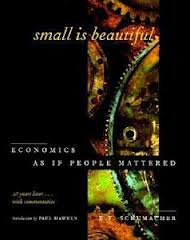
small is beautiful, E.F. Schumacher
Posted in Politics and Civic Interest, Reviews | Tagged , , , , , , , , , , , | 1 Comment

Starship Troopers

Starship Troopers
© 1959 Robert Heinlein
263 pages

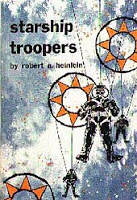
The worlds of the Terran Federation are under constant assault by the malicious Bugs, whose hideousness drives dogs insane and who don’t even have the decency to build their civilization out of buildings that can be blown apart:  the swarming arachnoids have to be dug out of the ground.   Juan Rico didn’t join the military to save truth, justice, and the Terran way of life, however; humankind was largely at peace when he took his oath. Instead, he joined because his best friend did, and because the school  hottie was signing up to become a pilot. Juan, or Johnny, didn’t get to be a pilot, though; that program prefers women’s faster reflexes.Johnny wound up in the Mobile Infantry,  part of a literal killing machine. During his  basic training, however,  a Bug attack completely destroyed Buenos Aires, and it’s up to Johnny and his follow boots to take the war to the enemy.  Starship Troopers is half political philosophy, a third speculation on future warfare, and a fifth wartime action plot.  The best known of Robert Heinlein’s works, alongside Stranger in a Strange Land,  Starship Troopers’s fame stems from its easy-to-loathe insectoid menace and its controversial politics; it well deserves its classic status.

Starship Troopers opens with images of future spaceborne wars, though space is something traveled through, not the battlefield itself; there are no capital ship duels here, only the paratrooper-like deployment and operations of Johnny and the rest of Terra’s finest.  If mobile infantry brings to mind foot soldiers jumping from trucks and riding through the countryside, cast that out of your mind; an M.I is one man in an armored suit, weighing tons  but powered and as responsive to the slightest movement that it might as well be skinned. The suit allows every trained soldier to be a one-man army, making the tanks of ancient days look like pushovers. Every M.I. is worth more than a thousand of the enemy, and that’s no hyperbole.

            But Starship Troopers isn’t chiefly about the Bug War or how sophisticated electronics  and space will alter combat. Throughout the book, largely through reminiscences of his training days, Rico’s understanding of why he’s fighting develops, laying before readers a political philosophy which is the basis for the book’s ‘controversial’ status. In the Federation, the voting franchise is limited to those who have paid their dues in the form of Federal Service, people who have proven that they have characters capable of engaging in self-sacrifice for the good of the nation; people whose sense of duty will keep them sober when they exercise the vote, and mitigate corruption as far as possible. Starship Troopers is paean to the highest ideals of republican soldiery, drawing on classical history, from Greece through Rome; if you’ve ever read Once an Eagle, it’s rather like that. The main argument of Troopers is that politics requires virtue, and for Heinlein, the sacrifice required in military service is the best way of sussing out the virtuous.  The military isn’t the meter by which society is run; in fact, those who apply to do their service are actively discouraged and given plenty of opportunities for second thoughts once they’ve begun.  Other elements of Heinlein’s society which have been criticized, like the use of violence as discipline, aren’t an example of the military governing civilian life; that’s simply the way Heinlein thinks children ought to be raised and how criminals ought to be deal with, and are separate arguments.  The most objectionable element of the worldview developed here is the author’s contention that man doesn’t have a moral instinct. He views humanity as a wild animal that has to be civilized through culture every step of the way, but if we had no moral instincts such inculcation could not possibly take.

Although I started this book prepared to see in it a glorification of war and authority, it is far more thoughtful than that. The tech speculation is fascinating for a work written in 1959, though the closest we’ve come to realizing  any of his ideas is helmets with HUD displays, or perhaps remotely-controlled robots.  (In Heinlein’s world, the powered suits are controlled with radio signals.)  This is definitely a worthy read.

Posted in Politics and Civic Interest, Reviews, science fiction | Tagged , , , , , , , | 7 Comments

small is beautiful

small is beautiful: economics as if people mattered
© 1973 E.F. Schumacher
288 pages

Get big or get out, said the Secretary of Agriculture to American farmers in the 1970s. But as the consequences of widespread industrialism and general upheaval began to show their faces, ,the environmental movement was born and another voice, E.F. Schumacher’s, rang out against the agribiz giants: not so fast.In small is beautiful, he argues against industrial and agricultural giantism that is not only unsustainable energy-wise, but malignant to the health of developing economies. Taking partial inspiration from “Buddhist economics”, a perspective which considers the impact modes of production have on the persons involved,  Schumacher argues for small-scale production and the implementation of ‘appropriate technology’; that is,  forms of technology that can be implemented into existing societies and increase production gradually, allowing developing nations to adjust without causing the kind of disruption that results in gigantic slums and spasmodic bounts of famine and war. This also applies at the individual level, for appropriate technology can allow laborers to still be personally involved in their work,  not alienated from it as happens with assembly-belt mass production.  Although penned in the 1970s, this is a work which has only increased in relevance:  environmental solutions constantly defer to the need for localism, from community-supported agriculture to roof-mounted neighborhood solar panels feeding into the local grid. Our lifestyle hasn’t become any more sustainable; our rate of progress down the dead-end road of  total consumption has only increased in the last decades.  Small is beautiful is definitely a work to consider if you have any interest at all in environmentalism, ecology, sustainability, or the economy’s impact on society.

Related:
  • Virtually anything by Wendell Berry, whose ‘Great Economy’  shares the same humane vision, as does the philosophy of distributism.
  • eaarth, Bill McKibben
Posted in Reviews | Tagged , , , , | 6 Comments

This week at the library: The Great War, politics, sex, and elephants

Dear readers:
Hours ago I returned from my monthly visit to my alma mater’s library, where I found a host of interesting books. Although I’ve have plenty enough on my plate already, being knee-deep into The First World War by John Keegan to start my year-long reflection and study of the debacle,  most of these are on far cheerier subjects. 
  • Plagues and Peoples, or how epidemics shaped human history. (Hey, I said most of them were on cheerier subjects.)
  • A Place on Earth, Wendell Berry; a novel about a father’s response to his son dying in WW2.  (Ibid.)
  • Starship Troopers, Robert Heinlein. My first Heinlein! 
  • The Bonobo and the Atheist: In Search of Humanism Among the Primates, Frans de Waal
  • When Elephants Weep: The Emotional Lives of Animals, Jeffery Masson and Susan McCarthy
  • Daily Life in Anglo-Saxon England, Sally Crawford
  • Silent Thunder: In the Presence of Elephants, Katy Payne
  • The Gift of Good Land: Further Essays Cultural and Agricultural, Wendell Berry
  • Ravens in Winter, Bernd Heinrich.
There’s a definite nature theme to this month’s pile, probably prompted by  my yearning for spring. 
We’re off to a rocky start this year, books-wise, as I’ve read a handful of books I liked well enough and a few I was disappointed in. There are a couple of reviews outstanding, for Shop Class as Soulcraft and Wendell Berry’s Sex, Community, Economics and Freedom. The latter’s eclectic nature defies adequate summation, at least for now.  Sex was also the theme of The Red Queen, which I enjoyed. Related to Soulcraft and Berry is Toward a Truly Free Market,  which presents an  economic idea which EF Schumacher was influenced by in writing small is beautiful. (I owe that one a review as well….)  Comments for Toward a Truly… are just about done.
So, I’ll be balancing the misery of the Great War with some fun books on animal behavior, and the toe-curling pleasure that is Wendell Berry, who is for me the literary equivalent of warm chili and a great big quilt sewn by Granny.  There’s such a feeling of being at home when I step inside his mind.
Happy reading, everyone! 
Posted in Reviews | Tagged | 4 Comments

The Liberty Amendments

The Liberty Amendments:  Restoring the American Republic
© 2013 Mark Levin
257 pages

The United States Constitution was written by men who appreciated their lack of omniscience, and who therefore included in Article V means for amending their handiwork, for fixing through Congress and the state legislatures any problems that might arise. How do you solve a problem through Congress, however, when Congress is the problem?   The solution, says Mark Levin, is right there in the Constitution: Article V, which establishes the means of amendment, provides two. While Congress can vote on amendments, the State Legislatures can independently  call a convention to propose amendments, amendments Congress is obliged to respect.

With that as a starting point, he introduces ten amendments intended to bring the metastasizing national government into hand. The amendments taken as a whole are strongly sympathetic to a states’ rights perspective, as all three heads of the Scylla-like national government are subordinated further to the state legislatures. The legislatures are given the power to override Supreme Court decisions and acts of Congress, and  term limits are imposed on all branches, including on the formerly lifetime Court seats.  Levin’s amendments make it clear that he believes sovereignty lies in the states alone. as he proposes measures intended to stifle the effort of the government to take a life of its own. The Supreme Court is denied a right it has assumed, that of judicial review (judging whether a law is constitutional), and federal programs are given an automatic expiration date that they escape only by submitting to a scrutionous review.  Most of the amendments are general and limited, with Levin arguing from what he believes the founders would have intended or believed; he draws on the Federalist papers, the anti-federalist papers, and the founding fathers’ letters to inform his views. The exception to this is the tenth proposal, which requires photo ID for elections. This is so specific to current political arguments and current technology that it doesn’t deserve the dignity of being attached to the Constitution: let it join the legions of acts of Congress.

As personally sympathetic as I am to any measure limiting the power of the state, and hostile to any measure intended to magnify its power,  something about this book doesn’t sit right with me. Levin speaks often about the founders’ firm belief in checks and balances, but his proposals put so many cards in the hands of the state legislatures something is bound to go wrong. The state legislatures are not havens of sensibility and justice; my own state has a constitution written by planters to disenfranchise the poor, place the burden of public finance on them, and force local ballot measures to be resolved by means of constitutional amendment.  On the other hand, perhaps we’d end up with something like Swiss cantons; that kind of dynamic localism is attractive.  My principle problem with Levin is that he doesn’t bother with a dialogue but writes to people who already agree with him as he presents his case against the dreaded Statists, the Evil Ones.  I don’t know if Levin’s approach is the answer, but it’s not mere talk: in late December, state legislatures sent representatives to George Washington’s Virginia home in Mount Vernon to discuss the possibility of an “Article V Convention“.   Thus, while Levin’s amendments aren’t necessarily ones I’d get behind in total (with the exception of term limits),  his basic premise of states using their article V right to discipline Congress, the Court, and the President has promise.

Posted in Politics and Civic Interest, Reviews | Tagged , , , , | Leave a comment

The Red Queen

The Red Queen: Sex and the Evolution of Human Nature
© 1993 Matthew Ridley
404 pages

The Red Queen begins with a question: why do creatures have sex? Why did it evolve? The answer, Matt Ridley believes, lies in the principle of the Red Queen. A character featured in Lewis Carroll’s  Through the Looking Glass, she announced to Alice that in her world, it took all the running one could do simply to remain in one place. This characterizes the constant struggle for domination between species in the natural world,  a struggle between creatures not only visible to us, but between parasites within our bodies  and our immune systems.  Every move is countered, every success overturned; such is the impetus for evolution. In The Red Queen, Ridley explains his reasoning, and demonstrates how  evolutionary principles subtly drive the expression of human sexuality.

There’s a lot of tension in this work, first when Ridley makes his case and somehow incorporates aspects of evolution from disparate camps (gene-centered, individually-driven, species-based) , and in the heart of the book as he examines the implications. This is especially true in the chapters, “Polygamy and the Nature of Men” and “Monogamy and the Nature of Women”:  while it is true men have a genetic inclination to sow seeds and women one to invest in a partner,  behavior as studied indicates that things are not to trite. In the last chapters of the book, Ridley looks at sexuality as a possible cause of advanced human intelligence (competition and tension between the sexes and individuals), which is amusing given the power sexual interest has to render victims dumbstruck and seemingly foolish.

Since its publication, The Red Queen has proven influential; I knew of it long before I read it because of its place in the literature, being cited often. That may attest to the science, which is is speculative but sensible based on what he presents. He certainly makes for an entertaining author,  one whose arguments are open to virtually anyone regardless of scientific reading;  he begins with a technical, biological edge before spending most of the book on behavior — a softer, fuzzier realm for readers.

Posted in Reviews, science | Tagged , , , , | Leave a comment

This week at the library: prospects for the new year

Dear readers:
The winter solstice is passed and December has ended, beginning a new year regardless of your reckoning. In the past few days I’ve used my time off, and the fact that it’s too cold and dark out to do anything outside, to finish a few books begun in late December — Bernard Cornwell’s Stonehenge, and The Red Queen, a book on sexuality and human nature. With the year anew, what lies ahead? 
January is a kind of penitent season, as people start New Years resolutions to get out of debt and lose all the weight they accumulated eating Christmas goodies.  In that spirit, I’m going to be making an effort to read some books I’ve long intended to read, but have never quite gotten around to. That includes the first book in a Roman historical fiction series (spotted on Seeking a Little Truth), as well as some science fiction.  I will also be resuming the Story of Civilization series by Will Durant sometime this..ah, year.  The problem at this point  is that the last three books all seem to be about the same things:   the climax of the Enlightenment, the French Revolution, and Napoleon.  
In the coming year I will of course have the usual tributary readings; a focus on English culture in April, for St. George’s Day;  a set on the American revolution in late June for the Fourth of July;  some French items in mid-July for Bastille Day, and something in October for Germany.  As previously announced, throughout 2014 I will be reading books on the Great War, one a month.  I won’t be combining the Great War theme with the heritage readings. 
I suspect historical fiction is going to take a hit, because once I read Sharpe’s Waterloo, I will have not only finished Sharpe’s series but exhausted virtually all of Cornwell’s fictional offerings. There remain a few books I’ve not read, like the second in his Grailquest series and a historical romance he wrote under a false name (yes, really), but after a few years of dedicated, wholly enjoyable reading, I’m reduced to waiting for him to write new books. Alas.  
I also think that 2014 will be a boom year for science and nature reading, because I’ve discovered an author whose work I think I’ll take to. We’ll see..
2014 will continue readings in city planning, food, and the like, with everything under the sun also under consideration.  
A year of fascinating reads to you all!
Posted in Reviews | 4 Comments

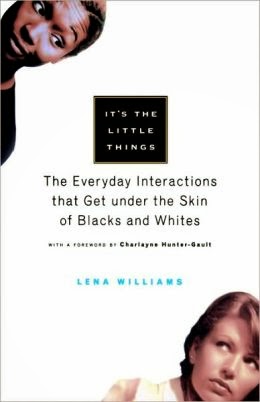
It’s the Little Things

  It’s the Little Things: Everyday Interactions that Get Under the Skin of Blacks and Whites
© 2002 Lena Williams
304 pages

It’s the Little Things is an account of Lena Williams and her family’s grievances with white people, which are legion. Its full title, poorly chosen, teases the reader with a prospect of being a fascinating look into racial or cultural behavior that we are unaware of. The author delivers, however, nothing but a series of complaints, drawn from a data sample of herself, her family, and her friends   It seemed so promising; imagine a book based on interviews in which people were honest  about their observations or questions about the ‘other side’;  this is more like a book of white-people jokes pretending to be one of social inquiry.

The majority of the ‘little things’ are not unique to black/white dynamics in the United States, but are common symptoms of ethnic tension,  with biological or cultural roots. She mentions that both sides complain the other ‘smelling’ funny,  which is an in-group sensitivity.  There are a few  genuinely helpful insights scattered throughout, like the bait-story that enticed me into reading it. There, the author bristles with resentment as she stands in an elevator and witnesses a white woman combing her fingers through her hair.  Because ‘black’ hair looks, grows, and behaves so differently from ‘white’ hair, which is considered the standard of beauty in America, many black women like the author have gone to great expense and bother to force their hair to  look like ‘white’ hair, implementing relaxers and weaves. The woman’s innocent hair-combing was seen as a flaunting of white privilege.  The book often demonstrates how ordinary tension between people can take on racial undertones: although the liberties telemarketers take in using people’s first names to effect an air of friendliness are obnoxious to everyone, the presumption can strike blacks (according to Williams) as offensive given America’s racial history.  As the privileged hair example illustrates, however, ascribing racist motivations to some behaviors is simply preposterous.

The work also makes clear that regardless of claims of equality, people remain different;  even if they are equal before the law, populations still have their own cultures and values, some of which rub against one another. For instance, the author declares that there’s a difference between the black notion of a party, which consists of plentiful food and lots of dancing, and the white version, which consists of finger food, wine, and subtle music serving as a background conversation.    That is indeed two different notions of a party,  but to say they’re black and white versions of a party is bizarrely simplistic.  Anyone with friends or relations in different economic classes can bear witness to the fact that not everyone’s idea of a good time is the same, regardless of skin color. This book’s greatest fault is the limited experience the author draws on to reach her conclusions;  her childhood background and experience are used to describe everyone’s, and that is decidedly not the case. In her world, black people beat their children at the slightest hint of public misbehavior, and feel pressure, when going into town, to dress their best.  She cannot possibly believe this is the case today.  Perhaps she’s drawing merely on her memory alone, but in the world of the mid-20th century, such behavior (dressing for town and stern discipline) would have been the rule among ‘whites’ as well.  The too-personal anecdotes, and the sweeping conclusions based on them, make me think this is a book with an identity crisis; it’s written as a playful riff, but wants to be  taken seriously.

Posted in Reviews | Tagged | Leave a comment

The Best of 2013: Annual Year in Review

Previous yearly wrap-ups: 2007 | 2008 | 2009 | 2010 | 2011 | 2012 

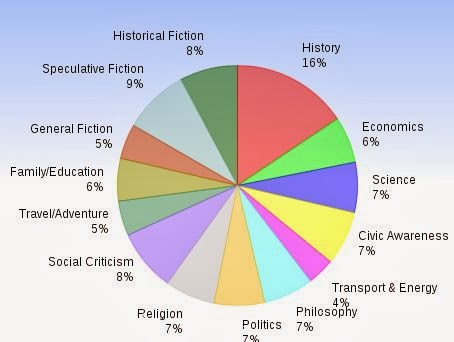
The year turns once more and it’s time to look back on the past’s reading, to think about which books really stood out and to reflect on the year in general. Let’s begin with pie!

As usual, ChartGo did the data-baking, and nonfiction dominated. This year was heavy on civics and society, economic and political philosophy, and bicycles; when I drew up a ‘top twenty’ list,  most of the books fell into these categories. Toward the end of the year I also got into outdoors-adventure books, including a lot of cycling memoirs.

The great theme that emerged from my reading this year was civics, society, and living humanely.  Not only did I read a great many books about the material arrangement of society, like those on city planning, but I also considered thoughtful works on other aspects of society:  culture, politics, economics, and more. Diverse authors who never met one another, who may have not have even heard of one another, have worked in concert inside  my head to prompt a sea change therein. In trying to understand how society works,  so that I might do my part to help create more resilient, healthier communities, I have developed a sharp aversion to the large-scale, top-down, and heavy-handed approaches I once favored, instead now preferring smaller, locally-oriented, and ‘organic’ tacks that emphasize healthy relationships between people, connect them to their physical place, and promote inner reliance or autonomy.  And so, the best from this sweeping category, books in bold indicating membership on the Top Ten Favorites for the year.

Now some highlights from other genres:


General Fiction

History

Science

  • The Little Ice Age: How Climate Made History, Brian Fagan
  • Chimpanzee Politics by Frans de Waal
  • Your Inner Fish; The Universe Within, Neil Shubin.  
  • Two Sides of the Moon, David Scott and Alexei Leonov

Historical Fiction

I read Pride and Prejudice largely so I could read Pride and Prejudice and Zombies, which started out hilarious and then drifted toward the merely silly. I did enjoy Austen, especially for the language. Kerr is a new author to me, and one I’ll read more of;  I’ve read three works by him so far, and all were police dramas/international mysteries set in Germany, often around the 1930s. Dark humor abounds.
Speculative Fiction
  • From History’s Shadow, Dayton Ward.  Treklit and historical fiction, this history of the United States’ attempts to investigate claims of alien life begins shortly after 1947 and 
  • 1632, Eric Flint. What happens when you drop a Pennsylvanian mining town into the middle of 17th century Germany? Good times.

In the long run I think I’ll remember this year most for introducing me to one Wendell Berry, an aging gentleman-farmer from Kentucky whose ideas on the good life are expressed in both essay collections and novels. I encountered Berry first when one of his essays, “Health is Membership”, appeared in The Plain Reader, a collection of essays on the simple life, many of them rooted in the Quaker tradition.  He writes reverently of the need to conserve and live a life grounded in Nature, mindful of the limits it would suggest for the scale of our activities. He champions a nation based on family farms, small towns, and decentralized political power; he writes against and mourns the destruction caused by agribusiness, urban sprawl, and big stick approaches to little problems. His essay collections are wise and often godawful funny, while the novels are painfully beautiful. I read Jayber Crow back in June, and not a day goes by that I don’t think of it– quote aloud from it, even.  Wendell Berry joins the very-elite club of featured authors for me, alongside Isaac Asimov and Bernard Cornwell.

Posted in General | Tagged , | 3 Comments

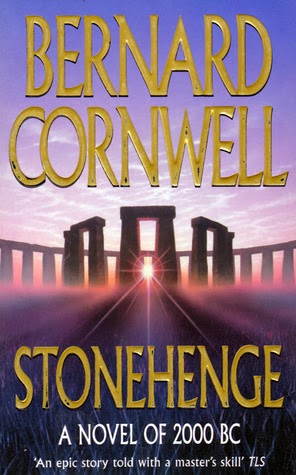
Stonehenge

Stonehenge: 2000 BC
© 2000 Bernard Cornwell
400 pages

         For millennia the hanging rocks of Stonehenge have stricken visitors with awe and mystery. Who  built them, and to what purpose?  Stonehange: 2000 BC  tells the story of those people, the ancient ones, whose dreams and fears were made material in their temple of the sky. Bernard Cornwell is a bonafide master of historical fiction, writing chiefly tales of adventure and war set in Britain’s storied past, but the world of Stonehenge is his earliest treated yet. Stonehenge is largely drama, personal and cosmic, with action throughout, including a battle or two.   It is the story of three brothers:  Lengar, the eldest, whose cruel ambition leads him to murder his father at a wedding and seize the bride; Camaban, born with a club foot and rejected by the tribe, who burns with bitterness and looks to the gods for consolation; and young Saban,  who begins the book fleeing from death,   a race that continues throughout.  Caught between his elder brothers’ constant treachery, Saban must survive the destruction and chaos caused by both, and lead his people to peace.

            Lengar, Camaban, and Saban share a father and little else; their dreams set them at variance with one another, for Saban only wants a quiet life with a woman, kids, and a few healthy pigs while his elder brothers spend the entire book besotted with dreams of grandeur. Lengar wants to be a fearsome warlord who brings the entire region under heel, while Camaban works to become a master sorcerer and restore order to the Cosmos itself.  This is a primeval setting, dominated by a religious worldview that is largely animistic, drenched in blood and steeped in superstition. The overall feel is reminiscent of the magnificent King Arthur trilogy Cornwell penned:  political and religious leaders vie for power, undergird with a metaphysical theme; while Merlin wanted to restore the old gods to Britain to drive out the Saxons,  Camaban wants to end the war between the native gods and bring about an epoch of heaven on earth.  While many find the claim suspect, a temple to the violent sun god serves the glory-thirst  of Lengar, and the challenge appeals to the craftsman Saban. (Not that he has a choice in doing their bidding,  since he has an unfortunate habit of becoming attached to people, a great source of leverage for his sadistic elder.)  The motives for building the temple are thus mixed, and the struggle of its construction is the foundation of the book’s many plot lines, from politics to war. At least a decade passes from the time the first stones arrive to its treacherous consecration.

            Like the King Arthur trilogy,  our main character Saban is a supporting actor in other men’s dramas, but he’s fairly sympathetic. A good thing, too, because he’s much abused;  his is a violent world, and his brothers’ ambitions make it doubly so.  He’s wily enough, and a good fighter,  though not nearly as self-assured or clever as other protagonists.  His life is often in the hands of Fate, which typically comes in the form of possibly-delusional characters who declare that going here or doing this is the Will of the Gods.   Though religious, Saban doesn’t put a lot of stock in such claims; fortunately for the plot, he’s ususally beholden to someone who does – either his brothers, threatening violence, or his girlfriends, who have an unfortunate tendency to become goddesses or prophets.  C’est la vie préhistorique.  

            Stonehenge is an impressive novel, harrowing and dramatic. Like all of Cornwell’s fiction, the world is rich in luxuriant detail. Not only does Cornwell paint the landscape for readers, but the human environment, of actors and legends, is simultaneously fleshed out, using an invented mythology  instead of vexing historic purists by throwing in the Celtic pantheon.  It suffers a little in comparison to the King Arthur trilogy,  but the mystery of the Stones has its own appeal, and seeing the temple appear in stages throughout the tome, as chiefs and priests struggle for power, will doubtless keep readers in thrall.

Posted in historical fiction, Reviews | Tagged , , , | 4 Comments