A Renegade History of the United States

A Renegade History of the United States
 © 2010 Thaddaeus Russell
402 pages

“All of you, you think there’s someone just gonna drop money on you? Money they could use? …well, there ain’t people like that! There’s just people like me!”  (Jayne Cobb, Firefly )

In A People’s History of the United States, Howard Zinn delivered the hitherto-untold story of the common man, the poor and oppressed, fighting nobly for equality, liberty, and justice.  Chumps! Thaddaeus Russell’s A Renegade History is a celebration of the unruly side of the common man, a tribute to those who just don’t behave the way they oughta.  It’s a prickly history, guaranteed to irritate to some degree just about everyone who reads it. At its best, it demonstrates how ‘progress’ is a subjective label, and something that happens herky-jerky, from a maelstrom of confusion and strife; at its worst, it hails man’s cravenness as heroic.

The stage is set when, in the first chapter, Russell delights in how utterly depraved pre-revolutionary America was. There were more taverns than churches;  prostitution, drugs, and dancing abounded, and whatever appetites existed in man’s nature could be fed. And then came the American Revolution, and there went freedom. With the war came sternness, moral discipline, and announcements that men must gird their loins not only for the martial fight against the Royal army, but for war against the sins of sloth, cowardice, and gluttony that would smother  liberty in its cradle.   After independence, the nation’s leaders were not distant bureaucrats in London, turning an indulgent eye toward the shenanigans of their colonists, but influential scolds like John Adams, who strolled the harbors noting with pleasure the growing American navy, and ignoring with great dignity the whorehouses behind him. The American nation took another direction, a more disciplined one — but ever since, there have been those who swam against the current, who attempted to turn the drums of a forward march into the beat of a ragtime dance.

Russell’s offensive is two-fold, first sneering at both great men and the dignified minorities fighting for rights,  and then Russell’s chapter titles give away his delight in overturning expectations — “The Freedom of Slavery”, “How Gangsters Made America a Better Place”,  and “How Juvenile Delinquents Won the Cold War”.   Although the Founding Fathers might, in defining freedom, look back to the hoplite-citizens of Greece and wax poetic on freedom’z ennobling effect on the human character, for Russell freedom is the ability to gorge, drink, rut, and sleep.  Slaves, he writes, were often better off than free men. To be sure, they were beaten for misconduct, but their legal status as property meant owners were bound by self-interest. They couldn’t dismiss a slave, or stop feeding him for slacking on the job:  they would forfeit every dime paid, every resource given before. Compare that to the northern factoryman, Russell urges, who worked long hours to the ruin of his body, who — if he was injured, sick, or otherwise unable to continue — was dismissed into the cold entirely. The apparent perversity continues throughout, as when Russell honors the Mafia; their fun habits of extortion, murder, and theft aside,  they saw profit in opening gay bars in the 1970s, so more power to them.  That they were doing this for selfish motives (a la  Adam Smith’s butcher) is Russell’s concealed point:  humans at their worst can create an environment where people are ‘better off’ in general.  The obscene becomes the respectable, as when First Ladies began sporting the makeup that once  belonged exclusively to Ladies of the Night.  ‘Better off’ will be a point of contention, however, since Russell’s idea of a good life is Pleasure Island from Pinocchio.

Civilization is the taming of human nature, the domestication of it — perhaps even its suppression. If there is any hope in A Renegade History, it is that human nature is simply too wild to remain in fetters for long: regardless of the dystopian nightmares of Orwell and Huxley, or dreams of politicians to inflict their favored order on us,  humans are an unruly race. A Renegade History is infuriating, but I knew even as I held my nose going through, utterly unforgettable. Not only are there gems to be found shifting through the garbage of history — startling facts, like that the FBI raid on the Stonewall Inn had more to do with its Mafia-owned status than a campaign of anti-gay persecution, or that Martin Luther King’s success was predicated on being the alternative to the violence already sweeping American streets — but there’s some slight comfort in knowing how contrary we are. Russell’s heroes aren’t protestors; they don’t whine. They retaliate. They kick over tables, throw up middle fingers,  and charge off. There’s ferocious energy here, the energy of a riot. But while it was  a disorderly, drunken mob that initiated the violence of the American Revolution in Boston, the prosperity that sustained them came from the peaceful, disciplined farms of civilization. It’s refreshing to take a draft of the human spirit here — there’s such a kick to it —  but   as always our best hope is the path of moderation — a little work, a little play.

Related:
The Redneck Manifesto, Jim Goad

Posted in history, Reviews | Tagged , , , , , , | Leave a comment

A Map of Betrayal

A Map of Betrayal
© 2014 Ha Jin
304 pages

When  Lillian Shang touched down in mainland China, her official purpose was to teach. Unofficially, however, she was there to learn — to uncover the truth of her father’s life by tracking down the family he left behind. Daddy dearest was exposed as a top-level Chinese spy embedded in the CIA in 1980, and when he committed suicide he left behind two wives, families in two hemispheres, and a lot of questions. With the help of a journal and a few estranged relatives, Lillian discovers her father — a deeply tortured man, torn by love for two nations. A Map of Betrayal uses the life of fictional Gary Shang to make personal the history of the Cold War, of relations between the Soviet Union, China, and the United States. In alternating chapters, Ha Jin tells the story of Shang’s life and his grown-up daughter’s attempt to come to terms with his legacy.  Only a young man when he accepted orders from the Chinese government to seek employment at an American cultural office and start forwarding relevant information to the Party,  Shang found the job inescapable. No matter how far it took him from home — to Okinawa, and eventually even to the United States — the Party insisted he stay embedded therein.  Not only was Shang forced to leave his young wife and child behind, but eventually, as the decades passed, he grew to love the American nation which adopted him as its own, even as he maintained a private allegiance to another. Shang’s attempts to find a way to serve both countries, to love both families, make him an enormously sympathetic character, even for a spy of the Communist state.  Although Lillian is the narrator of the novel, Gary is truly its star, and his story — gathered in full for the first time by his daughter — allows his Chinese family to reconsider their own lives, especially a grandson who is also employed by Beijing’s intelligence service.  A Map of Betrayal fascinates with its literary look into not only Cold War China, but the soul of a spy who loved that which he betrayed.

Related:
The Mao Case, Qui Xiaolong

[2015 Reading Challenge 5/52: Book Set in Another Country]

Posted in historical fiction, Reviews | Tagged , , , | Leave a comment

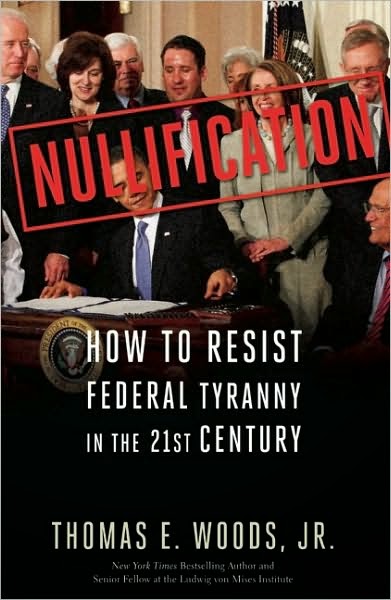
Nullification

Nullification: How to Resist Federal Tyranny in the 21st Century
© 2011 Thomas E. Woods, Jr
309 pages


In a game of word association, chances are that ‘nullification’ would not meet with flattering replies. Nullification is a word associated with the Civil War, or the Civil Rights movement, of the southern states blocking attempts at racial equality by insisting on their own right to declare a federal law unconstitutional, and thus null and void. But nullification has a richer and nobler history than its modern critics realize; in Nullification,  Tom Woods explains the legal basis of the principle, demonstrates its use throughout early American history, and points out areas in which the states have adopted it as a tool today.

Nullification’s sanction, Woods argues, rests in the little-c constitution of the United States. Though today the fifty states may seem like mere departments of the national polity, in the beginning this was not so. The united States began life not as a nation, but an agreement between thirteen, and with specific purposes. Treaties from the period enumerate the individual states, demonstrating their primacy. If not the States, who may declare a given law unconstitutional? The Supreme Court has assumed that role (‘judicial review’), but as part of the government, how can it be expected to police itself?  The individual States, however, have existence without the national government, and it exists, or was supposed to have existed, as their handmaiden — not the other way around. Theirs is the right to declare the actions of Congress, the President, and the Court unconstitutional — but theirs is likewise the responsibility to create measures for frustrating the government’s knavish tricks.

This they have done, from as early as the Adams presidency til today. Nullification first came onto the scene after the Federalist congress put into effect the Alien and Sedition Acts, which made defaming the government and its officials a crime. (Defaming the government was, until the rise of baseball, the national sport, and especially loved by Jefferson, Hamilton, and their respective parties.) Straightaway governors began throwing up barriers to federal agents attempting to arrest mouthy citizens. They did the same when, during the Napoleonic Wars, President Jefferson imposed an embargo on Europe — an embargo that might have driven American trade to its knees. The reality and the threat of nullification continued to force the hands of overambitious executives. Today, legislative sabotage continues as states decriminalize marijuana use even as the federal  government continues to insist it’s a no-no.   Given that the US attorney general is now retreating from parts of the War on Drugs (starting with that odd habit of theirs of seizing  property that has been declared guilty of participating in a crime), the principle seems just as potent.

Nullification is a small book (~165 pages, not counting the documents appended to it), but is a very worthy introduction to compact theory, in which the States are legally superior and not subordinate to the national state. It’s also a respectable attempt to rescue nullification from its historical taint, but loses some points given that Woods never squarely addresses the threatened use of it during the 1960s, maintaining only that nullification is a weapon that can be used unjustly as easily as it can be for justice.  I was also hoping for other kinds of nullification to be covered (like jury nullification), but Woods focused only on formal measures by the States themselves.  Altogether it’s a solid intro to the subject, and I am all for throwing wrenches into the machinery.

Related:
The Liberty Amendments, Mark Levin,  all of which aim to restore to the fifty states their original power over the central government.

Posted in history, Politics and Civic Interest, Reviews | Tagged , , , , , , , , , , , | 9 Comments

Casualties

Casualties: A Novel of the Civil War
© 2010 David Rothstein
465 pages

The year is 1863, and Tom Connor just survived the Battle of Gettysburg. His kid brother didn’t, though, and agonized emotionally he is looking forward to a Christmas furlough with his wife, Laura, in Indiana.  But war’s not that simple, and instead of going home for Christmas, Tom is captured by the Confederate army and sent south, to a town that has been abandoned several times because of yellow-fever epidemics and chronic flooding: Cahaba.   The Connors have been separated by the war for years, and this latest incident is too much for Laura to take. Her childhood home ruined by war, her brother-in-law perished, and now her husband, abandoned by General Grant to whatever fate will befall him, deep in the misty swamps of Alabama?   Leaving the family store in the care of kin, Laura decides to travel to Alabama and fetch her husband out of prison.   Can one woman travel through a war-torn wasteland, evading bushwhackers and starving refugees?  Such is the premise of Causalities, a novel that uses Laura’s descent from civilization into the wilderness to shock readers with the brutalities war visits not only on soldiers, but on innocents.

The tale is told back and forth, through both Laura and Tom’s perspectives.  Although Cahaba doesn’t have as bad a reputation as Andersonville, it may deserve it, for prisoners were housed in a frequently-flooded warehouse presided over by a man whose response  to pointed inquiries about prisoner neglect is to drone on existentially about the meaning of honor and duty in war.  Prison camps during the war were aatrocious sanitation was nonexistent, and the food was miserable if available. Starvation and disease visited the camps every night, and escapees or rabble-rousers were shot in cold blood by guards. Some of Tom’s experience seems to have been drawn from Andersonville, like a gang of hoodlums preying on their fellow prisoners, and eventually being put on trial and executed by the prisoners themselves.  Laura’s story is no less traumatic: while she is able to navigate through the country on the kindness of strangers, as she hits the war-ravaged south things change. Armies are active here, and leave behind them an expanse of burned-out homes and fields littered with diseased bodies. In the absence of law, gangs of highwaymen prey on villages whose men are off at war. Laura is in turn dependent on the kindness of others, and the agent of it:  after serving as a nurse after a battle, she is stricken with disease and rescued by newly-freed slaves. Laura, in her journey, will experience both extraordinary kindness and utter depravity.

Although Rothstein’s characters can get a bit formal and preachy at times, the research is well-grounded. Neither side is particularly heroic, and the easy companionability between “the Yankee woman” and the southerners who she helps and helps in turn hints that the people of America are not divided, hostile camps doomed to enmity, but have been abandoned to that by willful politicos on either side.   Laura’s journey touches on the major calamities of the war — disease, starvation, raids by armed forces; families torn apart by divided loyalties, or destroyed completely by the butchery of battles like Gettysburg and Cold Harbor. Tom’s quieter role would be a rude introduction to the obscenity of POW camps for any reader who has not experienced a place like Andersonville.  Although it has its limitations, this was quite good for a first-time author, and the focus on civilian life sets it apart from most Civil War fiction.

Related:
This Republic of Suffering, David Faust

[2015 Reading Challenge — A Book Set In Your Hometown, 4/52)

Posted in historical fiction, Reviews | Tagged , , , , | 1 Comment

Winter World

Winter World: the Ingenuity of Winter Survival
© 2009 Bernd Heinrich
400 pages

When winter arrives in the upper reaches of the northern hemisphere, humans take refuge in homes warmed by central heat, or bundle up in clothing. But what do creatures far smaller and more fragile than us do?   In a landscape apparently devoid of food, how do animals survive the months-along barrenness?  In Winter World, Bernd Heinrich applies his own boundless curiosity and devotion to meticulous research to the question, and draws from the work of others to tell the astonishing story of life in winter.
 Although in times past Heinrich has written books on particular animals (Ravens in Winter, Bumblebee Economics),  this work on winter covers birds, bats, bears, bees, and even critters whose names don’tbegin with a bee. There are frogs, gophers, caterpillars – it’s a menagerie. Who ever thought the silent winter forest carried within it so much life? As varied as the creatures are the strategies they use to survive the long cold spell. Some, like us, adapt by creating a comfortable ‘microclimate’;  squirrels and beavers create residences for themselves that stave off some of the worse of the cold, while the snow itself provides another refuge. When it lays thick above the ground, it traps the Earth’s heat being radiated from the core upward, creating a thin layer of warmer air that animals like mice positively flourishin.  Other animals have mechanisms for  gaming their body temperature; some produce natural antifreezes that allow their body to function at subzero temperatures.

There is in short an abundance of ways animals combat the cold, Although Hendrich frequently refers to and summarizes the studies of other scientists,  Winter World isn’t strictly a scientific survey. Heinrich is a naturalist, a man who earnestly loves his considerable time spent in the outdoors; from childhood on, he has spent long hours in the wilderness, for days and weeks at a time. He is a man who never passes up an opportunity to investigate nature’s secrets. Stumbling upon a chipmunk that lost a fight with an automobile, he couldn’t help but investigate its cheek pouches: just how many seeds could it carry, anyway? Another dead specimen, a kinglet, became the subject of another test as he microwaved it to find out how quickly it lost heat with its feathers on as opposed to without them.  Some of the naturalists he cites are just as…passionate, like the man who invaded a den of bears and decided to test their awareness, eventually snuggling with one and recording its heartbeat.

Winter World is one book I’ve been itching to read,  and it did not disappoint.

[2015 Reading Challenge: A Nonfiction Book COMPLETED 2/52]

Posted in Reviews, science | Tagged , | 1 Comment

Lives of the Planets

Lives of the Planets
© 2007 Richard Corfield
304 pages

            Ever wanted to take a tour of the solar system, but were deterred by that little problem of explosively decompressing once in the vacuum of space? Lives of the Planets takes readers on a tour by remote, through the history of American, Russian, British, European, and Japanese probes.  Like the moons of Jupiter, it contains a lot of diversity in a modest number of pages, being a physical exploration of our cosmic neighborhood, a history of our robotic journeying, and lectures in brief  along in the trail.  Each stop along the way presents cause for a new topic;  Richard Corfield writes on atmospheric dynamics near Venus, the origins of life on Earth, the vagaries of gravitational mechanics near Jupiter and the asteroid belt, etc.   Pluto is treated with the rest of the Kuiper bet objects.  There’s a great deal of entertaining astronomical history to be found here — history both distant (the formation of our solar system) and recent (our exploration of the same).  Actual content on the planets is harder to come by, however, and therein lies this very likeable book’s weakness:  the information on the planets, if gathered together, might constitute a full essay on their own. This is an utterly delightful collection of thoughts on our exploration of the solar system, and what the search has taught us about astronomy in general, but it doesn’t quite deliver as a work on the planets in particular. 


Posted in Reviews, science | Tagged , , | Leave a comment

This week: supercooled birds, President Palpatine, and people causing a ruckus

We’re off to a good start for 2015, opening the year up with Bernard Cornwell and two science entries, both of which (Lives of the Planets,  Winter World) will get comments as the week goes on.

Yesterday at the library I picked up:

  • The Monkey Wrench Gang, Edward Abbey
  • A World Lost, Wendell Berry
  • Surely You’re Joking, Mr. Feynman!, Richard Feynman  (2015 Reading Challenge)
  • The Hidden Wound, Wendell Berry
  • Tearing down the Streets: Adventures in Urban Anarchy, Jeff Ferrell
  • The Human Zoo, Desmond Morris (2015 Reading Challenge)
  • The First Day on the Somme,  (pos. 2015 Reading Challenge)

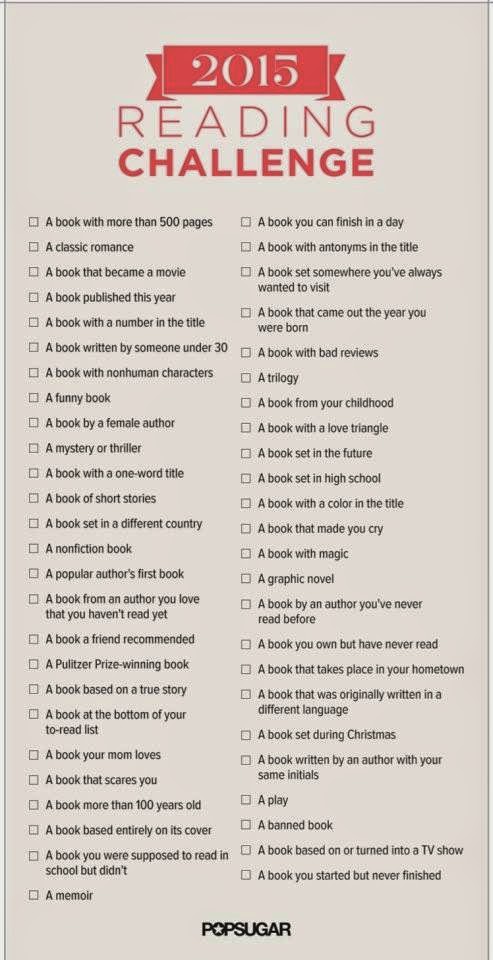
Last week I mentioned the 2015 reading challenge, which is a literary scavenger hunt with fifty categories on it. I’ve made good progressed so far,  with three(ish) item taken down:  a book published this year (The Empty Throne, Bernard Cornwell) a nonfiction title (Winter World, Bernd Heinrich), and — well, I’m not sure. Yesterday I reread The Pigman by Paul Zindel, but I haven’t decided what entry it will claim:  a book that made me cry (which it did, when I was younger); a book from my childhood, or a book I can read in one day.  Surely First Day on the Somme might make the eyes damp? The books from the library today should keep me going strong, though I won’t necessarily be reading everything: not only do I have two purchased books awaiting, but I have two interlibrary loan books in the works, both political. (One: Green is the New Red, on federal agencies’ war on environmental groups.)

Well, happy reading!

Posted in Reviews | Tagged | Leave a comment

The Empty Throne

The Empty Throne
© 2015 Bernard Cornwell
320 pages


Uhtred of Bebbanburg is an impossible man. A Saxon prince raised by Danes,  he  has nonethelessbeen the architect of a great redoubt against them, the defender of Wessex a hundred times over.  A lone wolf in a court of civilized dogs, Uhtred is despised by the court, but admired by its warriors.  In his life, Uhtred has wrestled victory from the jaws of ruin a dozen times; he has presided over the ruin of armies that threatened devestation. In a country increasing ruled by religion and law, Uhtred is a pagan;  he is primal, a man loyal to blood and oaths, a man who lives life lustily. Time and again, Uhtred’s irrational allegiances to people have gotten him into trouble, but they have led him to greatness. Now,after a life of strife, of love and war, he is aged, battle-worn, and sick — but fate tasks him still.

The Empty Throne sees Uhtred struggling valiantly to defend his friends and innocents yet again, fighting not only against the energetic scheming of men now far younger than him, but against his own mortality. His body carries many wounds, some fresh, and one which refuses to hill. But the chief of Mercia has just died, and if the schemers get their way the kingdom could fall into Danish hands, and a woman Uhtred loves (always the women with Uhtred and Sharpe!)  relegated to a fate worse than death: a nunnery.  So he and his own must gird themselves up one more time and fight the good fight — scheming, fighting, sailing — even if it takes them into the great unknown: Wales. 
The battles in Empty Throne are more like brawls,  much smaller in scale (aside from a fleet being set on fire); the book is a prelude to the great climax of the Saxon-Norse struggles. What volume follows this will presumably see the end of Uhtred’s career, too, given the many premonitions of death featured here, from Uhtred’s son becoming a narrator to visions of long-dispatched foes and friends inviting Uhtred to dine with them in the beyond.  Unlike Uhtred, Cornwell’s skills haven’t diminished in writing:  his flair for the dramatic seems especially pronounced in these Saxon books, perhaps given the cultures’  devotion to oratory, or the sheer fun of writing Vikings.  Uhred spends most of this book wearily trying to sort schemes  while fighting pain, but even so there’s humor — witness his schooling his son in the fine art of backhanding priests.  (Uhtred has bearishly swatted clerics in virtually every book of this series; surely Cornwell’s made a running joke out of it.)   Despite the contemplation of death,  there is the promise of life:  not only does his daughter Stiorra has a will of iron, like the blade she uses to dispatch a would-be assailant, but like her father she has embraced the old ways of heathenry. She’s a genuine shield-maiden, and I hope she appears in the finale.)   Even once he goes to rest his bones in the hollowed ground of his forefathers (as yet unrecaptured), that spirit of Uhtred, that fierce strength, that awesome wildness — will live on.

[2015 Reading Challenge: A Book Published This Year COMPLETED 1/52]

Posted in historical fiction, Reviews | Tagged , , , , , , | 5 Comments

Teaser Tuesday: The Empty Throne

It’s been ages since I did a Teaser Tuesday, but it’s Tuesday and here I sit with a Bernard Cornwell quotation worth sharing.

At night, in the hall, when the hearth smoke thickens about the beams and the ale-horns are filled and the harpist plucks his strings, the songs of battle are sung. They are the songs of our family, of our people, and that is how we remember the past. We call a poet a scop, and a scop means someone who shapes things and a poet shapes the past, so we remember the glories of our ancestors and how they brought us land and women and cattle and glory. There would be no Norse song of Haki, I thought, because this would be a Saxon song about a Saxon victory.

p. 10-11, The Empty Throne. Bernard Cornwell

Posted in General | Tagged | 6 Comments

2015 Reading Challenge

Tonight the gauntlet was laid down!

What a diverse set of challenges!   I’m excited about this considering I don’t have anything big planned for 2015 (I have something enormous in mind for  2016, though). Some categories will be harder than others to nail (books with antonyms?!), but  it looks like a lot of fun!   I’ve produced a text version of this list and have repurposed the old TBR page for tracking purposes.  Free free to make suggestions — especially on the titles with antonyms, trilogies, and books with bad reviews.

If you’re interested, some friends of mine and I have created the 2015 Dumbledore is Dead and Prim Doesn’t Feel Too Well Challenge group on facebook to talk about the books we have chosen, check on progress, that sort of thing.

Some ideas…
A classic romance
–  anything by Jane Austen, probably Sense and Sensibility so I can read Sense and Sensibility and Sea Monsters.

A book from an author who love that you’ve not yet read
Isaac Asimov’s End of Eternity, or something in Wendell Berry’s Port William series

A book originally written in different language
Alexandre Dumas’ The Three Musketeers!   

A play
“Joseph Marley’s Christmas Carol” or Howard Zinn’s “Emma”, based on the life of Emma Goldman.

A graphic novel
V for Vendetta

A book you own but haven’t read
No shortage of possibilities there, beginning with  the entire case of Trek literature (that’s what happens when you buy a couple of  $5 boxes full of TOS/TNG paperbacks from ebay) in my bedroom!

A book on the bottom of your to-read list
I don’t know if that’s more of “a book you’ve been meaning to read for a while now, but haven’t” or “a book you swore you would NEVER EVER EVER READ” situation.   If the former, then it’s technically We Who Dared to Say No to War, as it was on the bottom of my two-entry ‘Future Reads’ list.

Book published in the year you were born
Surely You’re Joking, Mr. Feynman, possibly?

Well, I’m off to investigate the lists of Pulitzer Prize winners!

Posted in General | 7 Comments