Death Comes for the Archbishop

Death Comes for the Archbishop
© 1927 Willa Cather
297 pages

Poor New Mexico — so far from God, so close to the United States. The Pope can’t help the tide of American — and very Protestant — settlement that is sure to follow Polk’s war against Mexico, but the church in the southwest can be strengthened. To that end he dispatches Jean-Marie Latour to Santa Fe, there to serve as bishop.  Aided by his faithful friend, Joseph Vaillant,  Latour tarries with the people of New Mexico for decades before being buried by a doting multitude.  Cather combines beautiful descriptions of the landscape — especially of the Sangre de Cristo mountains — with lovely little stories about the bishop growing to know and love his new parishioners. Theirs is a world of danger, of ferocious storms, unforgiving heat,  occasional Apache raids, and plenty of brigands. Worse yet, the Americans are coming, and as they continue gaining land at Mexico’s expense, the bishop’s province grows, stretching from the Rockies to Mexico. He complains, good-naturedly, that it is hard for a poor bishop on a mule to keep pace with the march of history, with thousands of square miles of responsibility placed under his care.

The bishop and his companion compel interest for their gentleness; while he has come to restore discipline in a land where the priests have taken to siring families instead of nurturing the family of the church, he does not rush in where angels fear to tread. He realizes he is in a wholly new environment, and sees in the Indians — the Apache, the Hopi, the Pueblo, and other peoples who were never reached by Spanish missionaries or forgot them — a civilization with wisdom and conviction as deep as his.  He is awed by the ancientness of the land and the people upon it,  When he is wronged, as he is by a schismatic priest who refuses to accept oversight, he is still quick to forgive.  The sheer abundance of tenderness here, as generously proportioned as the western skies, make it a perfectly lovely read — and all the more when Cather’s brilliant descriptive writing is taken into account, creating an image of the Southwest with beauty that penetrates even the viewers’ bones.

Posted in Reviews | Tagged , , , , , , , , , , | 3 Comments

So You Want to Read about the Revolution

Although I’m reading American literature for Independence Day instead of history, why not share some favorites from previous years’ Independence Day salutes?

Thomas Jefferson, John Adams, and Benjamin Franklin from HBO’s John Adams.

Founding Biographies
John Adams, David McCullough
First Family: John and Abigail Adams, Joseph Ellis
American Cicero: The Life of Charles Carroll, Bradley Birzer
The Cost of Liberty: the Life of John Dickinson, William Murchinson
Alexander Hamilton, Rob Chernow
American Sphinx: the Character of Thomas Jefferson, Joseph Ellis
His Excellency: George Washington, Joseph Ellis

Give me Liberty
Common Sense, Tom Paine
Founding Brothers: the Revolutionary Generation, Joseph Ellis
Chainbreaker’s War: a Seneca Chief Remembers the Revolution, Jeanne Adler
A People’s History of the American Revolution, Ray Ralphael

…or Give Me Death
George Washington’s Secret Six: the Spy Ring that Saved the Revolution, Brian Kilmead
1776, David McCullough

God Save the King
The Men Who Lost America,  Andrew Jackson O’Shaughnessy
The American Tory, ed. Morten Borden and Penn Borden

A More Perfect Union: the Early Republic
American Creation: Triumphs and Tragedies at the Founding of the Republic, Joseph Ellis
Founding Rivals: Madison vs Monroe, Chris DeRose

Fiction
The Fort, Bernard Cornwell
Redcoat, Bernard Cornwell

Books of note but which I don’t have review for are McCullough’s 1776, and Jeff Shaara’s revolutionary war fiction, beginning with The Glorious Cause.  Looking at a list of the books makes me realize I’ve read virtually nothing about the military aspect of the war, aside from 1776.   Something to remedy!

Posted in history | Tagged , , , , | 6 Comments

The Monkey Wrench Gang

The Monkey Wrench Gang
© 1975 Edward Abbey
352 pages

“Three things my daddy tried to learn me. ‘Son’, he always said, ‘remember these three precepts and you can’t go wrong. One, never eat at a place called Mom’s. Two, never play cards with a man named Doc.’
‘That’s only two.’
‘I can never recollect the third, and that’s what worries me.'”

They say you can’t stop progress, but with with plastic explosives, thermite, and a few friends, it’s worth a shot.  The Monkey Wrench Gang is the madcap adventure story of four very disgruntled folk — a brain surgeon with a predilection for chainsawing billboards, a wayward Mormon, a Green Beret out to wage a one-man war, and a lady-type —  who join together to wage a war of sabotage against the industrialists despoiling the Southwest. New Mexico, Utah, Arizona — wherever there’s an unguarded bulldozer, they’ll gum its workings and set it on fire.  Where there’s a bridge built at public expense for private gain, with smoggy air thrown in as a bonus gift, they’ll blow it. And where there’s a dam…they will dream and pray for a way to destroy it. The Monkey Wrench Gang chronicles their private beginnings, their chance meeting at the Grand Canyon, and their joint missions which draw down not only entirely too many helicopters, but the wrath of a bishop of the Mormons, who is working on his gubernatorial prospects and can’t have a bunch of anarchists running around setting fire to his plans.   Time and again they narrowly escape, but eventually things go south. This is a novel for those who see in the wilderness relief from lunacy, who have wished for a “pre-cision” earthquake to topple the godawful constructs that often mar it.

The Monkey Wrench Gang is a adventure novel in which explosive sabotage mixes with similarly fiery dialogue and humor.  A reader who has already encountered Edward Abbey will see him again in these characters; his ardent love for the southwestern wilderness, the thoughtful yearning that it not be ruined, both for its sake and for humanity’s, the contempt for the outsized.  It comes through in his characters’ conversations with one another, in their narrative of their ambitions and plight.  Abbey is sometimes serious, sometimes farcical.  What he takes seriously is the desert wilderness, a vast landscape of breathtaking beauty: what he does not take seriously is ego of man, who thinks he can tame it. Tame it, never — ruin it for others, maybe.  That’s what Abbey and his characters aim against. They are against coal factories puffing vile plumes into the open air of the desert, against power lines and roads that only said factories and mines put to use;  against the invasion of the southwest by ‘consumers” who want to check the Grand Canyon off their list, for whom the desert is not a profoundly moving  — challenging, even — experience, and merely a section of the photo album.   Each of the characters have their separate motives:  the Green Beret is furious that his home is being ruined by the same corporate SOBs who sent him to Vietnam, Seldom Seen Smith has lost his living because of the damned dam damming up the damned river, and the brain surgeon attributes growing health problems to the increasing amount of factories and mines. (The lady-type is involved because she majored in Classic French Literature, and what else are you going to do with that degree but blow up billboards?) .  Mostly, however, there is the conflict between the grand wilderness and the corporate-government complex that has delusions of grandeur but is only a major pain in the tuchus for the common man.  Abbey is, and his characters are shadows, of a kind of anarchism. Not the bomb-throwing type (they carefully set their bombs, no reckless flinging-about), but the kind that rages against the Man, embodied in the corporate-government complexes of power plants, mines, and the like.

I enjoyed The Monkey Wrench Gang,  having long found in Abbey a kindred spirit, at least as far as his small-is-beautiful political convictions and love for the wilderness go. (I hasten to add that I do not share Abbey’s habit of billboard-sawing.)   Although Abbey’s books were written during the dawn of the environmentalist movement, no one will find in him a stereotype. His characters, for instance, enthusiastically litter the highways they hate with beer cans,   because the vista has been so bespoiled that they are really only defacing the defacement.   While the Monkey Wrench Gang isn’t exactly a moral mark to aim at, the dialogue makes this a fun novel, especially if you share Abbey’s preference for decentralization. It’s a nice rebels against the Man sort of tale, at any rate. Abbey is a man to spend time with. What a kick he must have been a few sheets to the wind…

Posted in Reviews | Tagged , , , , , | 3 Comments

O Pioneers!

O Pioneers!
© 1913 Willa Cather
230 pages


The history of every country begins in the heart of a man or a woman.

Hannover, Nebraska, is a frontier town on the brink of failing, a temporary camp upon a wild landscape that refuses to give up its bounty. A growing stream of families are selling their land at a loss and retreating back to civilization, there to eke out meager if predictable incomes as employees of someone else.  Alexandra Bergson has been urged to follow them: here she is, managing a homestead and a number of younger siblings on her own, virtually an orphan. For ten years her father labored here, and all he achieved was to pay off debt. But Alexandra loves the land she buried her father in,  senses that the winds will turn, and above all — believes in her father’s dream.  And so, she committs herself to it — managing her resentful brothers, eagerly seeking out new information and carefully experimenting,  Virtually everyone leaves her. In the decades to come she is the core of her family, the creator of its success, whose growing staff of immigrants dote on her.  Her aim in life  is to see to it that at least one of her younger siblings transcend the farm, to gain entry into the professional class by the fruits of her labor.   Young Emil does, and for a time all seems right with the world — but domestic bliss is denied to virtually everyone here. The ending, in which Alexandra seems to realize her vocation at the farm is fulfilled and is reunited with a cherished childhood friend, leaves one feeling slightly…unfulfilled.  It has an air of resignation, almost, but at least the writing and characters make the story worthwhile.

Frontispiece:  Grant Wood’s Fall Planting. Wood is best known for his American Gothic, though my favorite is Spring in Town.

Related:
Hannah Coulter, Wendell Berry

Posted in historical fiction, Reviews | Tagged , , , , , | 4 Comments

White Fang

White Fang
© 1906 Jack London
pp. 1- 101, Tales of the North.

“An’ right here I want to remark,’ Bill went on, ‘that that animal’s familiarity with camp-fires is suspicious an’ immoral.’
‘It knows for certain more’n a self-respectin’ wolf ought to know,’ Henry agreed

White Fang revisits  the theme of the Wild versus civilization from The Call of the Wild and reverses it.  Whereas in Call a soft California dog was thrown into the Alaskan wilderness and forced to call upon his instincts to survive, finding joy running with wolves after his master is killed,  in White Fang a dog/wolf hybrid is lured from the wild into the camps of man.  First published in Outing Magazine,  the story begins with two men being tracked by an eerie creature, a she-wolf who understands man. It is she who will give birth to a cub, and rear him in a wilderness of even-more dangerous predators like the Canadian lynx,  and it is her own youth spent in an Indian camp that will first introduce the cub to man.  Three-quarters wolf, there is virtually nothing of the dog in him, only a respect for Man’s strength and a willingness to submit to it in exchange for shelter and food.  Yet there is more to man’s relationship with wolves and dogs than sheer animal dominance.

 Here again London touches on Nietzsche’s superman myth, and again rejects it; just as  he did in The Sea Wolf and Martin Eden.   White Fang is shaped by fear, hunger, and rejection to be a creature mighty in strength, desperately cunning, and comfortable only in solitude. He knows one law: kill or be killed, eat or be eaten, intimidate or cower. Every memory of tenderness, either from his cub days or his early adoption by an Yukon native, is erased after he falls into the captivity of dog-fighters.  Yet he is not lost; just as Wolf Larsen was defeated by a man who combined wild strength with moral courage, so too is White Fang’s savagery tamed by persistent and intelligently guided affection,  care that teaches him other laws — care that reignite the what little of the dog exists within him.  Considering that The Call of the Wild was my first novel, and that every single thing I’ve read by Jack London has proven unforgettable, it’s hard to believe White Fang has taken me this long to read. It combines adventure with a narrative that speculates on how a dog might, in coming of age, grow to understand the world. The writing is winsome as usual, dramatic and – occasionally, unexpectedly – with flashes of laughter. (London has given me a most excellent insult — “If you don’t mind me saying, you’re seventeen kinds of damn fool, all of them different, and then some!”)

Related:
The Sea-Wolf, Jack London.

Posted in Reviews | Tagged , , , , , , , | 1 Comment

Desolation Laughing

Dark spruce forest frowned on either side the frozen waterway. The trees had been stripped by a recent wind of their white covering of frost, and they seemed to lean toward each other, black and ominous, in the fading light. A vast silence reigned over the land. The land itself was a desolation, lifeless, without movement, so lone and cold that the spirit of it was not even that of sadness. 

 There was a hint  in it of laughter, but of a laughter more terrible than any sadness — a laughter that was mirthless as the smile of the sphinx, a laughter cold as the frost and partaking of the grimness of Infallibility. It was the masterful and incommunicable wisdom of eternity laughing at the futility of life and the effort of life. It was the Wild, the savage, frozen-hearted Northland Wild.

But there was life, abroad in the land and defiant.

White Fang, Jack London.

Posted in quotations, Reviews | Tagged , | Leave a comment

The Great Debate

The Great Debate: Edmund Burke, Thomas Paine, and the  Birth of Right and Left
© 2013 Yuval Levin
296 pages

The Great Debate uses the war of letters between Edmund Burke and Thomas Paine  to explain the philosophical differences between conservatism and progressivism. Both men were political actors, albiet in different spheres, and both achieved renown during the period of the American and French revolutions. While both the respectable MP Burke and the revolutionary Paine supported the American cause, they broke furiously over the French.  Drawing on each party’s respective works, some written as direct rebuttals to the other, Yuval Levin explores their opposing philosophies in different sections: the meaning of ‘nature’, the role of choice,  reason versus tradition, and so on.

As a pair, they remind me faintly of  John Adams and Thomas Jefferson, with Adams as the cynic and Jefferson the romantic. Burke emerges here as a man constantly aware of human frailties, and desiring to mitigate them as much as possible — chiefly by preserving the structure of government passed down from generation to generation, which he assumes as custom-tailored for its people through the ages — and making marginal, cautious changes as circumstances dictate.  Paine is marked more by idealism, mindful only of the good which we are capable of.  For Paine,  tradition and custom are the mere baggage of time. For him, there are certain principles which, if followed, guarantee freedom and progress. The trick is that these principles have to be built into the foundation, so  virtually everything has to be torn down to make room for them. It is in that vein that he argues that the American states should adopt a tack that would later be embraced by the French: erasing the historical boundaries of distinct places, and instead creating new little subdivisions of the State, purely for administrative purposes. Burke did not see the American revolution as a revolution; he saw Parliament’s recent presumption of absolute powers over the colonies as all-too-new preogative, at odds with the facts of distance and precedent. (For Paine, the Amercan revolution was the start of a global revival, the dawn of an Age of Reason applied politically.)  Paine can see no reason to create internal checks and balances: so long as the beginning principles are sound, there will be no need of conflict.

 For me,  I think back to Adams and Jefferson, and wonder whose vision I trust more — the skeptic of human nature Adams,  who mistrusted too much democracy but refused to own or  hire slaves…or the idealistc Jefferson,  who could sing ‘liberty’ to the heavens but who maintained his own stock of enslaved persons. Give me Adams — his actions have more weight than the prettiest words.  The same goes for Burke and Paine. While I can disagree with Burke time and again, ultimately erring on the side of caution strikes me as as better than ripping apart society and allowing for creatures like Napoleon.  While Levin doesn’t reduce Paine to caricature, the amount of time he gives to Burke — required given Burke’s sheer complexity —  gives the book a Burkean balance.   Paine’s idealism survived as long as it did, I think, because he never held an office of political responsibility. He thus enjoyed the luxury of never having to put his ideas into practice personally, rather like a few other political philosophers of the 19th and 20th century.   I found The Great Debate fascinating  dialogue between two equally sympathetic men, of idealism mixing with cognizance of our limitations.  The title is total oversell, though,  since Paine’s connection with progressivism only appears in the conclusion.

Posted in Politics and Civic Interest, Reviews | Tagged , , , , , , | 2 Comments

Harvest of Empire

Harvest of Empire: A History of Latinos in America
©  2000 Juan Gonzalez
416 pages

Harvest of Empire is a tale of two civilizations, Anglo and Spanish. In general terms, it recounts the history or rather the plight of Latin America, of people and cultures dominated first by European powers, and then by the colonial rebels turned colonial master, the United States.  The author ends by arguing that the United States owes as much its Hispanic tradition as its Anglo, and that it should embrace Hispanic culture  and make amends to foreign policy which has wreaked havoc throughout the eastern hemisphere.  Divided into three parts, Harvest first dwells on the roots of Anglo-American conflict by recounting the age of discovery and rise of American imperialism, moves to the “branches”, in which populations disrupted by war and famine (often linked to American foreign policy) migrate to the United States to seek their fortunes, and then ends with a “harvest” that looks towards a stronger role played by Latino culture in the United States.

 Considering that two of the leading recent  Republican candidates for El Presidente were Cruz and Rubio, ‘los hermanos cubanos’,  there’s no denying the book’s relevance, despite its sixteen years of age. Even though neither are in the running now,  immigration  — the causes and consequences of which are explored here — remains a big-ticket item.  While some of the author’s recommendations (that the United Staces embrace its Hispanic heritage and start promoting and protecting Spanish) are likely to fall flat,  at the very least this review of the United States’ catastrophic record of international meddling in central America might give American leadership pause about supporting future debacles.  More convincing is the authors’ case for settling the matter of Puerto Rico, which for a century has been a bastard, neither  sovereign, nor a territory or a state.  Harvest has a lot to recommend it, first as a general history of Latin America, secondly by focusing on the widely varying experiences of different Latino groups as they moved to the US.  What name recognition does Puerto Rico have with most Americans, other than the film West Side Story? (“Puerto Rico is en America now!”)   The author is right when he points out that the United States is scarcely over two hundred years old, a mere blip in the historical perspective, and the past century of exploitation and dominance by D.C. over Latin America are not likely to last. Latinos will play a larger role in the United States as they continue to migrate here, and will shape D.C’s policy as they achieve political influence — and as the descendants of those who have experienced the consequences of foreign-policy imperialism, they are unlikely to support more of it.

Posted in history, Reviews | Tagged , , , , , , , , , , | Leave a comment

Hurricane Katrina through the Eyes of Storm Chasers

Hurricane Katrina through the Eyes of Storm Chasers
© 2005
96 pages, virtually all photographs

I recently discovered a collection of Hurricane Katrina photography that I thought worth mentioning.  The book collects photos taken by Jim Reed and Mike Theiss, principally in the Gulfport area but also including a handful of shots in Orlando and New Orleans.  Eleven years later, the plight of New Orleans monopolizes any mention of Katrina, but these photographs were amazing.  The storm hit only a year after Hurricane Ivan walloped Alabama, so I watched it approach the coast with dread. Reed and Theiss are lunatics, judging by how close they were to the storm surge and the winds here — though at least once they set up a highly stable and encased camera near the path, then recovered it later. If the only Katrina footage you have seen is of New Orleans, this book is worth looking through.  Gulfport wasn’t merely flooded: the winds, 26-foot storm surge, and ships thrown inland wiped out massive swaths of development. Hotels had their first floors gutted, with only the load-bearing walls intact,  The shots of wind blown trees have a beauty about them, despite the sheer danger they make those of us living anywhere near the Gulf remember.

Posted in Reviews | Tagged | 3 Comments

The Romulan Stratagem

The Romulan Stratagem
© 1995 Robert Greenberger
297 pages

A planet on the border of the Federation, Klingon, and Romulan empires has invited the Enterprise to sell its government on Federation membership. When the Big E arrives, however, they find a Romulan warbird waiting for them. The Romulans have also been invited to make a pitch for membership, and their negotiator is no less than Admiral Sela. Sela, who claims to be the daughter of an alternate-universe Tasha Yar, fell from grace after Picard dismantled her last set of nefarious plans, and for her snatching this planet  from under his nose will be sweet revenge. During the week of meetings, however, several deadly explosions implicate the crews of both the Enterprise and Sela’s warship, threatening both powers’ desires. Incredibly, Data finds himself working with Sela to work out what third party is sabotaging the conferences. While this plot thread has considerable interest,  given Data’s intimate history with Yar,  that angle is never pursued. The ending is a departure from the unexpected, but on the whole there’s nothing really remarkable about the book. Ro Laren lends  interest in her comic-relief thread, being assigned to babysit a civilian family after bodily throwing one too many civilians out of her way attracts the Wrath of Riker.  A teenage boy in said family develops a raging crush on Ro, one which she is far too slow to pick up on.  All told, this is enjoyable enough, but I only read it for the characters featured on the cover.

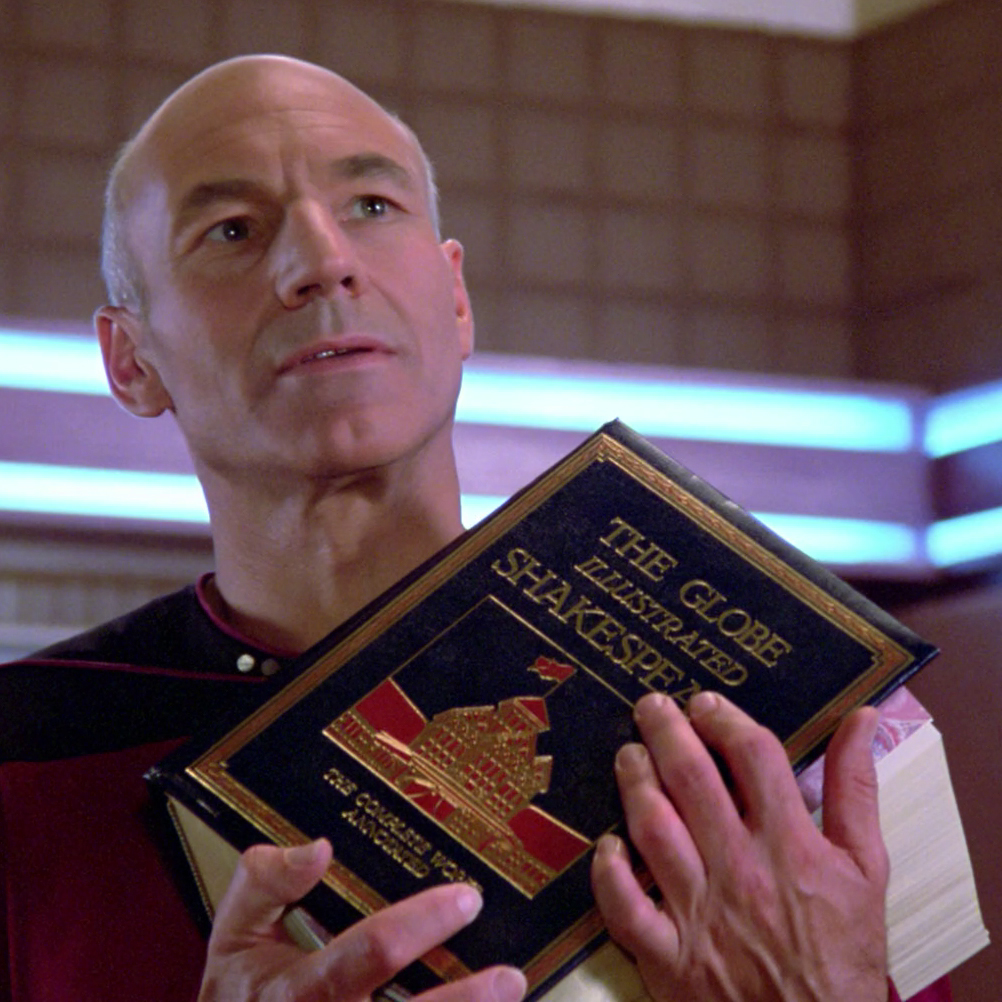
Read it for Ro. Patrick Stewart wants you to.


Posted in Reviews | Tagged , , | Leave a comment