WARNING: This review contains a prominent spoiler for Three Inch Teeth and Shadows Reel. Proceed with caution, pilgrim.
“See what happens when good people spend too much time around you? They kidnap their local sheriff.”
Joe Pickett and Nate Romanowski are both wounded men, having come close to losing all that was dearest to them at the hands of a sociopath, Dallas Cates, who in prison teamed up with a former covert operator for DC who has now turned his skills and cruelty against the government itself. Nate in particular has lost his wife and business partner, Liv, and abandoned his daughter Kestrel to the Picketts’ care so he can regain his ferality and wreck revenge on Dallas’ partner in evil, Axel Soledad. Nate and Geronimo thought they’d killed him in an alley fight, but evidently not: he’s still alive if not kicking, and actively planning on wiping out a large contingent of government officials and military-industrial leaders who are gathering for an annual “let’s pretend to be cowboys” conference in remote northern Wyoming. Joe has just been asked by the governor to go looking for a missing outfitter in those very parts, a man whose assistant happens to be the governor’s son-in-law – and whose disappearance the governor would prefer to keep under his hat for the moment. Joe and Nate’s paths will undoubtedly converge on Battle Mountain, but trouble is also waiting for them at home – and Sheridan will get her chance to shine.
I approached Battle Mountain with a little wariness, in part because Axel Soledad is a troublesome antagonist, sometimes very hatably effective and sometimes overused, especially the way he reliably gins up mooks from the ranks of college kids who like larping as activist and want to take down the system, man. I realize college kids can be naive even in their cynicism, but given how many allies Soledad betrays or abandons at some point you’d think some word of mouth would start hampering his recruiting ability. (There’s also the fact, of course, that now I have to wait an entire year for another Joe story after my two-month drive through two and a half decades of them.) Adding enormously to the tension is the fact that Soledad’s greater organization has a lot of shadow operators, including the sheriff in Saddlestring who threatens Mary-Beth and Kestrel. There’s also a possibly rogue FBI agent roaming around, one who claims to be on Joe and Nate’s side – but neither would trust a goonie boy any further than Kestrel could throw them. (If Nate were to throw a goonie boy, I’m pretty sure it would be off the side of a cliff and the goon in question would go pretty far.) This was almost all straight action, and had a great climax.
Today’s TTT is authors who live in my state/region! But first, a tease:
Hit `em where they ain’t, run when you really shouldn’t, keep going when you ought to stop. It was the modern age and his game was the baseball equivalent of modern art. It was at once a dramatic break from the past and a comment on it. It made people nervous. His game looked ugly until it looked bold and smart. (TY COBB: A TERRIBLE BEAUTY)
Please excuse my Publisher abomination
(1) Kathryn Tucker Windham. I have to begin with KTW because she’s a legend in Alabama and especially in Selma. KTW moved to the Selma area from Wilcox County in the 1970s, I believe, working as a journalist. She was a pioneer in that, and one of her books — Odd Egg Editor— has some of her early writing, as being both “The Girl” and “The New Kid”, she got only the scraps of news leads. She had a delight in folklore and oral history, and became famous for her collections of southern ghost stories. I had the good fortune to listen to her telling stories at Old Cahawba (Alabama’s first capital and now ghost town) as a kid, and plowed through all of her ghost stories. She also volunteered at the library after she retired from journalism, and was responsible for creating the Annual Tale-Tellers Festival in Selma, which features gifted storytellers. I’ve laughed myself sick every time I’ve gone.
(2) Rick Bragg. Bragg is one of Alabama’s most-read living authors, and like KTW began in journalism. Bragg is most known for his trilogy about growing up in Alabama’s northern counties, creating books that are both tragic and hilarious. My introduction to him was his The Best Cook in the World.
“I remember this time, up in Rich Bundrum’s barn loft, we found this case of dynamite,” Jack said, and then he paused and shook his head, as if realizing now what he should have then: that there are no good endings to stories that begin with ‘we found this case of dynamite’.
Beyond his family trilogy, Bragg has also released several collections of his newspaper columns, as well as other works.
(3) Harper Lee. Harper Lee isfamous for To Kill a Mockingbird, so I won’t go into any details. She comes from a small town called Monroeville, which — because it was also the home of Truman Capote, her friend — styles itself the Literary Capital of Alabama.
(4) Truman Capote. I have not read Capote’s most famous work, In Cold Blood, but I can’t mention his friendship with Harper Lee and not mention him, can I? I did read his Breakfast at Tiffany’s.
(5) Wayne Flynt. Also in Harper Lee’s company is Alabama historian Wayne Flynt, whom I’ve had the pleasure of talking to on several occasions when he has given booktalks at the library. In addition to formal histories about Alabama or its working poor, he’s also done a couple of books on his relationship with Harper Lee.
(6) Eugene Sledge, aka The Sledgehammer. Gene Sledge’s memoir about World War 2, With the Old Breed, was part of the inspiration for HBO’s The Pacific. Sledge later taught biology at the University of Montevallo.
(7) John Sledge. John is Gene’s son, and has written numerous histories relating to Mobile, as well as a general history of Alabama in the Civil War.
(8) Fannie Flagg. Flagg wrote Fried Green Tomatoes at the Whistlestop Cafe, made more famous by a movie. The cafe was based on one operated by two women in Irondale, Alabama, and it still stands: I was there just on Sunday!
(9) Sean Dietrich isn’t really from Alabama, but we’ve adopted him as ours. “Sean of the South” writes a daily column and substack that’s chiefly human interest/humor/chicken soup for the soul kind of stuff, and has also penned several novels, all of which I’ve loved.
(10) Winston Groom. I’m not sure how eager we should be to claim this one, but the author of Forrest Gump is ours. I read this back in high school back when someone on the football team discovered that “Forrest Gump is a DIRTY book” and …well, at least half the class read it to find out how different it was from the movie. I don’t remember much, but I also read the sequel in which Forrest creates New Coke.
Joe Pickett’s future son-in-law just got eaten by a bear. Granted, like most men Joe was a little wary about idea of son-in-laws in general, but Sheridan was fond of the boy and he’d rather no one get eaten by bears, especially his daughter’s friends. Unfortunately, as game warden it gives him a work problem as well as a dad problem: now he has to call in the Predator Attack Team to hunt down this beast with an appetite for human blood, and even as far as grizzlies go, this one is a proper terror, with multiple attacks being reported. While Joe is stealing into the woods hoping the last thing he hears is not the 30-mph rush of a grizzly coming to make him a Sloppy Joe sandwich, an even worse predator is released into the wild. Dallas Cates, the sociopathic rodeo star who beat Joe’s daughter and left her for dead, the man who had planned to torture Joe by killing his family one by one, is again free from prison – and he’s meaner and even more amoral than ever. He’s intent on revenge, and plans on using the grizzly attacks to mask his attacks on a list of six people he blames for ruining his and his family’s life – a list that includes both Joe and Nate Romanowski. (Imagine the stupidity of trying to kill Nate Romanowski!) This novel deftly mixes game warden business with the crime/action thrillers, since Joe’s family has been left in the dark about Dallas being released: they have no idea the savage is on the loose, but Joe’s experience with grizzlies and bears in general has him baffled at the string of bear attacks. To paraphrase him, there’s either bears working in concert, a bear with magic powers, or something else entirely going on. As it happens, it’s something else entirely. As with other intense personal fights to the death, there is blood paid for the resolution, but it’s effective all the way down to the end.
While out and about doing Game Warden-type things, Joe Pickett notices something odd. There’s a movable building of some sort hidden away on a ranch property, and a man who appears to be stuck with his head in the window. When Joe approaches to see what sort of mischief is being carried out here, he realizes to his horror that the window is a fan, and the man’s upper body has been shoved into it. When he calls it in to the property owner, the man can’t seem to decide whether he’s more outraged over a trespasser, or tight-lipped about the utility of the building. At the same time, a bad winter blizzard is moving in, and there’s not much that can be done. There’s an air of mystery around the body, one that thickens with the snow as the sheriff and governor both tell Joe to lay off and mind his business – and the man proves to be a Chinese national who was teaching at the University of Wyoming. At the same time, Nate Romanowski, everybody’s favorite falconer and libertarian crank, is approached by a man who intimates he’d like Nate to join him in a little conspiracy-type thing with fellow-minded men. Unfortunately for Mystery Man, Nate hasn’t survived as long or as much as he has by being a gullible naif. Improbably, these stories converge into a fairly wild story that involves geopolitics and Chinese conspiracies. While the premise of this one bordered on far fetched, the delivery was solid as usual, and I continue to like Sheridan’s increasing presence in the novels: unlike April and Lucy, at this point she’s more of an actor than supporting cast.
I’m going to short-round a bunch of Paul Doiron books and just comment on them in general, since the quality is fairly consistent from book to book. But first, on Willie Nelson’s birthday, I searched his name in Audible just to see what was there, and to my delight saw that he’d not only narrated a few Louis L’Amour short stories, he’d been joined by Johnny Cash and Kris Kristofferson. The Highwaymen! Nelson and Cash doing a western would have been amazing alone, but together? Wow. The first volume of “Trail Mix” was only a few hours long, and I listened with delight while playing..er, Stardew Valley. (There’s some mood whiplash for you.) The Audible presentation is more of an audio drama, since not only are there multple voice actors, but there are direct and ambient sound effects, so the listener is hearing the rumble of hooves, dogs barking outside a ranch, etc. The Highwaymen don’t appear in full on all of the short stories, though they are in the first and longest one, “Riding for the Brand”. Here, a man named Jed Ashbury assumes the identity of a murdered heir to a ranch to protect it from the man whose men committed the murder. Although the ranch’s people (we learn later ) have an idea that this vigorous outsider is not, in fact, the young heir, he’s such a good man and boss that they prefer his well-intended deceit to the villain of the piece. In another, a group of six men travel the plains to get vengeance on a man who killed one of their own in a bar brawl, and are outraged by the fact that their pursuee seems to be playing with them — preparing campsites for them to use, in fact! When they crest the ridge, they realize things are not what they seem. Willie Nelson has a great voice for reading westerns.
And now, for a few Paul Doiron short rounds! I should note these are not order of publication. My library doesn’t have all of his books, so some I’m getting in the library, some via ebook etc. I’m approaching the end of what’s available to me, so aside from a few posts next week this will probably be it. Paul Doiron’s game warden books are set in Maine, which is not a state I knew much about beyond it being a bunch of woods and mountains perilously close to Canada. While I found this via the warden connection to my Joe Pickett obsession of the last two months, they’re very different series: Doiron keeps things much more closely grounded to game warden business, with nary a Mexican cartel or government conspiracy to be had. Despite that, there’s no lack of interest, and in fact I’ve enjoyed the more character-focused storytelling. Mitch is no Joe Pickett: while they both came from an unstable familial background, Mitch begins the series younger than Joe and has a lot of growing up to to, evidence by a series of poor decisions like sleeping with the sister of a murder suspect, or pursuing law and order while under the influence of painkillers and whiskey. He does, however, mature. Although I mentioned in The Poacher’s Son that the Maine setting wasn’t as interesting to me as Wyoming, it has grown on me because of some of the later books I’ve read — one of which used islands and fog to superb dramatic effect, and another of which had Mitch commenting on different types of now and making the stuff come alive for me in a way I wouldn’t think possible, given that my only experience with snow involves weekend dustings that melt within 24 hours.
Game Warden Mike Bowditch just got a call about some dead moose on a lady’s property. Moose is a confusing word: it can be singular or plural. In this case, it’s plural. Four dead moose, an entire family. A dead moose is something, but four dead moose is a real inconvenience. When Mike arrives at the scene, he realizes that someone has shot these moose not for meat, but purely for the joy of killing – or for spite. It turns out there are ten dead moose on the property, and the property in question is owned by a woman who bought up half the county with the intention of turning it into a national park – loggers, hunters, and recreationists be damned. Although Mike is first on the scene, his local lieutenant is not a fan of this whippersnapper who keeps getting himself involved in murder investigations and decides to relegate him to the sidelines. Fortunately, that keeps Mike from getting stuck on the railroad the LT and his investigator pursue – down the wrong track. The property owner decides to use Mike as her liaison to the investigators, since she witnesses the slight acrimony between him and the lead investigator and suspects Mike will be more straightforward than diplomatic with her. Whoever killed the moose isn’t satisfied, though: not only is the woman’s lakeside home sprayed with gunfire, but her young daughter is frequently harassed. This book demonstrates Mike’s ability to bond with people who are not his supervisors, as well as his inability to let go of something that’s bugging him — rather like Joe Pickett!
Game Warden Mike Bowditch just got a call about a young woman striking a deer. When he arrives at the scene, he finds blood – but no deer, and no woman. Although he does due diligence and searches the site for clues, it’s a miserable night and he doesn’t resist it when a state trooper arrives and orders him to shove off. (Having a cop-killing father does not make someone especially popular with other LEOs.) The mystery continues to haunt Mike, though: something about it seems sketchy as hell, nevermind the state trooper’s assertion that the woman must have called for a friend to pick her up and fled the scene. He keeps getting in trouble with his superiors for butting in to areas where he’s not wanted — he’s a game warden, not a detective — but his momentary lapse in pursuing his gut is something he’ll regret all book long, as the missing woman is eventually discovered brutally murdered, in ways that recall another murder a few years before.
Two recent college grads, a pair of young women, have gone missing on the Appalachian Trail. Game Warden Mike Bowditch and his kinda-sorta girlfriend Stacey (the daughter of his mentor, that’s not weird or anything) are both called in to help with the search. This area of the AT is particularly treacherous, with narrow trails along rims that lead directly into the drink, and the increasing rumor of aggressive coyote activity. It’s also peopled by some odd characters, like an intense and unfriendly man named Nissen who holds the record for fast-trekking the AT. Although everyone’s nerves are on edge from the prospect of finding two dead students, Stacey is especially erratic and disappears halfway through the story to pursue her own lead, effectively ghosting Mike and causing both him and her retired warden father no end of worry. With multiple suspects emerging, this one is a thriller to the end.
A bayou bistro in the North Woods? The idea wasn’t so far out. The Appalachian Trail serves as a natural conduit for southern culture to the wilds of New England. And Mainers have a deep love of country music, which always surprises visitors who expect—I don’t know—sea chanteys. The way I had always thought of it was that we were just hillbillies with a different accent.
Of the Mike Bowditch novels I’ve yet read, Stay Hidden is fairly easily my favorite. Its one of the later ones, when Mike’s habit of putting his nose too far into the case has been recognized as a talent rather than a nusiance: he’s been promoted to warden-investigator, and this is his first case. It’s set on an island off of Maine, rather than maineland proper (yuk yuk yuk yuk): the island is rather insular, referring to the continent as America, and dominated by two families. A visiting tourist, a writer-in-residence, has gotten herself shot while hanging white laundry too close to the treeline during deer season. (The predominant American deer is the whitetail, which ‘flags’ when it’s on the run.) The case should be pretty open and shut: take the statement of the kid who said he accidentally shot her and see what the prosecutors have to say. Only, when Mike arrives, everyone on the island has changed their story: now the kid didn’t shoot the woman, he found her on accident. Because of the island’s location and Maine’s weather, Mike is quickly isolated — alone on the island, left to his own resources. His partner, a detective with the state police, is trapped by a court case but will arrive by ferry in a few days, but with every moment that goes by the case gets weirder. The dead woman, for instance, arrives on a ferry — still alive and kicking. Turns out someone was impersonating her, and doing a rather good job of it. There’s also the fact that Mike is staying in a home where he never sees the host, but communicates with them only through hand-written letters — and one of the people signing the letters is dead. This was a great thriller, using the fog and island setting to great effect and further bolstered by memorable characters.
This book is set earlier in the series when Mitch is still in impulsive bad-decision mode. Mike has been remanded to Downeast, a poor area of Maine largely populated by drug addicts. His mentor suggested he check in with a local professor, and after having dinner with the man — an environmentalist who is known for his obsession with primitive skills — Mitch is called to help with a man who has just stumbled to a cabin amid a growing blizzard, already frost-bitten. The man manages to communicate that there’s someone else still out there, and so Mitch and the other local authorities risk literal life and limb (and noses and ears) to find the guy. Mitch realizes that these two yokels were two trouble-makers he saw earlier in the day, accused drug-runners who were giving a distractedly cute McDonalds clerk a hard time. Frostbit Man happens to be her brother, and Mike falls into an incredibly ill-conceived relationship with her at the same time that they both fall off the AA wagon. It was entertaining enough, but boy is Mike a bonehead in this one.
Game Warden Joe Pickett has been told about a dead moose on someone’s property, and has gone to investigate to see if it’s natural causes or someone winging a moose out of season and then living the poor creature to die in flight. When he arrives at the location, though, he’s horrified to learn that the corpse is not a moose, but a human being: a fly fisherman guide who has a shack not too far away. When he investigates the man’s cabin, he discovers evidence that the poor man was tortured with ordinary house tools before being set alight, and our horrified warden has to wonder what on earth could have transpired. At the same time, Mary-Beth has discovered a bizarre donation at the library: a photo album from the year 1937 belonging to a senior Nazi official, one who collected shots of himself hob-nobbing with Hitler and other Nazi elites, along with his activities in the Reich that year. How on Earth did a top Nazi’s private photos find their way not only to America, but to a little town library in the middle of Wyoming? When suspicious sorts are spotted in town, Joe and Mary-Beth realize their two discoveries are linked: someone wants that album, and they’ll kill to get it. Meanwhile, Nate Romanowski’s wife was beaten and his falcons stolen by an amoral cretin who is using falcon sales to Saudi emirs to bankroll evil – and, as it turns out, the cretin is going to be a villain with some staying power.
Well, this is as strange a Thanksgiving novel as anyone could ask! While Joe and Marybeth are looking forward to the return of their daughters to the new family home – Joe’s last one was burnt by a vengeful ex-con and the state dragged their feet on building a new “game station” – discovering another murder just down the road throws a pall over Turkey Day, as does the fact that Nate, who was supposed to be at the table with his wife Liv and their daughter Kestrel, is instead involved in hunting down a former special operative who is now embittered against DC and wants to foment riots using antifa as his useful (and newly armed) idiots. Fortunately, Nate – who is just as close to fifty as Joe is now – has backup in the form of another falconer named “Geronimo”, and the two will make their way through metropolises filled with sons and daughters of privilege LARPing as black-clad social justice warriors chasing a villain with the appropriately memorable name of Axel Soledad. The central mystery to this one was very interesting to a WW2 history fan, and I enjoyed Nate having a ‘wingman’ for a change.
Joe Pickett has been asked by the governor to do something he’d….really, really, rather not do. The governor wants him to take Elon Musk hunting. Well, not really: the character’s name is Steve-Two, and he’s an eccentric techbro who has decided that he needs to know what it’s like to hunt, kill, dress, and cook his own meat. While the embattled governor doesn’t like Joe – he wants a bootlicker and Joe is 100% Western American Male – the Game and Fish head knows Joe is solid, reliable, and will keep the techbro out of trouble, whether that involves game laws or grizzly mouths. And so into the mountains they go, but there’s someone waiting for them who has a beef with Steve-Two, and Joe may get himself caught in the crossfire of a hashtag war. Dark Sky combines discussion over the morality of social media platforms – their responsibility in hosting or amplifying poor behavior – and combines it with an action-survival story in the mountains, as Joe is thrown to the wolves and elements.
Dark Sky is….strangely prescient in that its awkward tech bro Steve-Two, who styles himself such because he regards himself as the second coming of Steve Jobs, owns an up-and-coming social media network, “ConFab” – despite this book being published a year before Elon Musk bought twitter. Steve-Two arrives in an air of wild idealism and arrogance, shadowed by a gruff security-type and his business partner, and Joe and another local who have been recruited to help with this hunting trip can only look at each other in befuddlement as they listen to the breathtaking naiveté that these silicon boys are bringing into the wilderness. Despite being there for hunting, for instance, Steve-Two is aghast at the presence of Joe’s guns: he brought a bow that he intends to take his quarry with, and he’s been practicing. Nevermind that the technical ability to shoot a bow is only part of bow-hunting, and one overshadowed by the ability to read the land and the animal behavior to maneuver into a spot where using the bow is actually practical. (As someone who is only familiar with white-tail bowhunters, I was surprised to learn that yes, there are people who hunt elk with bows.)
It turns out that an Area Man’s daughter was driven to suicide after being bullied relentlessly on ConFab, despite Area Man’s attempts at contacting ConFab so they could put a stop to it by squelching hashtags or whatever. He blames ConFab and TwoSteve for the amount of social antagonism their platform facilitates and allows to accelerate and target the social media mob’s bete noir of the day. And…he’s not exactly mentally stable. Soon, Joe is ambushed and fleeing for his life through the mountain wilderness and a bitterly cold mountain night, being hunted himself. Fortunately, Marybeth has gotten concerned about Joe’s radio silence (his phone was sabotaged) and sicced Nate Romanowski – and Nate is bringing Sheridan, who is now his 24 year old coworker who is riding shotgun.
This was, as ever, a solid thriller, one in which I used my Good Friday day off to read in one sitting — under a perfect blue sky amid the smell of honeysuckle. Not quite the musk of elk or mountain pines, but close enough! There was one bit of humor in this I especially appreciated: when Mary Beth (Joe’s wife, a librarian) confronts the sheriff, she encounters him in flagranti delicto: in the awkwardness that ensues she can only comment to the sheriff’s paramour that she has three overdue books at the library.
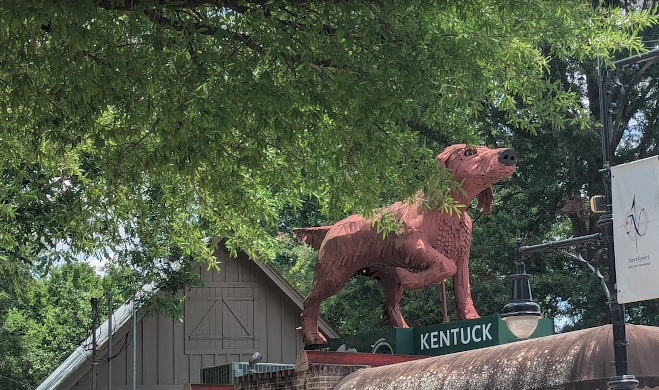
Leeds, Alabama. Hand-painted rockers and a Little Free Library. There’s a bookstore nearby called The Burrow!
Well, that was certainly an unusual April. It’s not the first time Read of England has been waylaid by a cowboy, though. Although I did start the month with some English-type reads, by and large it was Joe Pickett Month again. I did finish the series, though, and have freed myself from the hostage situation. In other news, I paid a visit to the oldest government archives in the United States — the Alabama Department of Archives and History, thank you very much — and spent a day doing research on a passion project (some would call it a morbid obsession) of mine, the history of the Hotel Albert.
The Albert was a ridiculously beautiful hotel standing in the center of my hometown, Selma, modeled after the palaces of the Doges in Venice, and was torn down in 1968 because the landowners thought they could make more money on the property selling it to the City. I’ve written a four page history of the hotel, but the ending was always soft and now I’ve gained enough to wrap things up more solidly. I’ll share that once it’s in better shape, for those who might be interested. (I did share some thoughts on the ADAR research here, but that’s an unfinished site — something I want to flesh out during the summer when I have more time.) I want to finish going through the boxes, first. One of the more interesting discoveries in ADAR’s collection was a one hundred and thirty page letter from one of the Albert’s managers about drama that happened on his watch in the late fifties and early sixties. It was quite scandalous and involved carbon monoxide poisoning, a distracted manager, a jilted wife, and a beauty salon owner whose feminine wiles, seductive charisma, and social influence appear to have made her have more say over what went on at the hotel than the manager or the controlling board! I probably could have gotten more research done, but I was fascinated by the letter-manuscript, and it offered some insight as to how the hotel operation was entirely different from the building management — and how the Albert Hotel Company board’s interests were very different from the interests of the Hotel Albert itself.
This is page 2, and no one’s even died yet!
Unreviewed
While the What I’ve Read This Year page makes it look like I have a pile of unread titles, in reality all but the Doiron books have scheduled reviews, and I have half-finished reviews for the Doiron titles.
Moviewatch
Another quiet movie-watching month, as my cinema friend was again running around in Atlanta looking at houses and making offers. Once he actually moves to Atlanta my movie-watching probably crater, but we’ll see. Posting this is slightly premature as we’ll probably watch something tonight, but I’ll just add it to May.
Cabaret, 1970. An English writer arrives in 1931 Germany and befriends a cabaret performer named Sally. Although it’s a bit of a Breakfast at Tiffany’s situation, soon they become an item, but this is interrupted when Sally becomes infatuated with a posh baron. This is a musical directed and arranged by Bob Fosse (making it my fourth or fifth Fosse), so there’s repeated cuts to the cabaret where Sally performs, and the music is connected to the plot: Sally’s social-climbing is mocked by a song about money, and there’s a piece at the end whose final line has distinct relevance for Germany circa 1931.
Snatch. 2000. British crime drama about ….different criminal groups trying to get ahold of a diamond? Brad Pitt is in it with a dialect even more obscure than whatever that attempt at Appalachian was in Inglourious Basterds.
La Cage aux Folles, 1978. A drag night club owner’s son decides he wants to get married: his intended is the daughter of a prominent conservative French politician. Said club owner must somehow convince the politician that he’s quite respectable, thank you, nevermind the shrieking in the background. I’ve seen The Birdcage before but had forgotten most of the plot and so was able to thoroughly enjoy the French original. Quite the comedy.
Marty, 1955. An aging butcher named Marty is shot down by the dames so much at the dances that these days he spend his weekends sitting in a park listening to his fellow chronic bachelors grouse about girls while they drink, listen to the ball game, or talk about Mickey Spillane’s novels. One night he encounters a school teacher who has likewise given up on finding someone, and they hit it off. But Mickey’s mom and friends are jealous of the girl and tell Marty he should dump her for being a “dog”. Fortunately, he stands up for her — and himself.
The Trouble with Angels, 1966. Teenage cloister hijinks
Showgirls, 1995. A young woman hitchhikes to Vegas to be become a dancer and does what she needs to do, including sleeping with her boss and kicking his current girlfriend down the stairs, to make it to the top.
Serial Mom, 1994. A…comedy/horror about a family who realizes that their June Cleaver mom might be more of a literal cleaver…..
Hannah and her Sisters, 1986. Character drama about three sisters and the men who love them;’ Woody Allen has an existential crisis. Lots of stars in this: Woody himself, Mia Farrow, Michael Caine, and Carrie Fisher for starters.
“I don’t know if you remember me, but we had the worst night of my life together.”
Going in Style, 2017. Michael Caine, Alan Arkin, and Morgan Freeman are in dire financial straits and about to hit eighty. The obvious solution is to rob the bank that’s robbed them. Solid comedy. A remake, I think.
Coming up in May…
I read so many Pickett books that they’ll continue posting themselves all the way to May 6, but I’m hoping it will be a return to normalcy here — or , whatever approximates normalcy.
Joe Pickett is back on the job riding the ranges, documenting wolf expansion into the Bighorns, and trying to figure out who is using a large drone to frighten elk and deer herds around. He doesn’t just find the drone annoying, it’s also criminal: the stress is causing members of the herds who were weakened by winter to collapse from exhaustion and die. He’s working with the lady warden across the mountain, Katelynn, since the drone appears to be working in her district but retreating to someplace in his. Suddenly, though, both he and Katelynn are confronted separately by two goonie boys who try to threaten and intimidate them into laying off their chief suspect, some strange man who lives on an isolated retreat outside of Saddlestring and who has public records only going back two years. While Katelynn – a young warden still learning the job – is overwhelmed with shock and fear at being threatened by feds simply for doing her duty, this ain’t Joe’s first rodeo. He recorded their threats, and while they might’ve sweet-talked him into more ready cooperation, their suited thuggery leaves a bad taste in his mouth and he has no intention of helping them whatsoever. But lo! Then came the Mexican hit squad.
Wolf Pack begins with a game warden lead before quickly accelerating into DC vs Cartel warfare, with the small town of Saddlestring and Joe caught in the middle – and in more ways than one, because it seems his youngest daughter Lucy has been dating a boy who lives from within the mysterious compound. This is a particularly bloody book in the Pickett series, as the presence of a hit sq uad would hint at: the members include three generic killers and one femme female, a beautiful woman who smiles and flirts alllllll the way until she jabs a stiletto into her victim’s heart. Unfortunately for the people of Saddlestring, these operatives are increasingly desperate and likewise unhinged, and as they make mistakes their pool of “People we have to kill because they saw us killing people we had to kill because they saw us trying to kill our original targets” broadens and things get sloppy. Unfortunately, we lose some characters.
Another enjoyable thriller, though I liked it more when it was still about the jerk with a drone than the assassin psychos. Villains are better when we know more about them from previous stories: with these guys (y chica) I was just waiting for them to get themselves killed.