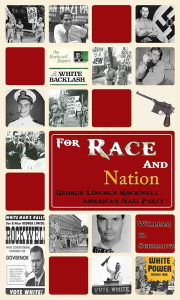
How does a man who fought Hitler come to deify him? George Lincoln Rockwell began life as the child of a popular entertainer, and by adulthood was well-poised for a successful life. He’d gone to a good university, though his education was interrupted by World War 2, and was a gifted illustrator. Instead, political passion for fighting the spread of Communism in the United States made of this Smeagol a Gollum, muttering nastily about Jewish conspiracies. His increasingly entrenched antisemitism cost him his Navy commission, his family, and would later lead to his death at the hands of an embittered follower. How can a soul go so wrong?
There was nothing in Rockwell’s early life to indicate the disturbing course his life would take; his father was well known as a comedian, and socialized with other performers like Groucho Marx. Rockwell’s first blush with racial radicalism and antisemitism came after he finished serving in the Korean War. He had become virulently anti-Communist, possibly as a result of fighting Korean and Chinese communists,, and in meeting with other anti-communists, he encountered literature which attributed communism to Jewish conspiracy. Intrigued, he flirted with taboo and decided to read Mein Kampf, and was so galvanized by it that he fell fully into neo-Nazism, founding the American Nazi Party and buying a home to serve as its headquarters and “hate monastery” , even decorating it with a giant swastika on the roof. Rockwell appears to have inherited his father’s gift for spectacle and showmanship, as he used Nazi imagery to provoke response and gain more attention than his organization’s numbers could otherwise achieve. In a Playboy interview, he stated outright that he was deliberately using racial epithets because they would attract more attention when it was printed — though he told (black) interviewer Alex Haley it was nothing personal. (Haley and Rockwell maintained correspondence after that until Rockwell’s own death.)
Oddly, although he and several others of his leading circle were agnostic or atheist, they claimed to be fighting for the defense of “White, Christian Civilization”: Schmaltz’s assessment is that Rockwell was trying to specify white non-Jews, and didn’t want to use “Aryan” because people confused it with the blonde with blue eyes trope. His expressed racial views were eclectic, in part because he deliberately used different approaches for different audiences: formal arguments with ‘intellectuals’, impassioned race rhetoric for the working class. This meant he could say to one room of people that of course, “most Negroes” were good people who wanted to improve themselves — while before another audience dehumanize them entirely.
As Rockwell’s career in hate was unfolding throughout the 1950s and 1960s, the civil rights movement was part of the drama — and part of his rhetoric, as he blamed Jews for promoting ‘race-mixing’. Bizarrely, he and the leader of the Black Muslim organization toyed with the idea of working together, since they were both race-nationalists who wanted the separation of blacks and whites. Rockwell personally contributed to an offering plate Malcolm X was passing around at a BM rally, and even gave tribute to the man in The Stormtrooper after his assassination. Rockwell and his group had little use for other radical right groups like the John Birch Society — and they, despite being anti-communist, understandably had no use for him, parading about in the uniforms of an enemy not twenty years defeated. (A point of trivia: Mel Brooks’ The Producers, which uses a Nazi musical as a plot point, came out in 1967. One wonders if Brooks’ lampooning of Hitler had Rockwell in mind.) Despite his contempt for much of the right, Rockwell appeared to respect William F. Buckley: after Buckley dismissed him in a National Review piece, Rockwell began writing to Buckley, leading to Buckley suggesting Rockwell meet with a priest. Rockwell did affiliate with some other groups of the period: some of his members were former Klansmen, and he toyed with the idea of using the strange Christian Identity cult — an extreme sect that believed Anglo-Saxons were the heirs of Israel and that Jews were demons — as political cover, but being an agnostic who didn’t believe in anything supernatural (besides “Destiny”) got in the way of that.
Rockwell always cautioned his followers to stay within the bounds of the law, even as he dismissed other radicals for not wanting to get physical: his preferred means of direct action was picketing events, being flamboyant, and attracting attention. During the Selma civil rights campaign, for instance, he arrived in town with plans of having one of his followers dressed in a monkey suit ambush Martin Luther King and do antics around him. Rockwell was frustrated to learn that few in Selma had any interest in assisting a self-declared Nazi: the Selma business community aired an open letter in the paper warning agitators of all stripes, from King to the Klan, to leave the town alone. Interestingly, King and Rockwell met on the city streets and had a conversation, whereupon Rockwell was invited to address the crowd at one of King’s mass meetings: the invitation was rescinded when one of Rockwell’s men punched King inside the Hotel Albert while he was registering. Rockwell believed, apparently sincerely, that racial agitation and race riots were part of a communist plot to create the downfall of the United States, but he also simultaneously believed that during an economic crisis or partial social collapse that more people would flock to his banner. Eventually, though, he was shot by an vengeful former fellower, just as his counterpart Malcolm X was.
This is not pleasant reading, given the subject matter. Being biographically-oriented, it largely focused on Rockwell, a man who threw away a happy life for hate and the pursuit of power. He and his followers, barely a hundred at any given time, are constantly scrounging for money and living in what one journalist called “a firetrap”. Their entire life was of conspiracism and antagonism. For students of the 1960’s social and intellectual currents, this may be of interest for the strange connections Rockwell had with other personalities like Malcolm X. There are occasional surprises, like Martin Luther King’s observation that race-hatred was far more intense in Chicago than anything he’d witnessed in the South. I chiefly read this because of the section set in my hometown: I try to read anything with a Selma connection, both out of personal interest and because I’m the local history librarian. On the whole, though, it’s a epithet-laden book about a man who narrowed his soul to oblivion and ultimately died for his nastiness.
This has been a quiet review week, in large part because I am trudging through a book I don’t like but have spent too much time trying to read to abandon it. Good ol’ sunk cost fallacy, how can I be aware of you and yet persist? I noticed recently that Vero at Dark Shelf of Wonders did a “Last Ten Books” tag, and I figured — why not?
(1) Last Book I Didn’t Finish: Congress for Dummies. I haven’t officially DNF’d it, but I have lost all interest in it. It’s over 20 years old and reading about committee processes is godawful boring.
(2) The Last Book I Reread. Rod Dreher’s Crunchy Cons.
(3) The Last Book I Bought. Man’s Search for Meaning, Viktor Frankl. Currently waiting for me at the post office!
(4) The Last Book I Said I Read and Didn’t Really. Best I can do is reading an abridged version of The Hunchback of Notre Dame instead of the real thing.
(5) The Last Book I Wrote in the Margins Of. Write in a book?
(6) The Last Book I Had Signed. Rod Dreher’s Living in Wonder. Funny thing, I’d actually preordered the ebook version, then bought the print version while in line to talk to him so he could sign it, then I wound up cancelling the ebook version and later reordering the ebook version because I’d lent it out to someone and wanted to re-read it.
(7) The Last Book I Lost. Um….me and books are like the Pentagon and billions of dollars. No only do I often not know where they are, I don’t even know that I don’t know where they are.
(8) The Last Book I Had to Replace. Mm…well, Living in Wonder would count, but I also reordered Rifles for Watie for a re-read I’ve yet to do.
(9) The Last Book I Had an Argument Over. Honestly can’t remember. My IRL friends who read rarely read the same books I do.
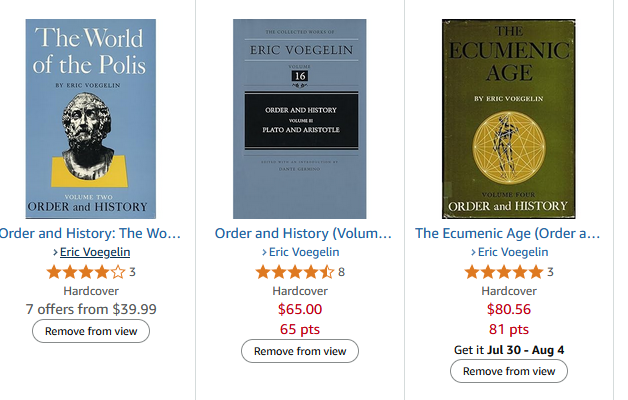
(10) The Last Book I Couldn’t Get A Hold Of. Erm……obscure books quoted in other books are always popping up onto my interest list and then disappearing when I realize I can’t find an affordable copy. Most recently was a trilogy by Eric Voeglin:
I’ve not quite given up on these, as I might have access via my university.
Today’s TTT is books set in _______, so I’m going to fill in the blank with….the American Civil War!
“I have even made attempts to see if I could finance a psychiatrist, not because I really do think I am nuts, but because I recognize that every nut thinks he is RIGHT. If I am NOT right, and am heading for this HORRIBLE battle, I DEARLY wish to be disabused of my delusion.”
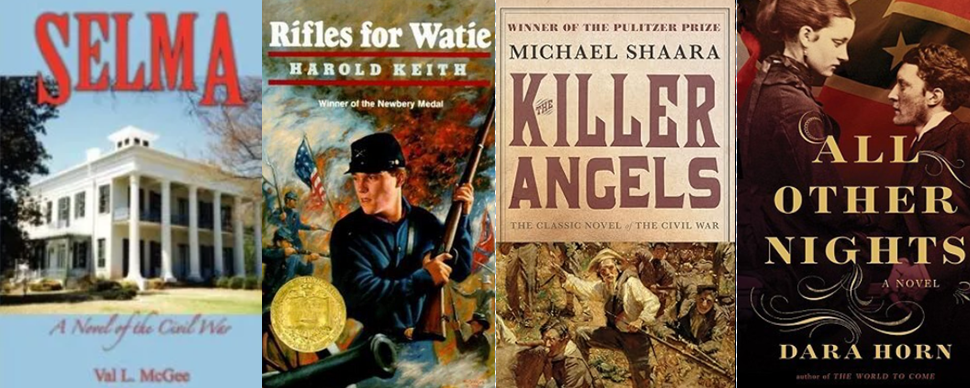
(1) The Killer Angels, Michael Shaara. The story of Gettysburg, from the men and generals who fought it.
(2) Rifles for Watie, Harold Keith. I read this as a teenager and it was thought-provoking, exploring the reasons why different men fought in the war. It also introduced me to the Cherokee participation in the war: General Stand Watie was the last Confederate officer to surrender.
(3)Casualties, David Rothstein. A Union soldier who just survived the Battle of Gettysburg has been captured by the Confederates and sent to Castle Morgan in Cahawba, Alabama. His wife aims to go see him, war or no war.
(4) Selma: A Novel of the Civil War, Val McGee. A novel set in my hometown during an era when it was not only prosperous, but regionally dominant. The town was burned by Yankees during the last week of the war, but rebounded.
(5)All Other Nights, Dar Horn. An interesting mystery-thriller focusing on southern Jews and a Confederate spy ring. My review described it as the best Civil War novel I’ve read in a “long, long, time”.
(6) & (7) Gods and Generals and Last Full Measure I probably shouldn’t list these since I haven’t read them in more than twenty years, but they were Jeff Shaara’s attempt to make his dad’s Killer Angels into a trilogy. Gods and Generals covers the outbreak of the war and its first two years, ending with Stonewall Jackson’s death, and Last Full Measure covered the last year or so of the war.
(8) The Copperhead, Harold Frederics. A look at a Northern town that destroys itself in its attempt to silence a man who speaks out against the war on Constitutional principles. Later turned into a movie.
(9) The Starbuck Chronicles, Bernard Cornwell. A trilogy about a Bostonian who finds himself fighting for the South after he’s hired to be a bodyguard. A woman is involved, too. (There are always women involved in a Cornwell novel.)
(10) Gone with the Wind. A Civil War novel list without GOTW? Fiddle-de-dee!
(11) The Unvanquished, William Faulkner. A novel about a family living through the South’s collapse.
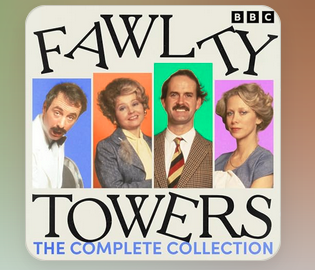
I’m not sure that posting something about this here is altogether appropriate given that it’s not an audiobook, despite being listed on Audible. This is the audio recordings of Fawlty Towers, the award-winning British comedy from the 1970s, made available with introductions from John Cleese and additional narration from Andrew Sachs, who played Manuel on the show. Listening to this made me more appreciative of the level of physical comedy that Fawlty Towers employs: Sachs does in-character narration to “fill in the blanks”, so to speak, but mere audio doesn’t translate all of the humor. Take, for instance, “The Germans”, which is one of the funniest episodes on the show, which has in its first half enough comedy for an entire hour, let alone fifteen minutes. Sachs/Manuel does a fine job providing narration to set up the hysterical scene where The Major confuses Manual practicing his English with a talking moose, but when the concussed and confused Basil is unwittingly antagonizing Germans in the dining room, there’s nothing at all. (“Here! I’ll do the funny walk!!!”) I can appreciate Sachs’ narration being limited to scene intermissions, but it didn’t serve all of the humor. Still, as someone who has watched this show an unhealthy amount of times, these recordings gave me laugh after laugh. I just don’t know that they’d work for someone who doesn’t have the shows in his head.
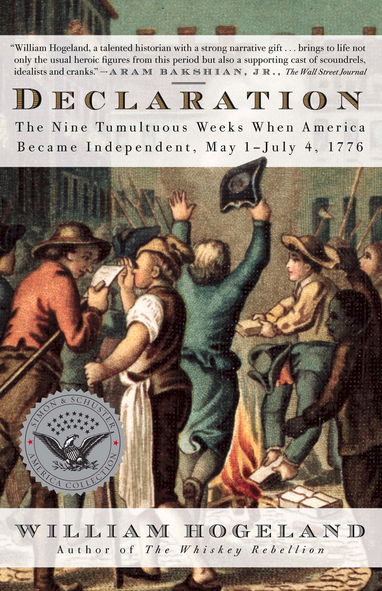
At the end of last week, I read Declaration: The Nine Tumultuous Weeks When America Became Independent an interesting little book that chronicles May – June 1776 when the American colonies shifted from “having disputes with the King” to desiring outright independence. The author, William Hogeland, provides the additional interest of focusing on how local Philadelphia politics impacted the shape of the Second Continental Congress’s discourse. Philadelphia had a strong artisan class, one that was active and wanted a larger role in the government: there was a reason Pennsylvania’s state government was the most ‘democratic’ of the states, with a unicameral legislature and barely an executive at all. (John Adams, on reviewing its new constitution, snarkily commented that within a decade Pennsylvanians would be writing to King George and asking for relief from their constitution: sure enough, in 1790 Pennsylvania adopted a new constitution that was bicameral and had a stronger governor.) This book features John Dickinson and Samuel Adams in more elevated roles than they usually get, and was fun reading. I picked it up because it covers the period where the colonies effectively asserted independence long before they formally proclaimed it, by creating state constitutions that made no reference to George III’s authority. The book focuses narrowly on Pennsylvania and Philadelphia, though, instead of looking at the variety of constitutions the new States were creating.
It is impossible to be truly conservative nowadays without being consciously counter-cultural. This book will show you how lots of us are doing it and living it every single day.
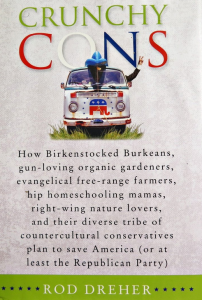
Eleven years ago I stumbled onto a book called Crunchy Consby Rod Dreher. I’d begun moving towards ‘localism’ in my later progressive period (circa 2009 – 2011), and had found unexpected insight in online magazines with some localist-oriented writing like Front Porch Republic and The American Conservative, the latter of which Dreher wrote for. Though then still a progressive, the part of me that yearned for cooperation rather than partisanship found the magazine incredibly interesting: TAC writers’ New Urbanist and anti-war writing were nothing like I expected of Republicans. Something about Dreher especially intrigued me, and I sent off for this title. Although my review was mixed at the time, it would be the beginning of a long literary relationship with Dreher. He’s since become an absolute favorite — the only author I’ve ever wanted to meet, and in fact have done several times now. Because so much has changed in the last decade — myself, the world, Dreher himself — I wanted to go back and see what would happen.
The premise of Crunchy Cons (2007) is that there is a growing conservative counterculture, one created by the increasing lack of a difference between the uniparty’s wings, and more importantly the fact that political policy is failing, or simply can’t, address people’s needs for meaning and an authentic life. Instead, both parties, and indeed the general zeitgeist of modernity appear to see humans as purely economic creatures, getting and spending: the economy and material concerns are all they promote. While it’s common to associate the counterculture with 1960s-70s young people who scorned materialism and the ‘burbs and yearned to go back to the land, Dreher writes that there’s a kindred conservative counterculture that is rapidly emerging as creature-comfort goals continue to numb our souls and make it hard for us to breathe. (Okay, the Monkees reference was mine, I’ll admit.) He refers to these fellow travelers as “crunchy cons”, and offers that one thing that unites them — regardless of location, religion, etc — is an emphasis on “living sacramentally”. That phrase is one hard to define, but one I understood almost immediately — living with meaning, perhaps, and living and acting with intention.
What we do matters, Dreher writes, as does how we live. Consider our relationship with food. He devotes an entire chapter on our relationship with the food supply, questioning whether those who consider themselves conservative Christians can countenance a food supply based on horrors like confined animal feeding operations, where thousands of creatures live miserable existences, filled with medications to counterbalance the insanely unhealthy setting. Is this ‘dressing and keeping the garden’? — or is it plundering it? Against this, Dreher offers his and his wife’s experiences with their local organic farm’s CSA, and points out that not only is the food healthier from a nutritional point of view, it’s building relationships and contributing to creation rather than abusing it. Farmers like Joel Salatin and Wendell Berry (who has a heavy presence here) restore Earth through their husbandry, rather than consume it the way industrial agribusiness does. While Dreher believes the free market is still the best economic approach on offer, he’s staunchly against deifying it, or worse still, deifying Efficiency. CAFOs have made chicken cheap, but the price is exacted elsewhere — in the quality of the food, in the destruction of our right relationships with animals and the land, in the predatory ways big-ag treat their suppliers, who are sometimes little better than tenant farmers . Chasing cheapness in other areas has its prices, as factories shutter and the towns and families that depended on them fall apart. We ought to live in such a way that grace is present, that holiness comes down to Earth. On the subject of living gracefully, there’s a strong aesthetic sensibility in this, one that appears not only in the food chapter but throughout: Dreher argues for slowing down and focusing on the good, the true, and the beautiful, rather than thoughtlessly participating in the rat race. He and his wife made the decision to simplify their lives so that they could raise their children without daycare, and later doubled-down by homeschooling them to maintain participation in their lives. For the Drehers, family mattered far more than chasing the Joneses.
This was a fascinating book to return to, originally reading it as I did during a transitional period in my life — and not necessarily a transition I was at ease with. I had to laugh at the amount of overlap between books Rod and I had both read before I picked this up, and books he mentioned that would later have a big impact on me. Wendell Berry, as mentioned, is a heavy presence here, but I hadn’t yet discovered him — and while surely his insight would have of interest to me at the time, I didn’t read Berry until later that year, prompted not by this but by a Art of Manliness booklist recommending Jayber Crow. While reading this, I tried to remember my cast of mind in 2012 – 2013: it was a time of both confidence and confusion, as physically I’d gotten on a health kick and was really enjoying life, but mentally my college worldview had fallen apart and I was reading far and wide looking for answers. Currents of thinking and reading were not taking me to places that my “self” at the time necessarily wanted to go, though: this was back when reading Hayek and Kirk felt positively transgressive. When I read Crunchy Cons the first time, a lot resonated with me — more, I think now, than I was comfortable with at the time, hence the mixed review. In my head, I was still the confident college progressive: realizing my thinking was increasingly at odds with that identity was just as uncomfortable as my secular-humanist college self finding the writings of mystics and monks inexplicably fascinating.
It’s amusing to read that review in retrospect because of the way my thinking and my values have changed over the years: 2012 me was not too far removed from my Pentecostal past and my emotionally charged exit from it, and so was more hostile toward Dreher’s homeschooling his kids for religious-values reasons, among others, then ignoring the fact that his wife’s cohort of homeschooling moms were largely liberal women who wanted to be more involved in their children’s education and life and believed they could do it better than a teacher having to deal with a hundred kids a day. These days I’m far more critical of the public education system — having witnessed it via the library for 13.5 years now. What’s more, I regard a system in which parents are separated from their children for most of the day as profoundly abnormal and unhealthy, just as it is unhealthy for children whose very being wants to bound into the world instead be confined into boxes all day, compelled to stare at screens and work on developing their future emotional-mental disorders. While it’s easy for me to say that this owes in part to my ingesting a Chestertonian or say, Catholic view of the family over the years, I think it has deeper roots than that. I resonated with the Catholic social doctrine when I began studying it around this time (2014, I think) for the same reason I resonated with the Buddhist eight-fold path’s emphasis on “right livelihood”: there’s something in me that recognized the need for an integrated or holistic approach to life that serves the needs of the human person — not only our material needs, but our need to live the good, to have lives shaped by virtue and wisdom in which the various roles we play are not separate, but like the petals of a flower creating a beautiful whole. This emphasis on human flourishing has been one consistency in my thinking from say, 2006 forward.
I rather enjoyed going back to this, and the challenge it and my first review posed to me to reflect on my worldview as it changed. When I began reading it then, Rod and I already had points of agreement: a strong criticism of consumerism, a worldview that rejected materialism, and an interest in slower, simpler living. Areas where we diverged, like Rod’s more observant religion, I’ve actually grown closer to: back then I was a church-goer, yes, but liturgy hadn’t seeped into my soul yet, and I hadn’t yet gotten serious about Christian formation and praxis the way I would in the years to follow. Reading this made me like Rod all the more, simply because of the amount of bookish overlap we have: I’d read books he references, and in the years to come I’d read others he referenced, not because he referenced them but because that was where my currents of thought were taking me. Wendell Berry, for instance, would become a favorite in both nonfiction and fiction. There was additional interest in seeing how Rod’s thinking would develop over the years, with some chains of thought that would lead to The Benedict Option and Living in Wonder. His interview with Catholic and Orthodox crunchies also hinted at storms to come in Rod’s life — his already present anger and grief over the Catholic church’s behavior during the sex abuse scandal, and his attraction to Orthodoxy. While I can’t say “in short” given the length of this review, I can only reiterate how much I enjoyed going back to this, both for my fondness for the author and for the amount of thought it provoked as I read it.
So Many Quotes
Maybe instead we should create a new politics by asking: What’s good? What’s true? What’s beautiful? What’s authentically human?
Too many people who call themselves conservative share the same fundamental conviction of many liberals, namely, that individual fulfillment is the point of life. Conservative, perhaps, in their sexual views, they are, however, libertarian in their economic principles, and believe that the free market should be the guiding light of our lives together. Thus they believe that a merchant or a manufacturer owes no loyalty to his community, nor the community to that merchant or manufacturer. They feel no particular responsibility to be good stewards of communal life or the natural world; if something of real value has been lost because of economic decisions, hey, that’s the free market. Cultivating an appreciation for art, architecture, and the world of beauty used to be considered by a previous generation of conservatives the mark of a civilized person; today, it is often disdained by many mainstream conservatives as an elitist pursuit. A college education is something you get solely as a ticket to a moneymaking career.
There is an older, less-ideological tradition, a sensibility that comes out in people I call crunchy conservatives. We are conservatives by conviction and temperament, and usually vote Republican (though to call us “liberal Republicans” is to fundamentally misunderstand us), but we’re “crunchy”—as in the slang for “earthy”—because we stand alongside a number of lefties who don’t buy in to the consumerist and individualist mainstream of American life.
Mainstream liberalism and conservatism, as the agrarian essayist Wendell Berry said, are “perfectly useless” to combat the forces in contemporary American society that are pulling families and communities apart. Berry says most liberals won’t take a stand against anything that limits sexual autonomy, and most conservatives won’t oppose anything that limits economic freedom.
The liberty we enjoy in America today is certainly worth prizing and defending, but it is insufficient to produce virtue, stability, or happiness. The free market in ideas, commerce, sexuality, and so forth offers various possibilities of how to live, but it tells us nothing of how we should behave to live as well as we ought. Both mainstream liberalism and conservatism are essentially materialist ideologies, and we should not be surprised that both shape a society dedicated to the multiplication of wants and the intensification of desire, not the improvement of character.
The answer is not to be found in a set of policy prescriptions, but in a considered critique of the assumptions on which mainstream American life is built, and a secession of sorts from the mainstream —all to conserve those things that give our lives real weight and meaning. Every one of us can refuse, at some level, to participate in the system that makes us materially rich but impoverishes us spiritually, morally, and aesthetically. We cannot change society, at least not overnight, but we can change ourselves and our families.
We should ask ourselves what kind of society we want to live in, and want our descendants to live in, and ask whether the way we’re living today is likely to get us there. Ideas have consequences, after all, and too many conservatives have unthinkingly accepted the mainstream Republican view that there is nothing wrong with the country that the free market cannot x, at least over time. Unmoored from our philosophical grounding, we allow ourselves to be carried along on the swift currents of consumer culture, and end up in a place where “conservatism,” practically speaking, ends up as general approval of whatever commercial interests want to do.
We have become a society that gives the place of prime honor to material progress, placing the demands of the economy above the considerations of family, of community, of country, and even of religion. Consumerism has become our religion, and it is difficult to identify anything within the contemporary Republican Party that stands against the dogma of the Market Supreme.
Americans naively accept new technologies, thinking only of what these technologies can do, but never, said Postman,what they can undo.
“The number one advice I give to my students is to be a culture creator, not a culture consumer,” Schuchardt continued. “You have to have time to create, and to create, you have to get rid of those things that steal your time. TV is the great time-stealer in American life.”
A society built on consumerism must break down eventually for the same reason socialism did: because even though it is infinitely better than socialism at meeting our physical needs and gratifying our physical desires, consumerism also treats human beings as merely materialists, as ciphers on a spreadsheet. It cannot, over time, serve the deepest needs of the human person for stability, spirituality, and authentic community. We should not be surprised that it has led to social disintegration. What kind of economy should we have, then? I don’t know; I’m a writer, not an economist. I do know this: we can’t build anything good unless we live by the belief that man does not exist to serve the economy, but the economy exists to serve man.
The point is, we learned in this way that food, properly understood, is sacramental; it carries within it the care of the farmers who raised it and the merchant who sold it, the love and devotion of the hands that prepared it, and the happiness of the friends and family who share it.
I started looking into how the government regulates the meat industry. It was shocking to see how agribusiness has gamed the system to keep small meat producers marginalized. Our regulatory system is designed to favor industrialized meat production, with its factory farms, its cattle jacked up with antibiotics and growth hormones, and its chickens raised in cages filled with their own feces. As a conservative, I am angry about this, not only on behalf of the small businesspeople slapped around by the deep-pocketed agribusiness behemoths, but because of how industrialized agriculture has made a traditional agrarian way of life difficult if not impossible.
When I asked Robert what he has in common with liberal counterculturalists, he said that there’s a lot of antiestablishment contrariness in all of us—echoing the quip of Juli Loesch Wiley, a Catholic pro-life pacifist friend who says she went all the way from the left wing to the right wing without ever once trusting the government. (Hah!)
But something struck me, a quote by Saint Francis de Sales, who said that we should treat everything we have as a gift from God, and that we are a gardener caring for the king’s garden. That struck me so much, because what I’m talking about is the body as the temple of the Holy Spirit. I don’t see how God could be pleased by the way so many of us eat. And that’s what motivates me. It’s stewardship of the body and of the earth. I just don’t understand why people have a problem with that.
How long do you think we can keep living as we do, destroying country life, rural traditions, and the countryside to produce mountains of processed food that makes us less healthy, and letting lay fallow the sacred trust we’ve been given by our forebears? Care for this trust obliges all of us, but conservatives, because we profess a particular commitment to upholding tradition, are especially responsible for stewardship of the land and its cultural legacy. If we live as if we have no duty to the land and the agrarian traditions of the people who live there, then we ought to be ashamed to call ourselves conservatives. We are no more than market-mad consumers who vote Republican, and whose commitment to conservative ideals ends the moment it costs us something.
If you’re like me, you’ll find as you grow older a strange new respect for the middle-class clichés you spent your smart-ass youth making fun of. Knife. Fork. Crow.
Thought experiment: You are standing at mass in the great Gothic cathedral at Chartres, beneath the vast symphonic complexity of the building’s soaring arches; now you are standing at the same ceremony inside an equally vast modern American suburban megachurch, which looks like an expensively built gymnasium or theater. Theologically, the ceremony has precisely the same meaning. But in which place do you feel closer to God, more aware of the holiness of existence? From which of these churches are you likely to emerge with a glow of exaltation? If a terrorist with a truck bomb forced you to choose which of these structures you’d rather see destroyed, would it make a difference to you? Why?
Notice: “outside of the norm that you see on TV.” The mark of the twenty-first-century nonconformist—the ability to imagine a life outside of the boundaries set for us by media culture.
“The common agonies we call ‘socialization’—playground cruelties, intimidating classroom snickers at mistakes, disabilities, or differences—more often serve to harden than to heighten the child’s sensitivity to other people’s pain. Homeschooled children for the most part don’t have to deal with that, and are more likely to retain their natural compassion.
Technology and wealth have given mankind dominion over nature unparalleled in human history. Everything in the tradition of conservatism— especially in traditional religious thought—warns against misusing that authority. Yet the conservative movement has become so infatuated with the free market and human potential that we lose sight of what Matthew described as our conservative belief “in man as a fundamentally moral and not merely economic actor, a creature accountable to reason and conscience and not driven by whim or appetite.” If we lose our ability to see nature with moral vision, we become less human, and more like beasts.
“Conservatives I respect a great deal are always telling us that man is not just an economic being, but a moral actor,” he said. “Well, there are moral costs to efficiency.”
“In America especially, we live beyond our means by consuming the portion of posterity, insatiably devouring minerals and forests and the very soil, lowering the water table, to gratify the appetites of the present tenants of the country,” [Russell] Kirk wrote.
Almost all on the religious right are Christians—and in this broad sense, I am on the religious right—but it’s odd how we limit our political concern to sexual issues. Jesus had as much or more to say about greed as he did about lust. But you will not find most American religious conservatives worrying overmuch about greed.
To see the world sacramentally is to see material things—objects and human actions—as vessels containing or transmitting ideals. To live in a sacramental world is to live in a world pregnant with meaning, a world in which nothing can be taken for granted, and in which no one or no thing is without intrinsic worth. If we live sacramentally, then everything we do and everything we are reflects the things we value.
In short, if one’s religion is to mean anything, if it is to last, it has to stand outside of time and place. Its truths have to be transcendent. And though we moderns have to nd a way to make the tradition livable in our own situations, we must never forget that we don’t judge the religion; the religion judges us. To be blunt, a god that is no bigger than our own desires is not God at all, but a divinized rationalization for self-worship.
“I don’t understand why the social-justice people don’t drop their attachment to socialism and embrace the ideal of widely distributed property,” he said. “I don’t understand why patriotic conservatives don’t seem to care that soulless corporations are destroying the old weird America—a phrase coined, I think, by left-wing rock critic Greil Marcus. This is the rich, vital, genuinely diverse, eccentric America that conservatives love, or claim to love.”
A religion in which you can set your own terms amounts to self worship. It has no power to restrain, and little power to inspire or console in times of great suffering. No matter what religion you follow, unless you die to yourself—meaning submit to an authority greater than yourself—it will come to nothing.
American politics has come to resemble the First World War, when powerful armies clashed endlessly and fruitlessly, with neither side gaining much ground, both having forgotten what they were fighting for, remembering only who they were fighting against.
Recently an article at The Free Press which attributed the decline of the public library to the fact that they’ve become homeless shelters has been causing some chatter in some online librarian communities. While looking into it, this book was mentioned and I decided to give it a shot. As an urban librarian, I can testify that homeless patrons have become an everyday part of my working life, including mentally ill and often physically aggressive ‘patrons’ who have precipitated our installing panic buttons at desks throughout the building. Patrons who have witnessed the kind of drama we see on a weekly basis have often whispered, “Y’all need a cop up in here!”. Overdue is a memoir from a librarian who served in a Washington, DC library with such security concerns that female staffers were not advised to go into the stacks by themselves for fear of being accosted. It details a lot of the stress that Oliver and her colleagues endured on a daily basis the fear of being attacked, the anxiety caused by being thrust into social worker and first responder positions with no training or real support from the board, and the psychological drain that spending all day listening to people talk to themselves takes on a person.
As interesting as that element was, her chronic self loathing detracted enormously from it: regardless how stressed she is, Oliver hates herself for not being up to it, and appears to dislike that libraries are not completely re-orienting themselves (i.e. installing public showers) for this new ‘mission’. When the city assigns a police officer to monitor the branch, she feels utterly relieved at his presence, and simultaneously hates herself for feeling relieved that now there’s an armed man standing between her and her frequently-menacing public. (Not surprisingly, she burns out, quits, and is diagnosed with PTSD.) The memoir is only perhaps a third of this book, though, as there’s also an obnoxious history of public libraries that makes men like Benjamin Franklin — who created a lending library for a club he’d also created — out to be villains because their privately-created and self-financed library wasn’t inclusive enough. Her self-loathing and long train of irritating PC writing (capitalizing White, Black, and Brown like these are ethnicities, for instance) made for a generally tiresome read despite the salience that parts of the book had for me. I recognized, for instance, her need to completely retreat from social interactions for a time after work — though whereas I turtle-up for an hour, she confesses to withdrawing completely. It does provoke the question, though — what is the mission of the modern library, and how can American societies better respond to the mental illness crisis in a way that doesn’t simply shove it into the laps of librarians and cops?
Generally, I didn’t mind reshelving, but I tried to never linger in the area. Male coworkers had warned me early on not to—female employees were particularly vulnerable back there. If something was going to go wrong, it was going to go wrong in the Adult Fiction area.
As we approached the second door, he explained that if I’d started the day before, we wouldn’t have met because he’d been in court. A patron named Ms. Lee was suing him for the third time. He quickly explained that Ms. Lee thought she was responsible for creating a secret café on top of the Spy Museum at the behest of the FBI.
[L]ibrarians expect to encounter people from many backgrounds, experiences, and moods. Empathy is an essential part of the work if you want to do it in any meaningful way. Find empathy before anger, fear, or confusion. Find empathy before you lose your cool. Find empathy before you lose your shit. Empathy is a first line of defense in public servant jobs—people are less likely to yell at a calm and patient person.
The actual work of being a public librarian, of showing up to that same building five days a week to perform an unending range of tasks in an environment that was unpredictable, chaotic, and sometimes violent, had warped everything in my life. If someone had told me ten years earlier when I first entered my MLS program that this would be the trajectory of my career, and that I would be diagnosed with complex PTSD in large part because of my work as a librarian, I don’t think I would have believed them.
“I’ve found myself becoming more cynical and jaded as a librarian. I also find it disheartening that so few people outside the library realize just how much library workers put up with. It’s like a dirty secret people are fearful to talk about. We have to put on this happy, cheery facade of ‘everything is fine’ for fear of what? Losing public funding? I can’t even decompress and share the horrors of my experience with nonlibrary people because the attitude is ‘you read books all day, how bad can it be.’”
In a 2009 speech to the plebe class at the United States Military Academy at West Point, author and literary critic William Deresiewicz cautioned the graduates about their constant exposure to social and news media: “You are continuously bombarding yourself with a stream of other people’s thoughts. You are marinating yourself in the conventional wisdom. In other people’s reality: for others, not for yourself. You are creating a cacophony in which it is impossible to hear your own voice, whether it’s yourself you’re thinking about or anything else.”
WHAT have you finished reading recently? An Audible presentation of The Lion, the Witch, and the Wardrobe, and Benjamin Franklin: An American Life by Walter Isaacson
WHAT are you reading now? The Swamp Fox, a history of Francis Marion’s irregular warfare against the Brits during the Revolutionary War.
WHAT are you reading next? Declaration: The Nine Tumultuous Weeks When America Became Independent, May 1-July 4, 1776, William Hogeland. This is an interesting period because the colonies made themselves legally independent by creating their own State constitutions, well before a formal Declaration was issued by the 2nd Continental Congress.
And now…..favorite quotes from books.
Oh, hey, I could totally cheat! But no, I’m not going to. I will, however, look back at that list to see how many of the items have stuck in my head for 13+ years. (I know one of them has, because searching for the exact quote was how I got that result.) Unfortunately, Top Ten Tuesday did a similar topic back in March with “Things Characters Said”, and a lot of my favorites are on that list. SO, I am going to restrict myself to nonfiction quotes. (We also did “Thoughtful Quotes” back in March, but a few of my very favorites are there so I’m not going to exempt them. Oh, and look, another Top Ten post on quotes! )
Neighborhoods like Georgetown or Beacon Hill are walking neighborhoods. It is not necessary to hop in the car to get an ice cream cone or a bottle of aspirin. You walk to a store — enjoying the felicities of the street as you go — and you are able to see other people along the way. You may even have a conversation with a stranger. This is called meeting people, the quintessential urban pleasure. (Or else it is called a mugging, the quintessential urban calamity.). The Geography of Nowhere: the Rise and Fall of America’s Man-Made Landscape; James Howard Kunstler)
“I explained — with the excessive exposition of a man spending a lonely week at the airport — that I was looking for the sort of books in which a genial voice expresses emotions that the reader has long felt but never before really understood; those that convey the secret, everyday things that society at large prefers to leave unsaid; those that make one feel somehow less alone and strange. Manishankar wondered if I might like a magazine instead.” (A Week at the Airport, Alain de Botton. One reason I like this quote so much is that de Botton is that voice for me.)
Who should ‘run’ America? No one. Or 250 million single individuals. Every man a king, every woman a queen, as the martyr Huey Long once sang. […] As Americans from Emerson to Mencken have known, following leaders is a fool’s game. Only when we restore to Americans their birthright — local self-government in prideful communities that respect the liberties of every dentist and Baptist and socialist and lesbian and hermit and auto parts dealer — will we remember what it means to be an American, first.” (America First, Bill Kauffman)
If only it were all so simple! If only there were evil people…and it were necessary only to separate them from the rest of us and destroy them. But the line dividing good and evil cuts through the heart of every human being. And who is willing to destroy a piece of his own heart?” – Aleksandr Solzhenitsyn, Gulag Archipelago
“I went into the woods because I wished to live deliberately, to front only the essential facts of life, and see if I could not learn what it had to teach, and not, when I came to die, discover that I had not lived. I did not wish to live what was not life, living is so dear; nor did I wish to practice resignation, unless it was quite necessary. I wanted to live deep and suck out all the marrow of life, to live so sturdily and Spartan-like as to put to rout all that was not life, to cut a broad swath and shave close, to drive life into a corner, and reduce it to is lowest terms.” – Henry David Thoreau, Walden
If any man feels that the world is too complex and its evil is too big to cope with, let him remember that it is too big to drown in a glass of whiskey. – Ayn Rand, Philosophy: Who Needs It?
The most dangerous thing you can do is to take any one impulse of your own nature and set it up as the thing you ought to follow at all costs. There’s not one of them which won’t make us into devils if we set it up as an absolute guide. You might think love of humanity in general was safe, but it isn’t. If you leave out justice you’ll find yourself breaking agreements and faking evidence in trials ‘for the sake of humanity’ and become in the end a cruel and treacherous man.” – C.S. Lewis, MereChristianity.
To love at all is to be vulnerable. Love anything and your heart will be wrung and possibly broken. If you want to make sure of keeping it intact you must give it to no one, not even an animal. Wrap it carefully round with hobbies and little luxuries; avoid all entanglements. Lock it up safe in the casket or coffin of your selfishness. But in that casket, safe, dark, motionless, airless, it will change. It will not be broken; it will become unbreakable, impenetrable, irredeemable. To love is to be vulnerable. –C.S. Lewis, The Four Loves
But I had a good uncle, my late Uncle Alex. He was my father’s kid brother, a childless graduate of Harvard who was an honest life-insurance salesman in Indianapolis. He was well-read and wise. And his principal complaint about other human beings was that they so seldom noticed it when they were happy. So when we were drinking lemonade under an apple tree in the summer, say, and talking lazily about this and that, almost buzzing like honeybees, Uncle Alex would suddenly interrupt the agreeable blather to exclaim, ‘If this isn’t nice, I don’t know what is.” – Kurt Vonnegut, A Man Without a Country
Be not unhappy, or discouraged, or dissatisfied, if you do not succeed in acting always by the right principles; but when you have failed, try again, and be content if most of your acts are consistent with man’s nature. Love that to which you return; do not return to philosophy as if she were a schoolmaster, but behave like those who have sore eyes and apply a bit of sponge or an egg, or like another who applied a plaster of a water lotion. For thus you will not fail to obey reason, and will find rest in it. And remember that philosophy requires only the things which your nature requires. – Marcus Aurelius, the Meditations
But when I am in an airport, that most harried image of the eternal tarmac of Hell, crowded without community, noisy without celebration, technologically sophisticated without beauty, and see people engaged in loud conversations not with one another but with a business partner in Chicago or a spouse and children far away, I see not freedom but confinement. And above them all, as if to remind us of our unhappy state, blare the everlasting televisions, telling us What Has Just Happened and What it Means, and preventing us from ever experiencing a moment not of loneliness but of solitude, not of idleness but of peace. It too is a tool of the Anticulture. For culture by its nature is conservative. It remembers, it reveres, it gives thanks, and it cherishes. A farmer tilling the land his father tilled, whistling an air from of old, in the shadow of the church where his people heard the word of God and let it take root in their hearts—that is a man of culture. He might live only fifty years, but he lives them in an expanse of centuries; indeed, under the eye of eternity. How thin and paltry our four score and ten seem by comparison! For we are imprisoned in irreverence. Our preachers are neither the birds nor the old pastor peering over Holy Writ, but the nagging, needling, desire-pricking, noisome voice of the mass educator, or of the headline, or of the television, which could never have won our attention without encouraging in us amnesia, indifference, petulance, and scorn, all destroyers of culture. – Anthony Esolen, from a First Things article I can no longer find. Phooey.)
(I know this is eleven but I couldn’t decide between my CS Lewis quotes. Oh, and here’s a bonus from Jack!)
“[My father] relied wholly on his tongue as an instrument of domestic discipline. And here that fatal bent toward dramatization and rhetoric produced a pathetic yet comic result. When he opened his mouth to reprove us he no doubt intended a short well-chosen appeal to our common sense and conscience. But alas, he had been a public speaker long before he became a father. Words came to him and intoxicated him as they came. What actually happened was that a small boy who had walked on damp grass in his slippers or left the bathroom in a pickle found himself attacked with something like Cicero on Cataline, or Burke on Warren Hastings; simile piled on simile, rhetorical question on rhetorical question, the flash of an orator’s eye and the thundercloud of an orator’s brow, the gestures, the cadences, the pauses. […] While he spoke, he forgot not only the offense, but the capacities of his audience. All the resources of his immense vocabulary were poured forth. I can still remember such words as ‘abominable”, “sophisticated”, and “surreptitious”. You will not get the full flavor unless you know an angry Irishman’s energy in explosive consonants and the rich growl of his r’s.”
Today’s Top Ten Tuesday is books with honorifics like Doctor, Mrs, etc. I went back through my booklists all the way to 2018 to find enough titles. First up, though, a tease!
Another times, [Franklin] was playing with his equal, the Duchess of Bourbon, who made a move that inadvertently exposed her king. Ignoring the rules of [chess], he promptly captured it. “Ah,” said the duchess, “we do not take the Kings so.” Replied Franklin in a famous quip: “We do in America.” BENJAMIN FRANKLIN: AN AMERICAN LIFE, Walter Isaacson
(4) Dr. Johnson’s London, Liza Picard. A social history of 18th century London.
(5) The Autobiography of Miss Jane Pittman, Ernest Gaines. The story of a woman who was a child when slavery ended, who lived to see the peak of the Civil Rights
(6) No More Mr. NiceGuy, Richard Glover. A self-help men for book advising them to stop living for the expectations/judgements of others, especially those disposed to look down on them to begin with.
(7) The Prince of Frogtown, Rick Bragg. A memoir-biography of Bragg’s troublesome father.
(8) The Awakening of Miss Prim, Natalie Sanmartin Fenollera. A cozy-philosophical novel about a librarian who moves into a village where everyone is interested in a humane life.
(9) Becoming Mrs Lewis, Patti Callahan. A novel about the relationship between Joy Davidman & C.S. Lewis.
(10) Every Man a King, Bill Kauffman. The story of a disgraced pundit who moves back to his Upstate New York hometown and tries to find meaning in his life again.
Ohh, dear reader, this is Kenneth Branagh as you’ve never experienced him. When I saw a seven-volume set of The Chronicles of Narnia on goodreads available for a single credit, with each book narrated by talents like Branagh and Patrick Stewart, I couldn’t resist — nor would I have wanted to had I could. Nevermind the fact that I already have a CD set of Narnia that’s an audiodrama narrated by Paul Scofield, with other vocal casting.
For the uninitiated, The Magician’s Nephew is chronologically first in the Narnia series, though not the first written. The book opens on a pair of kids, Digory and Polly, who become part of an unwitting experiment by Digory’s rascal of an uncle, Andrew. Andrew is an amateur magician, meaning in CS Lewis’ world he’s a reckless dilettante fooling with matters beyond his ken. Digory and Polly are thrown by a advice of Andrew’s creation into The World Between the Worlds, a peaceful wood dotted with pools that they realize can be used to travel to different “Worlds”. On their first attempt at visiting another place, they find a dying place and temptation — temptation that Digory can’t resist, and a choice that leads to the arrival of Jaydis, later known as the White Witch. As the story develops, the children will witness the Creation of Narnia, the order of which mirrors the Creation recorded in Genesis, and then meet Aslan and still more temptation. When I first read this some ten years ago, I liked the story but considered it the least of the Narnia tales. Here, I delighted in it much more, in large part due to the vocal talents of Kenneth Branagth. I’ve long favored Branagth as an actor, watching him in numerous versions of Shakespeare stories — he made a marvelous Iago, and an even better Harry the Prince — but here he shines vocally. The sheer variety of choices and characters he did was impressive, and some of them are absolutely hilarious. One of his critters sounded like of the vultures from The Jungle Book.
This was a wonderful rendition of Magician’s Nephew. I’m currently most of the way through The Lion, The Witch, and the Wardrobe, read by Michael York. (All are gathered at the Stone Stable, and Jaydis is about to demand the life of the traitor Edmund.)
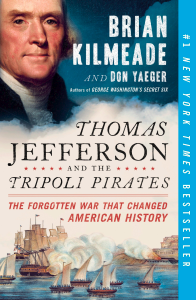
“From the halls of MONteZUUUUUUMA, to the shores of Tripoli” — ever wonder where that Tripoli business comes from? While I’d sometimes encountered references to the early United States having issues with pirates in the Med in its early history, it’s not a story I ever looked into. Recently, however, Gordon S. Wood’s Friends Divided mentioned Adams and Jefferson’s initial disagreement with how to handle the problem. What was the Tripoli problem? Four Islamist states along North Africa had developed a nasty habit of sallying forth, seizing ships and enslaving their crews or passengers under the mantra that all non-Muslims were fair game.While these states’ navies were not all that daunting, continental powers like England and France had larger problems that their navies were needed for (problems like France and England), so they simply paid off the looters. American ships had been covered under the Union Jack, but after Independence the Stars and Stripes represented a new target. At first, Jefferson tried to reason with the grand poobahs who controlled the pirates and work out a diplomatic solution, but founded they wanted an absurd amount of money. As other American officers would find out in the course of this history, they were also treacherous. The American government at tried to make a payment, only to be met with humiliation as the George Washington forced to carry tribute and slaves to the bloated royals of Constantinople. Soon the US Navy was dispatched in increasing numbers, and a great victory was won — only to be dashed by some diplomat oblivious to the military scene making a treaty under his own authority. Having seized a city with an exiled royal in tow — planning for some regime change — the Americans were forced to steal away in the middle of the night.
As with other Brian Kilmeade works, this is definitely pop history with a lot of flash: there is substance there, enough to prompt me to more serious reading, but it’s one I’d be careful about recommending except to those who already know to be cautious. Some reviewers on goodreads took issue with the “islamophobia” of Kilmeade’s approach, but Gordon Woods in his far more substantial Friends Divided also noted that Jefferson was prompted to use overwhelming force by the states’ “Islamic fatalism”. Given Islam’s perpetual problem with bloody borders I’m inclined to give Kilmeade the benefit of the doubt, but may follow this up with something like Lambert’s The Barbary Wars, which is more formal.



 Reading Freely

