“A cage of steel. It is a cruel thing to do, to cage such a beautiful, passionate creature as if it were only a dumb beast, but humans do it all too often. They even cage themselves, though their bars made of society, not of steel.”
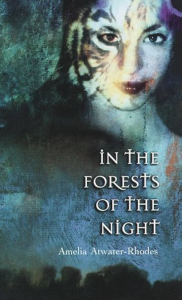
I decided to do my Roswell High re-read this week because I would spend most of it dogsitting in the backwoods, so deep into the green that there would be no internet. My evenings would therefore including reading and rubbing dog bellies. I opened the ottoman where I keep what remains of my middle school & high school libraries and threw what I though was the entirety of my Roswell High collection in a bag. I unwittingly threw in In the Forests of the Night with them. This book fascinated me in early high school when I read it, because the author was very near my age: as someone who wanted to be a writer himself, I was amazed it was possible to publish so early. I was drawn to In the Forests of the Night by its title: an X-Files novel had previously introduced me to Blake’s “The Tyger” (no, not kidding), and that poem was the first I ever memorized. I recognized the phrase immediately, and opened the book to find a…..vampire drama. Huh.
In the Forests of the Night is the story of Risika, a woman who was unwittingly enrolled in the “Devil’s Book” when a vampire gave her a black rose and it drew blood. A young Puritan girl, “Rachel” was trapped and pursued by an older female vampire, who sensed she would become, in time, an incredibly powerful creature of the night That proved to be true. The novel goes back and forth between Rachel’s slow death to Risika, the vampire she became, and her ongoing rivalry with her brother-in-the-night Aubrey, who is also the creature she hates most in the world. He preyed on her family, killing her brother and breaking her father’s heart by costing him all of his children. Aubrey is a vain and arrogant vampire whose pride is justified by his power, and although Risika knows he can destroy her, her own hatred for him and knowledge of her own gifts keeps pushing her to provoke him. One lone piece of her humanity she retains is love for a creature known as Tora, a Bengal tiger at the local zoo whose beauty mesmerizes her. Eventually, Risika and Aubrey go head to head in a vampire cafe.
Reading this as a teen, I was fascinated by it because I’d never read any fantasy beyond Redwall, and I’d certainly never gone near any vampire novels. I was aware of the tropes, I think, and Atwater-Rhodes’ vampires played with them. Her vampiric mythos is somewhat unmoored from their foundation — her vampires are not bothered by holy water or the Eucharist, unlike Stoker’s original — but there are still some bits of the classical demonic inversion, such as Aubrey wearing an upside-down cross. One of the few tropes that Atwater-Rhodes retains is vampires fading in mirrors: Risika comments that this is something that happens with age and power, and that their aversion to sunlight and garlic is merely a consequence of their augmented senses. As for wooden stakes through the heart, she says, it’s very likely that would kill her, but as a rule she avoids people wielding stakes.
Were I to read this for the first time today, I don’t know how much I’d enjoy it given the darkness. The writing is still compelling, especially the character drama between Risika and Aubrey. Dark fantasy is not my thing, but I found the author interesting enough that back in 2009 I read a followup novel, Demon in my View, in which In the Forests of the Night‘sauthor finds her fictional creation Aubrey confronting her in the real world. In reading this again, I was struck by how some of Risika’s observations — the author’s observations — were wise for a fourteen or fifteen year old, like the way humans waste their mortal lives in constant mindlessness, never existing in the moment but fretting about the future or the past or distracting themselves with work and pleasure.
On April 8, 1826, the two met on a field near the Potomac. Clay’s bullet ripped through Randolph’s white flannel coat without wounding him. Randolph’s hit a tree behind Clay. In a second round, Clay again missed Randolph, who raised his gun and fired into the air. The men talked and reconciled. Randolph joked, “You owe me a coat, Mr. Clay.” Clay replied, “I am glad the debt is no greater.” (WAKING GIANT: America in the Age of Jackson)
Top Ten Tuesday
Today’s TTT is a genre freebie, and since I feel like I’ve spotlit historical fiction recently, I’m going to take a look at science fiction. I’ve read SF since I was a kid, although I didn’t get really into it until my late twenties when I found Isaac Asimov. These are not in any particular order.
(1) DAEMON, Daniel Suarez. A distributed AI begins reprogramming the world using video games to attract and employ human agents. One of my very favorite thrillers.
(2) War of the Worlds & The Time Machine, H.G. Wells. I am including these two together because they were my first SF titles and cast a long shadow over my literary life and imagination.
(3) Upgrade, Blake Crouch. An SF thriller about augmented humanity. Crouch and Suarez are alike in everything they’ve published has been 10/10.
(4) The Circleand The Every, Dave Eggers. Including them together because they’re conjoined stories about we consumers in the hands of an all-consuming uber-corporation that’s like Google, Apple, Facebook, Amazon, and money apps all rolled into one.
(5) Foundation, Isaac Asimov. The beginning of my adult SF reading, Foundation is both a collection of short stories and the beginning of a much larger series that grew into an even larger meta-series when Asimov retroactively declared that Empire and Robots were also part of the timeline. My favorite volumes are the original collection of stories, followed by Asimov’s later “prequels”, Prelude and Forward. The premise of Foundation is that a mathematician named Hari Seldon develops a science called psychohistory, which can predict the broad future of humanity. Exiled for foretelling the fall of the Galactic Empire, he and his followers launch a thousand-year plan to reduce the chaos of the coming collapse and lay the groundwork for a more stable future order. The first book is a collection of short stories that tell how the leaders of the Foundation navigated several “Seldon Crises” — turning points in history — while the prequels are more traditional novels.
(7) Fahrenheit 451, Ray Bradbury. It always annoys me when people assume this is a book about censorship; that’s as accurate as saying 1984 is about surveillance. They’re both true to a minor point, but there are deeper stories at work. Just as 1984 is more about control — not only of society, but of the human mind, the very soul, Fahrenheit 451 is more about apathy or disengagement: this society is one where people are withdrawing more and more into sensation and nonthink. It has one of the most depressing scenes in literature, that of Montag’s wife completely removing herself from the human experience by sitting in a room where she’s surrounded — inundated by — her “Stories”. This kind of acedia is deeply disturbing. Dr. Brad Birzer is currently working on a book about Bradbury, and has just concluded a series of reviews about a Bradbury biographical trilogy. The possible title for Birzer’s own is Prophet of the Space Age.
(8) Contact, Carl Sagan. An astronomer’s realistic attack on what first contact might look like.
(9) 1984 by George Orwell and (10) Brave New World by Aldous Huxley. I mention these together because they’re both dystopias of an inhuman future — ones in which power and pleasure work to similar ends — the domination of humanity by a machine-system.
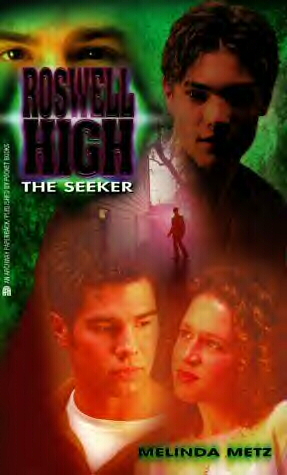
The scene: a kitchsy diner in Roswell, New Mexico, with a strong “aliens and UFO” theme: the tables are shaped like flying saucers, and the waitresses strut around in Star Trek-esque skirts. Two men at a far table begin arguing, tempers flare, a pistol fires, and a waitress drops to the floor. Instantly, two other teens rush to her aid — both trying to stop the bleeding. One of them, though, is an alien with the ability to manipulate matter. A life is saved, a secret is shared, and a series begins. I mentioned near the start of summer that I intended to re-read Roswell High, a ten-book series I devoured in middle school, and have finished the first three over the weekend.
The Outsider kicks things off when Max Evans risks his and others’ lives to save that of the girl he loves, Liz Ortecho. Max and Liz are lab buddies and friends, and each harbors feelings for the other that they don’t admit even to themselves. Max has an especially good reason for suppressing his feelings: he’s an alien. His first memories were of waking up in an incubation pod with his sister Isabel, each appearing age seven, and climbing out of a cave into the New Mexico desert to wander in confusion until being picked up and effectively adopted by a pair of lawyers. Max and Isabel proved incredibly able to absorb information, learning English quickly and then connecting the story of the “Roswell Crash” to their unusual origin. They also encountered another child like them, Michael Guerin, when they realized he had some of the same superhuman abilities they had — like seeing ‘auras’ around people. But how they came to be hidden in that cave, and why their evidently-dead parents came to Earth to begin with, is a complete unknown.
The Outsider largely deals with Max, Isabel, and Michael’s sudden exposure to Liz and Maria, and then later their friend Alex Manes, and all of the emotional ramification involved. Isabel and Michael are both horrified and angry at Max’s decision to save Liz’s life, not because they dislike her but because of the potential ramifications. The local sheriff, Valenti, is a terrifying spectre already, and he’s very interested in what happened at the diner. He doesn’t buy the story of Liz falling down in shock and accidentally breaking ketchup bottles in the process at all. As we find out, Valenti is a member of Project Clean Slate, a government organization charged with investigating the prospect of aliens on Earth and ….mitigating the threat, shall we say. Valenti is certain an alien was involved at the diner, because Max’s healing left a shining imprint of a hand on her belly — an imprint Valenti has previously seen, at a murder. As the story develops, Michael has a plan to make Valenti think the alien he’s after has died.
With that nice and neat-ish end, we move to The Wild One. In later years I have wondered if The Outsider was intended as a trial of sorts, a pilot, because The Wild One is largely incongruous. I’ve suspected it was written after the publishers realized how popular the first book was, and needed something to fill in the gap while Metz was still developing the overall story of the series. Its premise is simple: another alien teen has arrived, but he’s a Bad Biker Boy. Unlike our trio, he has no fear of humans, and utter contempt for the law or moral norms — and Isabel, who has lived her entire life in fear, is riveted by him. He’s her devil in skin-tight leather, a man as wild as the wind, and Isabel is happy to embrace him despite his disdain for her brother and an outright attack on Liz. Ultimately, The Wild One leads to tragedy and trauma — but contrary to my adult ponderings, The Wild One is fully connected to the rest of the series. Not only does it introduce Ray Iburg, who has a much more important role in the book series than the WB series done later, but the Cool Rider’s ring is the center of the next book.
In The Seeker, we deal largely with teen drama. Although Max and Liz have strong feelings for one another, Max’s concern for Liz’s life prompts him to pull away. Isabel is largely traumatized by the ending of The Wild One, and Alex is there as her human teddybear. Maria and Michael are also developing uncomfortable feelings for one another: Michael is used to seeing Maria as cute and innocent and increasingly unsettled by finding her….well, sexy. Maria, for her part, provides the non-teen drama part of this novel: she found a ring in the mall that appears to have unlocked her innate psychic powers (Maria’s very New Agey). She can use objects — like the sheriff’s pen, say, or Michael’s t-shirt — to “see” what they’re doing. Given the Sheriff’s connection to Clean Slate, she hopes she can use it to help the gang find their parent’s ship, since they’re confident it still exists. The ring — the Stone — is not innocent, however, and as Ray Iburg tells them, it’s connected to the Roswell crash. An object of immense power, it was stolen by a man who later stowed away on the ship to hide, and his discovery lead to the ship losing control. Ray was the sole adult survivor of the crash — that he knows of — and the man responsible for hiding the incubation pods. Ray’s role as mentor will become increasingly important.
Beginning my revisit of this has been fun so far. I’ve mentioned previously that I have a strong sentimental attachment to this series: my best friend and I discovered it together, he lending me the first book, me lending him the second book, and when we got to The Watcher, we buddy-read it on a school bus and talked about it chapter by chapter. I read and re-read the series in my teens, and have a strong affection for the characters. It was also fun to revisit the culture of the 1990s, with the Internet being a thing but of completely marginal relevance to the plot: Alex has a website that sounds a bit like 11points (“because Top Ten Lists are for Cowards”), and that’s it. I noticed a few jokes that I definitely wouldn’t have gotten as a sheltered Pentecostal kid, and enough local references to make me wish I’d read this before visiting Roswell back in 2016.
These books are fairly quick reads, so expect more clump-reviews before long.
I guess no one tugged the straps and said “That ain’t goin’ anywhere.”
Well, here we’ve come to the end of July, though for central Alabama we’re still a long way away from the worst of summer. I had an unusually high amount of audiobooks this month, and my fiction & nonfiction are now at a dead heat. My nonfiction reading was largely American Revolution related. I did pick up Tocqueville, but I was handling Walter Isaacs’ girthy biography of Ben Franklin at the same time. Regarding challenges, it was….not a good month, since the only challenge I made progress in was The Great Reread, revisiting Crunchy Cons.
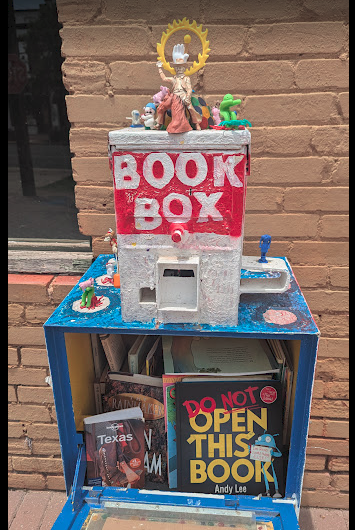
The Harmony Club Little Free Library:
Some years ago an enterprising city councilman had the idea to drop former newspaper boxes across town for people to decorate and turn into Little Free Libraries. One sat outside The Harmony Club, which I’ve written about prior, and even after its savior DJ died and THC was sold, his former business partner kept tending to the LFL. Now said partner is moving to Atlanta, leaving me as the LFL’s unofficial custodian. It’s not an official LFL, in that no one pays to have it listed on a map of LFLs, but it’s there and gets…….some traffic. I’ve been doing monthly check-ins in the last few months to get ready for this new responsibility, but now it’s more serious. I may start spotlighting some of the box’s current residents in these monthly posts. It’s an interesting anniversary of sorts: two years ago yesterday was the last time we ever gathered at the Sidewalk, and now THC’s steward is moving on. The artwork on the box is a combination of the former steward and a local artist who used to leave bricolage near the the Harmony Club for DJ to admire.
America at 250?
As American readers may know, next year is the 250th anniversary of the Declaration of Independence. I’ve been planning for what I might do to honor the occasion, seeing as I wasn’t here for the 200th and probably won’t be here for the 300th. I was thinking of a multi-track series that would feature a course of reading across American history, a series of biographies, and a series of books touching on different elements of American culture, or different genres that have grown up from American roots, like bluegrass and jazz. My history reading this month has made me wonder if it wouldn’t be more appropriate to start that now, building up to the 250th across a year and retroactively including this month’s reading in that celebration.
The Unreviewed: Benjamin Franklin: An American Life, Walter Isaacson. Not sure why I haven’t reviewed this one yet. Distractions, I suppose. Will try to remedy that! The Lion, the Witch, and the Wardrobe, audible version. I enjoyed this, though not as much as Kenneth Branagth’s Magician’s Nephew.
New Acquisitions: Man’s Search for Meaning, Viktor Frank (Gift) Evelyn Waugh title. (I forget, and it’s in my car. Definitely not Brideshead.) (Gift) Close Encounters with the Third Kind, Steven Spielberg. Will probably save this for a SF-focused month.
Coming up in August: August 20th is Dr. Ron Paul’s 90th birthday; Paul is the godfather of the American libertarian movement, and universally loved among libertarians despite our penchant for in-fighting. I played with the idea of going to his birthday BBQ (Tom Woods’ supporters received early invites), but tickets were a bit pricey, even considering the guest list. Plus, if I’m going to travel during the summer, it’s not going to be to a place that’s just as hot as Alabama. Anyhoo, I picked up a couple of his books with the intention of featuring them the week of the 20th.
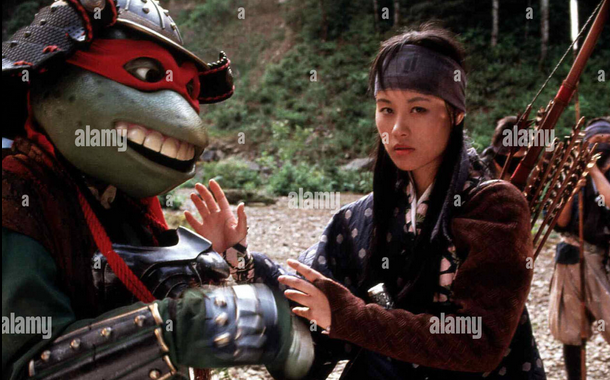
Teenage Mutant Ninja Turtles III, 1993. This is the one where April buys a weird lamp at a thrift store and then she gets teleported to feudal Japan, and the guys have to go after her and they get caught up in some civil war between Grumpy Man and Mitsui, Warrior Princess, a war that can only be remedied if Mitsui, Warrior Princess, marries Grumpy Man’s son Kenshin, who – inconveniently – was teleported into 1990s NYC along with his father’s honor guard because time travel only works if you match the number of people going and coming exactly. I have conflicted feelings about this one: it’s…silly, but Secret of the Ooze was downright preposterous, especially with Tokka and Razar who would only work in a kids movie. On the other hand, kid-me was a fan of Mitsui.
1776, 1972. A rewatch for me, an introduction for the ladyfriend. Excellent, excellent, excellent. I’d forgotten how great a movie it is, between the impassioned debates, casting, acting, and music. It’s only aged better the older I get, as I now recognize so much dialogue from the letters of the Founders themselves.
SuperVixens, 1975. A….crime….suspense…..trash movie about a man being chased by Charles Napier. Let’s leave it at that. (Just read Russ Meyer’s wikipedia article, you’ll get idea.)
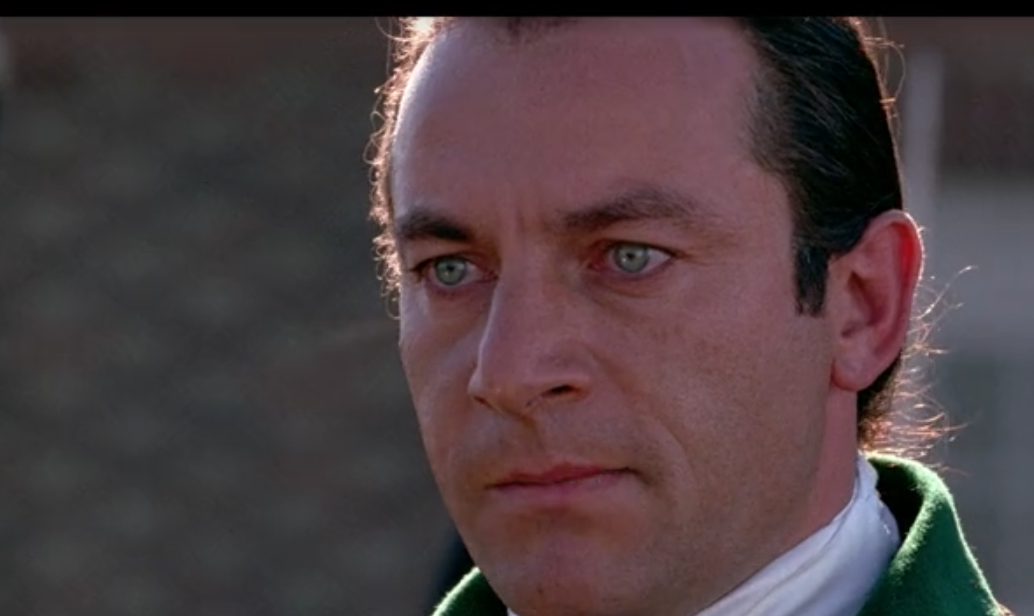
Tavington: This is madness!! Benjamin Martin: Madness? THIS! IS! AMERICAAAAAAAAAAAAAAAAAA!
The Patriot, 2000. My lord, I’d forgotten how utterly hatable Jason Isaacs is in this movie. In his first five minutes on film, he’s ordered an innocent man’s house and fields set fire to, ordered a teenager to be hung as a spy, and shot a child. This is a Revolutionary War murder drama in which a farmer who is determined to shield his children from the War sees one threatened with hanging and another one shot, at which point he chooses violence. Glorious, bloody violence. Also, Rene Auberjonis (aka Odo from ST DS9) is a supporting actor in this!
In Bruges, 2008. A hitman accidentally kills a child while on an assignment, and is told to hang out in Belgium until the heat dies down. He is accompanied by Mad Eye Mooney, which is funny because their mutual boss is Ralph Fiennes, aka Voldemort. The beginning of the film is a low-key suspense film with some comedic elements, as Moody enjoys the culture of Bruges but the hitman finds it only tolerable after he meets a local and starts dating her. It turns out that Voldemort sent the hitman to Bruges so he’d have a nice week before someone else knocked him off to avoid any problems with law enforcement and the dead kid.
Rock and Roll High School, 1979. An enthusiast of the Ramones meets them at a concert and invites them to take over her high school. Basically a Ramones musical with the plot being of secondary – perhaps tertiary – importance. I continued my parlor trick of finding Star Trek and Sopranoes links in almost every movie we watch because Del Pay has been in no less than three episodes of 1990s-era Star Trek episodes.
Microcosmos, 1996. French insect documentary with video work that is absolutely AMAZING for the mid-1990s. This is Planet Earth level detail. (This movie was prompted by my cinema buddy’s apartment being literally colonized by bees.)
Twelve Angry Men, 1997. The first time I ever watched TAM was the remake in high school, for creative writing or speech class (same teacher, same classroom). Watching this thirty years later was a…wholly different inexperience, in part because I knew the story and largely because I knew so many actors.
“Hey! That’s Tony Soprano! hey! That’s Gil Grissom! Hey! That’s Tony Danza! Hey! That’s George C. Marshall! Jack Lemmon! Wait, who ISN’T in this movie?”
Seven Brides for Seven Brothers, 1954. A musical comedy about some backwoods boy lookin’ for lady-types. Fun!
In the Army Now, 1994. Two slackers (Pauly Shore & Andy Dick) who work in an electronics store are fired for general incompetence, and decide to join the Army Reserves as weekend warriors specializing in water purification. Are they concerned? No, because the last war was like, what, WW2? (Boy, you guys need libertarian friends who will give you lectures on all of DC’s foreign policy misadventures.) Things happen, and soon the “waterboys” soon find themselves not only in a war, but behind enemy lines in a place where only they can do something. I watched this more than a few times as a teenager. There are also aspects I didn’t appreciate as a kid, like the absurdity of Libyan camp guards shooting machine guns during an air raid.
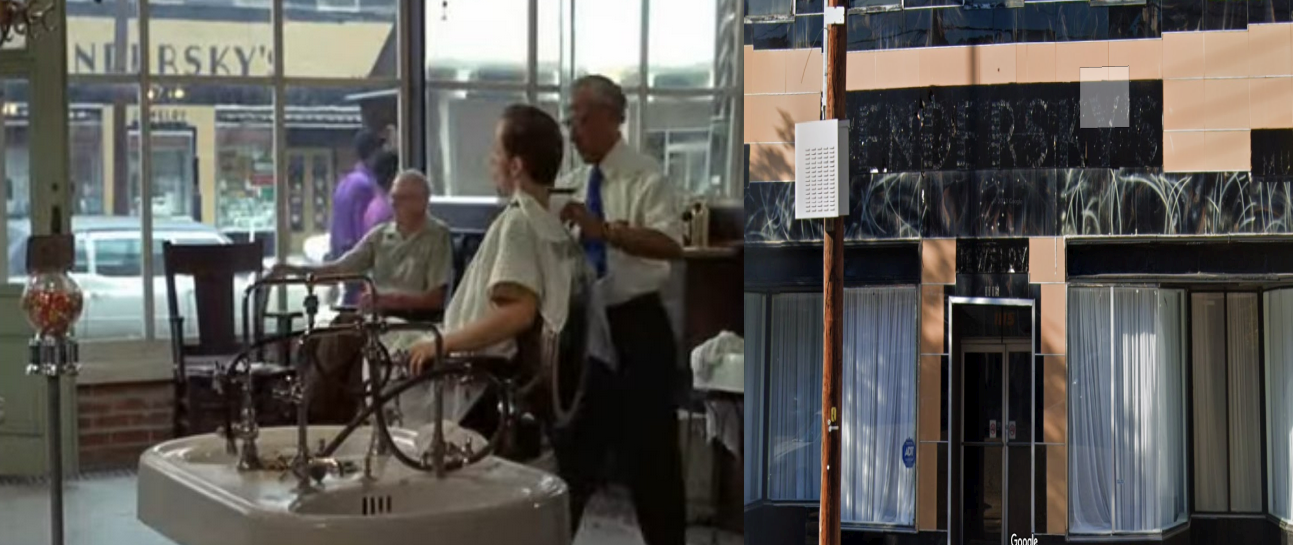
Payday, 1973. Watched this solely because it was filmed in and around my hometown, so my buddy and I were constantly pausing and rewinding to study background details and figure out where shots were being taken. There is a plot about a country-music singer whose life of excess is destroying him and those around him.
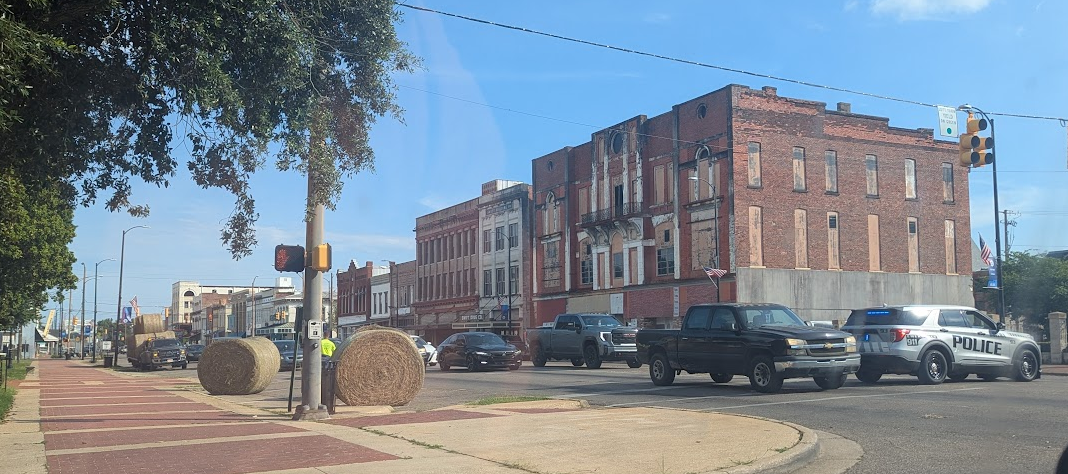
Bendersky’s storefront, 1974….and 2022.
Renaissance Man, 1994. Danyn DeVito plays an unemployed ad man who is assigned to work at a military base and teach a small group of boots who are judged being on the verge of flunking out. There’s no curriculum, so after a few halting attempts at finding some way to teach “comprehension”, DeVito stumbles into teaching ….Hamlet! The students include a very young Mark Wahlberg, as well as a minor character from The Sopranoes. (He’s one of Jackie Jr’s friends who gets shot.) While a lot of the film is weak, sense-wise, there’s a lot of humor and heartwarm-y stuff. My favorite part was the Sopranoes character, who is fond of Al Pacino impersonations, reading Henry V as Pacino in Scarface. (He does not do this in the big finale, where for some reason his DI demands he quote some Shakespeare, so he performs the “Band of Brothers” speech.) One impressive feat the film does is slowly humanizing a group of largely obnoxious students – Private Motormouth in general – so that the viewer can actually like them by the end. Ditto for DeVito’s character, who starts off very much like Emilio Estevez in Mighty Ducks but finds his passion.
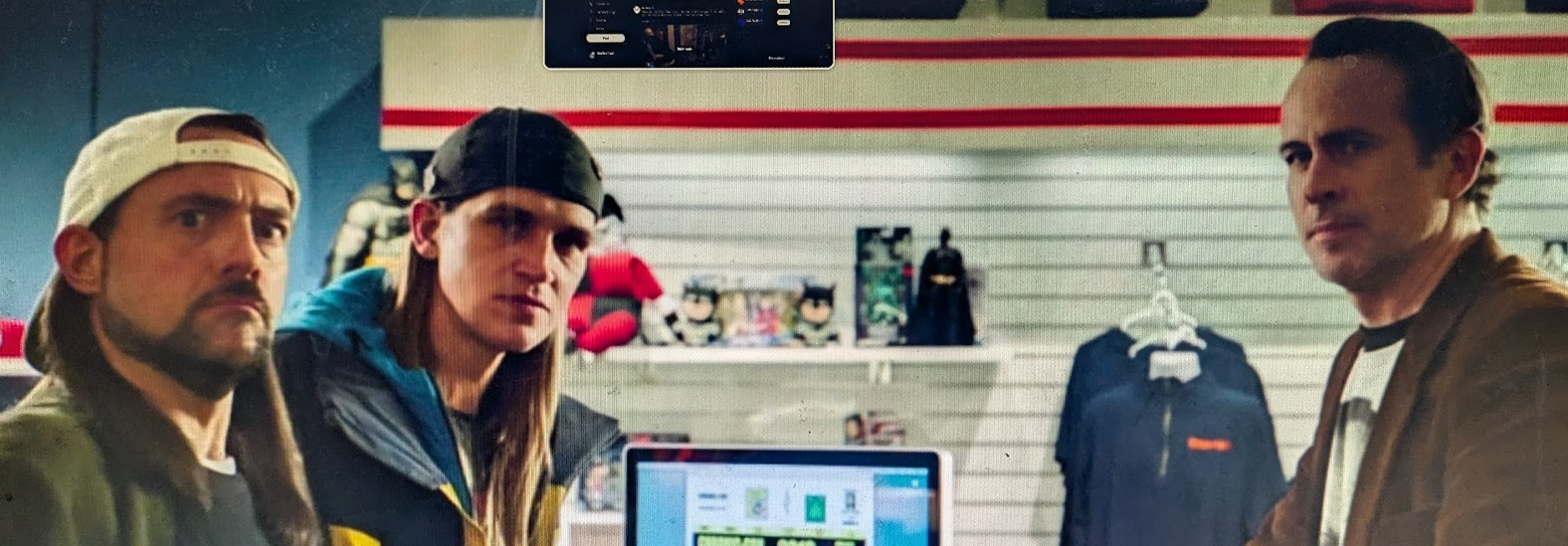
Jay and Silent Bob Reboot, 2019. Jay and Silent Bob have to go to Hollywood to stop Kevin Smith from making another Jay and Silent Bob movie. “What kinda broken down [creeps] still WATCH this stuff, anyway?!”
Me, the viewer: (waves)
Along the way, Jay discovers he’s a dad, and viewers are forced to deal with annoying teenagers. While my attitude during the movie was more toleration than wholescale enjoyment, there were nice parts: like cameos from Matt Damon & Ben Affleck. (Damon’s was the funniest, since he kept doing Bourne references.) There are a lot of inside references, like Kevin Smith’s daughter (playing Jay’s daughter) saying she hates Kevin Smith because he forces his daughter to act in all his movies. The ending is amusing, though.
“How old are these guys, anyway?” “I think they were alive during the ninenties.” “No way! That’s before they built THE INTERNET!”
“Silent Bob says, failure is success training.” “…then why aren’t you the most successful man in the world?”
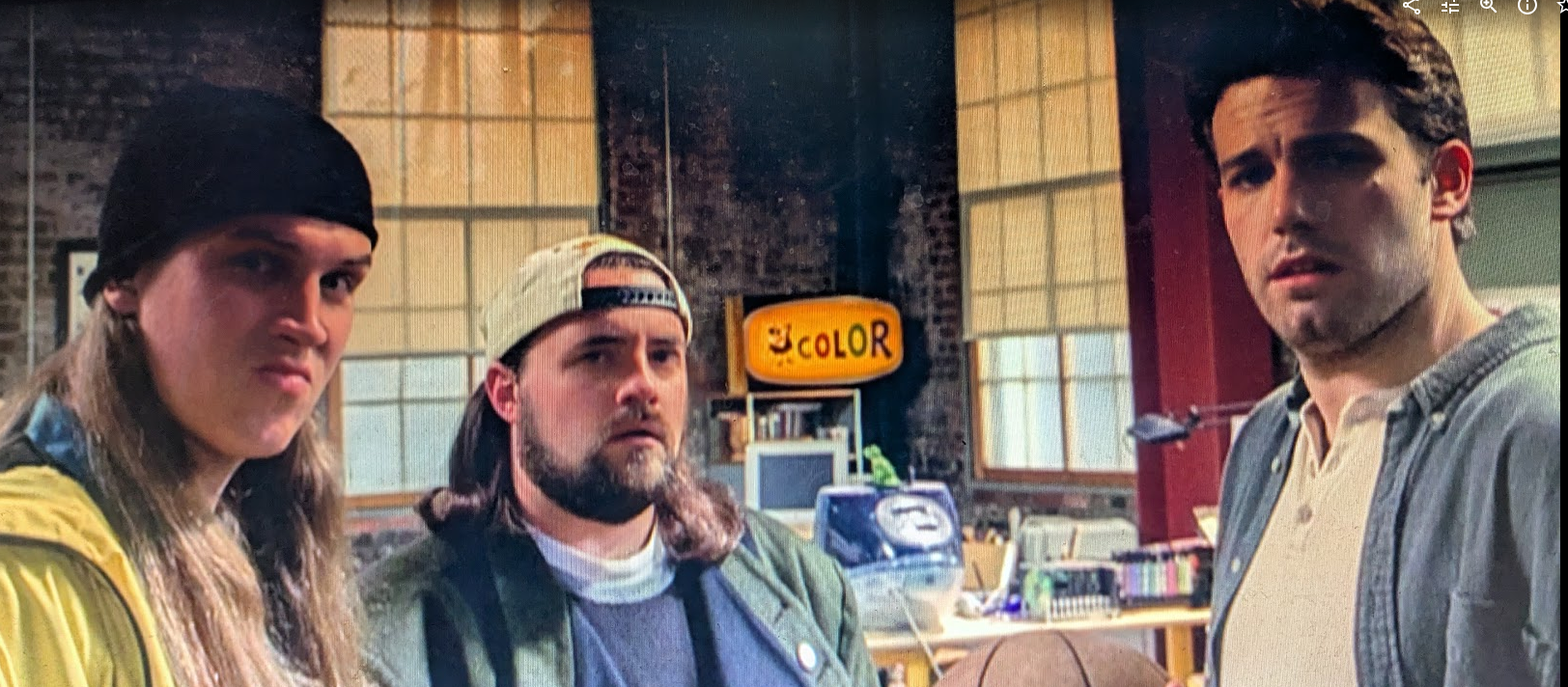
Jay and Silent Bob Strike Back, 2001. Watching Reboot made me realize that either (1) I’ve only watched unconnected clips from the original Jay and Silent Bob movie or (2) it’s been so long since I watched the movie I remember nothing about it. In Jay and Silent Bob Strike Back, Jay and Silent Bob learn that a movie is being based on them, so they run off to Hollywood to stop it.
“A Jay and Silent Bob movie? Who would watch THAT?” Me: (waves)
Enroute, Jay falls for a young woman and unwittingly joints a diamond-stealing gang as their love-smitten patsy. There are cameos from Ben Affleck and Matt Damon, and….a pre-Daily Show Jon Stewart, not to mention Will Ferrell. (Dante and Randall also appear a few times! On the downside, Jay repeatedly refers to an orangutan as a chimp and still worse, a monkey.
WF: Why are you shooting at me?! Bad Girl Band: Two reasons! One, we’re walking, talkin’, bad-girl cliches! Two, you’re a man!
Out to Sea, 1997. Walter Mathau and Jack Lemmon are a couple of old codgers who Walter enlists as “dance hosts” on a cruise ship. Walter’s not in it for a cruise, though, he wants to gamble & try to lure in some old biddie with a lot of money. He winds up falling in love with a youngish woman who (unbeknowst to him) is also a gold-digging con artist. Meanwhile, Lemmon struggles with being a widower in love. Entertaining, and it has Brent Spiner singing.
The Drop. 2014. James Gandolfini and Tom Hardy, madonne! Gandolfini plays the former owner of a bar who was pushed out by some Chechens who use the bar for some gangland things. His nephew Bob (Tom Hardy) tends the bar. One night they’re robbed by a couple of nogoodniks, annnnnd the Chechens want their money back. I’ve always only ever seen Hardy in roles where he’s very self-assured — Shinzon, Bane, Bronson, etc — so seeing him as a mild-mannered barkeep was fascinating. Continue to be impressed by his acting chops.
The Intern, 2015. Robert DeNiro is a retired widower with a hole in his life, so when he sees a flyer for a “Senior Intern” program at a local business, he’s intrigued. He’s soon the personal assistant of Anne Hathaway, the founder of the company who is working herself to death. There’s humor here, largely in the old-school DeNiro teaching Millennials a thing or two – like the importance of dressing for the office, say, and not like they’re staggering into walmart at 1 am in their pajamas and plastic shoes with a case of the pizza roll munchies. DeNiro and Hathaway’s relationship is interesting to watch grow, though, especially after DeNiro realizes Hathaway’s husband – who does not look like he could catch Hathaway – is cheating on her. Seriously, her husband is Pajama Boy with an ill-kept beard. Wonderful acting from both Hathaway and DeNiro, I thought, especially when DeNiro reveals that his old factory is the site of Hathaway’s new e-boutique firm.
The Master, 2012. I think Phillip Seymour Hoffman was meant to be L. Ron Hubbard enticing a Navy veteran played by Joaquin Phoenix into his cult, but the movie was lots of quiet, intense conversations and I was actively watching the clock waiting for it to end.
The Apartment, 1960. A young Jack Lemmon, a young Shirley Maclaine, and Fred MacMurray feature in a film about a young executive who has been pushed into letting upper executives use his apartment for their affairs, but things go awry when he realizes the girl he’s smitten by is involved in one of the affairs. Fun romantic comedy.
OSS 117: Lost in Rio, 2009. A French parody of James Bond films that is absolutely hilarious. Where else can you find Robin Hood and a Nazi in a Mexican wrestling mask fighting? Lots of cinema references to other films like Vertigo.
A Serious Man, 2009. A Jewish black comedy about a man whose wife wants to leave him, even while other crises are descending, so he sees three different rabbis (one played by a Michael Knowles doppelganger) and things get progressively weirder. It’s….slightly reminiscent of the Book of Job. Probably the most interesting film I’ll see this year.
“Why does Hashem make us feel these questions if there’s no answers?!”
.
What About Bob?, 1991. A comedy in which Bill Murray plays a distrubed man who stalks his new psychologist (Richard Dreyfuss) on vacation. Watched this in high school and though it was hysterical; enjoyed it well enough this time around, though I now prefer Dreyfuss in more serious roles.
John Scalzi meets Randall Monroe in a comic SF novel with an insane premise: the Moon has been replaced by a giant orb of cheese. Or, to use NASA’s language, it has “assumed an organic matrix”. How? Who knows?! It’s inexplicable, and that’s deeply unsettling for those who view the Cosmos as inherently rational and ultimately understandable. Whatever it is was pretty thorough: all lunar samples on Earth have ‘assumed aged organic matrices’, too. When the Moon Hits Your Eye opens with a string of separate stories following how the Cheese-Moon impacts people in different professions (astronauts, ministers, fromagers, etc). At first, these stories delight in the absurdism and are seemingly unconnected, but that changes as the physicality of the cheese-moon kicks into place. When the moon begins compressing, it becomes unstable — and scientists realize that it may soon constitute a hazard for life on Earth. While the arrival of the Cheese Moon was already upsetting for astronauts who’d planned a lunar landing in the near-future, the prospect of being barraged by cheese-asteroids puts the people of Earth into an existential crisis. Like Redshirts, Scalzi deftly takes a comic premise and finds a way to make it serious and meaningful: the chapter with a pastor trying to talk to a drunk and hysterical parishioner was one of the most emotional things I’ve read all year. Beyond this, I greatly enjoyed the variety of characters and microstorytelling here. When the Moon Hits Your Eye is an unusual SF book, but succeeds in delivering a very human story in absurd conditions. I kiiiiiinda wish I’d listened to Wil Wheaton read it, but as it happened an ebook version was handier.
Quotes/Highlights:
“Beyond that, there’s no one else in the world who would have the technology to disappear the moon, much less replace it with a globe of, probably, cheese.” “Do we have that technology?” “No, sir,” Axel said. “And even if we had it, disappearing the moon and replacing it with an equally massive orb of probably cheese serves no discernable military purpose.”
Recently I was looking for the author Nevada Barr, who has a series about a female park ranger who works across the United States. The library didn’t have the early ones in stock, so I grabbed this one without really looking into the plot: it was tagged historical fiction and would give me an idea of the author’s style, so why not? Such is how I came to read a prairie romance about two women, though it’s more of a drama with some romantic elements. While I don’t read romance, this kind of relationship in a historical context struck me as unusual enough to try. I was honestly curious as to how Barr would develop Imogene in the context of the 1870s and 1880s. As it turns out, it’s quite the story of resilience, opening with one woman having to leave town in a hurry, heading west, and ultimately scratching out a life for herself as the manager of a stage stop in the wilderness — learning to hunt, manage roughneck visitors, etc. As the title indicates, though, the women — Imogene and her partner Sarah — have a life of hardship ahead of them, with happiness squeezed from it at great effort. As historical fiction, this is wonderfully detailed, driving home the harshness of life in the old west: as a “love story”, it succeeds on the characters’ emotional bond and avoids becoming overly graphic, though there is an attempt at rape and the novel is fraught with violence.
Bittersweet opens with Imogene having to flee her Pennsylvania hometown after her relationship with another woman is discovered — the scandal being made more volatile by the fact that the woman was a former student of hers. Armed with a letter of recommendation from someone who either doesn’t know or care about that exposed relationship, Imogene heads west and is able to find another teaching position. Her new town is small and its schoolhouse in need of attentive care, which she provides; she also becomes closely invested in the future of Sarah, an intelligent but extremely shy girl about to graduate. After Sarah graduates, she and Imogene become closer still, as Sarah gets married to an older man who is well-regarded in the community but turns out to be rather sadistic at home. Over the course of a few years, Imogene becomes Sarah’s almost sole source of moral support, rising where her parents fall. Unfortunately for Imogene, her habit of letter-writing reveal her address to the wrong people, and they expose her to the town — and Sarah is caught up in the ensuing drama, as her already-abusive husband now suspects that Imogene has corrupted her. They’re forced to flee, and wind up in the middle of nowhere managing a stagecoach inn together, a la Ruth & Idgie. (Fun fact: Idgie’s real name is Imogene, only she couldn’t pronounce it as a kid so she became known as Idgie. ) Finally, a happy ending? Hah! More sorrow awaits, but that’s life in the wilderness.
As far as historical fiction goes, I was impressed by the level of details that Barr works in casually: there are no info-dumps, but we’re subtly reminded constantly of our setting and the hardness of life — both materially and socially, since Barr doesn’t shy away from characters being casually racist or hardened by suffering. The story feels believable for its historical context: some of the men who frequent the stagecoach are former Confederates who left the war-broken South, and over time the stage struggles as railroads continue their iron advance across the wilderness. She features the changing landscape quite a bit, and since the characters are constantly on the move, there’s a nice variety — prairies and mountains. The challenges of the west are extreme for Imogene and Sarah after they begin running the stagecoach, since they’re isolated: everything that needs doing, they need to do. Fortunately, Imogene has a mannish build, something that comes in handy when she needs to pretend to be a man to protect their lease on the inn, leading to someShe’s the Man-esque humor amid people dying and coyotes harrowing the cattle. Interestingly, though this is described as a romance, it’s not particularly romantic: Imogene and Sarah have a strong personal bond that strengthens as they support one another through their shared adversities, but as written it’s more of an emotional intimacy than a physical one. The novel is at its most graphic when depicting attempts at rape, which I suspect most everyone thinks we could have done without.
In short, this was a surprise: when I realized it was romantic in nature I was tempted to put it back down, but Imogene’s resilience and Sarah’s journey from timid wallflower to confident young woman both impressed me. I have a couple of Barr’s park ranger books on hold and am hoping to see how her style matured, since this appears to have been her first book.
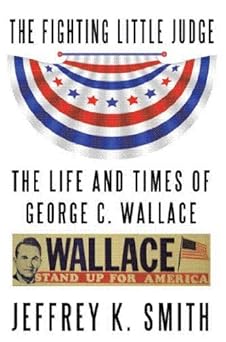
WHAT have you finished reading recently? The Fighting Little Judge, a biography of Governor George C. Wallace of Alabama and his political career.
WHAT are you reading now? Nixon’s White House Wars, an inside look at the Nixon administration.
WHAT are you reading next? Two possibilities are Waking Giant: America in the Age of Jackson, or Franklin & Washington: The Founding Partnership. Still on a history and politics binge…
Today’s prompt from Long and Short Reviews is “Books We Loved But Didn’t Read”. TTT did that back in 2020, so I will revisit that list and check my reading lists of the last few years to see if anything new has joined.
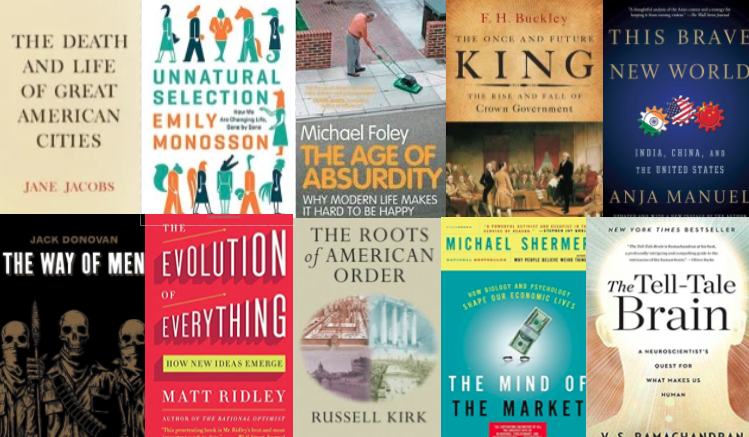
The Death and Life of Great American Cities, which is on my hopeful re-read list for this year.
Unnatural Selection, which I was sent as an ARC back in the day but shamefully did not post a review for.
The Age of Absurdity, which I’ve re-read several times but never posted a review for
The Once and Future King, on the return of over-powerful executives in America, Airstrip One, and Australia
This Brave New World, on DC’s relationships with India and China
The Way of Men, which I described as “Imagine if Tyler Durden wrote a book”. This one stands out as the only book I later reviewed!
The Evolution of Everything, on emergent order
The Roots of American Order, a cultural examination that looks at the role of Stoicism, Judaism, Christianity, and a few other elements in shaping American civilization
The Mind of the Market, Michael Shermer.
The Tell-Tale Brain, V.S. Ramachandran.
So, that’s the last list. What have I added since that were both bold end-year favorites and unreviewed?
2024: Abigail Schrier’s Bad Therapy: Why the Kids Aren’t Growing Up; Jon Haidt’s Anxious Generation. I have a long draft for that one, just never finished it.
2023: The Filter Bubble: How the Personalized Web is Changing How We Read and How We Think; Feminism against Progress by Mary Harrington.
2022: Live not by Lies, Rod Dreher. (Again, long draft review.) How to Think like a Roman Emperor. David Brook’s The Second Mountain: The Quest for a Moral Life.
2021: We Have Been Harmonized: Life in China’s Surveillance State, Kai Strittmatter. How Emotions are Made, Lisa Feldman Barrett
Almost another ten! Yikes. And if I’m not careful Provoked will join the list for this year, nevermind my long draft for it.
[Nixon’s] concern was my conservatism. “You’re not as far right as Buckley, are you?” he asked. “I’m a great admirer of Bill Buckley,” I replied. Nixon was then in a nasty dispute with National Review over a comment he made in private, that “the Buckleyites are more dangerous than the Birchers.” – Pat Buchanan, Nixon’s White House Wars
I ran across this title while looking for Nixon-related books, and it’s proving rather surprising. Although I knew “movement conservatism” was just coming of age in the 1960s, I didn’t realize Nixon put as much distance between it and his own politics. Buchanan’s book makes it appear that Nixon regarded the Goldwater crowd as an annoying subsection of his voter base that he had to throw the odd bone to. Given the period, there’s a lot of deja vu — student protests taking over college campuses, the president at war with the media, etc.
Related: Getting it Right, Willam F. Buckley. A novel about a romance between an Ayn Randian and a Bircher that explores the attraction and weaknesses of both approaches.
“There he goes. He don’t have no hobbies. He ain’t got but one serious appetite, and that’s votes.”
Back in 2016, I played with the idea of reading biographies of various populists, for obvious reasons. William Jennings Bryant, Huey Long, and George C. Wallace were the three figures who leapt most to mind. Although George C. Wallace is principally known for his symbolic stand in the schoolhouse door to stop the integration of the University of Alabama, he came into politics through the old Democrat tradition advocating for poor, rural Alabamians, and populism would be his mainstay. The Fighting Little Judge is a surprisingly fair biography of Wallace’s life in politics, one that reveals Wallace as a consummate political animal, striving for power from his teen days on.
Mention the name Wallace and the schoolhouse door image instantly comes to mind: defending segregation in the name of States’ Rights is what brought him national attention, fueling four presidential runs. When he began in politics, though — as a page on Goat Hill, serving the legislators — Wallace was more concerned with serving poor Alabamians in general. He rose from poverty, working his way through universityat a variety of odd jobs, and later served in the military. Smith writes that Wallace was offered OCS training, but declined on the basis of politics: he believes Wallace suspected a common soldier would do better in the polls than someone wearing brass on his shoulders. After the war, Wallace became a judge, the first step that would lead to him moving further in Alabama politics and ultimately becoming governor four different times.. He joked that he liked running for office more than he liked working in office, and the amount of time he spent running for president while living in the governor’s mansion reveals how true that was. It was a strike against him in one race, as the opposition declared that they would be a full time governor, not a part-time one.
It’s that vote-chasing that got Wallace in trouble and established his reputation as a bitter racist, a man who his haters half-expected to show up wielding a pitchfork or a whip. Judging by his personal behavior, Wallace exhibited no hatred for blacks. Indeed, when he served as judge, he frequently admonished white attorneys for not giving their black counterparts the respect due a member of the Bar, and Civil Rights attorney J.L. Chestnut commented that Wallace was the first member of Alabama’s legal community to address him as “Mr. Chestnut”. Wallace made an observation — long before he was shot — that life is too short to hate, an insight curiously close to MLK’s own saying about hatred being too heavy to bear. His first attempt at running for governor saw him being attacked by the KKK on the grounds of being too his lenient on black defendants in court, and too soft on the segregation question. (He was endorsed by the NAAACP.) Realizing that fighting for segregation was extremely popular among his base, though — presumed superiority over poor blacks being the only social thing poor whites had going for them — he flung himself into becoming Mr. Segregation. And it worked: the more he harped on the dangers of losing segregation, the more abuse he threw on the government and the intellectuals up north, the more popular he was. It was a Malthusian gamble, exchanging his soul for power. “When I talked about roads and schools, they listened,” he commented, “And when I mentioned the race issue they hooped and hollered.” Segregation was bundled with States Rights — resentment over the increasing role of the central government in people’s lives, a delayed reaction to how the New Deal had changed the relationship between DC and its subjects — and the fear of communism. The latter aspects must have surely been a large part of his appeal, too, since he was popular in states that had no race issue at all by the simple fact they were racially homogeneous. Interestingly, though, when in a different context like a formal debate, he would defend segregation on ‘rational’ grounds, pointing out that black-only schools created more opportunities for black educators, or that mixed-race football matches often created problems with racial fights between fans.
As readers may know, Wallace’s presidential ambitions and his role in the national spotlight ended in 1972, when a man who wanted to be an assassin of somebody (Nixon or Wallace, whichever was easier) shot the governor multiple times. Wallace would be paralyzed and live the rest of his days in pain, though astonishingly he ran again for governor and won. (The sympathy vote helped, one supposes: when he lost his first governor’s race it was against a man whose father had been murdered by the Dixie Mafia.) Wallace’s life definitely went downhill in the late 60s-70s: his first wife Lurleen died, his second wife left him after he was shot, and he’d been reduced to a man who could not only not feel his legs, but couldn’t control basic bodily functions. Getting shot was evidently a come to Jesus moment, though, as he began appointing blacks to office in Alabama, and continued to do so until the late seventies when he declined to run for a fifth governor’s term. Following his effective retirement, he became much more religious, and reached out to make amends to men like John Lewis, the Civil Rights activist who was beaten in the Selma to Montgomery march.
Smith ends the book by evaluating Wallace’s life and work and morals, commenting that while the governor always ran on populism, he didn’t actually do much in that realm. One of his contemporaries was interviewed and when asked to sum up Wallace’s role as a politician, the man replied: “George C. was good at winning elections.” Wallace was not a dedicated administrator, and appeared to devote more attention to rewarding his supporters with contracts and positions than making radical changes to impact the lives of poor Alabamians, black or white. Being absent while running for president didn’t help, of course. And yet…he must have done something, because rural/poor white boomers I know still speak with fondness about “George C”, and when I started researching on my own I found that he was responsible for the rapid expansion of trade schools and community colleges, highway-building, healthcare access, and so on. He also gained more of the black vote in every election he ran in: never compelling numbers (35% was the peak), but always more than could be expected from Mr. Segregation.
This was a fascinating volume to read, completely compelling for me as an Alabamian and a historian who has to wrestle with my state’s past every day. This is my first dive into George C.’s life, so I can’t comment too much on the facts: when the book intersected with my own specialty (Selma history), I noticed both good and bad. Smith correctly puts the site of Bloody Sunday as a quarter mile from the Edmund Pettus Bridge (contra the moronic media myth that marchers were attacked “trying to cross” the bridge), but he attributes the death of Reverend James Reeb to a deputy sheriff, which is baffling. There were four men involved in the beating of Reeb, and none had any connection to the sheriff’s office. (Reeb was a Unitarian Universalist minister who came to Selma in respond to King’s call for clergy, and within two days of arriving had gotten himself fatally beaten.) There’s also a…fantastical assertion that, following Wallace’s shooting, Elvis Presley met with him and offered to pay for an assassin to knock off the perpetrator: Wallace admonished Elvis not to ruin his career with violence. That sounds…all kinds of unbelievable, to be frank, and I’ve searched for anything to back it up but to no avail. Even so, I was impressed by its evenhandedness: Wallace is an easy man to villify, but Smith presents him as the messy man he was: a man driven by ambition strong enough to undercut morality, but ultimately shaken by the decisions he made. Quite good, I’d say.
Buckley: Conservatives find that Wallace’s background is that of a New Dealer, someone who is intensely concerned to multiply the functions of the state — George C. : You’ve made a statement here that in Alabama that I am for things you don’t exactly like. Name one thing — Buckley: If I may say so, your using public money for social functions — Wallace: Name the functions. Buckley: You want to care of of hospitalizations, of the senior citizens, of the poor — Wallace: Are you against taking care of the poor? Buckley: I hate the poor. I’m for shooting them. (laughs) I had a feeling you’d ask that (Buckley was …kidding.)
Quotes/Highlights
An expert at manipulating the masses, George C. sensed their uneasiness, “I guess you folks are sort of disappointed that I don’t have horns, after all you have read about me in the press.”
When the Ku Klux Klan endorsed John Patterson, the Attorney General did not publicly embrace the racist organization, but, more importantly, he did not refute their support. In contrast, Wallace made it a point to condemn the KKK in his campaign speeches. The Klan countered by spreading rumors that Wallace was actively seeking the “black bloc vote.”
After returning to Alabama, George C. mused aloud about how wrong the political elitists had been, “They thought I was gonna amble on the stage and say: ‘Hi, y’all. Sho good to see y’all. I’m just an ignorant, hookwormy redneck from Alabama come up to visit y’all. I ain’t had no education, and didn’t wear no shoes ‘til I was thirty. But, I come to ask y’all for y’all’s vote.”’
Never at a loss for words, Johnson immediately unnerved Wallace, “George, you have something in common with Martin Luther King. You are the only two fellows that have wired me to ask for an appointment with President of the United States, and then released the wire to the press before I received it.” Wallace was momentarily speechless.
JOHNSON: George, why are you doing this? You ought not. You came into office as a liberal. You spent all your life wanting to do things for the poor. Why are you working on this? Why are you off on this black thing? You ought to be down there calling for help for Aunt Susie in the nursing home.”
A distracted George C. often did not seem to hear his children when they called him “Dad,” but would reflexively look up when they addressed him as “Governor.”
Wallace continued, as the reporters scribbled notes, “Yeah, lots of folks think I’m a bad booger. They think I’m a hate mongerer. But, I ain’t no hate mongerer—shit, life’s too short for that. You can’t waste it hating folks.”
“If George had parachuted into the Albanian countryside in the spring of 1962, he would have been the head of a collective farm by fall, a member of the Communist Party by mid-winter, on his way to the district party meeting by the following year, and a member of the Comintern in two or three years. Hell, George could believe whatever he needed to believe.”
George C. offered his own assessment. When asked by a reporter which political figure he most admired, Wallace smiled sheepishly, “Myself.”




 Reading Freely