Today’s TTT is books with occupations in the title: I’m going to go back to 2007 and work my way forward, limiting each year to one book. But first, a tease!
What they understood at Johnny White’s, however, was what most Americans had yet to accept, was that New Orleans was no longer a city. It was a smattering if islands, rising out of the 80% of the city’s land that was submerged. THE GREAT DELUGE
The Undertaker’s Widow, Philip Margolin. One of my earliest (2008) blogging reads, but I remember nothing about it. Margolin is a thriller writer who I’ve forgotten about over the years despite reading a bit from in the mid-2000s.
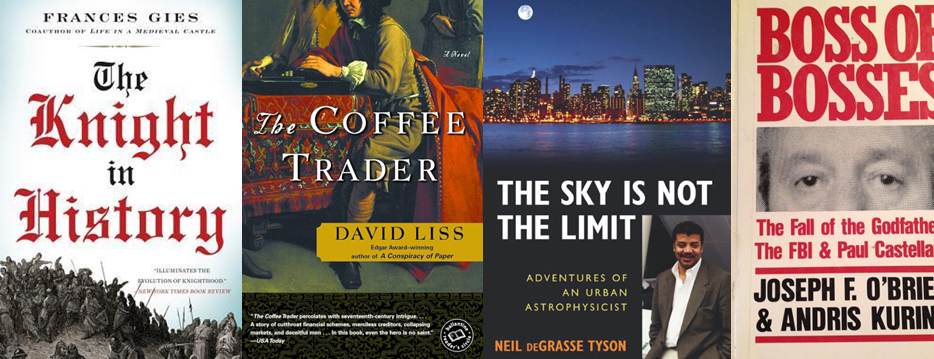
Boss of Bosses, Joseph F. O’Brien and Andris Kurins. On the criminal career and takedown of Paul Castellano, don of the Gambino family and overall Mafia heavyweight. .
Captain Horatio Hornblower, C.S. Forester. Naval fiction set during the Napoleonic wars. The entire series was fun.
The Revolutionist, Robert Littell. Historical fiction about the Russian Revolution, in which a young idealist sees it betrayed by the opportunistic schemes of an increasingly smaller Bolshevik inner circle.
The Coffee Trader, David Liss. A historical fiction business thriller about this “coffee” stuff that’s suddenly all the rage in Age of Discovery Europe.
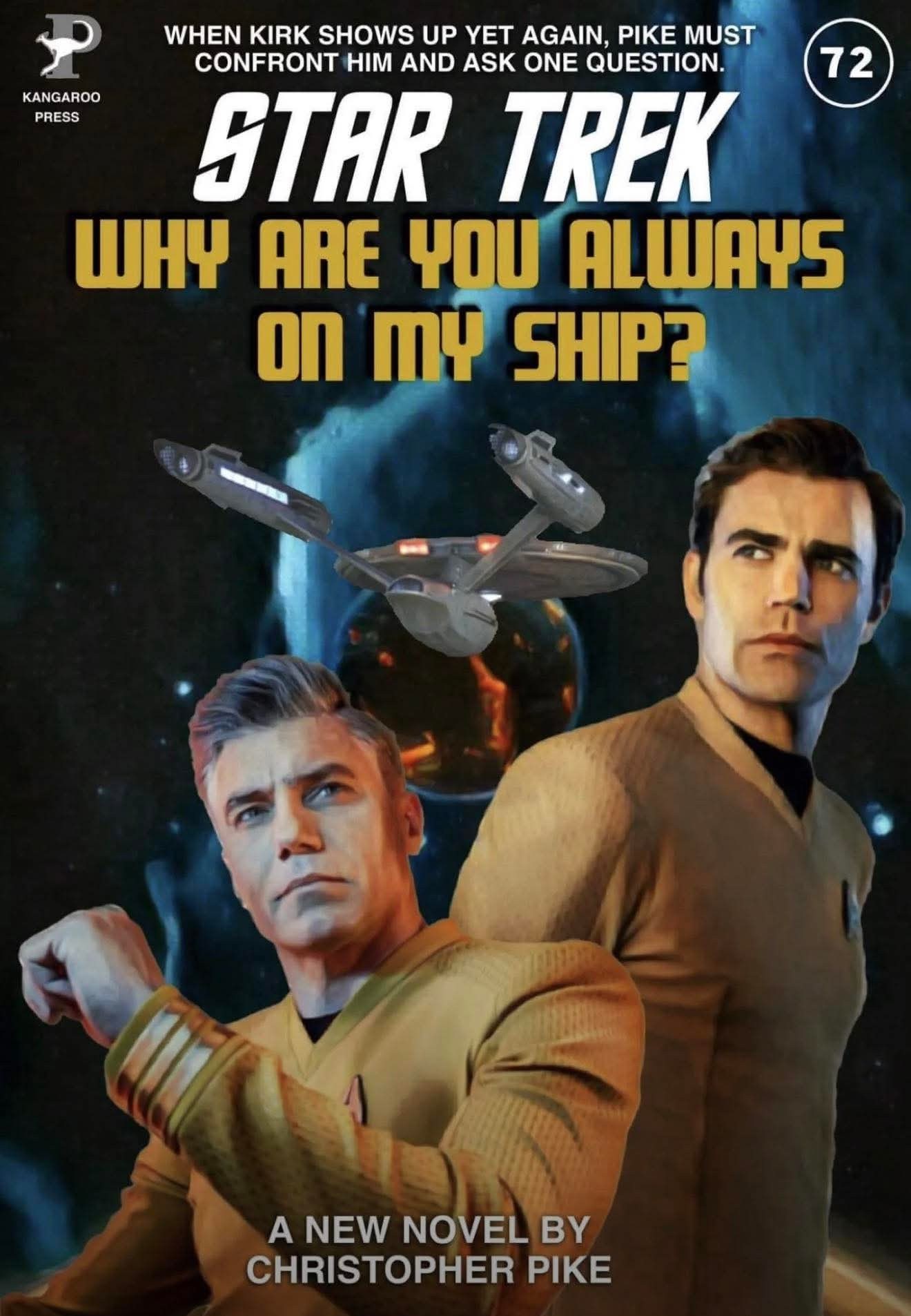
August ended with a surprisingly abrupt break from the intense heat and humidity that usually mark this period in Alabama: a cold front moved in, and as our air-conditioners suddenly turned off for the first time since May we sat and marveled at the strange silence. I even got to sit outside and read, something I haven’t done since spring gave way to the Great Sticky Siege. Reading-wise, I opened the month by rereading Roswell High, a series I read in middle school, and then began making amends to my nonfiction queen by switching to history. There were some more SF titles in there, too, meaning fiction is again beating nonfiction. We’ll see if September can correct that. Nothing was done on any challenges, I’m afraid, and the heat’s been such that I didn’t even get out and about to get any interesting photos, hence my using a funny Strange New Worlds meme I liberated from Facebook. I don’t think I’ll finish anything tonight- – I could finish a book on Atlanta’s homeless population, but it’s so depressing I keep reading of Hurricane Katrina and Chernobyl instead — so I’m posting the monthly review today.
New Acquisitions
I preordered Against the Machine: The Unmaking of Humanity by Paul Kingsnorth, which will be released in the latter half of September.
Coming up in September
No firm plans, but I do have one title checked out for 9/11, one focused on Windows on the World, and I might do a science push. I’m also anticipating the release of This is For Everyone: The Unfinished Story of the World Wide Web by Tim Berners-Lee. Will be interesting see how similar or different it is from How the Internet Happened.
Moviewatch August 2025
As mentioned previously, my cinema buddy who I’ve been watching 2-3 films a week ever since 2022 has left town. I figured my movie-watching would crater this month, but it appears that three years of regular movie-watching have created a bit of a habit. I watched as many movies as I’ve been watching, but now they’re less….random, I’d say, and more representative of my tendency — in books or movies — to go off on a tangent for a bit. I went on several genre and actor streaks as the month wore on.
Men in Black III. I watched the original movie when it came out, of course, and tolerated the second one, but it wasn’t until that I saw Josh Brolin’s Tommy Lee Jones impersonation – which he does throughout this film – that I thought, holy WOW do I need to see this. Will Smith is “J” and is thrown back in time to 1969 to help his partner K (Tommy Lee Jones/Josh Brolin) knock off an alien who wants to destroy Earth. This involves manhandling Andy Warhol and putting a thingy on the Apollo 11 Saturn-10. Such a good film, between the acting and the raygun gothic tech.
pastK: Okay, future boy, where to? J: Uh…wherever you went to last time. pK: I didn’t tell you where I went? J: We don’t really …talk. pK: What kind of partners sit in a car every day for fourteen years and don’t talk? J: EXACTLY. It’s dysfunctional.
J: The hell happened to you, man? pK: I don’t know, slick, it hasn’t happened yet.
Buzz Aldrin: If we call this in, they’ll scrub the launch. Neil Armstrong: I didn’t see anything.
The Naked Gun, 2025. Starring Liam Neeson and Pamela Anderson, this is a sequel-in-spirit to the Leslie Nielsen movies. I haven’t seen those (Yes, I’m serious, and don’t call me Shirley), but I was laughing the entire time throughout this one. Could have done without the graphical-suggestive sex scenes.
“It says here you did 20 years for man’s laughter. It must have been quite the joke.”
The Naked Gun, 1988. The Lelsie Nielsen original, in which the detective foils a plot to knock off Queen Elizabeth by…serving as umpire in a baseball game. KHAAAAAAAAAAAAAAAAAAN! also appears.
Loaded Weapon, 1993. Emilio Estevez (Coach Bombay) and Samuel L. Jackson feature in this cop-movie spoof that has a loaded cast: William Shatner and Tim Curry are recurring characters, and Jimmy Doohan (Scotty) and F. Murray Abraham both make cameo appearances. There was an unexpected Silence of the Lambs reference.
OSS 117: Cairo, Nest of Spies. Last month I watched the second in this set of French movies parodying James Bond, with an agent who is suave and potent but largely oblivious to context. This is the original of the modern movies. 117 is sent to Cairo and has no idea that Muslims frown on alcohol, for instance – and is so annoyed by the call to prayer at oh-dark-thirty in the morning that he accosts the nearest rabble-rouser and unwittingly inspires a jihad. Quite amusing but the Lost in Rio mocking of 1960s counterculture was funnier. Evidently there were films in the 1950s and ‘60s where the character was much more serious, but here he’s a delightful caricature.
This may give an idea of….some of the spirit of the film.
My Cousin Vinnie, 1992. A fourth or fifth rewatch for me. Joe Pesci plays a newly minted lawyuh from New York who comes down to Alabama to save his cousin and his friend who were arrested for murder in what has to be a case of mistaken identity. The movie is noted for its courtroom accuracy and is one of my favorite comedies for its “fish out of watuh” antics, plus the lovely brilliance that is Marisa Tomei. Fred Gwynne also nails the slightly aristocratic southern judge. Lane Smith did a solid job, as well. As a fan of real grits, I love that the evidence hinges on how long they take to cook.
“No self-respecting Southerner uses instant grits. I take PRIDE in my grits.”
Devil’s Advocate, 1997. A movie I’ve watched repeatedly, both for its disturbing nature and its acting talent. Keanu Reeves plays a hotshot attorney who makes a bad moral decision to maintain his winning streak and is thereafter tempted by the Devil, in the form of a senior attorney, John Milton. One of the more disturbing bits is the ending, in which Reeves’ character is given a second chance, pursues good, and is nonetheless targeted by Milton.
Cowboys & Aliens, 2011. An outlaw, the sheriff and his posse, a bunch of brigands, and even the Apache have to team together to take out a buncha illegal aliens who want to take our gold.
Enough Said, 2013.Julia-Marie Dreyfuss is a divorced masseuse who makes a new friend and client at a party, and meets a funny guy (James Gandolfini) to boot. Funny guy asks her out and they begin dating. New Friend keeps talking about her ex-husband. Ex-husband and funny guy are the same man. Dramedy ensues. My first time seeing JMD in a semi-serious role, since I was only familiar with her from The New Adventures of the Old Christine. She was in Hannah and her Sisters, another drama with some comic elements, but wasn’t the star.
Get Shorty, 1995. Where to begin? John Travolta! Frank Danny DeVito! Gene Hackman! James Gandolfini! …okay, it’s mostly John Travolta and Gene Hackman. Travolta is a loan shark who is being pressured by his new boss (a man whose nose he once broke and whose head he once grazed with a bullet) to produce $15,000 in three days or suffer the consequences. So, he ends up in LA trying to help Gene Hackman produce a movie. Then Pablo Escobar gets involved. A surprisingly fun crime story.
Welcome to the Rileys, 2010. A dramatic role for both James Gandolfini and Kristen Stewart. Gandolfini plays a businessman who goes to New Orleans for a conference, and encounters a young girl in distress who reminds him of his late daughter. An interesting if awkward relationship evolves between the two of them, in which Gandolfini’s character begins acting like a father toward her. Then his wife – intensely agoraphobic – is so disturbed at his decision to have an unexplained prolonged stay in the Big Easy arrives, and things get deeper. Good story and solid acting all around. It reminded me slightly of My First Mister, a film starring Leelee Sobieski and Albert Brooks, about the unlikely friendship between an isolated goth teenager and an intensely….reserved and isolated owner of a clothing store. Gandolfini’s relationship with Stewart is more obviously paternal, though. (Of course, it’s been fifteen years at least since I last watched My First Mister.)
Mobsters, 1991. F. Murray Abraham! I didn’t realize this was my introduction to one of my favorite actors. A gangster movie charting the rise of the Syndicate, featuring Christian Slater as Charles Luciano, who with Meyer Lansky, Benny Siegel, and Frank Costello revolutionized organized crime. I watched this during my obsessive Mafia phase in the early-mid 2000s. (I was also obsessed with the American Civil War and World War 2 at this time, so I haven’t changed in having multiple obsessions.) Michael Gambon also features as one of the mustache petes the Fab Four have to knock off on their way to the top. That really made the later Harry Potter movies weird for me. Pretty sure when I originally watched this as a teenager I just loved seeing how the 1920s and 1930s “were”.
Luciano: I don’t have a wife. Rothstein: Why not? Luciano: Emotion…is dangerous. Rothstein: Aren’t you human? Luciano: Would it help?
Luciano: I don’t bend over. It’s too hard to stand up straight again.
(Target): Jesus, Charlie, you want revenge after fifteen years? Luciano: I’ve been busy.
Capone: Julius Caesar never took no vote. Luciano: Caesar ended up dead on the street.
Carnage, 2011. I have only watched Inglorious Basterds one time since its release, but I have rewatched every single Christoph Waltz scene more times than I can remember. I asked ChatGPT for movies where Waltz was a similarly dominant presence, and it recommended this – a comedy wherein he features alongside JODIE FOSTER!!, Kate Winslet, and that guy from Step-Brothers who isn’t Will Ferrell. Four parents meet in a room to discuss what to do after their respective children get in a fight that ends with broken teeth. They get into a lot of side discussions and there’s interesting shifting character dynamics: different characters side with one another in different scenes depending on where the conversation is going. (This gets…more interesting after a bottle of 18 year old single-malt Scotch is uncorked.) This is a difficult movie to summarize, but if you’re into character drama like myself it’s quite a treat, especially with heavyweights like Waltz and Foster aboard. A plausible drinking game could be composed of the times that Waltz and Winslet take on or take off their coats and attempt to leave.
“You know my wife dressed me up as a LIBERAL?!”
“WHAT YOU DID TO THAT HAMSTER WAS WRONG!”
No Country for Old Men, 2007. I watched this for Tommy Lee Jones and Josh Brolin. Brolin plays a hunter who stumbles upon the scene of a violent shootout, with a bunch of dead suits and deader Mexicans and a bag containing $2 mill. Brolin takes the money, but doesn’t realize the bag has a tracker in it. Soon he’s being stalked by a dead-eyed psychopath, a killer-for-hire (Javier Bardem) who Tommy Lee Jones is also after. Good drama, but bleak ending. I…don’t like watching Javier Bardem. He’s unsettling. Both films I’ve seen him in (Skyfall being the other), I kept wanting him to go away.
The Mexican, 2001. Brad Pitt is a working boy in hock to a gangster trying to move a stolen antique pistol (“The Mexican”) that’s supposedly cursed; his girlfriend Julia Roberts wants him to give up his ways of Amateur Minionry and go work in an office managing TPS reports or something. When Pitt arrives in Mexico, things go south: his contact gets nailed by a falling bullet from morons shooting their pistols into the air to celebrate some Mexican holiday, and then some random hoods steal his car that has the priceless antique in it. Gandolfini plays an oddly empathetic hitman who wants the pistol back, so he kidnaps Julia Roberts. Then he picks up a postman in a bar, and the three of them have a merrie old time dancing and talking about relationships while Brad Pitt is trying to find “The Mexican” and not get knocked off by his bosses or a legion of people in Mexico who want it. It’s an interesting mix of action-drama and comedy.
“You’re very sensitive for a cold-blooded hitman.”
If I do watch anything tonight, I’ll just add it to September’s list.
The War between the States is nearly a year old, but Abraham Lincoln now has a bigger problem. Last November, a Navy ship intercepted a British mail packet on suspicion that it was carrying Confederate diplomats bound for Europe; the two men were promptly imprisoned, but Her Majesty’s government is not pleased that a British ship was accosted and its passengers kidnapped by some uppity colonists. A terse letter is prepared – but whereas in our timeline the letter was modified to be more diplomatic by Prince Albert, here his illness puts him in bed and the potentially explosive communique is sent as-is. The result is a growing diplomatic crisis (an intensified Trent Affair) that adds to the gloom around the White House – gloom already thick from the death of Lincoln’s son and the ongoing war. The tension breaks into open war after Canadian militia in pursuit of honest moonshiners encounter American cavalry patrolling the border and shots are fired. While this sounds like the beginning of a “Confederate Victory” story, Stars and Stripes Forever is far more interesting than that. Light spoilers to follow.
For the most part, Stars and Stripes Forever is solid historical fiction: even when the reader hits the point of divergence, the nature of mid-19th century communications is such that it takes months for any effects to be witnessed. The battle of Shiloh happens months after the affair’s kickoff point, and in a way sets the stage for what happens. While 1861 was the first year of the war between the states, it was more of a time of preparation interrupted by numerous small skirmishes like First Manassas and Ball’s Bluff. Shiloh, though, was a taste of the horrors to come, destroying over twenty thousand lives across the span of two days. In our timeline it was soon surpassed by the charnal house of Sharpsburg/Antietam, and then later the three-day scrum that was Gettysburg. Here, though, it creates a somber mood that leds to opportunity after Hanlon’s Razor goes into effect. A British commander with his dander up misreads a map – and a flag – and tears into Biloxi, burning the town and raping its women. Astonishingly, this leads to a local armistice between the Union and Confederate generals who agree to focus on their now-mutual enemy – and things get even more interesting.
I enjoyed this novel thoroughly, especially for the one-two combo that Shiloh and the armistice create in the psyche of Generals Sherman and Beauregard – a sense of what are we doing fighting one another. The action and characterization are good on the American side: I suspect a British reader would find Victoria’s rendering here annoying, as she’s positively hysteric following the death of Albert and blames it on Washington given that stress over the situation supposedly aggravated his condition. That growing wrath for the North drives a lot of what follows. The British diplomatic response is the weakest part of the novel, largely because they do nothing in the wake of the wrong-flag affair. At this point, though, I was more fascinated by the interactions between Union and Confederate officials and politicians: Jefferson Davis, Abraham Lincoln, Sherman, and Lee frequently meet as their respective nations begin collaborating to meet an ever-increasing British challenge. While there’s a fair bit of implausibility here, it made for a gripping novel nonetheless.
As a point of historical trivia: the original and primary Confederate national flag, “The Stars and Bars”, was so easy to confuse with the Union flag (as a Brit did here) that the Confederate Congress changed it several times in the later half of the war. What most people think of as the “Confederate flag” or the “Rebel Flag” is the infantry battle standard, which was briefly incorporated into a very poorly conceived replacement national flag: the Battle Flag in one corner of a mostly-white banner. After everyone pointed out that a mostly-white-flag looks like a surrender flag, the design got even sillier by adding a red bar to the end. They probably would have been better off just flying the infantry standard!
The King is dead. God save the Queen! When the RAF accidentally killed Hitler during a night-bombing and Himmler negotiated an armistice, many thought that was the war done. Tough luck for the Poles, but worse things happen at sea, you know. Speaking of — Himmler’s a bit of a pill and only negotiated the armistice so he could have more time to build air fleets, and now London’s being bombed into ashes and a general sea battle in the Atlantic has left the Germans smarting but HM George the Fifth rather…dead. Now his sixteen year old daughter Queen Elizabeth II is reigning in exile, and her uncle Edward, briefly King before he abdicated to chase skirts instead, has decided to call his former reign a mulligan. Welcome to Acts of War, a rather different alt-history novel in which things are….actually different. The Japs went to war with the Bolshies, for instance, Himmler has removed unworthies like Goering from the Nazi ranks, and he’s intent on being the potentate Hitler only dreamt of being. The Commonwealth is divided – which monarch to back, what war to fight? — and America’s sword still lies dead in her sheath, never wakened in the Sunday skies of Pearl Harbor. Although I’m still trying to understand the premise, Acts of War made for some fun naval 1940s naval fiction.
The Cobb family are the heart of Acts of War, as every single one of the brothers have joined some branch of the service or another, and several of them are stationed around Hawaii where their sister also lives. One of the brothers was so gung ho to fight Germans that he began as a volunteer in Spain, then moved to fight in the Battles of Britain alongside some Poles who had escaped. By the book’s midpoint, everyone gets involved in the scrapping, because Japan decides to attack the United States in 1942, and Himmler follows suit for whatever reason. As far as the action goes, it’s good: we are witness to two full-sized battle, the Battle of Regicide (where the German and British surface navies combat head to head) and the Battle of Hawaii, this universe’s version of the opening of the Pacific War. Both in terms of equipment and performance, the battle seemed believable, and while there’s a fair bit of gore it’s not center stage. Given how many Cobb brothers are involved in different outfits — one is a fighter, one aboard a submarine, etc — it seems inevitable that their mother will be getting some bad news.
One thing that puzzles me is the geopolitics of the war: this series is called the Usurper’s War, so presumably Edward VII is meant to play some central role, but US-Japan naval & air action dominated the book for me, and that has continued into the second book as far as I’ve gotten into it. What the consequences are for the UK having two contesting monarchs has not yet been delved into. The disposition of Japan, and the ambitions of Germany, are also a bit puzzling. We’re told that the Soviets attacked Japanese-held China and drove them out, so thoroughly destroying one battle group that Japan’s cabinet members all killed themselves in disgrace. There’s no obvious sign that Japan has been altered by this, though: her forces are evidently stronger than they were in 1941 of our own time, with more warplanes: but how many men were killed in the Russian war? How many men were freed from Chinese occupation by the failure? It’s all unclear, as are Himmler’s motives. Hitler, at least, had a cogent plan: he wanted to claim Eastern Europe for “living room”, destroy the Bolshies, and depopulate his new empire of those deemed enemies of the Reich. Himmler appears to be going for standard-issue villainy, and it’s hard to imagine an uncharismatic creep like him being able to command the party faithful after Hitler died. I’m intrigued but so far underwhelmed by the worldbuilding. I like the general change in premise, though, especially the dramatic potential of a divided Commonwealth, but I hope the Nasties and the Bolshies get to killing each other. I’m also hoping that Chinese resistance will be a lingering pox for Stalin, but we’ll see.
Aside from being a bit suspicious of the premise, I didn’t have any real qualms with this one: the action scenes are good, and there’s a nice mix of humor and tension.
Coming up….a book on homelessness in DC & Atlanta that was so dispiriting I stopped reading it and took a break with this alt-history instead. I’m almost done with it, though.
Highlights:
“I think, were I in your position, I would be ready to punch my captain out at the first opportunity. Given that you apparently have some experience with that, I would much prefer to clear the air before we have to work together.”
“Has anyone ever told you Southerners that the age of chivalry has long since passed?” “Just because you Yankee women don’t know how to demand proper behavior from your men doesn’t mean that we have to stop giving it,” David replied, looking out towards the harbor.
Well, this has been a rather…interesting day. I just wish someone would have told me I’d get shot down, see my squadron leader killed, and participate in a major sea battle when I got up at 0300 this morning.
“Zhukov was his name,” Adam said. “Looks like he studied blitzkrieg at the same school the Germans did.” “I don’t care if he learned it from Mars himself, he sure used it to kick the Japanese right out of China. My father told me just the other day that there was some rumor their entire cabinet committed suicide over the loss of face,” Overgaard replied.
A squirrel ran up one of the latter and chattered at him from one of the lower branches. Eric favored the animal with a glare. “You know, I can shoot you,” he said hotly. “I’ll even wear you like a hat as a warning to the others.” “Your mother would never forgive you,” his father said from behind him, causing Eric to jump and the elder Cobb to start laughing. “So what has you so distracted your old man was able to sneak up on you like a ghost while you were threatening your mother’s squirrels with haberdashery?” Samuel Cobb asked.
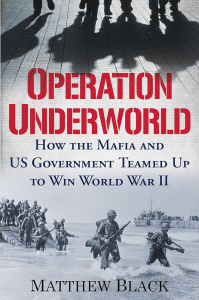
WHAT have you finished reading recently? Operation Underworld, a look into collaboration between the Italian America Mafia and the American government during World War 2.
WHAT are you reading now? There is No Place For Us, on the working poor who are also homeless.
WHAT are you reading next? Possibly The Day of Battle, on the American invasion of Sicily and Italy during World War 2. It dawned on me while reading Underworld that I know little about this part of the war, aside from paratroopers being employed in Sicily and the US army destroying an ancient monastery.
Today’s TTT is a non-bookish freebie, so I’m going to….spotlight YouTube clips I tend to watch and re-watch, excluding purely music videos. But first, the tease!
Maranzano had tried to live like Julius Caesar, so Luciano’s board of directors ordered that he die like the Roman dictator. Two of the hit men began stabbing him repeatedly. (Operation Underworld: How the Mafia and the US Government Teamed Up to Win WW2)
Ten Recent Youtube Clips I Rewatch Way Too Much
I haven’t watched American late-night TV since Craig Ferguson went off the air, but I enjoy watching Graham Norton clips.
(1) Seth MacFarlane on Graham Norton
(2) Charlie Berens and Myles
A few years ago I fell into the Midwest Comedy Hole. It’s not an official thing, but there’s a bunch of midwestern comedians who frequently feature in one another’s videos — mostly Charlie Berens, Myles of YouBetcha, DudeDad, and sometimes the Holderness Family. Big fan of Charlie Berens. If he ever comes southward he’ll be the first comedian I watch on stage.
(3) Christoph Waltz in Inglorious Basterds. I’ve only watched the movie once, but I rewatch Waltz’ scenes frequently.
(4) “Return to Me”, Mafia 2. So….I’m a big Dean Martin fan. When I finally played Mafia 2, I hurt myself laughing at this scene. For context, three mafiosi have just finished burying a body and at least two of them are very drunk.
Vito: Oh, God. Poor Dino.
(5) Mozart improvising, Amadeus. I know it’s just a movie and the producers actually used a simplified version of Salieri’s actual piece rather than the real thing to enhance Mozart’s genius, but I’m always enthralled by seeing the Muse at work. Also, F. Murray Abraham is one of my favorites.
(6) “Not Now, Phelps!” Super serious 1940s detective game meets….VR and gamers determined to break it.
(7) “Play the Sunset”, Mr. Holland’s Opus. The movie is a touching one about teaching and the power of mentors and music. I loved this movie long before I watched it, purely for the strength of scenes like this.
(8) The Virtual University: Marcus Aurelius. This is the first in a five-part series that I have saved to my phone. It remains one of the best lectures I’ve ever heard on youtube, and I’ve listened to it again and again over the last 15 years. Unfortunately, the professor — Michael S. something — has since passed on.
(9) Bug in Mouth Disease, Homestar Runner. When Homestar Runner hit the scene in the early 2000s, I was one of those teenagers who spent 5-10 minutes on a dial-up connection faithful waiting for the latest cartoon to load.
In New York harbor, one of the largest and fastest passenger ships ever built lies on its side, a victim of fire. French-built, the United States seized the Normandie after France fell to Hitler and renamed it the Lafayette, intending it as a troopship to help recover Europe from tyranny. Now, those plans were as defunct as the French defense in spring 1940. How could such a great ship flounder so quickly? Spies, perhaps? With German u-boats patrolling off the eastern seaboard, it wasn’t implausible that agents were snuck on shore – and it was even more plausible that German or Italian immigrants sympathetic to their home countries might aid and abet from inside America! The docks were obviously low-hanging fruit, and they were largely controlled by the Italian-American mafia – would it be possible for Navy intelligence to enlist their aid? It wasn’t as if Mussolini was a friend to the Mafia, after all: he’d persecuted their counterparts in Sicily vigorously. As it happened, the leader of the Syndicate in America, Charles Luciano, was in prison for his prostitution racket – and ready to make a deal. Operation Underworld is a mostly interesting if flawed history of both the mob’s role in helping the Navy secure the New York waterfront, and the Army in preparing for an invasion of Sicily. Its chief merit lies in that its subject is largely unexplored by anyone else, but it suffers from repetition, informality, and taking legends as fact.
When I’d run across Operation Underworld mentions in previous books, the information available was so slight as to leave the impression that Mafia soldiers themselves were actively working dock security for the Navy. The truth is a bit different: the Mafia effectively controlled the docks through control of the unions through which the docks operated, and the union leadership was only happy to help Navy Intelligence by creating Union memberships and jobs for government agents. This started off slow, at first, but allowed the g-men to create a network of patriotic fishermen and dockworkers who pledged to keep their eyes and ears open for anything hinky. One man did catch some German agents changing clothes on a beach, but ultimately the Navy deep-sixed their concern that German subs were being resupplied by parties in North America. Instead, the subs were being resupplied at sea by “milk cow” subs – though that doesn’t explain the presence of consumer goods sold only in the US aboard some German subs. Because many mafiosi like Luciano had contacts in Italy, they were also able to produce information that might be helpful to planning an invasion of Sicily and southern Italy.
As far as the unique content goes, it’s interesting enough — and I say that as someone who has interests in both the Mafia and WW2, so those who don’t may be less impressed. The author frequently revisits the backstory of Luciano, Lansky, etc, telling the story of their rise to power. This could be criticized as unnecessary bloat, but it did punctuate a stream of legal meetings and phone calls with occasional excitement like assassinations. Unfortunately, that adds its own problems: Black repeats legends like “The Night of the Sicilian Vespers” like they were facts. This, combined with his all-too-frequent and constantly repeated use of nicknames gives the book an unprofessional and sometimes sensationalistic air. Although I enjoyed this for its unique content, given how much of the text is accounts of meetings — meetings between lawyers and feds, meetings between lawyers and mafiosi, between mafiosi and mafiosi, etc — it took me longer than expected to get through.
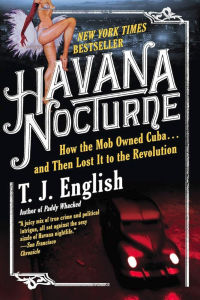
I used to be obsessed with la cosa nostra, but its Cuban ambitions never popped on my radar until I watched The Godfather II. I’ve long been curious about the Mafia’s role in developing Cuba and inadvertently feeding the revolution that swapped out one dictator for another, but not until recently did I come across this book. I went for it it immediately, teasing me as it did with the promise of information as to how Lucky Luciano and the Syndicate helped the Allies in World War 2. As it happens, that WW2 connection is marginal at best, but this is still the fascinating story of how the Italian-American Mafia began building Cuba up as an off-shore power base, only to lose everything to a rich boy turned revolutionary. (Odd how left-wing dictators are so often the children of privilege and right-wing dictators begin as poor populists, Stalin being an exception.)
The story of the Mafia and Cuba begins with the close friendship of Meyer Lansky and Charles “Lucky” Luciano, two men who revolutionized organized crime in the United States. As his last name might hint, Lansky was no Siciliano; he was, instead, the son of Polish Jews who’d fled pogroms in Russia to come to the United States. Meyer, despite his small stature, was cunning and ambitious, and as he aged he joined forces with similarly ambitious men like Luciano: “Lucky” would conspire to knock off the heads of the two largest Mafia families in New York, Massiera and Marazano, and create something new: the Syndicate, modeled on corporation-esque lines. Lansky, a man whose fortune grew on gambling operations, saw in Cuba an opportunity for expansion — but his dreams continued to be deferred, first by economic depression and then by the incarceration of Luciano. The Syndicate wasn’t as ethnically closed-off as the traditional Sicilian Mafia, but it still wasn’t going to let some “little Jew” dictate policy: for that, Lansky needed his buddy Charlie, who despite his imprisonment and later exile remained the de facto CEO of the syndicate. Luciano legally escaped prison by using the muscle of the Mafia to rout German saboteurs on the New York waterfront, then later supplied information to help the Allies invade Sicily; then, pushing his luck, he decided to emigrate to Cuba to begin realizing his and Lansky’s dream of a gamblers’ paradise in the Caribbean.
Cuba was enormously popular with Americans, both for the climate and the emerging Afro-Caribbean musical scene. Capitalizing on the amount of traffic already coming in by creating new entertainment venues to suck up tourist dollars was a no brainer. This was accomplished through both the mob’s existing money and Lansky’s longstanding contact with a certain Batista, the on-again off-again ruler of Cuba. The timing couldn’t be better, since American lawmen were taking an inconvenient hard line against gambling operations in the States. As it happened, Lansky and Co.’s desire to make big moves in Cuba coincided with Batista returning to power — this time as a coup disguised as a pre counter-coup. Although Luciano wouldn’t be part of it, DC having pressured the prior government to deport him back to Italy, the door was already open to Mafia investment. Soon financial institutions were in place that bought Cuba’s government and Syndicate money into full collusion, even as resentment to Batista’s bare-faced power grab brewed on the streets. The disparity between those in power and those not grew ever larger as casinos and nightclubs — the latter hotbeds of license, libertinism, and outright depravity — became gathering places for both Batista’s people and those connected to the Syndicate. Big names from the United States, including Sinatra and JFK, especially enjoyed the fleshpots. With firebrands like Castro in jail, though, and business booming, all seemed well.
Unfortunately for the mob’s ever-expanding array of hotels, clubs, and one-armed bandits, Batista got a little too cocky. He released the Castros from prison, and they fled the country to foment revolution in Mexico the way Khomeini worked from France during his own exile from Iran. Castro’s attempt to stage a comeback was at first a dismal failure — he and his men returning by boat were delayed by bad weather that failed to sink him, and his men in place in Cuba were slaughtered by Batista’s army. Upon finally landing, Castro linked up with his remaining men and continued to meet defeat after defeat, until Batista unwittingly declared him dead when in fact he was merely in hiding. Castro and his followers began rebuilding their numbers, importing weapons, and antagonizing the government through petty actions like raiding banks and setting things on fire. Disaffection towards Batista continued to grow even wealth flowed into the island: Lansky was actively planning Havana’s largest, most entertainment-oriented resort yet when the bottom fell out. Although some of the mafiosi were aware of Castro’s rising influence, they dismissed it: even if he did take over, he wouldn’t be so stupid as to close the casinos. Then, on New Years Eve, Meyer Lansky was told that Batista had taken money and run: Castro was on his way to claim Havana. Although Lansky scrambled to tell the Syndicate’s casinos to get their money out of the country, the people on the ground were slow to move, and soon Castro was actively working on undermining Cuba’s tourist-based economy by closing the casinos and nationalizing the hotels. Although some wealth managed to escape the country, the principal investors were largely ruined: Lansky died with less than $50,000 in the bank.
This was a fascinating history on two levels, both in providing a very cursory introduction to Castro’s takeover, and in diving into how the Mob had worked its way into so much of Cuba’s government and financial sectors. Thinking about what might have happened had Castro and his inner circle died at sea during the beginning of the “July 26 Movement” — as they very nearly did — is tantalizing. Imagine no Cuban Missile Crisis, a redoubt for the Mob after RICO hits, a Caribbean war between wiseguys and Escobar’s organization! It appears the author has written a lot on gangs of the 20th century, including Irish gangs, so I may read more of him: he may be a modern Herbert Asbury.
Related: The Little Man, biography of Meyer Lansky. Later released as The Thinking Man’s Gangster.
Quotes:
Siegel was always the wild card in the group. Devilishly handsome even at a young age, he was a ladykiller metaphorically, and a killer of men in a more literal sense.
“When the day comes that a person becomes beyond the pale of justice, that means our liberty is gone. Minorities and undesirables and persons with bad reputations are more entitled to the protection of the law than are so-called honorable people. I don’t have to apologize to you or anyone else for whom I represent.” “I look upon you in amazement,” said the senator. “I look upon you in amazement,” countered the attorney, “a senator of the United States, making such a statement.”
In March, Life magazine published an article entitled “Mobsters Move in on Troubled Havana.” Complete with photos of Meyer, Jake Lansky, Trafficante, Fernández Miranda, and Batista—a virtual who’s who of the Havana Mob—the article suggested that the mobsters were swooping in to take advantage of political instability in Cuba. Of course, nothing could have been further from the truth. The mobsters had been there from the beginning.
WHAT are you reading now? Havana Nocturne: How the Mob Owned Cuba, T. J. English
WHAT are you reading next? Frequent readers should know that’s a silly question, but here’s my Kindle shelf. New York City Cartmen: 1650 to 1850 sounds like exciting reading, no?
Today’s prompt from Long and Short Reviews is books we had to read in school and liked. As with the “not liked” books, I’ll have to go back to college for this one. One of my favorite books from college was A Life of her Own by Emilie Carles: it’s the memoir of a French schoolteacher who taught from the beginning of the Great War until after the end of the Second World War. She encouraged her students to resist the insularity of their little village and to develop a broader perspective. This book was extremely formative for me, as it introduced me to left-wing libertarianism/anarchism: before I’d associated the left only with authoritarianism, and this began a brief period where I read more deeply into the writings of the Frankfurt school and so on. Ultimately the association with libertarianism would end up in me exploring American libertarianism, but that was a junction in the road I’d yet to encounter. This is one I’d like to go back and read, because while I know I’d still find a lot of common ground — especially in rejecting the state’s aggressive wars — after nearly two decades of reading and thinking about politics I’d probably find something to argue with her about.
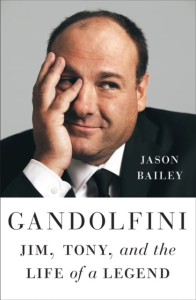
Like many, I was awed by James Gandolfini’s performance throughout The Sopranos, which made him an actor whose presence guarantees I’ll watch any movie he’s in. Gandolfini is a professional biography of an actor whose charisma and commitment to his work made nearly everything he was in exceptional. (The less said about Surviving Christmas, the better.) After the book begins by slightly skimming over Gandolfini’s childhood spent in a working-class Italian neighborhood in Jersey, Jason Bailey shifts to his subject’s growth as an actor, production by production, drawing heavily on interviews with both Gandolfini himself as well as those of his friends and peers.
Although Gandolfini was resistant to playing mobsters, two of his early breakout roles saw him feature as charming-but-menacing figures that were excellent practice for the character who would overshadow the actor for most of his life. He developed a speciality as a character actor, someone whose intensity could be brought in to “crush” a handful of scenes and add a strong seasoning to whatever movie he was in. Although he struggled with memorizing lines, his deep investment into developing characters and performing them – the persons, not merely the lines – opened the door to future projects. It was The Sopranos, though, that took him from “solid acting talent” to celebrity. The success of The Sopranos took the entire cast by surprise, as it completely disrupted their lives. Drea de Matteo, the young woman who played Adriana, suddenly had to be escorted through airports by security in a cart, or otherwise be mobbed by fans. Gandolfini was remarkably resistant to celebrity, though: he was grounded in Jersey’s working class, and despite taking advantage of his sudden ability to get last minute reservations at any restaurant he wanted, fame never went to his head. When he celebrated his 50th birthday party, the party included a few of his fellow actors, yes, but also a lot of people from the old neighborhood.
Tony Soprano dominates the midsection of this book, as he dominated Gandolfini’s life during the production years and continued to follow the actor in his remaining working years. Gandolfini’s research and intensity meant that even as he continued to breathe more and more life into the complicated gangster that Tony was also pushing his way into Gandolfini’s life. The actor would seek relief from the sheer emotional darkness through drinking and partying, sometimes not being able to work the next day, and this was habitual enough that his friends and family attempted to throw an intervention for him. It didn’t help that he was undergoing a divorce around the same time that Tony would, and Gandolfini began wondering if the showwriters weren’t mining his own personal misery to add fuel to the show.
His seriousness and intensity as an actor are remarked on throughout the book, but so is his warmth and generosity. He frequently treated the cast and crew to dinner at week’s end, and when the Sopranos wrapped up filming he dispensed nearly a half-million dollars in gifts. He’d been similarly generous during an actors’ strike, giving the cast money in gratitude for their support. He’s frequently noted here for his consideration of other actors, including young actors — helping coach those new to the stage, and always checking his acting peers to see if the take had worked for them. It didn’t matter if he’d been at work for over 10 hours, doing take after take: he wanted other actors to know that their art was collaborative – despite the fact that no one will argue Tony Soprano was the heart of The Sopranos and its success.
After The Sopranos wrapped, Gandolfini moved on to other projects, from serious dramas to rom-coms like Enough Said. When former cast members met him, they remarked on how dramatically he had changed: without having to channel Tony all the time, without living in the anxious, violent, and cruel don’s skin: it was if a cloud had lifted. He was also able to explore a bit, profesionally: he found he liked doing nonfiction documentaries, especially those focused on members of the US military who were dealing with physical and mental trauma from the terror war. Unfortunately, his post-Sopranos life would not be long: he died in June 2013 of a heart attack, one presumably brought on by weight, past stress, and past substance abuse.
As a fan of both The Sopranos and Gandolfini in general, I loved this book. As with Kaplan’s biography of Sinatra, it doesn’t ignore his weaknesses as a human – his own temper, his excesses – but it puts the man’s virtues and talent center-stage. I must note that it’s added several titles to my to-watch list – from his early stuff like Get Shorty to his later work like The Taking of Pelham 123.
Jim had built an entire character for Bear that he came out of the South,” Patty Woo says, laughing. “None of this was ever discussed. None of this was in the plot. But for Jim, it was important. And then he had to work on his Southern accent, and it became an issue—he got himself a coach, because Jim, from New Jersey, does not have access to an au then tic Southern accent. And now he’s killing himself to be au then tic to it!
Gandolfini despaired, “Oh my God, Roberto, I’m gonna be unemployed in less than a year. Who the hell is going to see a television show about Mafiosos in Jersey?”
He does much of his best acting with his eyes, carefully choosing when to bore them into a potential enemy, when to lower the hoods of his eyelids to shield his real feelings, and when to let them pierce one of his underlings so they know he means business.
“If there’s one thing I hate, it’s an actor getting up on a soapbox,” he told Matt Zoller Seitz, before chuckling and miming a “scratch that” motion. “Hey, forget I said that. If you print me saying that, it’s me getting up on a soapbox.”
Gandolfini’s take on Tony:
What you see in Tony is that a life of materialism, of constantly feeding on the world, leads to nothing but emptiness. Someone like Paulie Walnuts has his way of life and he is what he is. He can be happy. But Tony is smart enough to know that there should be more, a bigger picture. He sees through all the bullshit around him. So he’s empty. That’s what eats at him: Why can’t I be happy?
Most intriguingly, he met with brass at NBC to discuss joining the cast of its hit The Office when star Steve Carell departed in its seventh season. At the time, trades reported that Gandolfini “wasn’t interested”; years later, on an episode of the podcast Talking Sopranos, Steve Schirripa revealed that they got as far as an offer from NBC of $4 million per season, but, according to Schirripa, “HBO paid him $3 million not to do it.”


 Reading Freely