
The Great Depression: Fiddle-dee-dee!
“Life is worth more, too, for knowing Hoover. But for him Belgium would now be starved … . He’s a simple, modest energetic little man who began his career in California and will end it in Heaven, and he doesn’t want anybody’s thanks.”
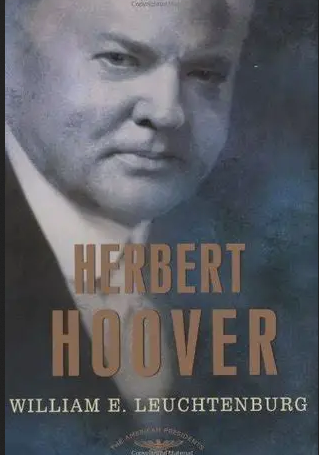
When I opened this book, I had some faint appreciation of Herbert Hoover as an accomplished engineer and disaster-relief organizer, a man who intervened after Black Thursday far more than is generally known, and who is unfairly blamed for the Depression. Twenty minutes into this, I had to shake my head. Herbert Hoover was…extra.
We begin in complete sympathy for a near-orphan who grew up in poverty, whose mind impressed a series of men who helped him get into higher education despite his writing skills being atrocious for the time. These days, of course, he’d be considered a master of the craft for writing a complete sentence. Hoover developed an interest in geology, its most practical application being mining — and that took him far, to Australia and China and England, there and back again. Young Hoover was despite his impoverished beginnings not a friend of labor: he prided himself on increasing hours, firing striking workers, and then hiring replacements at lower wages. It made the company money, though, and that made him money. (Pbtttt on being poor!) Although he began to dabble more in mine-financing than engineering, he still regarded himself as an engineer, first of all, and as he started feeling a vague sense of unease about the whole getting-and-spending-and-laying-waste-to-all-our-powers thing, he began looking at engineering as a noble service instead of simply a path to wealth. Now with pelf and place secure, he could begin talking about the importance of unions and the sanctity of the eight hour day — his hunger was now for meaning, not money. (He had $4 million in the 1910s, so…) He would find it in government service, making a reputation for himself as an organizer of relief for the Belgian people during World War 1 (annoying both Churchill and the Kaiser in the process) and then later being Coolidge’s man on the ground during the 1927 Mississippi floods.
I have previously commented that the AP series seems to have brought on writers with a particular shingle to address certain presidents — a surgeon for Garfield, a legal historian for Taft, etc. In Leutchenburg’s case, they brought in a New Deal Historian to analyze Hoover, which steadily eroded the book’s trust for me. Leutchenburg cannot restrain himself from personal potshots at Coolidge, who he calls a sourpuss who “wanted to shirk” from duties. Coming off a biography of Coolidge and seeing how very seriously he took service, these remarks got on the fightin’ side of me. Leutchenburg also fires at prior presidents who took no action during economic hiccoughs, dismissing them not as men who viewed intervention as outside their Constitutional prerogative, but as men who did not care. I do not trust, and do not respect, an author who turns historic personalities into his strawmen and imposes motives on men who are not allowed to speak for themselves. I doubt I will be reading him again. He is at least a better writer than finkleman, the turd-with-a-pen who began a biography of Millard Fillmore purposely to defame him. But, I digress.
The main reason I continued in this volume is that Hoover is so confusing: he begins as this hardass who is consumed by making a success of himself, and then he transforms into something I don’t quite understand — a man who, in any public offices, hoovers up any responsibility he can to expand his name, while at the same time beating his breast and talking about the importance of the individual. One minute he can sound like Obama and the next minute Ayn Rand: choose a lane! Lord knows I have enough conflicting opinions of my own to not sit in judgement if a man has conflicting values, but I’m not imposing those on the body politic and taking a salary for it: I’m just writing sometimes cranky but hopefully entertaining book reviews. By the time he was elected president — rather handily — he seemed more reluctant to embrace intervention than to embrace it, which would make for bad optics when the global economy endured the equivalent of being hit by a freight truck. Although FDR had shook his head in wonder at the outrageous expansions of government Hoover tried to instill as Commerce Secretary — and though he called Hoover’s policies socialistic — FDR could now castigate Hoover for not doing enough, or (in the case of the Bonus March suppression) doing too much. “That’s me elected,” FDR said in response to Hoover’s decision to put down the Bonus March by force. After being summarily dumped from office, Hoover became a strident critic of the New Deal, but Harry Truman began engaging him as a consultant for global food aide: his experience in World War 1 made him too valuable an asset to ignore. He would live to see the rise of Goldwater and the triumph of LBJ, taking solace only from the fact that he’d outlived his enemies.
So, who is Herbert Hoover? I don’t think I really know, because his opinions and his works offer testimony and opposing evidence: even though he’d grown so vocally conservative that Truman referred to him as being “to the right of Louis XIV”, once he was placed on a board for improving the Executive branch, he immediately began trying to magnify the authority said branch. It would be very easy to dismiss him as a hypocrite for continually saying one thing and then acting to the contrary, but during the crisis of the crash and depression, he didn’t act as dramatically as one might expect a hypocrite to do: he did in fact take actions that FDR’s New Deal would continue and expand, but his desire to expand his reach was not nearly as aggressive as when he was commerce sec. I found his cantankerousness as he aged endearing, but I leave his company –for the moment — still finding him a bit of an enigma.
Coming up: I solemnly swear this will NOT be another presidential-sweep week. For one thing, I don’t have that many left. (Grandpa Harrison, Polk, McKinley, LBJ, and Reagan.) For another, even I want to read something else. Right now I’m starting a book on the rise of Hitler and FDR in 1932 —
…well, baby steps.
Quotations
Not until Herbert Hoover was twenty-two would he see the country east of the Mississippi. West Branch was churchgoing, sober, Republican. The sole Democrat was the village drunk.
But for Hoover that was not enough. “If a man has not made a million dollars by the time he is forty,” he said, “he is not worth much.” And, by his lights, he was getting on in years. He was thirty-three.
An organization with no legal standing and no stable source of funds, the Commission for Relief in Belgium crossed national frontiers in the midst of the world’s first global war, plunged into markets on two continents, and spent unheard-of sums. Nothing daunted Hoover. He seized control of railways, took over factories and warehouses, and commandeered five hundred Belgian canal boats. When the kaiser’s armies occupied northern France, Hoover extended his realm there too. The [Committee for the Relief of Belgium], said a British Foreign Office functionary, was “a piratical state organized for benevolence.”
A man who wore scuffed suits (always of the same dreary design) and shoes with broken laces, he could not see why anyone should covet luxuries or want to dine out. “Afternoon tea,” the Kansas editor William Allen White wrote later, “was not in his social lexicon, and when he appeared at a tea he was like a Great Dane at a cat show—sniffy, but not so savage as evidently he wished to be.”
To lessen congestion, he ordered all amateurs off the airwaves; he empowered himself to issue licenses; and, in contravention of both domestic and international law, he assigned frequencies. In 1925 the department suspended the license of Aimee Semple McPherson’s radio outlet in California for straying from its assignment. The popular evangelist wired Hoover: “Please order your minions of Satan to leave my station alone. You cannot expect the Almighty to abide by your wavelength nonsense. When I offer my prayers to Him, I must fit in with His wave reception.” But Hoover prevailed, even though Congress denied him “the Napoleonic powers,” in the phrase of one critic, that he sought.
His conception of the need for long-range planning exceeded that of some progressives. “We had better let God run it as in the past,” said Senator George Norris of Nebraska, “and not take power away from him and give it to Hoover.”
“Acts and ideas that lead to progress are born out of the womb of the individual mind, not out of the mind of the crowd,” he argued. “The crowd only feels: it has no mind of its own which can plan. The crowd is credulous, it destroys, it consumes, it hates, and it dreams—but it never builds.”
“Mr. Hoover has always shown a most disquieting desire to investigate everything and to appoint commissions and send out statistical inquiries on every conceivable subject under Heaven,” Franklin D. Roosevelt complained to an industrialist. “He has also shown in his own Department a most alarming desire to issue regulations and to tell businessmen generally how to conduct their affairs.”
“If the election was held tomorrow,” a former Oregon governor said, “any Democratic candidate who had not been convicted of anything more than rape or murder would defeat Mr. Hoover.”
Commentators have often said that FDR always ignored his actual opponents and campaigned each time against Hoover until he ran against Hitler—but even in 1944 Hoover remained a target. “We ought to be eternally grateful to Herbert Hoover, who has been our meal ticket for twelve years,” a sassy New Dealer remarked.
Asked how he managed to endure the many years when leaders of both parties treated him as a pariah, he replied, “I outlived the bastards.”
Asked by an acquaintance bound for Europe whether there was anything he would like done, Hoover replied, “Well, you can tell the British to take their hands out of our pockets.” Nearly blind, toothless, and confined to a wheelchair, he stayed feisty to the last. He was so hard of hearing that his secretaries had to shout. That was all right, Hoover told a visitor. “I’m used to being hollered at.”


