
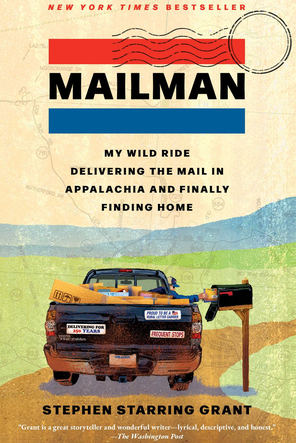
March 2020 was a bad time for most people, but for Steve Grant it was worse. He’d just been laid off from his lucrative marketing job. A man who once lectured at the nearby university and dominated corporate boardrooms was now jobless — and status-less. However, the post office still needed carriers. Mailman is Grant’s memoir of going to work for the post office as a rural mail carrier, which would already be more challenging than city jobs even without the unique topography of the Appalachians. I’m no stranger to on-the-job type memoirs, but this one takes the appeal of learning about how the post office works at the carrier level, and adds to it the story of a man going through an existential crisis in the middle of COVID. The soft-handed spokesman was suddenly spending ten or more hours a day in tiny vehicles full of packages and letters, trying to organize and distribute them while baking in the summer sun (or the winter cold) and avoiding getting lost or wiped out by the Mountains. The memoir is sometimes crass, but generally entertaining; working the rural routes was a definite learning experience for Grant, and he does not shy away from mocking himself struggling against the learning curve.
While I have read about the post office before, that was more of a history. What Grant offers is a behind-the-lines account of how rural carriers begin their days building a ‘case’ — that is, a library of all the mail they’re delivering that day, organized in route order, with package cards to remind them that there’s a package in back for the house or a VAC card to remind them that the house has no tenants and its mailbox may be full of angry wasps or something — and then heading out to deliver all the contents. Depending on the route and the carrier, case building and execution can take a long time: Grant confesses to working 14 hour days sometimes because he was so slow at creating his case, or because he ran into issues finding the house he was delivering to. Rural routes, especially in the mountains, are not as simple as walking down the street and plopping mail in. When one home ordered a minifridge that wouldn’t fit in their roadside parcel container, Grant had no choice but to improvise a way to haul the fridge across a creek and into the property. The people there were astonished: between the mountain itself and the pandemic, they hadn’t seen another soul on their property in months.
COVID plays a large role in Grant’s story, and not only because it’s what led to him being laid off and seeking work at the local post office. The imposed isolation of people created a huge surge in mail-order traffic, as people began ordering normal household supplies online, or began developing new hobbies and such during the worst of the lockdown period. This led to Grant and his colleagues delivering a strange upsurge in baby chickens and chicken feed, as well as consumer goods that indicated most Americans were not investing their off-time in learning to be musicians or potters or whatever. They were instead seeking escape into video games and..uh, prurient recreational equipment. Veteran postal workers complained that COVID had brought “Christmas in July” — but if you’re a rural carrier driving a small vehicle packed with parcels, “Christmas” translates to longer days and more work, not glad tidings of comfort and joy. The year 2020 was also an election year, leading to stress over mailed-in ballots (Grant is emphatic that USPS people take the sanctity of ballots seriously) and politics in general. While he worked with a lot of people of varying intense political views, the only time he was physically threatened was when someone accosted him at a gas station and demanded access to the PO Box they’d stopped paying for.
Although the book is fairly entertaining, at least for someone like myself who really enjoys seeing how different institutions and vocations work, it’s laden with digressions on everything from the author’s thoughts on guns to his religious experiences. It is clear that he took something of value from his time spent driving — particularly the idea of it being a service, a vocation, rather than merely a job — but it definitely needed editing, especially towards the end.
Quotations
Tom was about the same age as Hank. Bearded, lean, and an avowed Libertarian. How he was able to square being a Libertarian but working for the largest federal service is beyond me. If you’re wondering how I know he was a Libertarian, then you’ve never spent any time with Libertarians, because all you need to do is wait five minutes.
Everyday, each letter carrier effectively builds a library, loads it into a truck, and then disassembles that library in route order. We all worked in a big warehouse room with intake loading docks on one side and outbound loading docks for the mail trucks on the other. Everything smelled of machine oil and cigarette smoke, but there was something else. The smell of ink and paper, the smell of the mail.
Politics were always out in the open at the USPS. At the post office I worked with all sorts of people—militant leftists, MAGA Republicans, general hillbilly government rejectionists, the politically uninformed and uninterested, garden variety labor Democrats and standard-issue rock-rib Republicans. Yes, the politics were there, but there was no hate. Republican red, Democrat blue—at the end of the day we were all postal blue. The mail always came first. When you work with people, when you get to know them as people, it becomes much harder to hate them, at least for 99 percent of folks. And that remaining 1 percent is hateable entirely on their own human merits.
Mom had grown up in Baton Rouge, Louisiana. She’d never had a dog. So she gave me dog treats in a plastic sandwich bag. “Give these to the dogs and they won’t attack you.” A nice idea, but one that flew in the face of canine nature. Now I was not just a bite-size toy, but one that came with hors d’oeuvres.
I have a hard time believing books are obsolete any more than knives are. Unlike a knife, which wears with use, a book grows more valuable with each reading. Each reading spreads the ideas it contains further, to new minds where, if read with care, they will unlock new thoughts.
I think the distinction between white-collar work and blue-collar work is a false one. Both forms of labor want all of your time and both exact a toll. One form is no more or less noble than the other. The real distinction is between work and service, and I think it’s one of the great dividing lines in American life. I wonder if part of how we’ve become so atomized is that while we all work, few of us serve. It is service that gives life meaning, and it is service to our community and our nation that gives the ideas of “community” and “nation” meaning as well.


You’d never catch me being a postal worker. Maybe if I was starving or about to die from lack of insulin, but it would have to be an almost literal life and death situation.
It definitely doesn’t appear to be an easy job..
I knew a guy from my old church who was a carrier. The stories he told, man, it was brutal.
Sounds like an interesting look into a challenging job during an extra challenging time.