
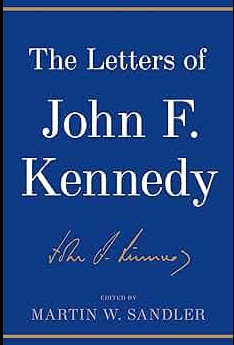
Having finished listening to George H.W. Bush’s family read his personal letters and diary entries across fifty years in All the Best, I could not very well refrain from the temptation of reading JFK’s letters. The Letters of JFK, however, is a different kind of collection than All the Best, and does little to reveal the man within the myth. Perhaps that is as he would have wanted it.
Letters is far more oriented toward Kennedy’s public life, and frankly suffers from bloat. Long documents that were technically policy statements delivered as letters are included and quoted at length. We are given, for instance, the entirety of JFK’s letter to Congress submitting proposed civil rights legislation. Readers keenly interested in Kennedy’s policy decisions may find such extensive primary-source material valuable, and I found them interesting to a degree. While Kennedy was committed to Civil Rights, he was also committed to not losing elections – that mean threading the same thin line LBJ would have to thread, advancing the Cause while not infuriating Southern Democrats.
Another major difference between this collection and All the Best, George is that it includes letters written to JFK as well as those written by him. We hear from schoolchildren smitten by the young president, and we are given exchanges with Nikita Khrushchev during the Cuban Missile Crisis. Seeing both sides of a correspondence was largely fascinating. One particularly entertaining exchange finds Kennedy trading blows with Eleanor Roosevelt after she casually passed along rumors that Joseph Kennedy was buying the election for his son outright. JFK was obviously angry, but he also knew better than to antagonize the most politically prominent woman in America. He manages to demand an apology while simultaneously charming his way back into her good graces.
A curious omission is the absence of any Kennedy-Nixon correspondence. Nixon, if mentioned at all, appears only as a malignant enemy lurking in the shadows whom young Jack must defeat—the Mordred of Camelot. My recent cross-reading has left me with a far more human picture of their relationship than this volume provides, and the fact that the editor includes condolence letters written to Jackie from every Tom, Dick, and Harry but not Dick Nixon is not only a missed opportunity, but nearly insulting to history.
There are surprises here. Young Jack was initially cautious about American entry into World War II, for instance. Later, after entering military service in the Pacific, he expressed open contempt for commentators who beat their chests and bloviated about the necessity of total war from a comfortable distance. Kennedy had watched men die, nearly died himself when PT-109 was cut in half, and borne responsibility for getting his surviving crew to safety. He had a different perspective, one forged in pain, blood, and despair. One of the most striking letters included in the collection comes from an officer aboard the Japanese ship that struck PT-109 that night. Years later, he wrote Kennedy a gracious note congratulating him on both his survival and his success. Could I have expected this? Absolutely not, and it completely delighted me. It made me think of Poppy, standing in honor of an emperor who he’d fought with zeal as a young man – our humanity bobbing to the surface once nationalism’s fervor has faded.
Unsurprisingly, the editorial commentary is almost wholly flattering. No mention is made, for instance, of the longstanding controversy surrounding Profiles in Courage and allegations that it was substantially ghostwritten. More importantly, the editor seems far more interested in preserving the Kennedy legend than revealing the Kennedy man: in fact, he refers to Kennedy himself as projecting the legend through a “triumph of the will” — displaying his strength, his optimism, his vigah, rising above his chronic pain and life-threatening illnesses. I will admit: I find Kennedy’s resilience inspiring, especially since I’ve struggled with one illness after another since 2021, with each medical intervention made bringing successes – but new challenges. However, I still wanted Jack – not JFK.
I wanted the man beneath the martyr’s crown—the real Jack, the man who got spitting mad, down in the dumps, or tickled pink over some inanity. He’s here – occasionally, but it’s hard to spot him between the long exchanges with other dignitaries. Jack is buried beneath speeches and policy letters. I’ll definitely be reading more about him, because I’m starting to hear the siren song of why people liked him so much and remember him so fondly. I’m not particularly impressed by this book, especially given its ending with correspondence that supports a Mossad-conspiracy take on JFK’s assassination. I’m glad I read it, however, because it offered me just enough to make me more curious about the man beneath the cape of martyrdom.
When you talk to [JFK] or see him you always have the impression that his big white teeth are ready to bite off a huge hunk of life. There is determination in his green Irish eyes. He has two backbones: His own and his fathers. Somehow he has hit the bulls-eye in every respect. “He cant fail.”
Oddly enough, the man who, as an adult, received the last rites of the Catholic Church four times—and who, according to historian Richard Reeves, was “something of a medical marvel, kept alive by a complicated daily combination of pills and injections”—never let his physical ailments negatively affect the way he conducted his presidency. “He lived with pain,” William Manchester wrote, “though only those who knew him well could tell when he was suffering. … This image was a triumph of will.”


Pingback: The Best of Teaser Tuesday, Oct ’25-’26 | Reading Freely