
320 pages
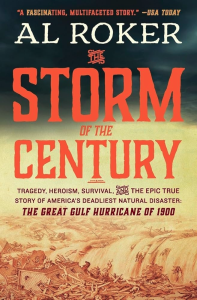
In 1900, a powerful hurricane swept Galveston Bay and destroyed a boomtown that in time may have become the New York of the Gulf. In ways, Al Roker’s Storm of the Century is rather similar to Isaac’s Storm, in that both chronicle the growth of the storm, American meteorologists’ failure to predict its course, and the immediate aftermath of virtually the entire town being flattened. The book even opens with an extensive section on Isaac Cline, the hardworking and talented meteorologist who worked Galveston, whose industriousness failed to overwhelm his acceptance of the prevailing dogma that hurricanes always broke east after hitting Cuba. What makes Storm different is its extensive coverage of the aftermath, as Galveston’s civic leaders struggled to deal with the thousands of bodies and complete shambles of their city. Ten thousand souls and nearly three thousand buildings gone in a single night: the 1900 hurricane remains America’s deadliest natural disaster over a century later. The Storm of the Century is an immersive history of Galveston’s — and America’s — worst hurricane, one that’s already gotten me looking for more from the author.
The book opens with Isaac Cline, a meteorologist who had distinguished himself in the field and yet was powerless to prevent a catastrophe. Mr. Cline was an impressively industrious man, someone who was not content in distinguishing himself in meteorology — he earned laud for predicting floods that DC’s national boys didn’t even put on the radar — but apparently strove to be a Renaissance man. In addition to pursuing a medical degree and later a PhD, Cline also invested himself in Galveston after being stationed there and became a contributor to the local newspaper. He went far and beyond his required duties as a weatherman, taking readings throughout the day instead of his four mandated intervals. Despite this, a combination of the scientific establishment’s dismissal of Jesuit hurricane studies and entrenched dogma on how hurricanes behaved led him to not realizing that a potent threat was headed for Galveston. The deceptively placid sea and skies, combined with a stable barometer, gave him no cause for challenging the assumption that Cuba’s storm would break east and hit Florida. No one in Galveston had any reason to worry until massive swells began hitting the city and the Gulf began claiming the city as its own. When the barometer plunged, Cline scrambled to warn citizens — but it was too late for most. The Gulf flooded Galveston, and then came the savage winds and rain. The wind was arguably worst, knocking over wooden buildings with ease and then turning their parts into battering rams to destroy more of the city. A long night passed in which most Galvestonians lost their homes, and thousands their lives — drowning in the ferocious black night, the air filled with danger as debris flew past with deadly speed.
The aftermath was literally horrific. Most of the city was gone, and across the bay the plains were littered with debris and bodies for miles. The city government condensed itself into a three-member commission and declared martial law, focusing itself on the biggest challenge of getting rid of the thousands of bodies: they chose funeral pyres, which burned for weeks. The American people were quick to respond to Galveston’s need for help. One of the few amusing stories in this history is that of Winifred Black, a female reporter who used a male disguise and local help to sneak herself into the city to earn a scoop for Hearst newspapers: part of her reporting included a call for assistance, and it came so readily — some funneled through the Hearst corporation — that she was told by her bosses that she was now the coordinator for Hearst relief work. The reporter soon found herself managing a school in Houston that had been converted into an emergency hospital, a shining example of the maxim that those who work hard will be rewarded with more work. The history continues for several years after the disaster, ending with the erection of Galveston’s seawall, an engineering feat that has been steadily improved upon over the years.
This was quite the read: written by a meteorologist, it had a good mix of science, history, and human interest. Having read Isaac’s Storm, I expected not to finish this, but the other stories Roker pulled in, plus the expanded section on the storm’s aftermath and recovery, made it more than worth reading. Roker has written a few other history meets weather esque books, and I will probably have a look at them.
Quotes/Highlights:
One [weather] observer pawned all his weather instruments to raise cash for gambling. At least that one kept up his reports: he went down to the pawnshop every day to take readings.
Other houses were down because the wreckage of buildings had itself become a cause of further destruction. The waves tossed ruined timbers and roof structures again and again against standing walls, driving down walls and roofs together. Then the newly fallen wreckage added greater and greater power to an assault on the standing houses.
But soon the relief train slowed to a halt. The tracks were gone. This was still well inland, more than six miles from the point where the bridge began. The team couldn’t yet see anything of Galveston, of course. What they could view, here on the coastal prairie, was shocking enough. The plain was strewn with dead bodies. Along with those corpses, huge pieces of lumber were littered about the flat ground as far as the eye could see. Roofs. Packing trunks. Pianos. From the stopped train, the relief team saw a whole steamship. It was wrecked—all the way up here on land. They stared, amazed. The ship seemed to have been tossed out of the bay.
Louise lived to experience nearly all of the amazing advances of the American Century: interstate automobile highways, jet travel, television, the moonshot. Yet she never forgot her terrifying experience, as a seven-year-old, of what nature can do to all that human aspiration.

 Reading Freely
Wasn’t Roker the weather guy on good morning America for several years?
I think so. His name sounded distantly familiar, but I haven’t watched TV since the analog-digital changeover back in 2008 or so.
He definitely was!
Thanks for the validation. I knew I knew the name from somewhere 🙂
I live just down the road from Galveston, so I’m always fascinated with stories about this island, especially stories about the big hurricane of 1900.
I was in the area around 20 years ago, but unfortunately didn’t know about the storm back then. I would’ve pestered my parents to go see a related museum, otherwise!
This is the 125th anniversary of the storm so the library has a big 1900 Storm exhibit. I need to stop in next week.