
there’s never been a Broadway show, man, with rock and roll music?”
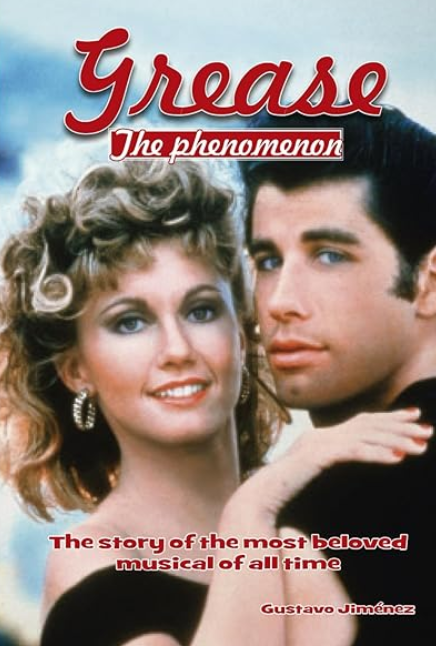
I’ve lost track of how many times I’ve watched Grease over the years: much of its music is firmly lodged in my head (and insisted on playing itself as I read this), so you might say I’m a fan. Grease: The Phenomenon is a history of not just the 1978 movie that everyone knows, but of the original play that inspired it — and has continued to inspire works around it. It was a treat to read given the behind the scenes and production stories included, and follows the actors’ careers to the present day.
The original play was prompted by the question — “Why has there never been a Broadway show, man, with rock and roll music?” The writers began composing music before they had the first inklings of a story, though one centered around working-class greasers in Chicago emerged. The original play was a different beast than the movie, and even the Broadway musical that preceded the film production: the play and movie only share 50% of their songs, with some of the original numbers being dropped from the movie version, and the movie version creating its own. It was a grittier production, too, with more focus on the gang elements and rawer language throughout. The play was a surprise success, and then left Chicago to hit New York, and even tour nation-wide. The musical was retooled as it moved, sometimes in response to criticisms and in part because of so much of its script referenced Chi-town itself. The play was changed further when it was eyed for film adaptation, its language and character actions being cleaned up a bit. Rizzo’s spotlight-stealing “There Are Worse Things I Could Do” was scheduled to be axed, but after witnessing Stockard Channing’s powerful performance of it, the director felt compelled to keep it in. The ticket-office success of the film prompted interest in not only a sequel, but a potential line of them. Unfortunately for those with money in the game — but perhaps good for Grease as a whole, its legacy never being tarnished by perpetual milking — Grease 2 did not repeat the success of the original. It didn’t help that the only person involved in the production end of both movies was the choreographer, Patricia Birch. Jiminez offers that Grease 2 nontheless became a “cult” classic thanks to VHS tapes. (Personally, I’m a fan of its music: “Let’s Do It For Our Country” and “Reproduction” are both hysterical.)
Just think about it — it would be like as if we were doing it for the Statue of Liberty, or the Grand Canyon, or the New York Yankees… it would be like as if we were doing it for… DISNEYLAND!
There was a lot to like about this book, though I suspect the author is one of those people who is a bear to watch a movie with — constantly talking about other works that actor was in, comparing direction, etc. Jimenez goes into a lot of detail about performers’ career histories and other works, which is tolerable to a point. John Travolta and Olivia Newton-John receive a lot of the focus, and not only for the obvious reason that they were the movie’s stars. They are lauded for their charisma and talent as actors themselves, not merely for their success in Grease, and the lasting friendship they formed is a thread in the latter part of the book. Travolta was involved in Grease before the movie ever came into being, playing the part of Zuko in stage productions — something that Adrian Zmed, who played Johnny Nogarelli in Grease 2, also did. Interestingly, for legal reasons Grease couldn’t begin filming until 1977, and since Travolta had already signed a contract he was put to work in Saturday Night Fever. This meant that he already had a fan following when Grease hit the silver screen. There are a lot of behind the scenes stories that will change the way I view the movie: the epic gym dance, for instance, was hellish to film because the gym wasn’t air-conditioned, the doors were kept shut to control lighting, and it was being filmed in August. Multiple cast members were sent to the hospital after fainting from the heat, but one member of the production staff commented that it brought out some manic energy on the part of the “teenagers”. I also didn’t realize what an afterlife Grease has had: the movie’s enduring charm has resulted in rereleases, and the original play was also revived. That leaves me with an itch to hunt down recordings, especially given the amount of songs in the stage play that are absent from the movie.
All told, for a Grease fan this was a fun read, even though some paragraphs were too IMDB-esque in listing performers’ past histories. There’s another book out there — Tell Me More, Tell Me More! — that focuses just on the stage play, so I will probably look into that.
Here’s a Grease broadplay playlist for ya.

 Reading Freely
Grease is a favourite in Australia and in our household. too. The play is a regular school production, the film is often repeated on tv and I can’t think of many parties or weddings that I’ve been to where we haven’t danced to the Grease Megamix. There’s something about bopping around in a circle as the bride and groom do their take on Sandy and Danny!
This book sounds fabulous. I’m sure it will be a smash hit here, and not just because of the Olivia Newton-John connection.
That’s fun to hear! Do you think it’s the Olivia Newton-John aspect and her playing an Australian that helped the movie’s reputation in Australia?
I think the movie would have been popular in Australia anyway, but it’s hard to know how much ‘Our Olivia’ played into that.
I remember going to the drive-in with my family to see the movie, and our primary school having a Grease dress-up competition. Mothers came to school armed with curlers and hairbrushes so their little Sandy might win!
It sounds like this book would inspire a great documentary. Now that would be something I’d love to see.
Ooh, yeah. I think the writers are dead by now, but the original film crew should still be around!