
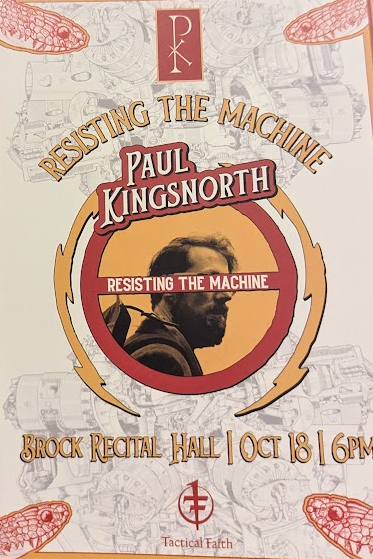
This past weekend I had a rare opportunity to meet not two, but three authors, two of whom I’d read previously and one of whom I consider my favorites. Some months ago Rod Dreher, author of The Little Way of Ruthie Leming, How Dante Can Save your Life, and Live not by Lies, announced that he would be speaking in Birmingham along with Paul Kingsnorth as part of a multi-day event (“Resisting the Machine”) that would culminate in the booklaunch of Dreher’s Living in Wonder, on the human need for enchantment and the sometimes dangerous ways people are pursuing it in the current day. Kingsnorth is not an author I’ve read a lot of: I encountered him first via his editing of Wendell Berry’s essays, The World-Ending Fire, and then began reading his blog, an eco-Orthodox attack on the “nexus of power, wealth, and technology”.
Friday, October 18th
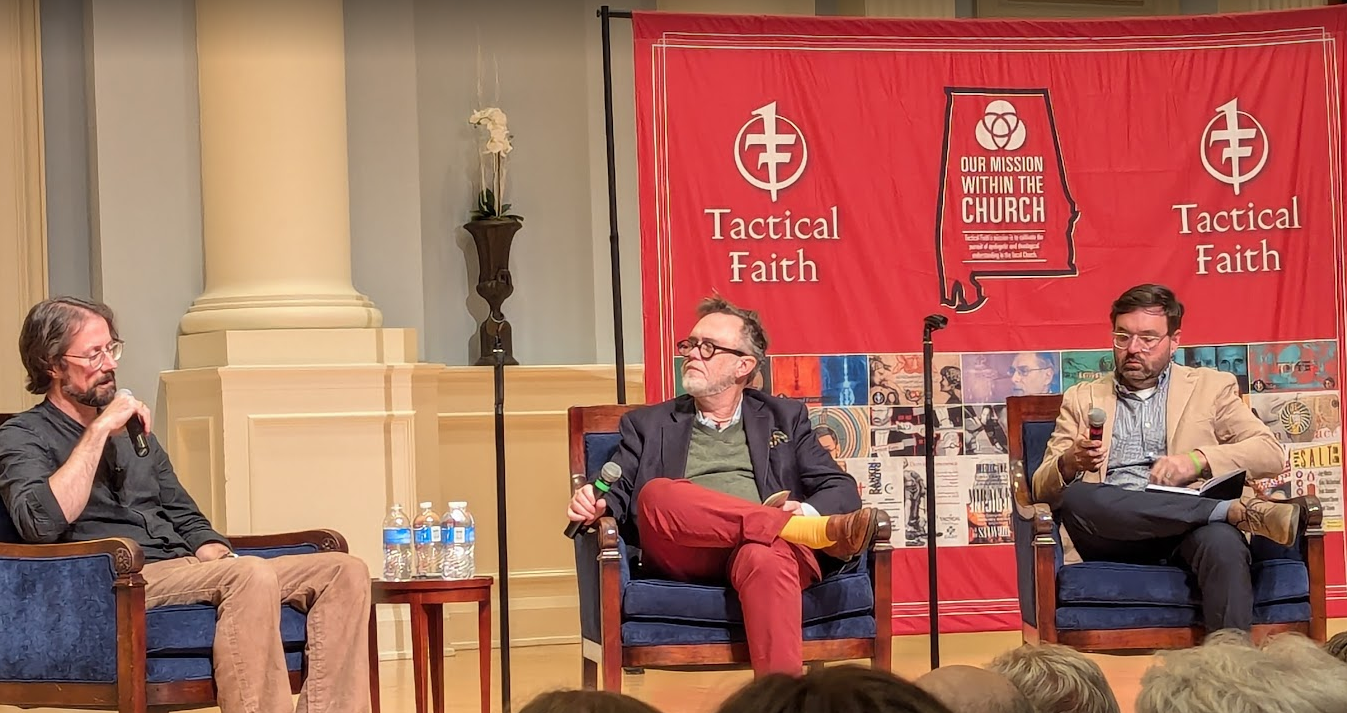
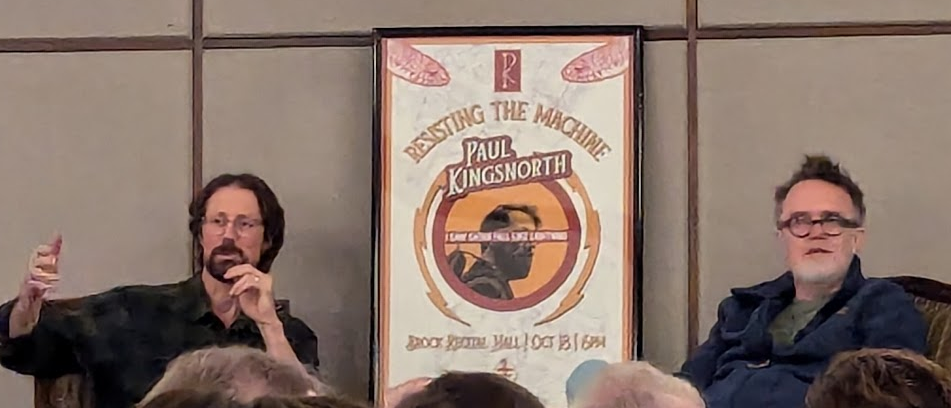
The evening kicked off with a talk from Paul Kingsnorth, whose substack writing is an interesting mix of environmentalism, Christian humanism, and sharp criticism of industrial technology and its effects on human civilization. Paul outstrips even me in his hatred for cell-phones, volunteering to smash anyone’s smartphone if they’d like. (Rod held his close and gasped: “My preccious!”) The talk was principally about Kingsnorth’s conception of The Machine, but then shifted from this very broad view (of the Machine now being an international beast) to how smartphones and social media deform us at the microlevel. He urged those of us in the audience to ‘repent’ — to literally begin turning away from these devices and the compulsive, consumerist, vicious behaviors they inculcate in us. After Paul’s talk, he was then joined on stage by Rod and Baxter: Rod essentially interviewed Paul, with Baxter piping up a time or two: here, Paul’s view of the Machine was connected to Dreher’s own soon-to-be-released title, as living in meaning & wonder are the opposite of living as machine-creatures, self-absorbed and forever running on the hamsterwheel of modernity. The third fellow, Baxter, is author of The Medieval Mind of C.S. Lewis, a book I’ve thought about buying frequently: I wound buying it after the talk. When Rod does a write-up on the interview I’ll link to it here, and if it’s paywalled just let me know if you’re interested and I’ll send a few choice excerpts your way.
Books! Books! Books!
Check out some of these books! When I saw Ed Abbey, Wendell Berry, and Neil Postman mixed in with a gob-smacking variety of Christian culture books, I knew I was among my people.Eighth Day Books is the vendor if you’d like to check them out.
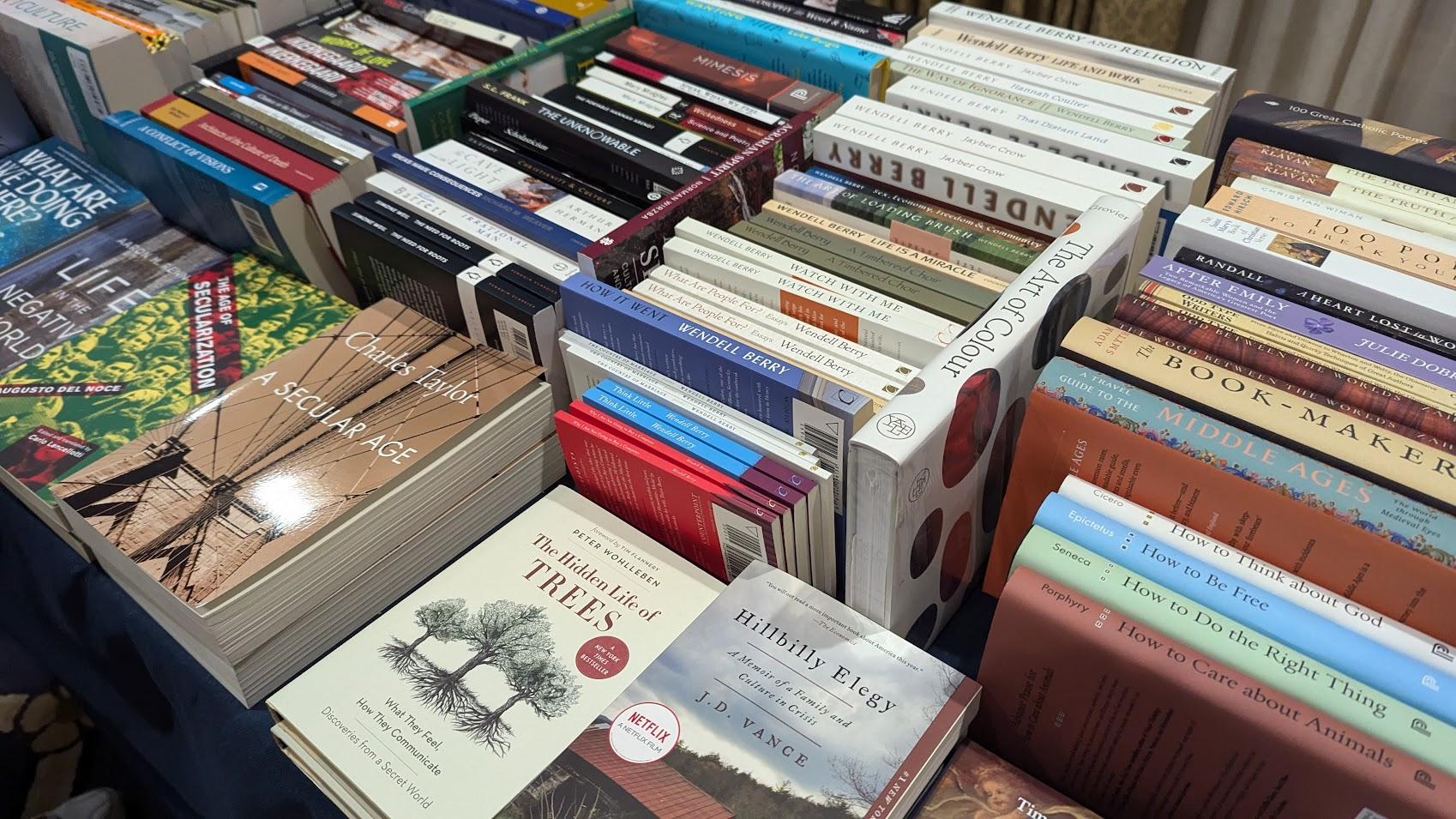
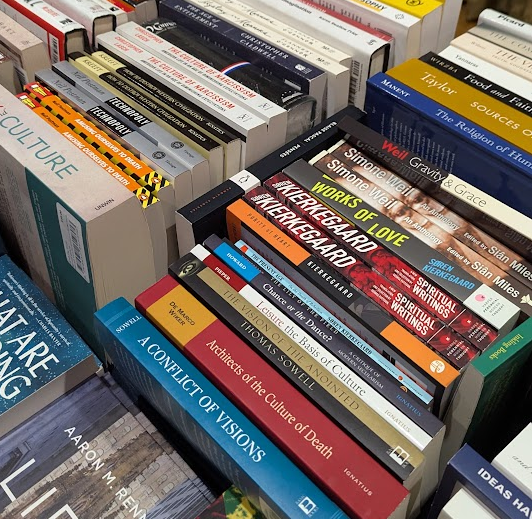
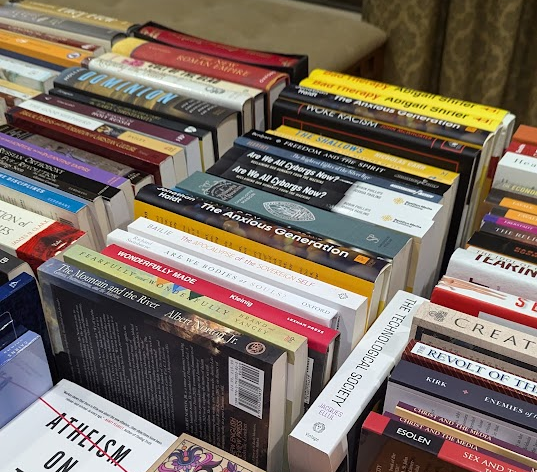
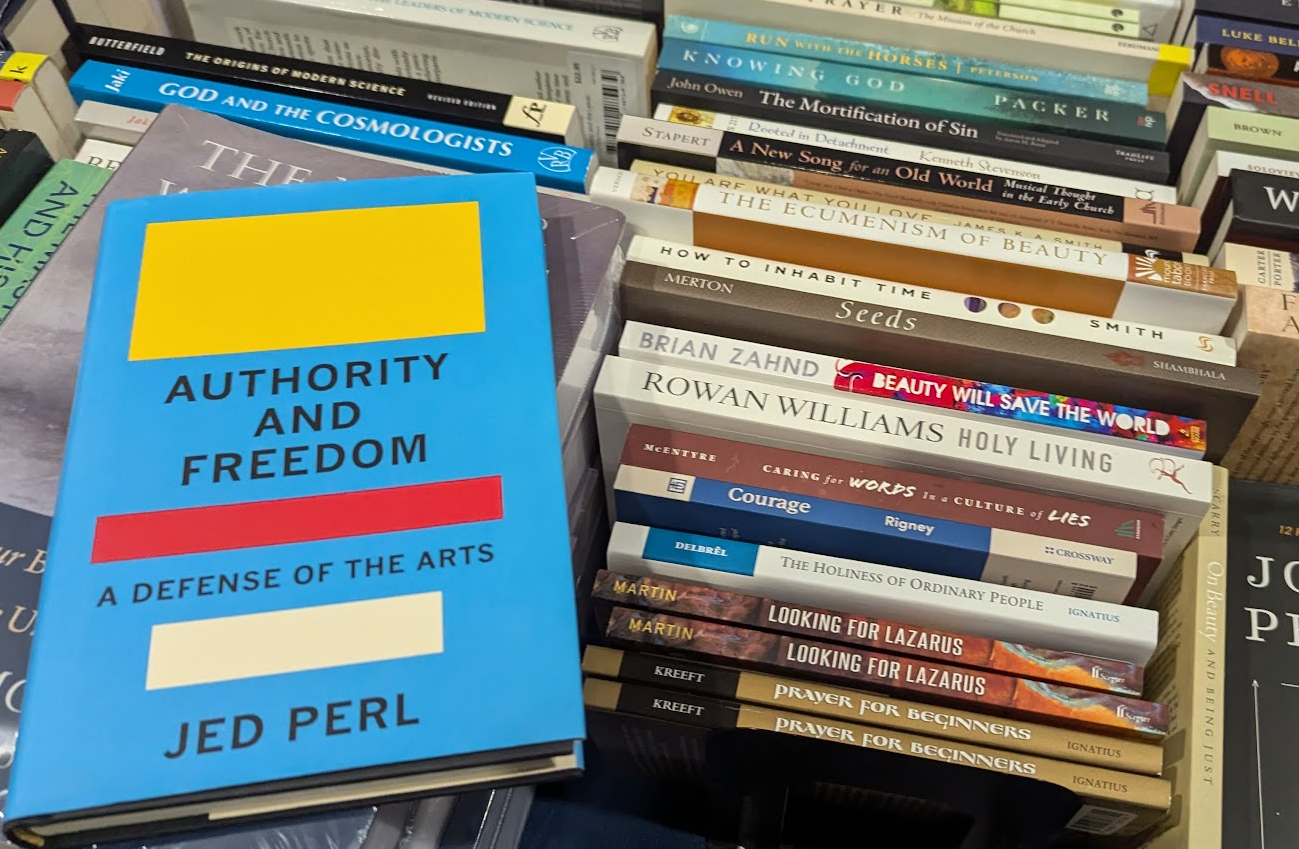
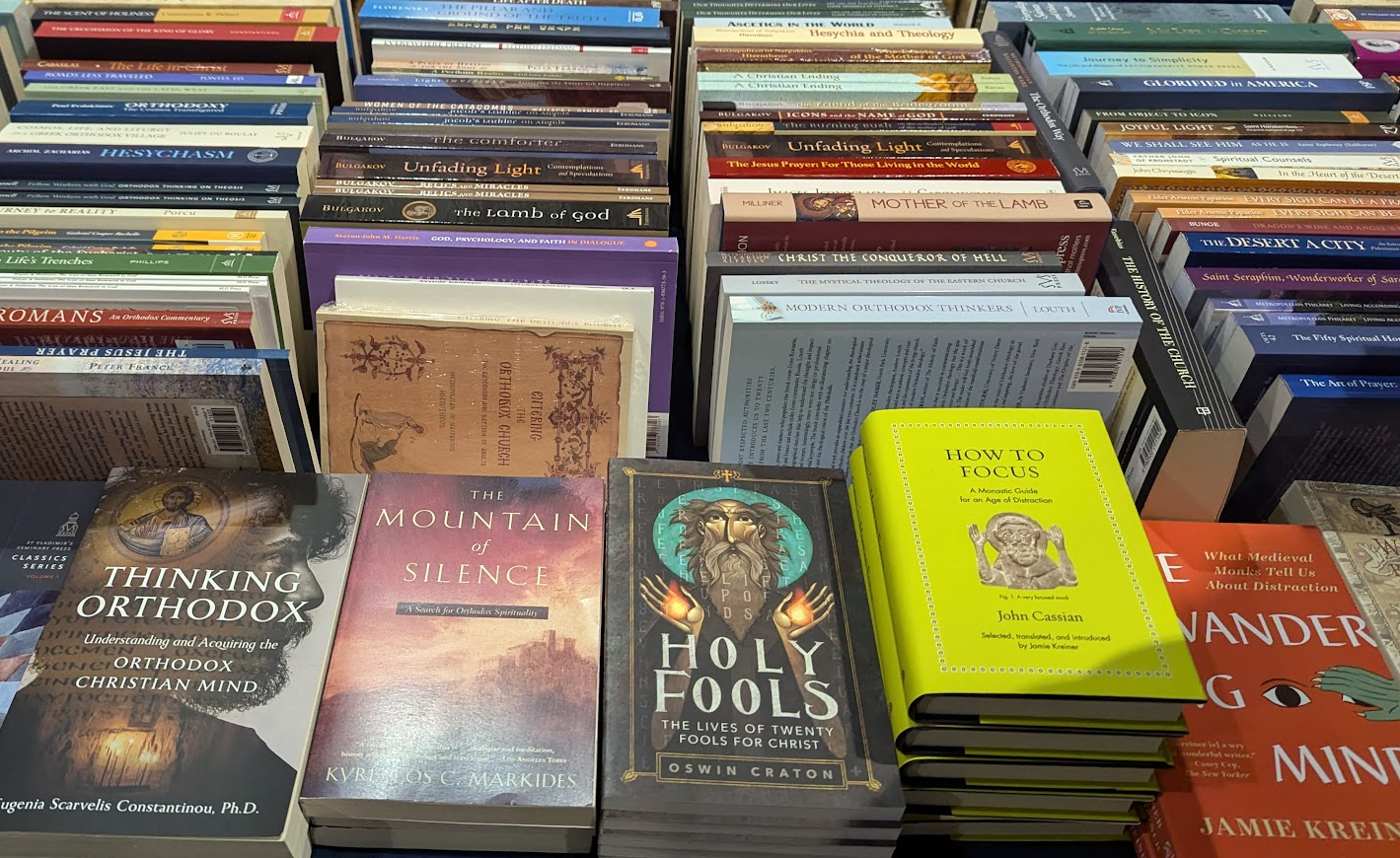
After the discussion, I mingled in the hallway where all the books were. Rod passed behind the table, and I impulsively said “Hey, Rod!” like we knew each other. I do, in a sense: I’ve read his thoughts and reflections for years now, and for me it was surreal seeing That Man/Voice from the Internet suddenly a baseball’s throw away from me, with the same wild hair and black eyeglasses as his photo. Although I’ve already preordered the Kindle version of Living in Wonder, I grabbed a physical copy so I could get it autographed and have a chance to talk to Rod. He and I have very similar backgrounds, in that we’re both boys from the deep south who were really bad at being rednecks, much preferring books, writing, and classical music to Budweiser, football, and spending winter weekends in dark woods freezing while waiting for a shot at a deer. I’ve always felt a strong resonance with his writing, then, especially in his difficulties relating to his family — and despite my conflicted response to Crunchy Cons, he’s grown to be one of my very favorite authors. His How Dante Can Save Your Life landed a key time for me, and inspired me to finish the Commedia. The only other author I’ve traveled to see was Tom Woods, in 2015 at the Young Americans for Liberty conference. In addition to a print copy of Living in Wonder, I also bought the CS Lewis book — though I waited until I was back in my air bnb room (oddly enough, owned by a member of Holy Cross, Holy Trinity) to buy it as a Kindle title. (I plan on re-reading Crunch Cons: as with many books I read in 2013, I imagine my perspective would be very different now, as back then I still associated conservatism ONLY with neo-cons. I was also mixed about Russell Kirk that year, and yet Dreher and Kirk have remained constant presences in my mind ever since.)
Saturday, October 19th
The next morning, I attended a 7 am “Akathist to Jesus, Light to Those in Darkness” service at Holy Cross, Holy Trinity Orthodox in downtown Birmingham. They were the hosts of the next part of the event, a breakfast followed by another Kingsnorth-Dreher discussion which would be followed by a question and answer period.

(Taken after the event.) Although I’m faintly familiar with Orthodoxy through reading authors like Frederica Mathews-Green and Timothy Ware, as as Rod’s own writing (he converted from Roman Catholicism in the 2000s), this service was ..otherworldly. The first half-hour was essentially silent prayer, as a priest fussed around in the sanctuary. I have no idea what he was doing, because this wasn’t Divine Liturgy: once the service started, we were standing and meditating on the chants three men were doing, which took us through passages of the Gospels in which people called to Jesus for help in their despair/illness/sorrow, etc. I was very much moved by this for personal reasons I won’t go into, but suffice to say between the chanting and the incense I can definitely see being enraptured by Orthodox worship. I was mildly surprised not to see Paul or Rod in the audience, though I figured they wanted to avoid turning a religious service into a “meet the author” event. Lo and behold, though, when I turned around at the dismissal, I got a jump scare because they were right behind me, against the back wall. It’s a standing service, so I suppose they didn’t need a pew. If you look at that picture above, it’s fascinating because the presentation of the sanctuary is three-dimensional: there’s the Theotokos in the far back, of course, but she’s surrounded by an entirely different artwork depicting the Apostles (I’m assuming), and they’re all looking down on a Crucifix. All of these works are separate and distinct — and yet, conjoined in a powerful way.
“WE CAN’T HEAR YOU!”
“What? Oh. The Mountain of Silence. The machine is fighting back.”
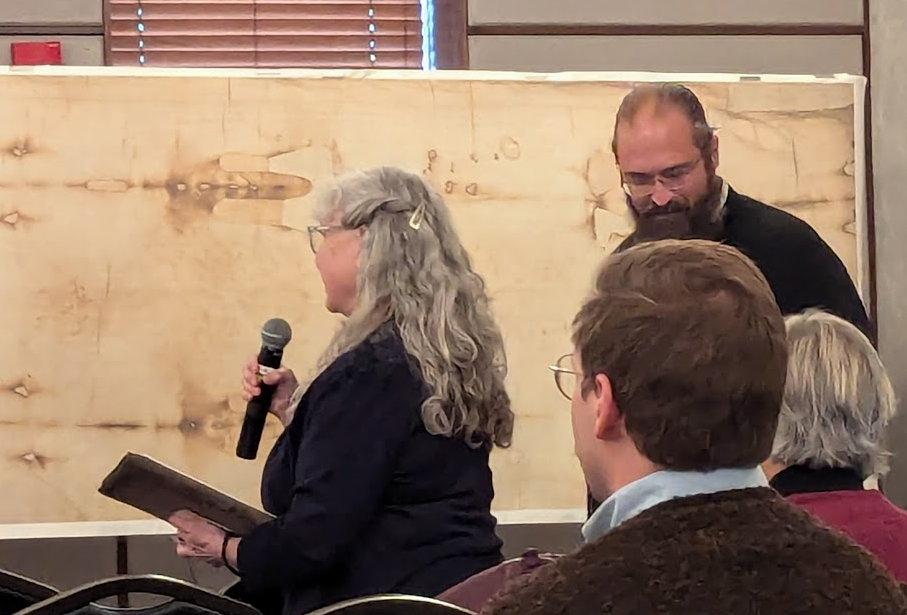
After this, we proceeded to the “Banquet Hall”, where we had breakfast, followed by another discussion between the authors. This one was more tightly focused on the difference between “precept” and “concept”, and specifically the way western Christianity has focused on latter over the former: to reference Pogle’s The Church Impotent, essentially western Christianity became fixated on “mental” aspects — apologetics — it drifted away from experiential aspects of Christianity, aside from some some mystics. If Christian faith is to triumph against the machine, it must incorporate body, mind, and spirit — not be dominated simply by syllogisms. I can testify to this to some degree, as it wasn’t until I had my own touching-a-live-wire experience that I began to open to becoming a Christian — and C.S. Lewis, too, had to wait until he’d been ‘surprised by joy’, this bolt he could not account for, before Tolkien and others could frame his experience with argument and convinced him to begin practicing as a Christian. Dreher’s entire religious experience has been punctuated with such moments, beginning with his being overwhelmed by Chartres, and more recently in later years, a series of events related to the life of St. Golgano, which I’m familiar with through his substack but which he related during one of the discussions. After this, I met with a dear friend for lunch at a restaurant Rod recommended, then sallied forth home.
It was quite the weekend. I greatly enjoyed being among likeminded people — not Christians, per se, but people who are deeply concerned about the way technology, industrialism, modernity, etc are warping humanity and taking us away from meaning and authenticity. This was something I was interested in long before I ever opened myself up to the Christian way, but Christianity — and particularly, the social doctrine of the Catholic church I discovered through Schumacher’s small is beautiful (available through Eighth Day Books!) — helped me understand the problem of modernity and the machine better. I imagine this next week will be marked by reading inspired by this weekend’s reflections and conversations.
Some videos, if you found all this interesting:

 Reading Freely
Wow, that must have been fascinating. So glad you had the Akathist experience.
And unusual picture with a whole bunch of Orthodox books in the foreground. Thanks for sharing. I need to watch some of these videos for sure
Indeed! Those pictures were taken at Samford University in Birmingham. Eighth Day was also present at Holy Cross, Holy Trinity,
Sounds like a FUN and interesting few days you had there! I would definitely have enjoyed finding the *odd* book in those stacks. No doubt at all that I’d have been bringing a few home with me too….! [grin]
Oh, and that church is *beautiful*…
Gob-smackingly so. Lots of Greek writing inscribed above, which I would be curious to understand. The book display was amazing — I’ve never seen so many interesting books in one place. I limited myself to the two author books and took pictures of the rest so I could look for them later when I have more $$$ and time! The first night’s lecture actually incorporated different notions of the machine in SF & fantasy.
Any interesting SF machine insights? Which books/movies did they reference? Anything unexpected? Presumably they’re quite worried about the future of AI?
The most explicit example is comparing the “towers” of the Two Towers & a Clarke story with a space elevator — one viewing the tech-tower as a tool of power and exploitation in a bad sense, the other a tool of power and discovery in a ‘good’ sense, but Kingsnorth thinks both are the same tower. The enclosure movement was progress to some, and land theft to others. Ditto for industrialization: we’re more productive and wealthier, but most workers are completely disconnected from the fullness of their work to that it’s meaningless drudgery. I’ll find out more when I read his book on environmentalism, but I’m fairly certain Kingsnorth believes the entire modern order is unsustainable for multiple reasons, including destruction of the Earth.
As far as AI, yes. That came up — discussing how even its developers weren’t sure how it worked, wasn’t sure what it would grow into, were actually concerned about what it might become — but felt compelled to continue feeding it so China doesn’t beat us to it. Feed me, Seymour!
There was also some interesting discussion that AI, UFOs, and the entities people observe on DMT trips are all interconnected, but I’ll wait until I read Living in Wonder to delve into that.
Oh, Kingsnorth also mentioned Zoltan Istvan quite critically — he’s the author of that awful “Transhumanist Wager” novel, which plagiarized from Ayn Rand but replaced philosophy with tech-triumphalism.
Never heard of Zoltan Istvan, but then again I’m a firm believer that Transhumanists are complete crackpots so I tend to ignore them.
Those Kingsnorth ideas sound distinctly Marxist…. Presumably he’s not one?
Oh, I’m firmly convinced that AI will, one way or another, kill us all – or at very least disrupt things to an extent that it’ll cause LOTS of angst for a LOT of people… We do seem to be driving head long into it – just in case someone else gets there first! Whoever gets there first won’t really matter to be honest. Not once it becomes self-aware and figures out who its potential enemies are….
I posted a review of his work on the blog! As far as I know, Kingsnorth isn’t a marxist, but one doesn’t have to be one to regard global industrial civilization as….fragile, let’s say. We saw a partial implosion of global trade almost a century ago, and that was just from economic hiccups, not destruction of the soil/water shortages et One can criticize globalization or capitalism in general without being Marxist — the Catholic localists/distributists do, for instance. I just started Dreher’s “Living in Wonder”, and he regards capitalism — for all the good it’s done to raise living standards and such — as one of the primary drivers of ‘disenchantment’, reducing everything into material to be manipulated/processed/sold. However, I don’t think that’s unique to capitalism — it’s just BETTER at it than other economic systems. I remember back during my Marxist days trying to read “A People’s History of the World”, but DNFing early because it was was wholly about economic matters, as if getting and spending were what we were here to do.
Pingback: October 2024 in Review | Reading Freely
Pingback: Christmas 2024, journaling, this and that | Reading Freely
Pingback: Top Ten Love Freebie + Teaser Tuesday | Reading Freely
Pingback: Top Ten Books I’d Like to Re-Read | Reading Freely
Pingback: American Orthodox | Reading Freely