
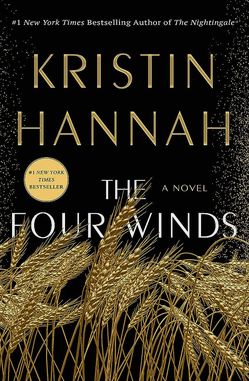
464 pages
When the clerk at my local diner coughed at me to remind me that I was standing in front of her cash register, bill and money in hand, but ignoring her to finish the chapter I’d walked up reading, I realized that the coworker who lent this to me with a warning about its compelling nature had undersold it. The Four Winds begins as the story of Elsa, a young woman growing up in the Texas panhandle, overlooked and unloved by her own despite her best efforts to please them, who begins finding happiness only to see it buried by the drought and dust storms of the 1930. Forced to leave her home behind in order to keep her children alive, they migrate west and find not a land of promise and opportunity, but of cruelty and contempt. The Four Winds is a novel of enormous pain and suffering, of human resilience, of a woman’s tortured love for her daughter — and finally, of courage. It is quite the book.
Elsa was sickly as a child, and perhaps that explains why her parents distanced themselves from her emotionally, bestowing more love on their flower garden than her. She sought love elsewhere, and (as is the natural course of things) found herself pregnant with the child of a young man who was engaged to someone else. Despite their reservations, the Martinelli family are good Catholics, and make their son Rafe do the proper thing — and they quickly learn to love Elsa, who doesn’t cling to her city ways but throws herself into the life of the farm, growing to love it. Though her husband is not in love with her, she has their children, and she is much the Martinelli’s daughter in law as she could have been their daughter in blood. But then the rains stop, and the dust begins to blow.
It’s one thing to read nonfiction about the Dust Bowl, another to see photos of it — but Hannah’s slow burn of misery really drives home the point that the Dust Bowl sucked. Through Elsa’s eyes we witness the boom years of the 1920s, when farmers in the Texas panhandle were enjoying high cotton — or high wheat, in their case, buying threshers and more land on credit. But then the rains failed, as they were known to do in the Great American Desert, and the plowed-up land waiting for growth began to blow away — and nothing would be reaped for years but the whirlwind. We experience through words the slowly growing desperation and fear as the seasons pass and nothing gets better — as the pantry empties out, as the light in her husband’s eyes grows dimmer and dimmer and soon there’s nothing but the moonlight reflecting off his whisky glass and the pale glow of a cigarette as he mopes for hours on end in the now-desolate barn loft. The physical torture of a place is one thing — the constant fight against the growing dust dunes, the groans of starving animals whose bellies are filling with dirt, the all-too-frequent arrival of death. But for Elsa, the hardest part is watching her husband, never happy, sink into true misery — and enduring her daughter’s sudden viciousness, for Loreda is very much a daddy’s girl and blames her mother for trapping her father here, for depriving them of lives of adventure and fun. Loreda is a character I’d very much like to see a switch taken to early on.
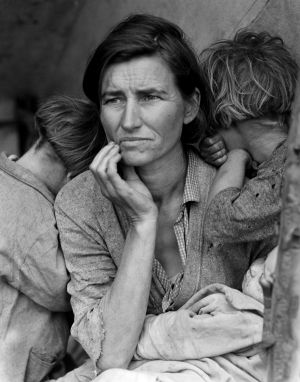
Dorothea Lange
Despite her fierce love for her in-laws and for the farm, despite her stubbornness, when her husband abandons her and her son almost dies of dust pneumonia, Elsa has to take her two children and seek work elsewhere. Anyone who has read The Grapes of Wrath knows what’s waiting for her there: desperate men hardened by their hunger, frightened Californians who don’t know what to do with this sudden tide of displaced farmers looking for work, who close their hearts and doors to fellow Americans; cruel men who see in the need of others an opportunity to make the most of hard times. It isn’t just that the hours are long and the pay envelope light, but the workers are paid in scrip and the company store charges money to cash that scrip, and if people have cash from elsewhere, the store won’t take it: only company credit will do. The result is debt-slavery, not even worthy of being called serfdom because the feudal lord at least saw peasants as people he was obliged to take care of. At every turn, Elsa is wrung like a turnip for the little she can produce, and survives only by the help of those around her — sharing resources admid the hatred of the Californians for these ‘Okies’, and the armed viciousness of the bosses. These hardships are a forge, though — forcing Lareda to grow up and see her mother for who she is, a woman of inexaustible strength. Lareda has that strength, too, but instead of merely enduring meanness until she dies, she wants to fight back against the cruelty — but we’ll not cross that line into spoiler territory. Suffice it to say, Hannah takes the politics of The Grapes of Wrath and raises the volume.
“This was a hell of a novel,” I said to that same clerk several days later, who had seen me reading it so intently and ignoring my food that she asked if anything was the matter. I was generally aware of the Dust Bowl and its connection with the Great Depression, but Hannah’s writing made the suffering and despair come alive — and perhaps that doesn’t sound attractive, but when a character I’d quickly become attached to because of her strength despite rejection and heartbreak had to face these challenges, I had to see her through them. The character drama in this novel is superb, its only weakness being how quickly Lareda erupts into viciousness. Frankly, I don’t buy her as a character who came of age in the 1920s: she has too much of the emotional shallowness and meanness of a kid who grew up with a smartphone in her hands. She has no roots to her time and place. I’ve seen nothing like her in Wallace Stegner or Willa Cather’s western novels, which shared the general temporal setting. She does mature, though, and her constant struggle with her mother — their love for one another despite their differences — continues making the novel work, even as the politics drift more obvious and more shallow. The Californians begin as antagonists who are roughly understandable, but by the time we’ve reached the end, they’re more Snidley Whiplashy. Their taking a level in villainry forces heroism from our main characters, though, so it’s not necessarily gratuitous.
The Four Winds is a novel I won’t forget about any time soon, and it prompted me to begin reading a nonfiction title about the Dust Bowl. I can definitely see visiting Hannah again, though she’s apparently known as a romance author. There’s little of that here: this is a love story, sure, but it’s about a mother and her daughter. Frankly, there’s more romance in the average Jack Lark novel than this.
Related:
The Grapes of Wrath, John Steinbeck.
My Antonia, Willa Cather; O Pioneers, Willa Cather. Other stories of resilient women who love the land of the West.
The Jungle, Upton Sinclair. There are some definite similarities between Elsa and Jurgis’ determination to endure.

 Reading Freely
Absolutely agree. THE FOUR WINDS is mesmerizing. Horrifying, but completely immersive and memorable. I’m glad it sucked you in so much that you forgot about your surroundings! LOL.
Susan
http://www.blogginboutbooks.com
Pingback: Tis time for teasing tuesday | Reading Freely
Pingback: Nonfiction November, Part II | Reading Freely
Pingback: The Best of 2023: Annual Year in Review | Reading Freely