July 2023 in Review

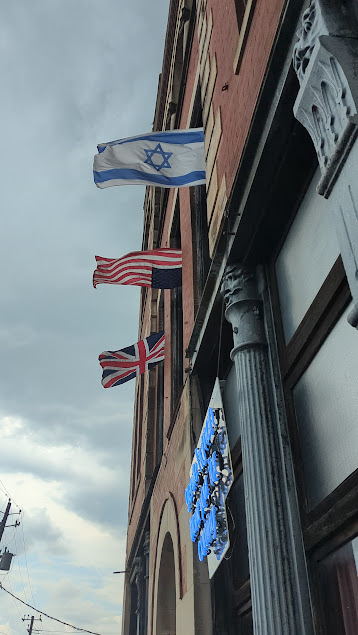
While it’s conceivable that I could finish a book today (I’m halfway through The Last Republicans, and ditto for Off the Planet: Five Months on Mir), I doubt it. I spent the weekend saying goodbye to a friend: the Harmony Club, a Jewish community center turned restaurant/bar turned antiques store and clubhouse, is passing into new ownership tomorrow. I’ve spent every weekend and holiday there for the last three years, hanging out with friends, yakking with tourists, watching birds and bugs and the skies — riding out tornadoes and heartbreak. C’est finis, alas. Those of us who used to gather there helped clean the place out over the weekend, and that will continue a little tonight. The sideshot was taken yesterday, as we took a break from moving to huddle inside while a thunderstorm rolled through the area. July certainly proved to be a different month ’round these parts. My plans for focusing on American lit titles in my Classics Club and Mount TBR endeavors were derailed completely when an early TBR read, The Presidents Club, sent me on a presidential reading tangent that was interrupted only by Space Camp and then Blast from the Past, a fun look at kid lit from the 1990s. It was a very healthy reading month, just…er, not for any of my goals. I’m still have a few more Blast from the Past posts upcoming, but they’ll be mixed in with ‘normal’ reading. (As normal as RF ever is!)

Climbing Mount Doom:
British Soldiers, American War; Don Hagist
The Presidents Club, Nancy Gibbs and Michael Duffy
What the Dormouse Said. I read some of this, then skimmed the rest. Count that as a DNF, I suppose. Lots of characters and more LSD than computers.

Classics Club, Readin’ Dixie, and The Big Reads:
Space Camp:
Space Camp went well, I think, and will be remembered chiefly for Mike Collin’s excellent Carrying the Fire. I expect to see it on this year’s top ten list.

Read but Unreviewed:
The Invisible Man: The Life and Liberties of H.G. Wells. This is a short biography of H.G. Wells that covers a lot of his work, with some odd exceptions, and is sharply critical of Wells’ relentless womanizing. It focuses a bit on Wells’ relationships with other men and women of the age, particularly his public argument about evolution with Hillaire Belloc. Interesting enough but not memorable, I don’t think. An excerpt:

“To-day I’ve motored from Stonehenge, and you may care to know that I polished that off in forty minutes.’
‘Good heavens!’ I gasped, ‘a place that has been puzzling antiquaries for a thousand years!’
‘Very likely,’ he rejoined, ‘but anyhow I’ve settled it to my satisfaction,’ and then, catching sight of my horrified expression, ‘I’ve left a couple of experts behind,’ he added quickly, ‘they have a fussy kind of knowledge that looks well in a footnote.’

The Trump White House was inspired by my presidential reading tangent, but it was less about the Trump White House and more about the Trump Oval Office — specifically, it’s Kessler’s review of Trump’s first year in office, and an introduction to some of the very strong personalities that marked it. Kessler has written several score of books about the presidency and various executive-level offices, and has known Trump personally for over a decade. The book is thus an interesting mix of frank observations about the turbulence of that first year, particularly the undue influence of Trump’s family, and his unorthodox approach while at the same time defending some decisions and comparing the media’s treatment of similar decisions made by prior administrations. It’s a little People Magazine at times, especially when covering the social scene around Palm Beach and the ludicrous wealth concentrated there. Kessler has done a separate book on the Palm Beach scene, so that’s not surprising. His First Family Detail was similarly gossipy, so that just may be his style. Some highlights:

“Every administration has people in it who get White House-itus,” says Robert Gates, a former National Security Council staffer in the White House and a former director of Central Intelligence. “The first giveaway is when a relatively junior staffer has his secretary place calls saying, ‘The White House is calling,’ instead of ‘Joe Schmo from the National Security Council is calling.’ ”

The paradox of Trump was that he could be generous, supportive, and considerate and at other times treat his aides like dirt. In effect, some aides felt, Trump manages through chaos by pounding someone down to the ground to build someone else up for a couple of weeks. While the team-of-rivals game sparks competition, it also stirs resentment among the staff. When it came to his tirades, Trump seemed to lack empathy, aides thought. While Trump could make an aide feel like a million bucks, at other times he seemed incapable of understanding how his humiliation of them made them feel. Yet if Trump treated an aide rudely, an hour later he acted as if nothing had happened, as if the incident had vanished from his brain. Since he did not view the humiliation of an aide as awkward or strange, it did not exist in his head.
Posted in Politics and Civic Interest, Reviews | Tagged , , , , | 6 Comments

Amber Brown and Matilda

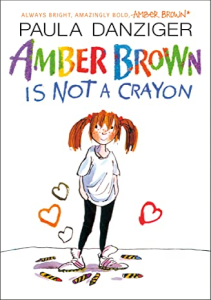
Most of this week’s reading has been of books I read in the 1990s, or at least were books from series I read in the 1990s. I never read Amber Brown, though, possibly because by the time they were published I was too old for them. I wanted to take a look, though, given that the author did the Matthew Martin series. In the first one I tried, Amber Brown is Not a Crayon, we meet the main character, who writes in the first person. The great drama of the book is that her best friend Justin is moving to the other side of the country. I suspect if I’d read this as a kid, I would have strongly sympathized, as I had two best friends move away on me in elementary school, back when we had to resort to letters to stay in touch. (Fortunately the internet arrived and with it, AOL Instant Messenger.) Amber Brown Is Green with Envy was a different story, as it’s about Amber’s problems with her now-divorced parents, her unease with her mother moving on, and her resentment that her dad suddenly wants to be back in her life despite being work-obsessed in her younger days. Divorce and split families was thankfully something I never experienced, save through books. Despite the I could see going back to this series when I do another kidlit sweep, as I like the way “I, Amber Brown, tells stories”.

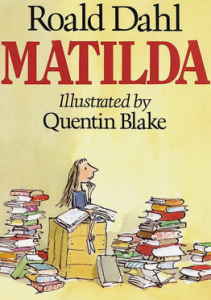
Matilda, with Charlie and the Chocolate Factory, was another re-read. Given that it’s by Roald Dahl, though, absolutely nothing is lost. I understand that Netflix is attempting some drama based on this, but I can’t imagine it rivaling the original movie with Mara Wilson and Danny DeVito. Matilda is the story of a precocious young girl who from an early age exhibits extreme talents in both reading and math, despite the fact that her parents dislike her, regard book-reading as a noxious habit, and would be happy she would sit enthralled in front of the television like normal children. Matilda finds her joys at the local library, reading through Dickens, but it’s when she’s sent off to school that things get interesting. Although Matilda’s teacher Miss Honey is The Best Teacher Ever (sorry, Mrs. Jewls) and recognizes her gifts, the school headmaster is The Worst Ever and tries to stick Matilda in a torture-closet called The Chokey. Simmering with rage, Matilda unexpectedly discovers she has other gifts. When I first read Harry Potter and the Philosopher’s Stone back in 2007,* Harry’s magical talent manifesting itself in times of stress immediately brought Matilda to mind.

Some quotes:

So Matilda’s strong young mind continued to grow, nurtured by the voices of all those authors who had sent their books out into the world like ships on the sea. These books gave Matilda a hopeful and comforting message: You are not alone.

“Fiona has the same glacial beauty of an iceberg, but unlike the iceberg she has absolutely nothing below the surface.”

*The friend manically laughing at the top of that post is the same friend who ran off on me. That was from one of our many AIM convos!

Posted in Reviews | Tagged , | 9 Comments

Charlie and Harriet

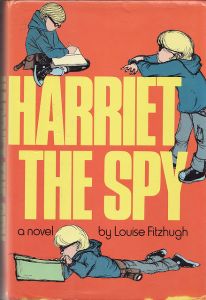
At some point in 1996 or ’97, I got to watch Harriet the Spy. I also began keeping a journal in 1997, which is not an accident, though I found California Diaries at the same time. As part of this week celebrating children’s literature of the 1990s (or at least, children’s books I read in the nineties, never mind when they were published) , I wanted to go back to the original book and see what it was like. I can’t compare the book and movie because I remember nothing about the plot of either, only that Harriet was constantly scribbling in her notebook. Harriet is the only child of a fairly wealthy home (wealthy enough that she has a nanny and a cook!), who wants to know Everything in the world and has a spy route in her town. She’s found different hiding places (trees, dumbwaiters, etc) to access and eavesdrop or watch on them. Harriet would be a menace had she been born in a different time, because she writes down seemingly everything she sees or thinks, and it’s often disparaging of her classmates and neighbors — but reveals a child’s inexhaustible curiosity and frank observations. When her classmates read her notebook, she promptly becomes persona non grata at school, exiled from all social interactions and subject to the slings and spitballs of outrageous fortune. Even worse, her chief ally in the world, her nanny Ol Golly, has gone and fallen in love, so she’s on her own. Harriet doesn’t have much in the way of emotional self-control, so when she engages in a vengeance campaign against her classmates (involving planting frogs in desks, cutting their hair, etc) her parents sent her to a shrink. Things get better, though. This was a….chaotic read, with some good writing, though I wasn’t sure where the story was going.

Janie Gibbs was Harriet’s best friend besides Sport. She had a chemistry set and planned one day to blow up the world.

Harriet was getting tired of standing up and screaming. She wished she could sit down but it wouldn’t have done. It would have looked like giving up.

There is more to this thing of love than meets the eye. I am going to have to think about this a great deal but I don’t think it will get me anywhere. I think maybe they’re all right when they say there are some things I won’t know anything about until I’m older. But if it makes you like to eat all kinds of wurst I’m not sure I’m going to like this.

“[Love] feels…it feels—you jump all over inside…you…as though doors were opening all over the world…. It’s bigger, somehow, the world.”
“That doesn’t make any sense,” said Harriet sensibly. She sat down with a plop on the bed.
“Well, nonetheless, that’s what you feel. Feeling never makes any sense anyway, Harriet; you should know that by now,” Ole Golly said pleasantly.

Her mother came to the door. She looked down at Harriet lying there with the chair on top of her. “What are you doing?” she asked mildly. “Being an onion.” Her mother picked the chair up off Harriet’s chest. Harriet didn’t move. She was tired. […]
“It’s for the Christmas pageant…is that it?” “Well, you don’t think I’d just be an onion all on my own, do you?”

You’re eleven years old which is old enough to get busy at growing up to be the person you want to be.

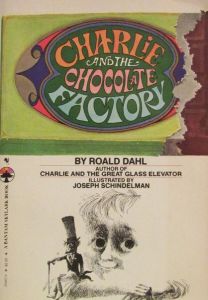
Next up, an old Very-Favorite: Charlie and the Chocolate Factory! I was pleased to discover that my library has a copy of the original edition which I read back in he day, with the same illustrations by Joseph Schindelman that I remember as a kid — and they’re imprinted enough on my mind that neither of the movies really took over the characters in my head, except for Julie Dawn Cole as Veruca Salt. She owned that role. I can’t tell you how many times I read this book as a kid, and its original dramatization is one of the first movies I ever saw, as we watched it in class. I’m sure anyone reading knows the story: our character is Charlie Bucket, who is desperately poor and starving, living with his four grandparents (all of whom are in their ninenties) and his parents (who aren’t old enough to be the kids of 90 year-olds, but this is in a book that involves snozzberries, Ooompa-Loompas, and magic elevators). Willy Wonka, the eccentric genius candymaker, has offered five children a chance to tour his factory — those who find the Five Golden Tickets in his candy bars. Charlie is lucky enough to come across one, and he joins his four fellow tourists for a tour of a wonderful place with a very eccentric owner and guide, one is mischievious and sometimes manic. The other kids have serious character flaws which lead them into ghastly accidents, and soon Charlie is all alone and — well, I’ll not spoil the rest. Wonderful writing. I remember reading James and the Giant Peach and this book’s sequel back in the day.

Everything in this room is eatable, even I am eatable! But that is called cannibalism and is in fact frowned upon in most societies.

Whipped cream isn’t whipped cream at all if it hasn’t been whipped with whips, just like poached eggs isn’t poached eggs unless it’s been stolen in the dead of the night!

Posted in Reviews | Tagged , | 5 Comments

Goosebumps and Boxcar Children

I’m lumping these two together because as much as I liked them as a kid, I wasn’t able to get access to many copies while I was prepping for this project, so I’m limited to one or two books .

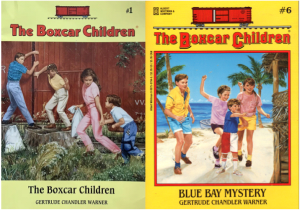
First up, The Boxcar Children. TBC is a funny series because it began as a simple story about four children who were being sent to live with their grandfather after being orphaned, but they’d heard he was a grump who didn’t like them, so they ran away. The book opens with them traveling lonely roads at night, looking for refuge, and soon their foraging leads them into the woods where they find an abandoned boxcar. The book develops into a very mild kind of My Side of the Mountain or Hatchet, with these young kids (Benny is all of four or five) creating a life for themselves in the woods, made possible by the oldest boy Henry walking into town and doing odd jobs like handywork or picking apples. Eventually the kids are reunited with their grandfather, who turns out to be not grumpy at all, but a very nice and understanding fellow who even moves their boxcar to his back yard so they can play in it all they like. From what I understand, the book was so popular that fans demanded more, so the author created a series in which the Alden kids go places and encounter mysteries — and do so with such regularity that when the original author’s series stopped and other people began writing in the series, they made a joke out of it. The first twelve books depict the kids growing and aging, but then after Warner’s death, they become a bit like comic book characters: their ages are rolled back a few books, then frozen while the world changes around them. The books coming out when I grew up involved computers and the like, despite the fact that in the first book, cars aren’t a thing. Seriously, the only vehicles mentioned are horses and wagons. I did not notice that as a kid.

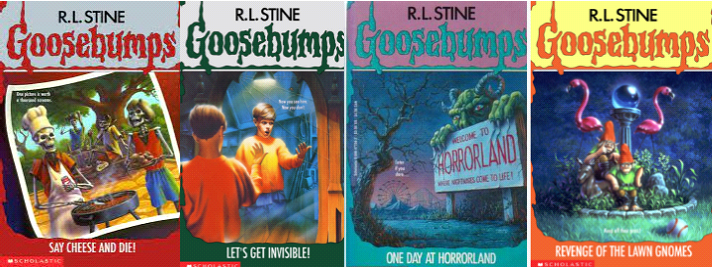
At some point in 1993, my mother made a decision she’d later regret. She saw a book in Food World or wherever called Let’s Get Invisible! and thought it would be a fun choice for her son who always had his nose in a book. Let’s Get Invisible was my introduction to Goosebumps, which I’m confident was The Series of the 1990s. Everyone read Goosebumps, even the jocks who would have only otherwise read baseball cards and the Spalding logo on their sports equipment: the fervour was such that my library hosted a Goosebumps fan club, complete with posters that were blown-up versions of the books. (I vividly remember the Monster Blood II cover, with an overgrown hamster….) Goosebumps was my introduction to not only the horror genre, but staples thereof: most of R.L. Stine’s premises were original to him (monster blood, Horrorland, the haunted mask), but he also incorporated horror traditions like ghosts, mummies, and demon-possessed ventriloquists’ dolls. My parents were increasingly disturbed by the covers over the years. One of the original series’ hallmarks was Stine’s love of structural suspense: each chapter ended with something like a cliffhanger, and at the end of each novel there was a twist, in which the main character has a sickening moment of realization, or the reader realizes the narrator isn’t who they thought. (In one memorable instance, we get Sixth Sense’d.) Stine quickly replaced Beverly Cleary as My Favorite Author, and I began raiding my sisters’ collection of Fear Street novels, which…er, were considerably different in content, as they involved much more murder. Fortunately I don’t remember much about those books, beyond one (Silent Night) that involved a Santa, a toy store, and one of the characters’ hatred of “Little Drummer Boy”.

Some remembered favorites:

Let’s Get Invisible! My first Goosebumps. A mirror is discovered in an attic with an attached light. When the light is turned on, anyone directly in front of the mirror is rendered invisible — leading to the usual childish antics of pranks and spying. The longer one stays invisible, though, the harder it is to come back — and the mirror has its secrets, as the main character learns when his little brother’s mirror-self attempts to trap the little brother in the mirror so that the mirror-self can escape into the real world.

One Day at Horrorland. While lost on an interminable road trip, the Morris family spots a sign for an adventure park they’ve never heard of: Horror Land. Figuring that it’ll be easier to find their way once the restless kids have been properly distracted, the dad pulls in and the fun b- oh, wait. The car just blew up. Well, that was unexpected. After that promising start, the kids go in by themselves to leave the adults to do adult things, like call the insurance company to ask “My car just randomly exploded, is that covered”. The park is not popular, and what other children Lizzie and Luke see are crying. They soon discover why: the rides here are terrifying. Not hah-hah fake scary, more like one-second-away-from-juvenile-cardiac-arrest scary. The scares continue throughout.

The Monster Blood miniseries is one I wanted to revisit, but couldn’t find any ready copies of: it involves a canned toy called Monster Blood that, if eaten, makes the eater grow enormous and go a little beserk. The Haunted Mask was somewhat similar in that the mask attached itself to the wearer and began changing their personality, I think.

The Ghost Next Door has one of my favorite twists in the entire series, and that’s all I can say.

Say Cheese and Die! Very memorable for its cover that featured skeletons bbqing. While exploring an abandoned house, the main character discovers that whenever he takes a photo of someone or something, it develops into a picture of destruction and misery: a shot of a new station wagon, for instance, develops into a shot of that station wagon crumpled from a massive car wreck. Does the camera show the future — or does it dictate it?

Revenge of the Lawn Gnomes. I can’t remember much about this book beyond it featuring lawn gnomes who came alive and did mischief, but I remember one bit of dialogue that freaked me the heck out when reading this as a kid. Do you remember the scene in Toy Story where the toys are trying to scare Sid, and it culminates in Woody doing that uncanny turning-his-head-completely-around thing and saying “…..so play nice….”? That happens here in book form, but the dialogue is — “Not funny, Joe. Not funny at all.”, and it still give me the creeps.

Posted in Reviews | Tagged , , , | 7 Comments

Henry, Beezus, and Ramona

I wish I could tell you when I met Henry, Beezus, and Ramona, but it’s been 30+ years and a child’s early life is full of firsts, too many to hold on to. I do know that it was Ribsy that I found first, a novel with a skinny looking dog on the cover. The story was of that skinny dog getting lost from his boy Henry and then trying to find his way back home. As a boy who loved dogs — who almost always had one, and who pined for one when he didn’t — I devoured the book and was only happy to read more stories about Henry and Ribsy from the library, and when I ran out of Henry stories I moved on to the girls — to that of Beezus, Henry’s friend, and of her kid sister Ramona. I loved these books, constantly re-reading them and remembering odd little details from them decades later — like Henry carrying a box of kittens, of Ramona staring at a clock and trying to figure out the time. They sometimes inspired or informed my own adventures: how many of my attempts to build a fort in the yard (including the one involving post-hole diggers and ending in my finding the water main and..um, “mass irrigating” two lots) were based on Henry and the Clubhouse? For a while I even declared Beverly Cleary my favorite author.

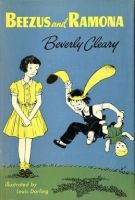
Beezus and Ramona is the original book in this meta-series, I think, introducing us to Beatrice (“Beezus”) and her holy terror of a sister, Ramona. As a boy I would have preferred Henry among the three characters, but it’s Ramona I remember best as an adult. She’s such a chaos-machine that she makes for great fun reading, though I’d pity her parents (and the neighbors) if I knew her in real life. Beezus and Ramona‘s main story is about Beezus about to have her birthday, but Ramona’s creativity and spontaneity cause…erm, challenges, destroying several cakes and invoking a teeny tiny parade of three and four year olds who Beezus is compelled to entertain. I couldn’t have asked for a more memorable return to the series.

This is the style used in the majority of the books I read back in the 1990s.

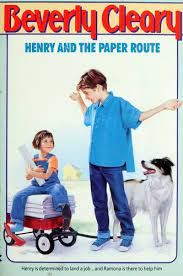
In Henry and the Paper Route, we find young Henry pining for a job of his own — not for money, but because it’s a responsibility, and he wants nothing more than taking on something that proves he’s grown up and responsible. When he learns that there’s a spot opening, he hastens to apply — but doesn’t count on running into a litter of the cutest little kittens on the way, kittens that he just has to take care of. He can put them in his pockets and the newspaperman won’t even notice them, right? … well, read and find out. At any rate, Henry has stiff competition for the job from a new arrival — a boy so brilliant he’s creating a robot. But then there’s Ramona, the little anarchic wildcard, and hilarity and exasperation both ensue.

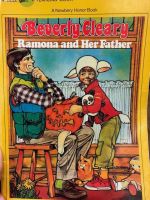
Ramona and her Father, the last in this revisit set, proved to be more serious. It’s later in the series, and Ramona is a slightly less manic kid, closer to ten than four: she’s old enough to be seriously bothered by her father’s being laid off, especially when she learns in class that smoking is bad for you and she sees him doing it a lot. To make matters worse, she’s a sheep in the school play, and her mother (who is now working to provide some income while Mr. Quimby is searching) can’t make a good costume, so she has to settle for an embarrassing sort-of-sheep.

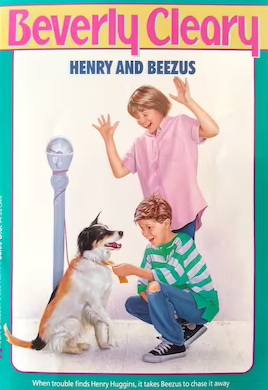
And lastly, in Henry and Beezus we have an earlier story in which Henry also helps with a paper route, but he’s younger still and is tied up pining for his own bicycle. He knows the very one he wants, but it’s $50! Scooter has offered to let Henry take his route for a weekend, which will get him a little money for the bike fund, but faithful pooch Ribsy knows how to fetch so well, that whenever Henry throws a paper out — well, Ribsy brings it right back. In addition to de-training Ribsy to fetch, Henry is also trying to sell hundreds of gumballs he found in an empty lot (….nothing sketchy about that, nope…..) and looking for a beater bike in the meantime. Beezus helps him out at an auction, but lands him a girl’s bike. No boy can be seen cycling without a crossbar!

While I wasn’t able to revisit much of this series (my library hasn’t held on to much Cleary, unfortunately), I enjoyed each of these thoroughly. The appeal of the books hasn’t diminished in the least.

Posted in Reviews | Tagged , | 3 Comments

Wednesday blogging prompt and song of sixes

Today’s blogging prompt from Long and Short Reviews is “A Job I’d Be Good At”, which is…pretty easy.

I’ve been told on multiple occasions in the past twenty years that I’d make a good monk, which is….not surprising given my longstanding practice of simple living, my fascination with intentional communities, and my obsessive interest in religion, philosophy, and meaning. I also love liturgy — both the liturgy of a given religious service, and the way the day, seasons, and year are ordered, like a dance, with both rhythms and variety. I’ve read a few books on practicing Benedictine spirituality and have even attempted to schedule a retreat at St. Bernard’s, but they’re apparently a very popular monastery to retreat to.

From virtue to vice, now a survey appropriated from Seeking a Little Truth, “Sing a Song of Sixes” — or rather, the idea. I saw few other bloggers doing it, and they all have different questions, so I think I can just do what I want.

Six authors I am looking forward to reading more of
Blake Crouch. Terrific SF.
Daniel Suarez. Ditto.
Will Storr. …interesting journalist who explores weirdness. I have a book of his on ghost-hunters but it’s disappeared somewhere. Blasted poltergeists!
Jon Ronson. Ditto.
Rhett Bruno & Jaime Castle. I’ve enjoyed their dark-western fantasy collabs and see that they have a SF book, as well.

Six Books I Recently Previewed on Kindle:
When Computing Got Personal, Matthew Nicholson
How to Forget: A Daughter’s Memoir, Kate Mulgrew
The Painted Veil, W. Somerset Maugham
Sins of the Father: Joseph Kennedy and the Dynasty he Founded, Ron Kessler
Diary of an Apprentice Astronaut, Samatha Cristoforetti. A possibility for next year’s space camp, which would be my first non-Russian European astronaut memoir.
Radical Suburbs: Experimental Living on the Fringes of the American City, Amanda Kolson Hurley

Six Books Currently Checked Out on Kindle Unlimited:
A Voyage Long and Strange: Rediscovering the New World, Tony Horwitz
On Reading Well: Finding the Good Life through Great Books, Karen Swallow Prior
Crazy Like Us: The Globalization of the American Psyche, Ethan Watters
The Moral Landscape: How Science Can Determine Human Values, Sam Harris
Hitler’s American Friends: The Third Reich’s Supporters in the United States, Bradley Hart
Philokalia: The Bible of Orthodox Spirituality, Anthony Coniaris & Stanley Harakas

Six Books I Most Recently Added to my Goodreads Wannaread Shelf
Asperger’s Children: The Origins of Autism in Nazi Vienna
The Call of the Weird: Travels in American Subcultures, Louis Theroux
The Power of Meaning: Finding Fulfillment in a World Obsessed with Happiness, Emily Esfahani Smith
City of Sedition: The History of New York City During the Civil War, John Strasbaugh
Ballpark: Baseball in the American City, Paul Goldberger
Blood Passion: The Ludlow Massacre and Class War in the American West, Scott Martelle

Six Unread Star Trek Books
Star Trek Discovery: Die Standing, John Jackson Miller. A story about Mirror Georgiou.
From Sawdust to Stardust, Terry Lee Rioux. A biography of DeForrest Kelly
Star Trek: Living Memory, Christopher Bennett. There’s some space drama going on and Uhura has lost her memory.
Star Trek: Agents of Influence, Dayton Ward. Riker & co try to make first contact but some randos from the past show up to create drama.
Star Trek Titan: Fortune of War. Riker and co attempt to prevent mysterious alien technology from falling int othe wrong hands.
Star Trek Titan: Sight Unseen, James Swallow. Titan responds to a powerful enemy that can alter the perception of reality itself.

These were all $0.99 deals from last year.

The Six Most Recent Books I Bought in Direct Disobedience To My Own Order Against Buying New Books, Which I Have Not Yet Read and Which are Therefore Contributing to the Problem that is Mount Doom
Live, From New York! An Uncensored History of Saturday Night Live
Astounding: John Campbell, Isaac Asimov, Bob Heinlein, L. Ron Hubbard, and the Golden Age of Science Fiction
Plato, not Prozac! Applying Eternal Wisdom to Everyday Problems
Sons of the Waves: The Common Seaman in the Heroic Age of Sail (Read of England acquisition)
The Stonemason: A History of Building Britain (ditto, and I blame Cyberkitten for it entirely, not my own lack of willpwer)
The Royal Society and the Invention of Modern Science. Another RoE book, but not CK’s fault


Posted in General | Tagged | 13 Comments

Top Ten Teaseday

Today’s TTT is the last ten books we DNFed, but I’m picky about the books I pick up and don’t DNF very often. So, I’m going to wander off the reservation a bit and go with “The Last Ten Books I Previewed on Kindle”. But first, the Tuesday Tease, from The Last Republicans: Inside the Extraordinary Relationship Between George H.W. Bush and George W. Bush.

During those later academic experiences in the Northeast, [George W. Bush] would come to know the children of privilege whose identities were tied up in their family’s wealth and social positions, which engendered a sense of entitlement. His disdain for them—or anyone who was putting on airs, for that matter—came from the West Texas lens through which he saw the world. Among them he would often wield his West Texas persona defiantly. When he was four, his father wrote of him, “Georgie has grown to be a near-man, talks dirty once in a while and occasionally swears. He lives in cowboy clothes.” As he got older, not much changed. At Harvard Business School in the mid-1970s, he would strut around Cambridge in his National Guard flight jacket, beat-up Levi’s, and cowboy boots, a wad of chewing tobacco stuffed in his cheek that he would spit into the paper cup he clutched in his hand. Amid the ivy-strewn environs, his incongruous demeanor asserted, “I’m not one of you. I’m a Texan.”

And now, last ten Kindle previews!

How to Forget: A Daughter’s Memoir, Kate Mulgrew.

The Painted Veil, W. Somerset Maugham

Sins of the Father: Joseph P. Kennedy and the Dynasty He Founded, Ron Kessler.

My Life as an Astronaut, Alan Bean

Confessions of a Recovering Environmentalist and Other Essays, Paul Kingsnorth. Kingsnorth combines Orthodox spirituality & ecology. He has a substack called “The Abbey of Misrule“.

Write it When I’m Gone: Remarkable Off-the-Record Conversations with Gerald R. Ford, Thomas DeFrank

An Immigrant’s Love Letter to the West, Konstantin Kisin

Your Table is Ready: Tales of a New York City Maitre D’, Michael Cocchi-Azzolina

Radical Suburbs: Experimental Living on the Fringes of the American City, Amanda Kolson Hurley

The Call of the Weird, Louis Theroux. Amusing this is the only one of these samples I’ve actually looked at as yet…

Posted in General | Tagged , | 5 Comments

Matthew Martin!

This week’s reading owes its existence to the Matthew Martin books, which I found in my home library and devoured. The star? Matthew Martin (no prizes for guessing that), who the series follows for four years, through the awkward tween stage. I think I found these books just before I hit those years myself, but readily identified with Matthew and found his computer-geekness especially interesting: thinking about these books takes me back to the days of elementary school, of Apple computers, trays with both 5 3/4 & 3 1/2 floppy diskettes, and tractor-feed printers. (The first print-outs I ever saw came from those dot-matrix printers: my best friend found a web site with Star Trek jokes and Klingon expressions in ’96.). I don’t know why, but I wanted to revisit this series and the week’s theme grew around it.

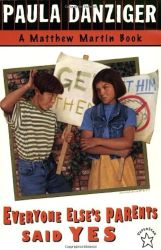
In Everyone Else’s Parents Said Yes, young Matthew is about to hit the big time. Ten. Double digits. He is beyond excited. With his computer, he has created a bounty of lists — the junk foods his health-conscious mother only allows him once a year, the guest list, the complete itinerary that involves Nintendo tournaments and pestering his older sister Amanda — or, as he likes to call her when she’s bothering him, “runt-chest”. (My favorite line from this book, wholly unnoticed reading as a kid: “Matthew, please don’t refer to your sister as runt-chest. In fact, please don’t refer to your sister’s chest at all.”) Matthew’s occasional — okay, constant — pranks against the girls in class result in them forming a group called G.E.T. H.I.M, which makes him the subject of their collective prankery and culminates in their staging a singalong protest outside his house at his birthday party. The nerve of these junior high broads!

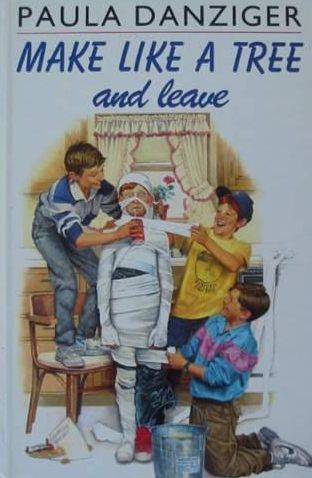
Make Like a Tree and Leave is second in this series, in which the undersized and over-energetic prankster Matthew is dismayed to learn (along with the rest of his class) that one of their elderly neighbors has been badly injured and will have to sell her land to pay hospital bills. The woods she owns are a favorite running-about place of Matthew and his classmates, so the kids decide to start raising funds however they can to help an adult effort to establish a conservancy that will protect the elderly lady’s property. The kids promptly split into girls vs boys teams, but when the two begin sabotaging one another, Matthew acquires a sudden bolt of maturity and argues that The Cause should be more important than fighting. He finds an ally among the girls in Jil!, and all things end happily — except for the child of one of the teachers, who evidently died of polio decades before. That little splash of cold water was not something I noticed reading this as a kid. Also, Matthew inadvertently traps one of his friends in a full-body cast while trying to create an exhibit for their ancient Egypt project.

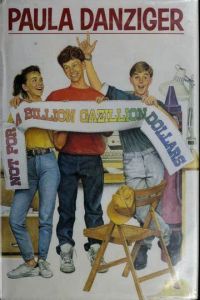
In Not for a Billion Gazillion Dollars, Matthew is bound and determined to get The Best Computer Program Ever. Reading this as a 30-something techie in 2023 is interesting, because it sounds like a networked version of Adobe Photoshop or something similar. Adjusting for inflation, it would cost $400+ today, so small wonder that his parents refuse to pay. His winninginest smile doesn’t prevail, so Matthew resigns himself to making money himself. After he learns that no, he can’t rent out his sister’s room while she’s at college (air bnb doesn’t exist yet, Matthew, wait a couple of decades), and that no, he shouldn’t wander into traffic offering to wash windows for drivers at red lights, Matthew and his besties (Jil! and Josh) stumble upon a venture that combines their mutual strengths: printing and graphic design! It’s here that The Feelings first begin between Matthew and Jil!, something that will be explored in the next book, but which is obvious to their friends even here — Jil! draws out Matthew’s more thoughtful and mature aspects, and she’s a fun character in her own right. My favorite scene is when Matthew is pestering someone with an invisible pair of scissors, and Jil! forces him to hand over the imaginary scissors, whereupon she places them in an imaginary box, locks it with an imaginary key, and then places said key carefully in her pockets. Their mutual friends can only watch and shake their heads.

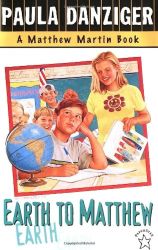
Next, in Earth to Matthew, we find Matthew and his class preparing for a weekend field trip to the Franklin Institute, a science museum on steroids, and struggling with Feelings more seriously now. One of his classmates, Jil! (she changed the spelling of her name because Jill was just so boring) and he attended a dance together, and now they’re drifting into becoming a pair. Considering that in the first book Matthew was using his computer to create “GIRLS KEEP OUT” signs, and disappointed and bothered by some of his friends’ disinterest in making their own, that’s quite a sea change — but such things happen with puberty. Both kids are struggling with these feelings and the expectations that follow them: are they supposed to be A Couple now? What does that mean when you’re eleven? Their confusion leads to fighting, but by the end they’ve found a place where they can co-exist.

I thoroughly enjoyed going back to this series, and will be holding on to the used copies I found on ebay so I can jump back into the mid-nineties, a time for me that is unique and special and wonderful because it was when I was growing up. I noticed some weaknesses in the writing (a penchant for showing and not telling ) that I wouldn’t have seen as kids, and suspect that this series contributed heavily to my love of puns, considering that wordplay is one of Matthew’s favorite ways to annoy his family, friends, and archenemy Vanessa. (Which is odd, considering that he’s also a terrible speller — but all of his puns are audible ones.) Reading as an adult, I noticed a few little jokes Danzinger included for parents who might have been reading these out loud, and appreciated the moral elements in every story. These tend to be a little obvious, like when the class does an environmental project, or Matthew’s dad tells him about his young-man problems with credit card deb, but there are more subtle ones as well.

Posted in Reviews | Tagged , , | 1 Comment

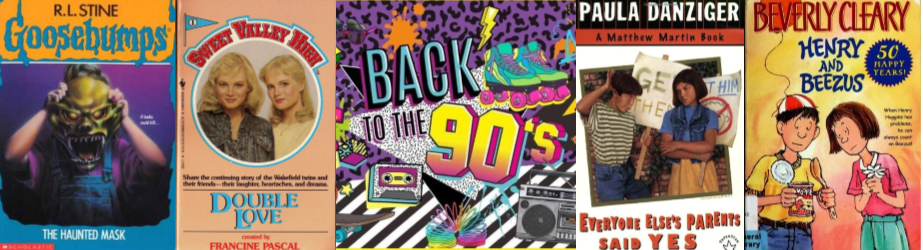
Blast from the Past: NINETIES KIDLIT WEEK!

Featured so far:
The Henry Huggins / Beezus and Ramona Quimby books
The Matthew Martin series by Paula Danzinger
The Boxcar Children
Goosebumps

Welcome to a special week here at Reading Freely, in which I’m going to be revisiting some of the books I was reading as a youngun’, with a special emphasis on series that were written during the nineties themselves. Each day will feature a different series, from which I’ve reread some books in the last couple of months. If you didn’t have the good fortune to be a kid in the nineties, this week’s postings may be wack or even lame but for readers my age, or for those who were otherwise exposed to these series (or shared them with your own mini-me’s), hopefully this will be a fun ‘blast to the past’. So…stick a straw in your CapriSun, grab your Fruit by the Foot, take off your sticky candy ring, and settle in for some reading that’s all that and a bag of chips. Feel free to share your own fun kid reads, especially those that were da bomb dot com.

As posts roll out this well, they’ll be featured above. In the meantime, take a look at reviews / look-backs from a few other books I read as a wee bairn.

The Indian in the Cupboard
Where the Red Fern Grows
The Adventures of Tom Sawyer

The Little House on the Prairie
Redwall

Posted in General | Tagged , , | 7 Comments

We Have Capture

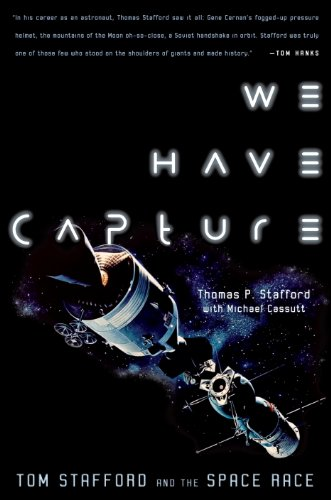
Tom Stafford is the last man of Gemini, having outlived all of his previous colleagues. Born in 1930 on the Oklahoma plains, he sought escape from poverty like many through the armed forces. Though too young for World War 2, he found his home in the newly-made Air Force, and served in Korea before his childhood love of the stars and love for flying the newest and most interesting vehicles prompted him to apply for NASA, where he became a member of the New Nine. (He was a man to hedge his bets, though: he’d applied for Harvard Business School and attended class for all of three days before Deke Slayton rang him up and asked if he was still interested in going to the Moon.) Stafford would fly in both Gemini and Apollo, and develop a name for himself as Mr. Rendezvous after being the first to rendezvous with an object in Earth orbit. Stafford does not dwell on this accomplishment in We Have Capture, but focuses more on his role in American-Soviet relations. Though the other astronauts occasionally met Russian cosmonauts at flight shows and the like, it wasn’t until the Apollo-Soyuz capstone mission that genuine relationships began to grow, eventually culminating in larger projects like the International Space Station. Stafford became close friends with Aleksei Leonov, Russia’s first space-walker, and was able to learn about the Soviet Union’s own mishaps and near misses (Leonov was very nearly killed attempting to return to his capsule), including deaths in their program. He also grew to appreciate the fact that the cosmonauts were ordinary and often likable men, doing their best in a harsh system. As a way of paying tribute to his friend across the ocean, Stafford devotes part of his biography to covering Leonov’s as well, though not to the same degree as Two Sides of the Moon. Stafford went on to greater responsibilities, including commanding his old stomping grounds of Edwards Air Base and Groom Lake, otherwise known as Dreamland or Area 51. (Says Stafford: there are no aliens at Groom Lake. There was, however, a small fleet of Russian planes, obtained through mysterious means.) We Have Capture is a very accessible and personable Apollo memoir, from a man who is solidly straightforward and likable.

That ends Space Camp for this year, though there may be a couple of space books later in the month: I ordered a memoir (Off the Planet) from an American astronaut who spent several months on Mir, and there’s still a lunar novel I’m thinking about trying.

Posted in history, Reviews | Tagged , , , | 4 Comments