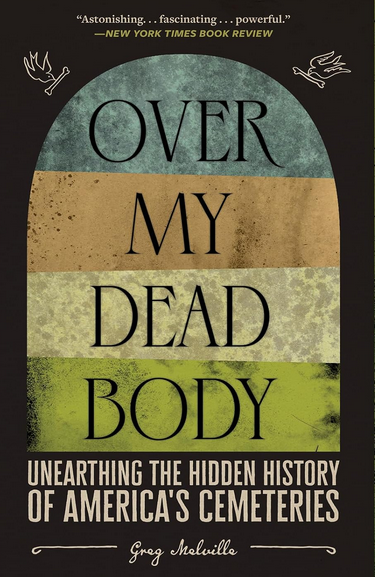
Over my Dead Body: American Cemeteries

“There is glory in graves; there is grandeur in gloom”. So begins a poem inscribed on an elaborate tombstone in my favorite cemetery, Selma’s own Old Live Oak. Perhaps it was growing up in a city with such a picturesque cemetery that gave me my interest in them — at least, old ones. Modern cemeteries made for machines — and specifically, with no monuments and memorial stones designed so that lawnmowers can pass over them — hold zero interest for me. Given that it’s spooky season, I thought it might be interesting to look for a history of cemeteries. Over my Dead Body is a mix of cemetery history and cemetery tourism, though the history is sketchy and the tourism is mostly prominent places like Hollywood’s celebrity necropolis or — interestingly — Central Park. I enjoyed it in parts, but not consistently, and developed an acute dislike for the author’s frequent personal anecdotes about eating vegan at his friends’ house or boring his daughter wih dad-jokes. Other readers’ taste may vary.

Although there’s a chronological orientation to this book, it’s not a straightfoward history of American cemeteries. We do begin with Mississippi mound-builders and the graves at Jamestown and end with a modern push for ecologically-friendly burial practices, but in between it’s more focused on the ‘hidden history’ aspect, and not so much American cemeteries in general. There’s a chapter on the destruction of native American gravesites, for instance, a look at segregation’s expression in burial practices, the role of Chinese labor in the west, and so on. A few chapters do serve to illustrate American funerary practice in general, like the section on how the American Civil War changed perceptions about death and began leading to embalming becoming more popular, to the point that the grotesque practice is now the default option in the US (and no where else, thankfully), but it’s more focused on special subjects. I enjoyed the book when it was focused on the cemeteries, as the more I read the more suspicious I became about its merits as a history: he attributes Lincoln’s speech at Gettysburg National Cemetary to bolstering the president’s reelection bid, and not, say, Sherman’s successful drive into Georgia during the election season. His treatment of the Civil War is uniformly egregious, so that’s not surprising.

While I enjoyed this in parts, I found the author more annoying than not — in his frequent off-topic anecdotes, in his modern contempt for anyone in the past who didn’t have the right politics — and was disappointed by the book’s contents, which focus either on small topics or are only connected to metropolitan cemeteries. There’s little here on the ordinary history of cemeteries, or how they may reflect their region’s culture — like the use of shells as decor in coastal cemetaries, say. There are some interesting stories in here, like Central Park’s popularity as a place to disperse ashes, but it’s not one I’ll remember and reccommend.

Coming up:…I’m going back to a book I started last year for spooky season, a celebration of obituary writers. I’ve read the author previously, so I’m looking forward to it.

Related:
This Republic of Suffering: Death and the American Civil War
Smoke Gets in Your Eyes (and Other Lessons from the Crematorium). A much better history of funerary practices in America.

Quotes:

Cremation in the ancient world was difficult and dependent on an ample supply of trees. The human body is two-thirds water, after all, and it takes about 1,000 pounds of wood to produce enough heat to turn one person to ashes.

For me, romance involves seeing dead people. For my wife, Ann Marie, a physician who generally likes to keep people alive, not so much.

A body buried in America today doesn’t actually become food for worms or push up daisies. Typical graves are like mini Superfund sites. America deposits about 4.3 million gallons of toxic embalming fluids—including 800,000 gallons of formaldehyde—into the ground yearly, according to the Green Burial Council. We also inter 20 million board feet of wood, 1.6 million tons of concrete, and 81,000 tons of metal. In addition, human
remains contain mercury from fillings, metals from pacemakers and other devices, and potent pharmaceuticals like chemotherapy drugs, which leach into the soil. Then there are the chemical fertilizers, herbicides, and pesticides cemeteries use to keep the grass above the graves looking pristine, which requires regular mowing from exhaust-belching, fossil-fuel guzzling machines.
Posted in history, Reviews | Tagged , | 3 Comments

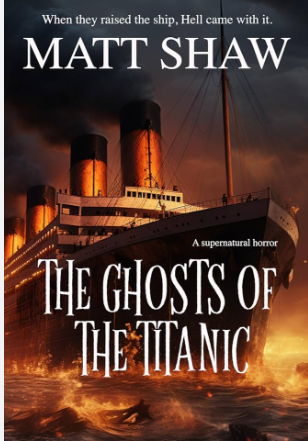
Ghosts on the Titanic

Billionaire Jackson Riggs has a plan: raise the Titanic! Currents and bacteria are steadily eating away at it, so if the Mary Rose can be brought to surface, why not the big T? (Well, 40 feet versus 12,500 feet….) So he does, to no international friction whatsoever beyond a reporter asking him if he feels strange at all disturbing a mass grave. The ruin (presumably just the bow, since the stern is a crumbled mess) is put on display in the very shipyards that built it, and the locals — demonstrating an astonishing knowledge of history — are a bit uncomfortable with that. It’s like the doomed ship has come back to haunt the community that built it. And…so it has, because not only do bits of the ship begin falling off and destroying people (tut tut, they should’ve worn gloves and helmets), but then people began committing suicides-by-drowning at 2:20 am, the very minute that Titanic surrendered to the cold deep of Oceanus. Evidently the ol’ girl still possesses the spirits of those who died aboard her, and they’re taking out their revenge on the descendants of those who built her!

…and that’s the story. It’s really just a novella. Can’t say I was impressed by it: the initial premise is interesting, but there’s no consideration given on how difficult an enterprise raising a substantial part of the Titanic would be, either from a physical point of view or from the fact that outcry would be huge. At the moment robots can photograph the interior of the bow and do shot-for-shot comparisons, seeing things as they were — if sunk. Begin moving the ship, though, and all manner of disturbance is going to happen inside, so I can imagine the scientific community alone getting incensed about this prospect. We see none of that here, though, and the mass suicides are only creepy when we witness the first one, and after that there’s a lot of cops wandering around thinking all this is really weird, and then someone else dies a different way and the story ends. There’s no unearthly whispering, no ghostly eyes of Captain Smith staring in recrimination at the billionaire, nothing really horror-like save for the first drowning scene. It’s not a developed story, to be frank.

On the bright side, this book made me aware that the Mary Rose wreck exists!

Posted in Reviews | Tagged , , | 6 Comments

WWW Wednesday

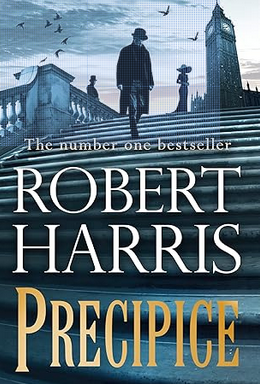
WHAT have you finished reading recently? Precipice, Robert Harris. I found it enjoyable enough to finish, but it was distinctly underwhelming.

WHAT are you reading now? In addition to the things I’ve started but have not yet continued in earnest, I just picked up a Mafia history called Borgata: Rise of Empire, A History of the American Mafia. It’s a history of the Mafia by someone who was imprisoned for being a member of la cosa nostra. While I’m not particularly impressed by the tone (it’s extremely casual for a history), so far I’ve liked his dive into Sicilian history and its importance in shaping the origins of Mafia culture. I should not be reading about the Mafia, I should be reading about inter-war Germany.

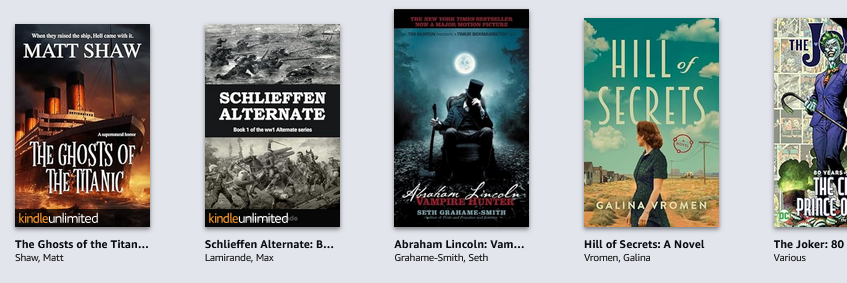
WHAT are you reading next? In addition to the things I should be reading, I just saw another Titanic horror novella (how is this a genre), an alt-history in which Germany seizes Paris early on, annnnd Abraham Lincoln but with vampires. The last title would be of no interest except for the fact that it’s October, i.e. Spooky Season. Amazon also gave me a book for being a Prime subscriber, which is about the Very Secret Science being done at Los Alamos in the 1940s. I should pair it by watching Oppenheimer. Oh, and I’ll probably start The Grandest Stage, a history of the World Series, this month, given that the series will be starting in a few. My Red Sox didn’t make it, so I’ll be rooting for the Braves (my closest regional team) and the Orioles (who have a local boy playing).

Today’s prompt from Long and Short Reviews is….”something that was better when you were a kid”. Well, I didn’t have to listen to people’s inane phone conversations literally everywhere there are people. That was nice. Even better, people were walking around, not shuffling along staring down at a device 10 hours a day, or blocking an entire aisle in the store because they’d decided that This is The Place to have an extended conversation about medical matters while their cart is parked sideways. Nevermind the strangers who just want to get past and get some coffee or pickled okra or what-have-you. (Yes, I’m a crank. I’d tell you to get off my lawn but I’d honestly be relieved you were outside instead of screen-bathing.)

Posted in General | 10 Comments

Precipice

Summer 1914: there’s a man dead in Sarajevo, and ominous rumors of war are drifting from eastern Europe. Across the Continent, war machines are slowly cranking up. At 10 Downing Street, though, the long-serving Prime Minister has more pressing issues: why hasn’t his young quasi-girlfriend written back yet? Three letters a day he writes her, and she’s getting very bad about responding promptly. Such a wicked girl! But so loving, and sympathetic, and – oh, why won’t she write already?

Precipice is Richard Harris’ latest novel: though he’s known for thrillers, Precipice isn’t exactly exciting. It’s an interesting through-the-keyhole kind of novel as we witness the first two years of the Great War as experienced by Britain’s leadership: Winston Churchill and Admiral Fisher are prominent characters, and Lord Kitchener (you know his face even if you don’t know his name) also appears quite steadily. The novel takes us through the war through its two principal characters, Prime Minister H.H. Asquith and Venetia Stanley, a woman his daughter’s age. The PM and Venetia have an interesting relationship going on, reminiscent of courtly love: while they’re not physically intimate they frequently go on drives and write extraordinarily emotional letters to one another. We experience much of the war not through debates in Cabinet — though there are plenty of scenes there — but through the news that Asquith shares (quite inappropriately) to Venetia, including forwarding her classified letters and telegrams. Because Asquith has a horrible habit of chucking them out the window (littering as well as being negligent with state secrets!), some of these telegrams are found, the police are involved, and —

Here’s the thing. If all this hadn’t happened, there could have been an interesting story here in which a prime minister’s affections for a young woman half his age leads to public scandal, his resignation, and a change in the war: instead, Harris sticks to the facts and we get a mild soap opera with no serious drama. British intelligence knows about the passing-on of intelligence, but they appear more interested in learning about the war via the letters than they do reminding the PM of his duties toward the Realm. Oh, one could argue that the PM distracting himself with this courtship undermined his effectiveness as PM, and Harris certainly tries to tie the reckless treatment of telegrams to the logistics issues Britain was having, with some characters commenting to the prime minister that boy, wouldn’t it be nice to have Kitchen’s reports on munitions before addressing Parliament? Don’t you think you could find the letter, Prime? Perhaps write another letter to Venetia and ask her to retrieve it from the shoebox she’s keeping state secrets in! In the end, the story simply….ends. Frankly, I think Harris would’ve been better served with a fully fictional novel inspired by these events, where he would be at liberty to have exciting arrests and powerful speeches and wrenching sobs and all that. As it was, this novel was interesting enough to keep me reading, and it does offer the slightly voyeuristic pleasure of reading a prime minister’s love-letters.

Posted in historical fiction, Reviews | Tagged , , , , | 4 Comments

Top Ten Bookish Brags and Confessions

Today’s TTT is Bookish Brags and/or Confessions. But first, the tease!

“Imagine it — to be the King-Emperor of nearly five hundred million subjects and to be able to locate the twelve dullest, then gather them together around one table. It takes a special kind of genius.”

“The government seems to be very popular. You’d think we’d already won.”
“I don’t much care for it,” said the Prime Minister. “It reminds me of Walpole’s remark before the war with Spain. ‘Today they are ringing the bells; soon they will be wringing their hands.'” (Precipice, Robert Harris)

So….bookish brags and confessions. I’m going to kick off with a brag and alternate!

(1) I have read War and Peace, and in my review I posted “Bragging rights for life”.

(2) It took me three attempts to finish Catch-22 and that was with partial help from some CliffNotes-like web resource.

(3) I read The Glory and the Dream, a 1400 page social history of America in the 20th century, in middle school. I suspect I was the only kid in the history of the school to do it!

(4) The version of Hunchback of Notre Dame I read from in my library turned out to be abridged. I’ll have to do the full thing at some point, maybe if I get in a French mood. Rewatching Mon Oncle may do the trick. (Click to listen to its delightful, ear-wormy soundtrack.)

(5) In 2007, I read the entire Harry Potter series through for the first time in about a month: the back half of August and the first week of September, specifically, being delayed slightly by Deathly Hallows still being a waiting-list book.

(6) In the 2012 Bookish Confessions top ten Tuesday post (holy cow, we’ve been doing this for a while), I said:

.Although I’m hostile toward digital readers, I’ll probably wind up buying one within the next five years. My rising Luddite tendencies notwithstanding, my job as a reference assistant often entails helping people with computers, and increasingly their own wireless devices. If touch-screen interfaces are the way of the future, I need to learn to navigate them to function out in the world. Of course, at home I can be as tech-free as I want.

In February 2016, responding to an essay I’d written critical e-readers called “Go Go Gadget Literature?“, I sheepishly admitted to having bought a Kindle in 2015 at some point. Today ebooks generally claim about half of my reading, though I haven’t used my actual Kindle in years. The Kindle app on my phone & the Kindle Cloud Reader are my main e-reading sources. And be it noted, I’m not quite ‘tech-free’ at home: for the last few years I’ve used a Google Nest Hub as a virtual photoframe and an object I can demand the time from in the middle of the night. (I use British Racing Green as my Google voice. I like having a posh personal assistant, even if she’s hopeless with Spanish place names like “Valley Grand-dey”). 2012 me also knew which way the wind was blowing: I’m absolutely fluent in both ioS and Android.

(7) My highest-bookcount year remains 218 in 2009. Looking at the list, it’s easy to see why: lots of fiction, as that was the year I discovered Greg Iles, Steven Saylor, and Robert Harris — not to mention plowed through the entire Series of Unfortunate Events. I was also obsessed with religion and philosophy that year, reading books on Buddhism, neopaganism, Christianity, and Stoicism.

(8) I once had an entire bookcase devoted to nothing but Isaac Asimov (five shelves!) but in time have reduced it to two shelves. Most of the discards were science essay collections I’d knew I never re-read — or read, seeing as some of them I’d procured in lots from eBay and were hopelessly outdated.

And because I don’t resist puns, here are our last bookish Braggs and Confessions.

I will literally not resist an opportunity for a pun.
Posted in General | Tagged , | 19 Comments

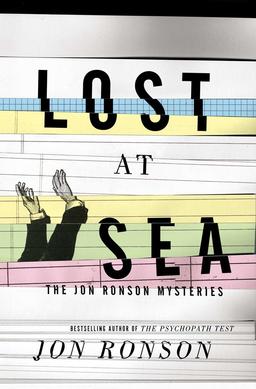
Lost at Sea: The Jon Ronson Mysteries

I’ve been wanting to revisit Jon Ronson and Will Storr, whose books visiting extremists and cranks were both amusing and thought-provoking: October seemed an appropriate month to do so, given their tendency to visit the strange. This collection of pieces from the 1990s and early 2000s is varied both in subject and quality, ranging from the amusing (Ronson re-creating James Bond’s Aston Martin drive across France in one movie, complete with matching him drink for drink at a hotel) to the disturbing, as when he spends time with a convicted serial pedophile who got a relatively light sentence because of his fame. It appears to be more a collection of miscellany than anything else: although the “hanging out with people who believe weird things” is a consistent presence here, it’s not dominant enough to be the main theme. The only thing that links them is Ronson himself, whether he’s talking to a man once arrested for trying to split atoms in his garage, or talking to cruise ship crew about a young woman who disappeared from the boat at sea. Although there’s humor here, between the child molestation and the debt-induced family slaughter and suicide, this was generally fairly grim and uncomfortable reading.

“Don’t think of her as psychotic,” Bruce says. “Think of her as a three year-old. If you try to interview a three-year-old, you’ll think after a while that they’re not living in the same world as you. They get distracted. They don’t answer. Hang on.”
He does some fiddling with Bina48’s hard drive.

I spent a week sending e-mails: “Dear Lady, I’ve read that, if the portrait in your drawing room is moved, a ghost is apparently disturbed and manifests itself. Recently I have been contacted by the pop star Robbie Williams who would like to spend a night in a haunted house and so Iwonder whether he and I can pay a private visit.”
I expected not to hear back from anybody, but, in fact, once I invoked Robbie’s name, owners of country piles started flinging their ghosts at me as if they were their debutante daughters

Six of last year’s middle school elves, now aged thirteen, were arrested
back in April for being in the final stages of plotting a mass murder, a
Columbine-style school shooting. The information is sketchy, but
apparently they had elaborate diagrams and code names and lists of the kids they were going to kill. I’ve come to North Pole to investigate the plot. What turned those elves bad? Were they serious? Was the town [of North Pole, Alaska] just too Christmassy?

Coming up….Robert Harris’ latest, Precipice, following a lovelorn p.m, as he tries to steer Britain through the Great War.

Posted in Reviews | Tagged , | 3 Comments

“Reader’s Advisory: Thrillers!”

Grad school has kept me very busy this semester, with serious deadlines every single week. It would be the reason I haven’t posted any reviews in the last week, though there are a couple upcoming, if only in a short-round form. Tomorrow’s assignment was to create a book brochure & accompanying video promoting “Thrillers”. (Thrillers was my topic — others got banned books, Hispanic Heritage month, etc.) I have almost no experience with video editors (having used Windows Media Maker for very primitive projects), so I’ve been getting accustomed to Filmora today. This is the video I uploaded for class, and while it has its problems (some vocal pauses, no transitions, etc), I thought it would be interesting to share here given that all the books I talk about are ones I’ve reviewed here. I should note that this video is presented as if it was part of a bimonthly series, but my library has no YT presence — and that “address” for a mailing list is intentionally incorrect, though the library interior shots are from the actual place I work. The Natchez shots were all taken from my visit there last December, wholly inspired by Iles’ books set there. This was an interesting experience, altogether — writing a script, trying to record without echos/dogs parking/random people screaming/etc, then pairing visuals and audio.

Anyway, I am to finish Precipice tonight and post a couple of reviews to get the week started.

Posted in General | Tagged , , , | 8 Comments

Wednesday memin’

WHAT have you finished reading recently? A Prophet without Honor, an alt-history novel told in letters about a German officer who leads to Hitler’s downfall in 1936.

WHAT are you reading now? Precipice, Robert Harris. As Europe drifts into suicide in autumn 1914, the British p.m. is undone by an affair.

WHAT are you reading next? Will focus on All Power to the Councils, I think, for the Germany interwar series.

Today’s prompt from Long and Short Reviews is: What genre do you want to read more of?

Hmm. Science fiction, I suppose. I know that sounds wild because it’s a healthy category, but I don’t feel like I read a great deal of it, and a lot of my SF is just technical thrillers set a bit in the future. Looking back on the year, I’ve read maybe five real SF stories, stuff like Dune, The Dispossessed, and Shelli. There’s so much SF I haven’t read, like almost all of Heinlein, bar a few titles like Starship Troopers and The Moon is a Harsh Mistress. There are other SF greats like Ellison whom I’ve never touched.

Apropos of nothing, here’s some music. I stumbled on it while trying to find the name of the “Play the sunset!” piece in Mr. Holland’s Opus and keep listening to different covers of it.

Posted in General | Tagged , | 18 Comments

Top Ten Teases, round 2!

This week’s Teaser Tuesday!

“My darling Rosamunde, I don’t wish you to remain in suspense during the reading of this letter. This is a proposal of marriage.” (A Prophet Without Honor, Joseph Wurtenbaugh and Manoj Vijayan)

[…]
“My demented sister, This morning our mother presented me with news so horrifying my hair literally stood on end. She informed me that Heinrich Haydenreich had proposed marriage to you, and that you had accepted.” (Ibid)

The Confessions is one continued and coherent prayer, a profound profession of faith, and a plea for more, ever more wisdom, ever more love. It is artistic in its whole conception, in its parts and their arrangement down to the merest sentence. It is closer to the Gothic cathedrals that would grace Europe eight hundred years later than to anything that you or I might write about ourselves and our lives. (The Confessions, trans. Anthony Esolen. From the introduction.)

The house of my soul is too cramped for you to enter: make it more spacious. It is falling to ruin; repair it. Much inside it offends your sight; I know it and I confess it. (Ibid)

Today’s Top Ten Tuesday is books we’ve avoided because of the hype, but I think falling so hard and so fast for Harry Potter cured me of that back in 2007. Instead, I’m going to share my top ten favorite book teases from the last year, celebrating two years of perfect-attendance Tuesday Teases. If you like teases, check out last year’s as well!

“You mean you ain’t going to drink no more?”
“I mean I’m taking it one day at a time.”
“But if you don’t drink no more, then how come you got beer in your refrigerator?” “Hard to say goodbye.”
“And you got a lot of whiskey under your kitchen sink too.”
“What are you, the Southern Baptist Convention?” (Kinfolk, Sean Dietrich)

McCoy shook his head. “Unbelievable. An emotional Vulcan who’s having problems with telepathic humans. Did we cross over into an alternate universe again? (Star Trek: The Higher Frontier, Christopher L Bennett)

In the end, Lizzie chose insult by way of Shakespeare. It felt more dignified. “I do wish that we could become better strangers,” she said coldly. It took Collins a moment to register her jab, and his faux polite expression darkened into open resentment (Pride and Premeditation)

“Are you busy with something?” said the Major. “You can always call another time, when your paperwork is finished.”
“No, no, it’s just a final deal book I have to read—make sure all the decimal points are in the right place this time,” said Roger. “I can read and chat at the same time.”
“How efficient,” said the Major. “Perhaps I should try a few chapters of War and Peace while we talk?” (The Major’s Last Stand)

<Jennifer to Beth> Aren’t you missing the point? Clark Kent doesn’t want to be famous. He doesn’t want people to look at him. If they really look at him, they’d see that he’s just Superman with glasses. Plus, he needs to be someplace like a newsroom, where he’s the first to hear big news. He can’t afford to read “Joker attacks moon” the next day in the newspaper.
<Beth to Jennifer> You make an excellent point. Especially for someone who doesn’t know that Superman never fights the Joker. (Attachments, Rainbow Rowell)

“This is interesting, meeting you here,” said Madred.
Placing his spoon next to his bowl, Garak clasped his hands on the table. “It was my understanding that being forced into exile meant never having to see people I don’t like. Leave it to Central Command to fail at something so simple.” Star Trek: Pliable Truths

He winked at her when he handed over the reins. “The English breed fast horses and beautiful girls, my lady. I enjoyed sampling one of the two.” Millicent mounted quickly and looked over her shoulder at the bold young Welshman. “It is well you chose the one you could handle, my lord,” she said, wheeling the horse around and digging her heels into its flanks. (The Broken Realm)

Boredom, I knew, was a dangerous thing. For some children, it led to experiments with sex, and drugs, and alcohol, and lighting one another on fire, sometimes with the alcohol. For some of us, the never-ending rural ennui led to destructive habits with literature. (The World’s Largest Man, Harrison Scott Key)

If we let ourselves, we shall always be waiting for some distraction or other to end before we can really get down to our work. The only people who achieve much are those who want knowledge so badly that they seek it while the conditions are still unfavourable. Favourable conditions never come. (The Weight of Glory, C.S. Lewis)

Will you come forward and tell us your name?’ she says.
‘Rarrrrrrrgggggggghhhhhhharrrrrrr!’ says Steve, even louder than
before.
‘Please be gentle on the medium,’ says Penny.
‘Hoooooooaaaaaarrrrrrgghhhhh,’ says Steve, louder still, his neck jutting out and his head moving from side to side, like a riled T-Rex in an old Hollywood film.
Will Storr vs the Supernatural

Posted in General | 11 Comments

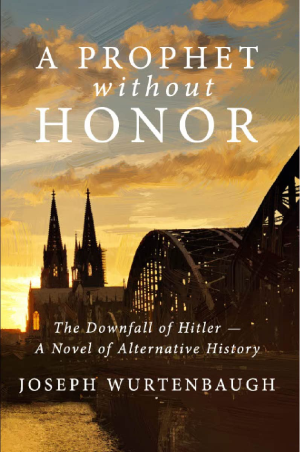
A Prophet Without Honor

. ‘And you do not believe this is betrayal?’
‘My Fuhrer, I have never confused the Nazi Party with the German nation,’

A Prophet Without Honor without a doubt one of the more interesting alt-history novels I have ever read, in part because it is told not through a straight narrative, but via a collection of excerpts from letters, journals, telegrams, and histories with varied viewpoints. The reader realizes quickly we are heading into a different timeline than our own — one in which the Wehrmacht rebelled against Hitler in 1936 — but the story is learning how that happened, and more pointedly in getting to know the man who was most chiefly responsible for that rebellion. This is the story of Karl von Haydenreich, the grandson of a vicious anti-Semite, the son of a principled aristocrat and the stepson of a Jewish woman who the Spanish flu bore away to eternity. Although interesting for its initial premise, this novel’s commanding character drama drove it into the ranks of superb storytelling.

A Prophet without Honor is first and foremost wonderful character drama. We are first introduced to the Haydenreichs via Karl’s father, Heinz, a man who has been forced to deal with tending to his family’s estate after creditors realized his father was absolutely hopeless on financial matters, and his elder brother was little better. Heinz is largely alienated from his family, who regard him as a spineless effete with far too much tolerance for Germany’s enemies, even permitting his wife Lottie to maintain a close friendship with a Jewish woman named Rosamund. When Lottie dies in childbirth giving the world young Karl, Rosamond becomes the children’s unofficial governness — and then, their stepmother, after Heinz and Rosamund fall in love over the course of time. Although Karl will have a youthful dalliance with the exciting Nazi party in his teens, thanks to a summer spent with his hateful grandfather, he is far more his father’s son than his grandfather’s, and joins the army (Reichwehr) out of concern that Germany is sailing into treacherous territory and will need a stabilizing force if it is to survive. The interesting thing about A Prophet is that, beyond the core “Nasties”, few people in this novel are absolutely rotten or virtuous: Heinz’s brother repents of being a bigot on his deathbed, and Karl’s best friend Albert remains wholly sympathetic to the causes of National Socialism even as he aids in some of Karl’s late-novel plans to save those who can be saved. Another character, who is steadily sympathetic, exposes himself at the end as fundamentally lacking in character. Karl’s own experiences as a teenager during the 1923 putsch — witnessing Hitler flee the scene rather than stand and fight with his men — privately galvanize him against the ‘little corporal’, even as he enjoys favor from the upper ranks thanks to his impetuously joining the party as a teenager, and his grandfather’s material support of the NSDAP. A key component of the story is the accidental friendship that emerges between an American officer stationed in Germany after the war — some fellow named Eisenhower who later becomes a military attache — and the Haydenreichs, so much so that “Ike” becomes a godfather and mentor to Karl. When Karl begins expressing doubts about the integrity of Hitler, Eisenhower is only happy to offer him support — and their bond becomes a means of intelligence passing into Allied hands that make the re-militarization of the Rhineland quite different.

In short, this is quite a compelling novel, though it’s unclear as to what happens in Europe after Hitler is removed from the scene: there are occasional hints that de Gaulle rises to power and gets up to mischief, and other hints that Bolshevism runs riot, but these are coming from contradictory sources who we have gotten to know over the course of the novel, and can’t completely trust. While I certainly don’t profess to be an expert in German history, the interwar history has been of morbid interest to me for decades, and lately I’ve been reading more into it: Wurtenbaugh appears to tack pretty close to the changing zeitgeists of the age, made especially obvious in characters whose spirit and morality are sometimes hard to box up. Definitely recommended to alt-history fans who want something more than “WW2 but Hitler wins” or “WW2 but there are space lizards“.

Highlights:

My darling Rosamunde, I don’t wish you to remain in suspense during the reading of this letter. This is a proposal of marriage.

My demented sister, This morning our mother presented me with news so horrifying my hair literally stood on end. She informed me that Heinrich Haydenreich had proposed marriage to you, and that you had accepted.

We are going to be coming home to a different world, a different Germany than the one we left, Willy. There are too many angry men, too many grieving women – too much blood, too many tears, for anything to be left unchanged. Does anybody even remember why this war began? Or what is the great reason why so much human misery had to be inflicted? I surely don’t. The people will demand answers, and there are none to give.

There is a French saying, si jeunesse savait, si vieillesse pouvait – if youth but knew, if age but could.

But it is my belief that it befalls to every man to meet one woman who haunts his life, who both comforts and afflicts him.

‘I feel I must justify this in my own life somehow,’ [Karl] said. ‘There must be a reason why I alone am left out of all of them.’

These [SA] men were not traitors to Adolf Hitler. The truth was that they were fanatically devoted to him, always had been, and remained devoted even now. They had exhibited that devotion throughout the morning, making grim, comic fools of themselves – pledging their loyalty to, or attempting to salute, a man shouting maniacal denunciations in their faces — even as they were being thrown into cellars. Murderers, sadists, pederasts, human vermin – all true. But traitors? Perhaps this was the only accusation of the lot that was not true. The truth was he was the traitor to them. Hitler continued to rage, refusing to be calmed. The word ‘rabid’ sprang to mind. At times, he had actually foamed at the mouth. He knew that the accusations he was shouting were absolute lies. I knew he knew and then, all at once, I fully understood the mechanism. He used the sheer magnitude of the lie to his benefit. He transformed the energy he had to exert to force himself to believe this preposterous hypocrisy into a manic, hysterical rage that swept aside all opposition, including his own awareness of the truth. The objects of his fury were too cowed and intimidated by its intensity to give him the lie. As I watched, he drove himself to even stormier heights.

I’d already seen and heard enough of the Third Reich to know where my real duty lay. The hell with practicality.

‘It is your honor that must compel you, Werner. The pistol is only there in the event you misjudge it.”

“I will use my little broom to brush away what muck I can. It is not possible to cleanse it all, but the house can be made cleaner. That will be my life’s work.”

Posted in Reviews | Tagged , , , , , | 2 Comments