- Follow Reading Freely on WordPress.com
Reading Now
-
Recent Posts
Categories
Blogroll
- Seeking a Little Truth
- The Social Porcupine
- Inspire Virtue
- Classics Considered
- With Freedom, Books, Flowers, and the Moon
- The Inquisitive Biologist
- Relevant Obscurity
- Trek Lit Reviews
- Stoic Meditations
- A Pilgrim in Narnia
- Gently Mad
- The Frugal Chariot
- The Historians' Manifesto
- Classical Carousel
- Lydia Schoch
- The Classics Club
- Fanda Classiclit
- Reading In Between the Life
- The Bilbiphibian
Archives
Meta
This Week at the Library (16 November)
The postman was kind to me this week, delivering a batch of reading I’m very much looking forward to. Some of the books I received include works I’ve been intending to read all year long: Neil deGrasse Tyson’s Space Chronicles and Charles C. Mann’s 1493: Discovering the World Columbus Created. Adding to that is The Humans Who Went Extinct, which I’ve had on my ‘book wishlist’ since its inception, and the most recent book in the Star Trek Voyager Relaunch, The Eternal Tide. And who is that on the cover?
Janeway’s back and you’re gonna be in trouble
Hey-la, hey-la, Janeway’s back…
Oh, what fun times we’ll have. Also, to go along with The Humans Who Went Extinct, I’m going to be exploring Robert Sawyer’s Neanderthal Parallax series, which establishes an alternate universe where Neanderthals, not Homo sapiens, are supreme on Earth. I have the first book, Hominids, checked out from the library. My reading tends to flow in moods, and right now the prevailing wind is one of natural history.
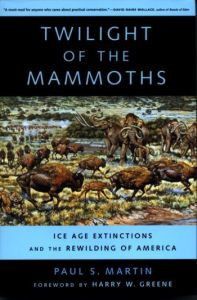
Speaking of which, I finally finished Twilight of the Mammoths, which I began….months ago. I’d wanted to learn more about the megafauna that dominated the Americas before humans arrived. I’m utterly fascinated by the idea of primitive North America as a land of lions and cheetahs, a wilderness teeming more with large life than even Africa. As it turns out, a primary source for learning about ancient mammalian behaviour is…dung. Dung is mentioned more in Twilight of the Mammoths than it is in Flushed: how the Plumber Saved Civilization. That I mark impressive, but it’s versatile stuff, dung. The oh-so-serious dung dissection didn’t interact well with my desire to be awed, so my interest trailed off until being reignited by Baxter and Pratchett’s The Long Earth, which involves as part of its setting an Earth in which humans never spread to the Americas, and so the native ecology is intact. Twilight exists to argue that human predation (“overkill”) was the primary cause of megafauna extinctions in the Americas, as opposed to climate change. In the decades since Martin released this book, I believe overkill has become the standard explanation, but even so this is a worthwhile book for the curious mind. It puts overkill on solid ground for those new to it, provides a catalog of large animals that were driven into extinction, and ends with a smaller argument advocating for the restoration of the prehuman ecology, one using still-living animals to replace the many gaps the spread of human civilization created. He suggests, for example, using camels to counter the spread of mesquite in the southwest.
Posted in Reviews
2 Comments
Read of England 2012

Last week, Britons celebrated or observed Guy Fawkes Night on 5 November, a date I usually try to do some English-themed reading around, just as I do readings for the Fourth of July and Bastille Day. This year’s reading consisted of my finishing off Bernard Cornwell’s excellent King Arthur trilogy, along with two nonfiction works: Bill Bryson’s Notes from a Small Island and Kate Fox’s Watching the English: the Hidden Rules of English Behaviour.

To start off my set, I decided to take a tour of Britain with Bill Bryson, an American humorist author who lived in England for twenty years, beginning in the 1970s. Before returning to the United States, Bryson decided to mull over his adopted homeland by traveling over it, in part repeating the journey he made upon first arriving. Bryson is a riotous author for me, and here he’s of course an entertaining guide, cheerfully rambling through the country, offering commentary that varies from serious reflections on English culture to absurd thoughts and irrelevant tangents. At the outset, when repeating his initial 1970s travels, the commentary compares the Britain of his youth to Britain today, though the changes he notes (in the flowering of chain stores, the destruction of older architectural for modern boxes) are scarcely for the better. Even so, this is a delightfully fun book.

Kate Fox’s Watching the English takes a more serious tack, slightly so. The author has a earnest endeavor — scrutinizing English culture with an anthropologist’s eye — but she offers a spirited analysis. Although her intent is to discern the rules governing English behavior by watching how Britons act, she’s no passive observer, instead turning her fellow Brits into lab rats and experimenting on them. She devotes afternoons to jumping queues (cutting into lines) and bumping into people on purpose, noting how many of them automatically apologize. As she studies one area of English life after another — work, hobbies, sex, shopping — patterns emerge, rules which interact with one another, and eventually the patterns create a cohesive analysis of English culture. Fox declares that the English are fundamentally socially anxious, and that many English behaviors act to counter that awkwardness. The weather, for instance, is not actually all that interesting to English folk, regardless how how incessantly they speak of it: instead, talking about the weather is a way to be social without being impolite, to make a human connection without seeming weird. Fox sees her countrymen and women as being desperate for fellowship, but denied it by a culture that encourages emotional coolness — reserve, moderation, and the respect of privacy. Other aspects of English culture she touches on are the prevalence of class consciousness (which is ubiquitous, being expressed and betrayed not just by the word you use to describe household furniture, but which items you are willing to buy from a Mark’s and Spencer), English humor, and a fundamental belief in fair play. While I can’t judge her book against personal experience (not yet having traveled to England’s green and pleasant land), I found it utterly engaging and entertainingly written.
Posted in Reviews
Tagged anthropology, Bill Bryson, Britain, humor, sociology, travelogue
Leave a comment
The Long Earth
The Long Earth
© 2012 Terry Pratchett, Stephen Baxter
400 pages

Suppose there were an infinite succession of Earths, and travel between them was as easy as taking a step. A new age for humanity begins when a reclusive scientist posts plans for a “Stepper” online, a relatively simple piece of machinery that is remarkable only for the potato it uses as a power source. Suddenly, the borders of states are irrelevant, and the very idea of scarcity is outmoded. Travel to the other Earths has few limits: iron can’t make the passage, and stepping between worlds induces nausea for most. But not for Joshua Valentine, a strange boy raised in an orphanage by nuns who “read Carl Sagan before they read Genesis”. When a globe-spanning corporation of infinite power and aggressive curiosity decides to launch a mission into the “Long Earth”, the chain of infinite planets humanity is now spreading into, they come to Joshua for help.
The Long Earth has a lot going for it, particularly the titular setting, which tickles the readers’ fancy with Earths-that-might-have-been, alternative natural histories. A step away, and the differences are slight: absent of humans, the Americas are still wild and home to megafauna that seem otherwordly to 21st century. In more distant Earths, evolution has taken wildly divergent courses from what Joshua would consider ‘normal’. Deep into the long Earth, there are strange and inhuman intelligences, and something is driving those that can step across the earths forward — toward the datum, and away from danger. Joshua and his companions choose to probe further into the darkness, to confront whatever lays beyond them. Throughout most of the book, his only only traveling companion is a sentient AI named Lobsang who claims to be housing the soul of a reincarnated Tibetan bicycle repairman — definitely a quirky sort. Fate seems to be an active component of the book, as there are hints that Joshua is Bound for Something, the Chosen One. He’s an agreeable enough main character, but the setting takes center stage, especially as human society begins evolving in its new boundless universe. The new abundance of resources means that gold is transparently useless; instead, bartering and the exchange of favors are king. With people breaking away into small communities that can sustain themselves through forage and hunting, human history seems to be reversing itself.
The Long Earth ends with the partial end of a journey, but it isn’t the end of the story: a second novel is in the works. I’m looking forward to it.
Reads into Reels: Timeline
Chris is a twenty-something guy with the hots for Kate, an archaeology student who is studying under Chris’s dad, The Professor. But smitten as she is by the world of medieval France, Kate won’t give Chris the time of day. Fortunately, The Professor has gotten himself lost, via time machine, in medieval France, and the Amoral Corporation responsible for this has decided to send in a bunch of archaeology students to rescue him, which will give Chris and Kate some bonding time. Sure, they’re just kids; they know nothing about self defense, they haven’t been inoculated for anything, and they apparently know nothing about the culture they’re going into except for the fact that once upon a time, Evil British guys hung a young woman from a castle under siege, and it so enraged the French army that they captured the castle in one night — but the corporation has decided to send them in instead of security goons, because they’re at least aware that the medieval world is marginally different from the modern world and won’t spend their time wondering where all the cars are.
Unfortunately for the students, not only do they transport into time right over water, they also appear right in the middle of a chase scene. Some Evil British fellows on horseback are pursuing a young French woman, and although she gets away, the aforementioned Evil Brits decide a bunch of wet young people dressed in generic-but-clean medieval clothes will do nicely. When the students are presented to the Evil Brits’ lord, Oliver, they introduce themselves as Scottish. Now, if *I* were to be transported into the court of a medieval English lord during the hundred years war, when England fought against France and its chronic ally Scotland, I would not say to the lord, “I am a Scot”. This, to me, would be like infiltrating the Taliban and pretending to be Israeli. But I’m just a lowly history student. Perhaps archaeology students possess more wisdom, wisdom that can make full use of being imprisoned in a town that will be set ablaze by an angry French army within a few hours’ time.
In present course, the kids escape through a hole in the roof, though it does them little good since the Evil Brits find out quickly enough and the Chase Scene continues until the end of the movie. The movie is in fact one great long Chase Scene, with occasional breaks for speeches and war. The chase scene could be set anywhere, and that’s the great problem with this adaption of Michael Crichton’s novel of the same name, because the novel was a unique blend of history and science fiction, but the movie is generic. In the novel, the medieval world itself presented the challenge that characters had to contend with. They had to grapple with the fact that modern English and modern French would be mutually unintelligible to the medieval forms and dialects of these languages: social mores were an obstacle that had to be navigated, as Chris learned in the novel when he accidentally accepted a challenge to a duel by picking up a laid-down glove. Here, the kids might as well as had invaded a Renaissance fair.

I watched this movie because I wanted something medieval, and because I’d read the book. In retrospect I’m glad I read the book before watching the movie, because I probably would not have read a book with a plot I thought to be as irrelevant as this. The movie’s technical setup establishes that while the Amoral Corporation was trying to figure out teleportation, their machine connected to a Wormhole that sent everything from the machine into 1357 France. Part of the reason the corporation sent the professor and the kids into the past was so that they could figure out why this was the case. This is immediately forgotten by everyone involved. The movie has exactly one interesting character, Andre Marek, who is portrayed by the film’s salvation, Gerard Butler. Butler, who also played King Leonidas in 300, appears in Timeline’s every scene of worth, starting from an early one in which a passionate Marek attempts convey the value of studying history to Chris.
The presence of two other actors is a highlight for me: Billy Connelly, who played Uncle Monty in A Series of Unfortunate Events, is a professor here, rather like Monty except that his penchant is for medieval history instead of snakes, and David Thewlis, who is the project head for the Amoral Corporation. You may know him as Professor Lupin. Predictably, the movie is poor history: the opposing armies each wear uniforms, red for the villainous English and blue for the valiant French. Each speaks modern English or French, with the only barrier to communication being that a French woman doesn’t understand Marek’s euphemisms when he attempts to chat her up. “Am I seeing anyone? I see you…”
Timeline doesn’t do justice to the book, and it’s not a particularly good movie by itself, but if you’re really in the mood for swords and bows, it should prove entertaining, especially seeing as it features Gerard Butler, who I became a fan of while watching it. You might be better off with Men in Tights, however, which has as much historical integrity and much better acting.
Excalibur
Excalibur: a Story of Arthur
© 1999 Bernard Cornwell
436 pages

In Britain’s darkest hour, a man named Arthur came to rule. With the high king dead and enemy Saxons filling the shores looking for land to settle, he confronted the tremendous challenge of uniting the feuding British kingdoms and guiding them to victory against a foe superior in numbers and in spirit. He faced adversaries from within his camp, as well, as even longtime companions proved treacherous when tempted by ambition. Now Bernard Cornwell tells the final story of Arthur with Excalibur, a fitting conclusion to an extraordinary trilogy.
The trials that Arthur has faced would break lesser men, even other heroes. It would be easy to give into despair, to abandon hope — but here in Excalibur, Arthur again looks adversity square in the face. Although an uneasy peace prevails at the start of the book, the aftermath of Enemy of God’s epic ending, for Arthur and his ally (our narrator, Derfel), the growing might of the Saxons will soon need to be reckoned with. The unity Arthur fought for seems to have dissolved, but he remains determined to defy the inevitable, and this culminates in the Battle of Baden Hill, which is incidentally the only historical reference we have to an Arthur of any kind. But Baden Hill is not the end, for this King Arthur trilogy is inspired both by history and by myth, and the final battle is between Arthur and a final betrayal, that of the dark prince Mordred. The conclusion is masterful, beautifully appropriate: this being a trilogy about King Arthur, it could not end but with a flourish.
Excalibur lives up to Cornwell’s usual legacy, but reveals an additional strength of this trilogy in particular: character evolution. Although Cornwell doesn’t shy away from writing evil characters, in the Arthur trilogy the lines between heroes and villains isn’t a clear cut. Guinevere, for instance, was utterly despicable in Enemy of God, but moves toward redemption in this final volume, while someone who has been Derfel’s friend since his childhood becomes monstrous, continuing a trend that began in Enemy of God. It points to the complexity of life, of people and our motivations, and the fact that nothing can be taken for granted.
…nothing, that is, except for the quality of a Cornwell novel. This trilogy has been absolutely stunning, and I’m sad to have finished it. Happily, though, it can always be re-read.
Posted in historical fiction, Reviews
Tagged Arthur, Bernard Cornwell, Britain, fantasy, historical fiction, Medieval, military
2 Comments
The Mark of Athena
The Mark of Athena
© 2012 Rick Riordan
608 pages
In The Son of Neptune, Percy Jackson — a demigod, the son of a human mother and Poseidon — discovered another population of half-blood like himself, a veritable city called New Rome. The Romans are hostile to Percy and his Greek brethren, but the two sides must unite against Gaea and her plans to destroy life and create it anew — which is unfortunate, because Percy’s plans for an alliance soon crumble into war. The Lost Hero introduced Jason Grace, the leader of the Romans, and in The Mark of Athena he and Percy (joined by five other demigods drawn from both of the camps) have to score a victory against Gaea before the Romans reach Camp Half-Blood and destroy it. Their quest takes them to the old world where Annabeth Chase must descend into the bowels of Rome on a private mission from Athena, one that offers the hope of achieving peace between the demigods and preventing the real city of Rome from being toasted by two campy giants.
Riordan’s novels tend toward the episodic, with a monster milestone threatening to destroy life next week if the kids can’t scamper across the continent (or the world, in this case) in two days and win out, but Heroes of Olympus has already established itself as a different beast altogether from Riordan’s previous Greek and Egyptian series. The first two novels read very similarly to the previous series: there were three characters, each trio had a private romance, and the group had to accomplish ludicrously big things alone. But Heroes of Olympus is developing into a more mature series. Now there are seven characters, each with a fascinating story to tell, and tension between them is rife. Jason and Percy are accustomed to leadership, for instance, and subtly vie for the role of alpha male. While a monster-killing mission usually drives these novels, here it’s incidental, just a very small part in the larger scheme of things, and marginalized by Annabeth’s solo mission. There are of course lots of monsters; the book writhes with urgent fight scenes against all manner of unpleasant beasts, from giants with snakes for legs to American tourists. Happily, not every fight is resolved with strength; sometimes clever escape is the best option, and the book ends by depriving two heroes even that, giving readers something of a somber cliffhanger.
Heroes of Olympus continues to delight.
Posted in Reviews
Tagged children's literature, Children-YA, fantasy, Heroes of Olympus, Rick Riordian
Leave a comment
This Week at the Library (2 November)
Being as 5 November falls in a few days, it’s finally time for me to do my reading set in tribute to England, and I’ve been looking forward to it since before July — though when it came time to order my books, I forgot a couple of the titles I had on my short list. Alas. I’m currently in the middle of Bernard Cornwell’s Excalibur, which has me bowled over. It’s not as fantastically dramatic as Enemy of God, but he’s already portrayed the epic battle of Mount Badon, and I’m all a-quiver with anticipation as to how he’s going to end the trilogy.
Strictly speaking, Excalibur wasn’t part of my planned English reading. That will include Bill Bryson’s Notes from a Small Island, about his cultural observations of England, and Watching the English, an anthropological study of English folk which takes offense at Bryson’s notes for dismissing English weather as uninteresting. I had planned to introduce myself to the works of P.G. Wodehouse by reading one of his Jeeves & Wooster collections, but there’s always next year. Besides, I’m distracted by the fact that I have two library books out at the same time, and both Demand to be Read Immediately. One is The Mark of Athena, the latest in the Percy Jackson series, and some of my friends know I am partial to the grey-eyed goddess of wisdom. Given the series’ newfound Roman emphasis, it should be interesting…but I must finish Arthur first. On all this, I found a copy of The High Cost of Free Parking, by Donald Shoup, which I’ve been wanting to read for quite some time now. It’s rather expensive online, selling for $30 even used, but I found law library in Alabama that was willing to check the book out to me through my own, so now I’ve got it.
In short, I have entirely too much to read this weekend, but both the English books both seem breezily fun. On top of this I’ve dipped my toe into doing NaNoWriMo, mostly because I’ve had this fantasy novel in my head for years now and despite constantly playing scenes from it in my head and tweaking them, I’ve not actually written anything down. One problem is that I’m such a pedant that I can’t so much as put a star in the sky without thinking “How would that affect this culture’s mythology? Can I have months without a moon? And if I don’t have a moon, how will this world have predictable seasons?”
I think next year I will do my English tribute on St. George’s day in April, in part so it won’t be so close to Armistice Day, and in part because then I can stop explaining to people that yes, I know Guy Fawkes night isn’t England’s national holiday, but it’s as close as I can find. Besides, St. George’s Day seems so charmingly old-fashioned. I don’t know if anyone outside of England or an English literature class would recognize the name. (I must confess my curiosity was picqued by that “Once more into the breach” speech in Henry V…)
I’ve finished Jesus: Apocalyptic Prophet of the New Millennium, and was much impressed by it although it didn’t delve into the history of Apocalypticism like I’d hoped. Expect a review for that this weekend.
Flushed
Flushed: How the Plumber Saved Civilization
© 2006 W. Hodding Carter
241 pages

So, plumbing. You use it. Chances are you wouldn’t be alive without it, because civilizations without plumbing tend to be miserable places rife with disease. Despite its importance, not much fuss is made about plumbing; in fact, the topic is studiously avoided by various modern cultures, who have placed a taboo on the discussion of human waste. W. Hodding Carter rejects that taboo and his breezy account of plumbing’s contribution to civilization – both historically and presently – suggests that sparing a few thoughts for toilets would do us good, helping us not only appreciate the importance of good sanitation, but make use of it to create a more sustainable future.
Carter is an author who is very much excited about plumbing, and he’d like dearly to pass on that passion to the reader. Although he reports on the storied past of plumbing with gusto (and, entertainingly, attempts to bring the past to life by forging a Roman pipe himself), this isn’t a comprehensive history of plumbing. Nor is it a detailed guide to the plumbing systems of modern homes, though Carter does explain how most systems set to work, information he obtains by giddily smashing through his own wall to follow the pipes. And it’s not a guide to considering plumbing as a career, though Carter does follow plumbers around and describes the path to the toilet that each man took. And it’s not a consideration of human waste as a possible means of creating sustainability. Instead, Flushed! is a quick romp through all these subjects, Carter leading the reader to and fro like a crazed tour guide – but as frantic as it is, his approach conveys the fact that plumbing can be genuinely interesting. It undergirds not only society, but our homes – and possibly our future. Carter’s race through the pipes of modernity takes him across the world, where he sees the future of toiletry in India, with the invention of a “biogas digester” that uses excrement to create fuel; such an invention literally creates energy by eliminating waste. (David Owen would ask, of course, how much energy it takes to manufacture the digesters.)
This is in short a commendably fun book about a element part of civilization, which manages to be entertaining and amusing without resorting to a series of toilet jokes.
Posted in history, Reviews
Tagged civic awareness, history, infrastructure, Politics-CivicInterest, Rome, social history, sustainability, waste
Leave a comment
Bitterly Divided
Bitterly Divided: the South’s Inner Civil War
© 2008 David Williams
310 pages

Why did the South lose the Civil War? Was it the strengths of the Union — a better rail network, a superior manufacturing base, more soldiers? David Williams doesn’t think so, emphasizing rather the great weakness of the Confederacy, its divided populace. In Bitterly Divided: the South’s Inner Civil War, he demonstrates that the south did not fight the war as a unified body. In Williams’ view, secession and war were forced upon the population by a few self-interested planters, who instituted the first draft in American history to compel the masses to do their fighting for them. Such an idea flies in the face of modern southern nationalists, but the evidence here does bear out that the the south was a land set against itself during the planters’ insurrection, and its disunity — not Union armies — may have well led to is demise.
Williams’ narrative is energetic and direct. After first establishing that the war was, in fact, about slavery, with a ruling planter aristocracy forcing secession conventions on the states to defend the ailing and embattled institution of slavery against anticipated attacks, Williams notes how quickly popular support for the conflict waned after the first few months. Despite an initial outburst of patriotism following Lincoln’s call for volunteers, most “plain folk” quickly lost interest in fighting what they perceived to be someone else’s cause. The falling out of volunteers prompted the confederate government to pass the conscription act, forcing everyone, even those without a stake in slavery, to fight to defend it. Curiously, though, the planters themselves passed legislation exempting slaveholders from the draft and providing a means of escape for the wealthy who didn’t have quite enough slaves (20) to qualify as indispensable. These same planters also took advantage of the wartime uptick in demand for cotton, and the increase in prices brought on by the Union blockade — neglecting food in the process.
This selfish neglect deprived the common people food, and wives wrote to their husbands lamenting of their impending starvation. When the price of food climbed, in part owing to speculation, southern ladies took a page from the books of the French revolution and stole the food from merchants at gunpoint. The news of their loved ones’ misery, coupled with that of their own, prompted millions of soldiers to start deserting, so much so that Lee and Davis were fretting over their shrinking numbers only two years into the war. Meanwhile, rebels-against-the-rebellion were hiding in swamps and raging guerilla war on the confederacy, tying down troops and cooperating with slaves, who were not only deserting or killing their masters, but likewise taking up arms – sometimes officially, for the Union cause, joining millions of white southerners who chose to fight for the north in defense of the nation. Nearly a quarter of Union soldiers came from the south. In short, the Confederate government’s enemies didn’t wear blue and weren’t massed on one front: they were everywhere. The Confederacy failed because it was a corrupt, abusive institution from the start which never earned the loyalty of the people it claimed to govern.
This is a lively retelling of the story of the Civil War, and a heartening one, but it has its faults. There’s no denying the essential truth of Williams’ account: the letters, newspaper articles, and government memos he relies on here firmly establish that corruption, abuse, and revolt against the same were rife in the south during the war years. The problem is that Williams hits the reader with a barrage of scattered incidents that doesn’t bear the weight of comprehensive evidence. It’s easy to pile on examples, but even an avalanche of anecdotes wouldn’t do the job. More focused data sets are needed: military reports listing proportions of desertions, for instance. What percentage of the planter class stayed home? As was the case with A People’s History, Bitterly Divided needed more attention in the editing process. Repetition abounds, with some cases being cited three or more times. This borders on obnoxious given that the book isn’t particularly lengthy.
Bitterly Divided has an excellent point to make, but it is in need of refinement. Presently, it makes for compelling if rough reading. I intend to pursue other authors in this area of scholarship, and will readily recommend Williams to others despite the book’s limitations.
Posted in history, Reviews
Tagged America, American Civil War, American South, critical history, history, social history
Leave a comment