Waterloo

Waterloo
© 1990 Bernard Cornwell
378 pages

Although Napoleon Bonaparte came from Corsican royalty, his upbringing evidently lacked manners, else he would know it is most uncouth to interrupt a ball with a massive invasion. After years of brutal fighting in Portugal and Spain, Richard Sharpe thought he had seen the end of war. The imprisoned emperor’s armies were defeated while he languished in Elba– and yet, like a horror movie villain, he sprang back to life as soon as the peace was settled, resuming his role as Emperor and resurrecting his grand army. So much for the allies’ little dance party. Richard Sharpe couldn’t be happier to march off to war and leave the frippery of the ballroom floor behind — well, provided his adulterous wife returned the fortune she stole from him when she ran off with a charming cavalryman.  So the peace is ended, and the conflict begins anew — but this time there are no grand campaigns, only Napoleon’s furious drive toward Brussels to capture the allied high command, and the Duke of Wellington’s hurried hope to to find ground firm enough to make a stand against Napoleon’s army and utter lack of tack. Both meet on the plains outside of Waterloo, where Richard Sharpe will lay eyes on the man he’s fought for so many years, and make history yet again.

The grand finale to Sharpe’s series and the Napoleonic wars, Waterloo must be one of the best-known-of battles in western history.  Although many preceding Sharpe stories have rivaled this in spectacle — the man has charged a fair few forts, both in India and in the Iberian Peninsula —  Waterloo is easily the largest.  The ranks of both armies swell, not just with thousands of ground-pounding infantry and artillery, but a full host of colorful cavalrymen.  Officially attached to a Dutch unit with an aristocratic idiot for a commander, and suspended from duty for refusing to serve incompetent orders, Sharpe spends the battle moving from frantic scene to frantic scene, at one point standing with his own old regiment, the South Essex, against the mighty French horde. Cavalry charges in all their glory strike again and again, but as usual Cornwell is careful to create not only the show of war, but its awful, grisly consequences; one man is left to a fate so obscene that I felt sorry for him despite his loathsome character.  Even though Sergeant Harper is no longer in the service, he and Sharpe spend the entire battle palling around raising hell, seeing  Sharpe’s old regiments (including his very first, the 33rd Regiment of Foot) and running into a few old comrades. Cornwell is excellent in the usual categories; dialogue between Sharpe and Harper is fast and witty, and the characters stand out even from the lushly detailed background the author gives them, rich as it is with the sight of fog rolling over the hills or the thick smell of horse manure filling a valley floor. It’s the usual Sharpe fun, but added to a far larger and grander battle; Cornwell always writes spellbinding battle scenes, but here the effect is magnified by the sheer scale of the forces involved. Waterloo is thus a good end to a fantastic series. Those who’ve never marched with Sharpe will be pleased to note that Cornwell adds in a little background information, in no doubt anticipating that the simple title will draw in more readers than the usual Sharpe devotees.

Posted in historical fiction, Reviews | Tagged , , , , | 7 Comments

The Yellowhammer War

The Yellowhammer War: The Civil War and Reconstruction in Alabama
© 2013 ed. Kenneth Noe
University of Alabama press
320 pages

First home of the Confederacy’s government, and site of some of its final battles, Alabama’s involvement in the Civil War was intense from the beginning– and given its diverse geology, loyalties were mixed from the Union-sympathizing hill folk to the secessionist plantation owners living in the coastal plains. The Yellowhammer War collects articles from southern historians that delve into how Alabamians experienced the war’s strife and Reconstruction’s havoc. Most are domestic, with only two pieces centered on combat. The detail throughout is considerable, and well-documented, making it an absolute  boon to students of Alabaman history.  It is valuable, too, in presenting so many thoughtful voices, working from the letters from a diverse set of southerners.
An opening section examines the motives of the most stereotypical secessionist – the elite lawyer-plantation master – but the articles which follow give repeated attention to the role of women in supporting the rebellion, and the waxing and waning of support for the Confederacy among the poor laborers. Reconstruction, often ignored, is given special attention here, and the author opines that compared to the experience of other defeated nations by the victors, the south’s treatment was comparatively mild – not a trace of ethnic cleansing followed, for instance. (Still-grumpy southerners will no doubt appreciate the basis for comparison: “Well, it wasn’t as bad as an ethnic cleansing…”)  Especially of interest are essays examining the roots of white Republicans in the postwar period, and a history of the Freedman’s Bureau, which attempted to convert ex-slaves into citizens of the republic with mixed results. What all of the essays convey is a sense that Alabamians played no simple role in the story of the Confederacy;   loyalties were mixed, and even some ardent secessionists did not believe themselves to be leaving the Union voluntarily  Students of southern history, and especially Alabamians, will find this a treasure. 
 Related:
Alabama: the History of a Deep South State, Wayne Flynt
Posted in history, Politics and Civic Interest, Reviews | Tagged , , , , , | Leave a comment

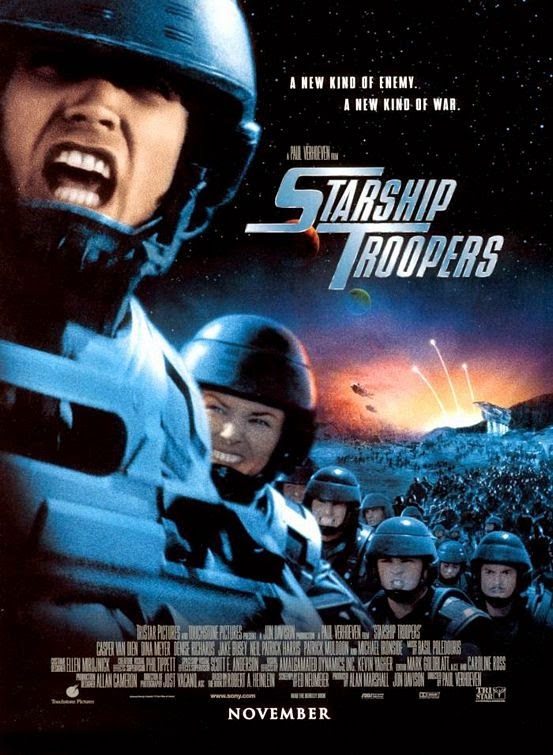
Reads to Reels: Starship Troopers

C’mon, you apes ! You wanna live forever?
            Robert Heinlein’s Starship Troopers combined intelligent speculation about the future of space warfare and controversial if thoughtful political philosophy; Paul Verhoeven’s Starship Troopers does not. The dramatization of Troopers has the same characters, the same belligerents,  and the same labels; what it lacks in every department save for looks and mocking humor, is substance. A military adventure flick that spits in the face of military adventurism, Troopersuses a generically ominous world government’s bombastic war against a planet of “Bugs” to deride military enthusiasm and pugnacious patriotism generally. The tactics employed by the ‘Terran Federation’ are so execrable that even Hollywood must have winced to see them onscreen: imagine sending scores of ships across the galaxy to dump a mob of men armed with light machine guns, into a desert, with orders to kill anything that moves, eventually deployed against a building-sized monster with a flamethrower!  Although the film’s desert setting might scream “Iraq” to modern viewers,  the characters’ costumes and the  series of propaganda reels that serves as a framing service are drawn more from the 1930s and 40s, with officers looking like members of the SS.  The graphics strike me as impressive for 1997, especially the varieties of ‘Bugs’ that rise against the human invaders, and  — assuming one can forget any attachment for the actual book —  the film is stupidly fun.   All would be well were it not for the fact that the film doespretend to be a version of Robert Heinlein’s story, and so much is lost that claim is tragic. There’s no trace of the motorized suits Heinlein imagined, for instance, and one of the book’s better moments – Johnny’s discovery that his father, who scorned him for choosing the military, had joined the service himself – is  completely erased.  I enjoyed it for the lampooning of warmongering, but I now understand why Starship Troopers fans grimace at its mention. 
SERVICE GUARANTEES CITIZENSHIP!
Posted in Reviews | Tagged | 2 Comments

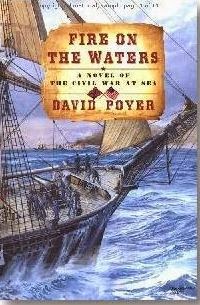
Fire on the Waters

Fire on the Waters
© David Poyer 2003
448 pages

When Eli Eaker volunteered his services to the USS Owanee, his chief intention was to get away from his domineering father and an arranged marriage to his beautiful but sisterly cousin Araminta.  That, and physicians suggested the sea air to him as a cure for his ailing lungs. He never expected that the threat of secession, which he used as an excuse for running away from father dear’s iron hand, would be realized in the form of open war, but soon Mr. Eaker finds himself an increasingly needed officer on a cantankerous ship, a sailing-steaming hybrid tasked with the resupply of Fort Sumter. Those with a little historical savvy might guess that such a mission doesn’t pan out, but that’s not the worst of it. The  union’s hemorrhage of southern states takes a toll on its officers and enlisted ranks, meaning that Mr. Eaker — a rich scion whose naval experience is limited to adventures on his father’s yacht — finds responsibility thrust upon him, while at the same time he’s distracted by a possibly deathly illness (tuberculosis, known as ‘consumption’) and the woes of his fiance-cousin who is likewise desperate to escape Eaker Sr.  

Fire on the Waters is the ‘hardest’ historical fiction I’ve read; not difficult, but hard in the sense of science fiction that is based on ‘hard’ fact. This is a novel heavy with details, and delivered with the authenticity of a cast-iron skillet to the head; Poyer uses old literary conventions and archaic spellings of words to give his narrative real historic grounding. The charm this adds distracts the reader from the fact that the story consists of one dismal failure  after another for its characters – though such reverses give Eaker a chance to prove his worth. Though this is a novel of the Civil War at sea, and most of the characters are sailors, combat is minimal and occurs mostly on land. The real strife of the novel is between the characters over competing loyalties the Owannee‘s captain and first officer are both southerners,  and each are torn between the home they were raised in and the flag they have fought under for so long. The first novel in a trilogy, Fire on the Water impresses most with its detail, and its maritime setting is quite different from most Civil War-related historical fiction.

Posted in historical fiction, Reviews | Tagged , , , | 2 Comments

This week at the library: war, commerce, and cities

Last week was taken up with Away Down South: A History of Southern Identity and  The Yellowhamer War: Civil War and Reconstruction in Alabama. Considering that my leisure reading was Fire on the Waters, a naval novel set amid the war’s outbreak, one might think I’ve committed to read a book a month about the Civil War instead of World War 1. There may be more down the pike, but this week’s readings should be a break from that. Considering that in the last month or so I’ve read Look Away!,  Away Down South, and I’ll Take my Stand, however, if I run into any more books with titles taken from the refrain and chorus of “Dixie” I’ll have to read them on principle.

This week, however, I anticipate starting my English tribute with For King or Commonwealth, a  sea story set during the English civil war. Who knew such a beast even existed? I also picked up Conscience, my next Great War book, which follows the journeys of four brothers — two soldiers, two pacifists — during the war. That came from my university library, where I also found….

  • Human Scale, Kirkpatrick Sale, a work I’m assuming to be similar to E.F. Schumacher’s small is beautiful
  • A Splendid Exchange: How Trade Shaped the World, William Berstein
  • Why We Buy, Paco Underbill
  • More Work for Mother, Ruth Schwatz Cowan. Like Susan Strausser’s Never Done, this focuses on housework but examines how modern conveniences have….created more of it.
  • Point of Purchase, Sharon LukinA history of how shopping has shaped human history.

These will all fall later in the month, though, as this week it’s more war, this time of an English variety.

Reviews will follow this week for the aforementioned South and Civil War books, but to tidy up loose ends a few weeks ago I read Bruce Katz’s The Metropolitan Revolution.  In it, Katz shines a spotlight on local governments who are girding their cities for the future, using three larger case studies and a handful of more minor examples. These cover technical investment into the future, like New York City’s in-progress creation of a future rival to MIT,  regional cooperational, and citizen-led community development centers. He also examines trade relationships which have developed between cities across the world, like Miami and Buenos Aires. I found it interesting, but most of the material concerned larger cities, as the’metropolitan’ title indicated.

Posted in Politics and Civic Interest, Reviews | Tagged , , , | Leave a comment

A reading on Europe and the American South

To Europeans, Helen Taylor observed, the South ‘seems to share a troubled and profound burden of history’. [….] Europeans can see themselves in southern writing and history.
William Faulkner’s famous observation that ‘the past is never dead, it’s not even past’ was even more relevant to Europe than to the South. White southerners who are still fighting the Civil War hardly seem unusual to people in Ireland who speak of ‘King Billy’s great victory on ‘the green, grassy slopes of the Boyne’ in 1690 as if it happened last weeks, and Serbs who are clearly still deeply embittered by the outcome of the Battle of Kosovo in 1389 could surely teach the ‘fergit hell’ crowd of southern whites a thing or two about holding grudges. Italy’s North-South antagonists are much sharper than they are here, and pro-secession groups like our League of the South seem a little less unusual in a country where it is actually disgruntled northerners who have been threatening to break away. Expressing their defiance of the North, some in southern Italy even sport Confederate flag bumper stickers and wave the banner at soccer games. When Don H. Doyle asked if the people of the Italian South knew what the flag meant, a professor from the University of Naples assured him, ‘Oh, yes, we know what it means…..[W]e too are a defeated people. Once we were a rich and independent country, and they came from the North and conquered us and took our wealth and power away to Rome.” 

Regional distinctions still matter throughout Europe, and while many in this country claim the South is now indistinguishable from the rest of the United States, from their more detached perspective Europeans can still see the differences, and these differences are precisely what makes the South so fascinating to many of them. Both the inexorable process of globalization and the ongoing efforts of the European Union to shape Europe into what is effectively a single nation make the South’s long-standing resistance to total immersion in the American mainstream seem not just relevant but in many ways admirable.  

This identification with the American South has led a group of European scholars to organize the Southern Studies Forum, which convenes biannually to discuss various aspects of southern literature, history, and culture. At their 1991 meeting in Bonn, two Danes talked about antebellum southern literature, and a Dutchman about Mark Twain. An Austrian focused on Walker Percy; an Englishman, a Frenchman, and a German tackled Faulkner; and another German discussed Thomas Jefferson.

p. 329-330, Away Down South: A History of Southern Identity. James L. Cobb

Posted in quotations | Tagged , | Leave a comment

Confederates in the Attic

Confederates in the Attic: Dispatches from the Unfinished Civil War
© 1999 Tony Hortwitz
432 pages

          For most of the United States, the Civil War is like any other entry in the history books, of interest but not very consequential. . For the South, however, the war was and is a conflict that left deep scars across its fabric. Long after the surrender of the Confederacy, its flag still flies from countless homes throughout the region; old arguments and symbols continue to be reinterpreted and invigorated through new arguments. In Confederates In the Attic, Tony Horwitz builds on his lifelong interest in the Civil War to take an extensive tour through the old Confederacy.  Spanning at least three years, his visits take him from the study of Shelby Foote to the trenches of the Antietam battlefield,  sojourning with ‘hard core’ reenactors.  He visits with the not-quite-so-obsessed, as well, citizens black and white, about the lingering legacy of the Civil War. The result is a triumph, a book entertaining to read, and balanced to book, providing both laughs, reflections, and twinges in spades.

          Confederates is essentially a travel diary with meaning; as Howitz moves through the south, he attempts to absorb the experiences of the war through its museums and battlefields, as well as the attitudes of the people who live with this history. Most of the people recorded tend toward the eccentric, like the aforementioned ‘hardcore’ reenactors who purposely march for days on blistered feed scarfing hardtack and staining their woolen uniforms to go for the ‘authentic’ look. There are more moderate voices, like that of Shelby Foote, who illustrate why the Civil War remains so visceral for southerners, especially whites. In an era of tumultuous social and political change – when jobs vanish, cities are destroyed,  and families riven apart —  the glory days of the Old South, and its Confederacy, are something to hold on to. They symbolize resistance to change, defiance of pushy outsiders. The Civil War, in storied memory, was an age of flamboyant heroes defying the odds in style.  The Confederacy’s dramatic attempt at defending its autonomy serves as a source of inspiration to working class guys being antagonized by their bosses or ‘the system’; on a larger level it inspires libertarians and conservatives who wish to keep the Federal government within certain constitutional limits.

          For all the remembrance, however, the Civil War was not a feud fought on principle between gentlemen over ‘rights’. It was an economic battle, the doubly misguided defense of slavery by the planters and their armies against the armies of the north. That slavery, based on race, continues to enslave the minds of black and white southerners alike. Although many of Horwitz’s experience tend toward the humorous, there are dark passages here.  Strife between the black and white people of the nation continues, driven by ignorance and the time-honored custom of one generation poisoning another with learned hatred.  In one chapter, Horwitz visits a town that saw a murder when a carload of young black men gave chase to a truck flying the rebel flag and fired shots into the truck, killing him. When interviewed, the chief suspect said he knew little about the Civil War, only that he’d been told that flag was flown by whites to antagonize blacks.  Before moving to the South, he said, he only knew it as the Dukes of Hazzardflag.  Where poorer whites are acculturated to see the Confederate flag as a symbol of self-defense, blacks are raised to see it as a symbol of antagonism. People continue to fight over the meaning, and literally, as Horwitz sees a school coalescing into two race-gangs wearing shirts to provoke the other into fistfights. It is tragic, and if the ethnic brawling in the Balkans and the middle east are any indicator,  the tragedy may continue for centuries hence.

          Although Horwitz is a self-professed Yankee, and his account takes tragic turns, as a southern reader I found it fair. Of course, most southerners are not as extreme as the ones the author mentions; I know of no one who submits their children to learning a Southern Catechism, like the Sons and Daughters of Confederate Veterans do in one chapter, so readers living in the south might object to the slightly exaggerated take of most of his subjects. Racial tension exists throughout the nation, not simply in the South, and the battle flag’s symbolic power is appreciated or despaired over likewise across the United States.  But even the craziest of characters in Confederates in the Attic is treated with respect;  Horwitz never breezes by anyone; they receive extensive time to tell their story, and they do. Horwitz is perfectly respectful of the issues at hand’s complexity, and his work is a standout.

Posted in Reviews | Tagged , , , , , | Leave a comment

Raiders of the Nile


 Raiders of the Nile
© 2014 Steven Saylor
352 pages

  If fortune favors the foolish, young Gordianus of Rome must be foolish indeed. On his 22ndbirthday, he lavishly adorns his slave-turned-love-interest, Bethesda, only to see her kidnapped when she is mistaken for a rich man’s companion.  The kidnappers, a notorious gang of thieves, cutthroats, and miscellaneous scoundrels intending to hold her for ransom, operate out of “The Cuckoo’s Nest”, hidden somewhere amid the Nile Delta.  To rescue his love from abuse and execution, Gordianus must track down outlaws even the king of Egypt is quailed by Soon wanted for murder and navigating the backside of a country on the verge of civil war, Gordianus is forced into trusting strangers at his peril. Although the young main character will later be wise and street-savvy, here he’s giving his real name to barkeeps at mysterious tarverns and accepting drinks from smiling strangers.  Such things generally lead to death, enslavement, or other misfortune in novels, but Gordianus lives a charmed life.  The book opens with him taking part in a grave robbery (the sacking of Alexander the Great’s tomb) , in a splash of action that introduces a mood that remains throughout. While most of Saylor’s novels are political-legal mysteries, Raiders of the Lost Nile is thoroughly a light historical action-adventure novel with a twist at the end. It’s highly speculative, of course, but enjoyable.
Posted in historical fiction, Reviews | Tagged , , , , , | Leave a comment

This week at the library: the South and the search for meaning

Dear readers:

Spring is finally here, and with it, April.  As is my custom, I’ll be doing a special set of readings relating to English history or culture as we near St. George’s Day on the 26th.  While nothing is finalized, I’m planning on two history books and two historical novels.  The past few weeks have been taken up with the South, what with Redneck Manifesto, I’ll Take my Stand, and Confederates in the Attic. (I finished that just this morning, so look for a review later in the week.)  I anticipate that trend continuing somewhat as April marks the big Civil War reenactment. A growing interest in appreciating the South’s history and culture is dangerously closed to reigniting my high school obsession with the Civil War.  (I don’t say ‘obsession’ lightly; I used to go to sleep to Civil War music and had an AIM profile as done by a member of the “Coffee Rangers”, an old Alabama regiment, complete with appropriate away messages and sounds pulled from my much-played copy of Sid Meier’s Gettysburg.)  Speaking of wars, I’ve not yet decided on my Great War book for April, though there are a couple I am leaning toward.

Obsessions aside, the month won’t just be taken up with the South, England, and the Great War (as themes collide…) I also wanted to do a few books on trade, commerce, and the like, including Why We Buy.  It’s going to be a good month, I think. Happy reading!

Recent reviews:

Posted in Reviews | Tagged | 3 Comments

An Ice Cream War

An Ice Cream War
© 1982 William Boyd
408 pages

Although most of the action of the Great War took place in Europe, it spread throughout the world wherever Europe’s nations had allies or colonies. An Ice Cream War is a novel of the first world war set in southern Africa, with the battles between British and German colonial forces serving as background for all of the plot threads, and the active component of many. Its principle characters include an English farmer who is displaced and ruined by his German next-door neighbor, for whom the war becomes a personal vendetta, as well as two brothers who come of age as a result of the war and its human cost.  Its title not withstanding, An Ice Cream War is a tragedy with some comic elements.  Both the comedy and tragedy stem from the same root source, the vagaries of fate. Life is unpredictable enough without the chaos of war, but amid it the characters can only respond in absurd ways. The bewildered mirth is overrun by sorrow and horror later in the book, as it waxes depressing. An Ice Cream War can be considered an anti-war book, given that a main character is an ardent pacifist until he joins the Army to flee heartbreak, but only meets more sorrow as he realizes that the war is just a pointless and obscene in fact as he long held it in theory.  An Ice Cream War features an interesting and extravagantly detailed setting, but is definitely on the despairing side by the end.

Posted in historical fiction, Reviews | Tagged , , , | Leave a comment