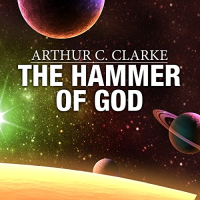
TIME magazine, unlike many other older magazines, never had a tradition of publishing short fiction — until golden age of SF author Arthur C. Clarke offered to change that. “The Hammer of God” takes us a century into the future, aboard the good ship Goliath. Its mission is to rendezvous with rama — um, “Kali”, an asteroid that is headed to strike Earth and end all life as we know it. They have equipment that can be used to alter the asteroid’s course, so that it will avoid the Earth — or at worse, skim the atmosphere and give some people below a fireworks show. Unfortunately, though, as the story opens on the demoralized captain indicates, something with the equipment has gone wrong — internal sabotage that wasn’t caught before initialization! I won’t comment further on the story, given how close to the surface spoilers can be in a short piece, but I enjoyed it despite the fact that multiple parts of Clarke’s future-building struck me as nonsensical. Not the technical aspects, but his idea of an economy managed by experts in chaos theory, and the rise of a merger religion of Christianity and Islam. That particular possibility could only occur to someone with no real grasp on either religion, I think. Still, I might check out the expanded novelization he did of his story, carrying the same name.
“Hammer of God” can be read at Time.com’s archives, though I listened to it from audible.
It’s been a quiet week for reviews, largely because I’m nibbling on several books at once instead of committing to anything.
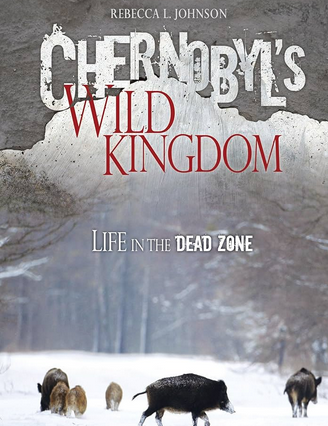
Chernobyl’s Wild Kingdom is, as I discovered upon laying eyes on it at the post office, a junior-level science book about how wildlife living in the exclusion zone around Chernobyl. (I was so delighted by finding a book on this subject I ordered it without looking into the details. Oh, well.) The book begins with a simple explanation of how reactor 4 exploded, one I’d say borders on simplistic but that’s coming from someone who’s read Midnight at Chernobyl and rewatches the Chernobyl series an unhealthy amount. Because the radiation was so deadly, people at the time assumed the Exclusion Zone would turn into a dead wasteland. Instead, even high-radiation areas like the Red Forest became home to an increasing number of animals, including species that had been marginalized by human development in other parts of Russia, Belarus, and Ukraine. How is life surviving and even thriving amid such high levels of radiation, in which the animals composed of radioactive nucleotides, having ingested them in the water, lichen, and grass? The answer is…we don’t know. The book looks at two species, voles and barn swallows, and both of them tell different stories. The voles may exhibit ‘radiohomeostasis’, in that their bodies have adapted to persistent low-level radiation by becoming more aggressive about cell repair, but nearby barn swallows often have visible tumors producing from their bodies. The author also mentions the giant catfish living in the lake that once supplied cooling water to the plant, but argues that the size owes not to radiation, but because this particular catfish species stocked in the pond is one that will naturally grow to a large size (eighteen feet!) when not exposed to aggressive predators (i.e. us). The book was interesting, but didn’t have a lot of substance. Still, can’t fault it for that given the intended audience.
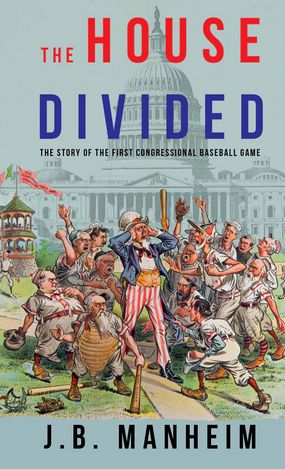
Next up was The House Divided, which is billed as a history of the first Congressional baseball game, is more a history of the fight in the house to get a tariff bill passed. The game was the idea of a former ballplayer turned Congressman, who saw it as a way to ease tension and increase rapport between the parties. I had no idea the Congressional ballgame was even a thing, so I enjoyed the book at first just for that novelty. but not even baseball can make tariff negotiations exciting. I liked the minibiographies of the Congressmen/ballplayers at the end, complete with their ‘statistics’. The cover is also fun!
Today’s prompt from Long & Short Reviews is: do we follow celebrity gossip? I do follow a few celebrities on instagram, but they’re mostly musicians and their shared media is largely music clips — with the exception of Morgan Wade’s pictures of her dog Chop.
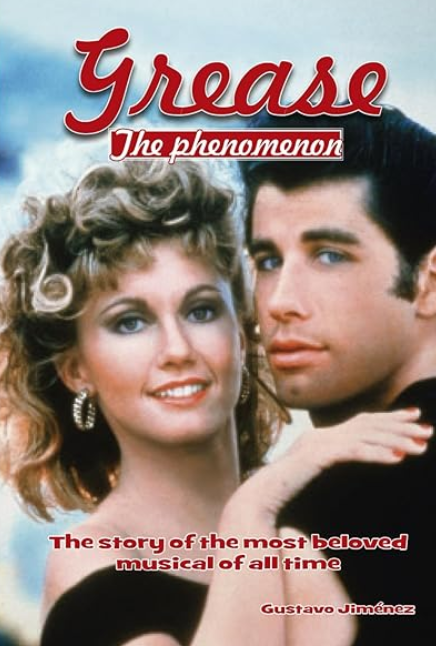
WHAT have you finished reading recently? Grease: The Phenomenon a history of the “Grease” stage show and movie. Why this was not called Grease is the Word is beyond me.
WHAT are you reading now? The Summer Before the War. Still plodding through Congress for Dummies. Also Grease, the original book! (Well, almost original. It’s an edition that has Travolta & Newton-John on the cover, but I’m pretty sure the story is original.)
WHAT are you reading next? The Wild Kingdom of Chernobyl, as soon as I rescue it from the post office.
Additionally, Vero @ Dark Shelf of Wonders just did a mid-year book tag, which I’ll be following in part — omitting questions like “Your Favorite Fictional Crush”, because that does not happen.
What is your favorite book from this year, so far?
Ty Cobb: A Terrible Beauty, Charles Leehrson. A comprehensive biography that reclaims the Peach from libel.
“How come there’s never been a Broadway show, man, with rock and roll music?”
I’ve lost track of how many times I’ve watched Grease over the years: much of its music is firmly lodged in my head (and insisted on playing itself as I read this), so you might say I’m a fan. Grease: The Phenomenon is a history of not just the 1978 movie that everyone knows, but of the original play that inspired it — and has continued to inspire works around it. It was a treat to read given the behind the scenes and production stories included, and follows the actors’ careers to the present day.
The original play was prompted by the question — “Why has there never been a Broadway show, man, with rock and roll music?” The writers began composing music before they had the first inklings of a story, though one centered around working-class greasers in Chicago emerged. The original play was a different beast than the movie, and even the Broadway musical that preceded the film production: the play and movie only share 50% of their songs, with some of the original numbers being dropped from the movie version, and the movie version creating its own. It was a grittier production, too, with more focus on the gang elements and rawer language throughout. The play was a surprise success, and then left Chicago to hit New York, and even tour nation-wide. The musical was retooled as it moved, sometimes in response to criticisms and in part because of so much of its script referenced Chi-town itself. The play was changed further when it was eyed for film adaptation, its language and character actions being cleaned up a bit. Rizzo’s spotlight-stealing “There Are Worse Things I Could Do” was scheduled to be axed, but after witnessing Stockard Channing’s powerful performance of it, the director felt compelled to keep it in. The ticket-office success of the film prompted interest in not only a sequel, but a potential line of them. Unfortunately for those with money in the game — but perhaps good for Grease as a whole, its legacy never being tarnished by perpetual milking — Grease 2 did not repeat the success of the original. It didn’t help that the only person involved in the production end of both movies was the choreographer, Patricia Birch. Jiminez offers that Grease 2 nontheless became a “cult” classic thanks to VHS tapes. (Personally, I’m a fan of its music: “Let’s Do It For Our Country” and “Reproduction” are both hysterical.)
Just think about it — it would be like as if we were doing it for the Statue of Liberty, or the Grand Canyon, or the New York Yankees… it would be like as if we were doing it for… DISNEYLAND!
There was a lot to like about this book, though I suspect the author is one of those people who is a bear to watch a movie with — constantly talking about other works that actor was in, comparing direction, etc. Jimenez goes into a lot of detail about performers’ career histories and other works, which is tolerable to a point. John Travolta and Olivia Newton-John receive a lot of the focus, and not only for the obvious reason that they were the movie’s stars. They are lauded for their charisma and talent as actors themselves, not merely for their success in Grease, and the lasting friendship they formed is a thread in the latter part of the book. Travolta was involved in Grease before the movie ever came into being, playing the part of Zuko in stage productions — something that Adrian Zmed, who played Johnny Nogarelli in Grease 2, also did. Interestingly, for legal reasons Grease couldn’t begin filming until 1977, and since Travolta had already signed a contract he was put to work in Saturday Night Fever. This meant that he already had a fan following when Grease hit the silver screen. There are a lot of behind the scenes stories that will change the way I view the movie: the epic gym dance, for instance, was hellish to film because the gym wasn’t air-conditioned, the doors were kept shut to control lighting, and it was being filmed in August. Multiple cast members were sent to the hospital after fainting from the heat, but one member of the production staff commented that it brought out some manic energy on the part of the “teenagers”. I also didn’t realize what an afterlife Grease has had: the movie’s enduring charm has resulted in rereleases, and the original play was also revived. That leaves me with an itch to hunt down recordings, especially given the amount of songs in the stage play that are absent from the movie.
All told, for a Grease fan this was a fun read, even though some paragraphs were too IMDB-esque in listing performers’ past histories. There’s another book out there — Tell Me More, Tell Me More! — that focuses just on the stage play, so I will probably look into that.
Today’s TTT is “Top Ten Books Anticipated Releasing in 2025”, which doesn’t work for me because I don’t really follow potential publishing unless it’s an author I stalk or it’s Star Trek related. So, here’s a tease or two for you.
After the debate, the Biden White House was less like the TV series The West Wing and more like House of Cards. Or, as Biden’s aide Anita Dunn tartly observed in a farewell toast with staffers, Francis Ford Coppola’s film The Godfather.(UNCHARTED, Chris Whippell. A history of the 2024 presidential campaign.)
“Surely one can write poetry and pursue a responsible career,” said Hugh. “Perhaps surgery can be a Sunday hobby, but I assure you poetry is life and death for me, Hugh,” said Daniel. (THE SUMMER BEFORE THE WAR)
Let’s take a crack at the prompt for today, though, by trawling upcoming releases over at Amazon!
(1) Algospeak: How Social Media Is Transforming the Future of Language. Adam Aleksic
(2) Lions and Scavengers: The True Story of America (and Her Critics), Ben Shapiro.
(3) The End of the World As We Know It: New Tales of Stephen King’s The Stand, various authors. The Stand was my first King novel, and revisiting its world harrowed by Captain Trips sounds fascinating. Little suspect about the fact that it’s an anthology from non-King people, though.
(4) Peak Human: What We Can Learn from History’s Greatest Civilizations
(5) Mailman: My Wild Ride Delivering the Mail in Appalachia and Finally Finding Home by Stephen Starring Grant
(6) Star Trek Strange New Worlds: Ring of Fire, David Mack. No idea what the plot is about. David Mack is already a lock-in, but add Strange New Worlds and I’m like a neocon with a new country to bomb.
(7) The Golden Thread: A History of the Western Tradition, Volume I: The Ancient World and Christendom (The Golden Thread, 1). James Hankins and Allen C. Guelzo. The first volume is priced at $100, but I’ll keep an eye out for it.
(8) King of Kings: The Iranian Revolution: A Story of Hubris, Delusion and Catastrophic Miscalculation, Scott Anderson.
(9) Yield: How Google Bought, Built, and Bullied Its Way to Advertising Dominance by Ari Paparo
(10) A More Expected Hero: A LitRPG Sequel. This has disappeared but I have faith it may yet reappear. It used have a catalog entry! Rhett C. Bruno & Jaime Castle.
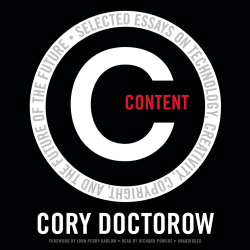
Content collects several of Cory Doctorow’s favorite pieces of his written on “technology, creativity, copyright, and the future”, clumping in the mid-2000s. The content is mixed in medium, but united in message: herein are essays, speeches, and interviews that cover technology and creativity, with the occasional obstacle of law. Doctorow began his life’s work in libraries and bookstores, but took note of the bookwarez scene as it emerged in early Usegroups — committed to the scanning and electronic sharing of books — when he shifted into tech and began writing science fiction. If, he figured, people are going to spend hours disassembling, scanning, and sharing books regardless of the law — and science fiction books are especially popular for scanning and sharing — why not simply….offer an ebook version of the book to whosoever wants it? A clean copy, with no OCR errors and with the author’s blessing? Doctorow took a gamble that he could gain more readers through exposure, and thus indirectly, more buyers. Yes, some people may be content with reading an ebook copy, but once hooked they might elect to buy a physical copy they can read outside, or give to a friend. This is not that similar from the early shareware approach of video games, in which the first levels of a game were freely available to play & make copies of, but the full version had to be sent for by mail. Although Doctorow pursued this on a hunch, he also believes that stringent copy protection of ideas is both impossible given the nature of the internet, and ultimately bad for artists and human creativity in general.
In later books he’s advanced this more, writing in Information Doesn’t Want to be Free that there are other models creatives can pursue, like the ‘subscriber’ model employed by Substack, YouTube, and Patreon. Doctorow attacks some legal and technical hurdles directly: his cheeky opening piece is a speech he gave to Microsoft on why it should abandon intrusive digital rights media software, or DRM: I say “cheeky” because Bill Gates famously penned “An Open Letter to Hobbyists” decrying those who copied software and shared it for free, denying programmers like himself sales. Much of the book remains relevant today, like Doctorow’s observations that most ‘consumers’ of media, be it stories or music, pursue ease of use over quality: they prefer an mp3 player packed with low-quality mp3s that they had control over, to something like a Sony Music Clip that offered better quality but few sharable options. This sometimes causes changes in the way creative works are delivered: because most people listen to songs by themselves, not as part of albums, the idea of concept albums has largely faded. There are dated elements, but for those of us who were plugged in in the mid-2000s, that adds its own nostalgic interest: I was interested in his defense of early Wikipedia, and amused by his confident proclamation that facebook would go the way of MySpace, because the more people it attracted, the more negative interactions would grow around it — moving people to ditch the platform for others. I’m told the whippersnappers have moved on these days, and I’m so out of the loop I can’t even go for laughs by guessing at outdated platforms — but facebook is still a giant as far as web traffic goes. right behind Google & YouTube for monthly views.
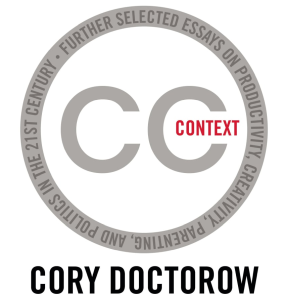
Context is a similar essay collection, but smaller and more varied. While Doctorow still writes on copyright and licensing, this set also has random articles like a complete list of all of the tech Doctorow uses — the specific laptop, mice, etc — and columns responding to events of the day (like a piece on Net Neutrality), in addition to the odd book review on a related topic. The iPad, recently released, comes under fire in several pieces: although Doctorow is the kind of gadget geek that sees him faithfully buying his phone model’s latest release every year, he shares the same contempt for Apple’s locked-down devices and ecosystem as Steve Wozniak did in the 1980s, fighting with Steve Jobs over the unmoddability of the Macintosh. He’s particularly incensed that Apple’s terms of service make jailbreaking the software iPads use to restrict app installation to its app store — a copyright crime. Interesting, he’s more critical of streaming & cloud services than I would expect from a technophile, arguing that owning one’s own equipment and files is still cheaper and consumer-friendly. The essays aren’t dated, but the cloud essay appears to have aged like the finest milk, especially for businesses. This was another interesting collection, but you do have to be interested in tech and internet creativity.
Related: The Perfect Thing, Steven Levy. On the ipod and its influence on the music industry Pirate Cinema, Cory Doctorow. A novel based on remixing context
Quotes/Highlights:
People think the Amish are technophobes. Far from it. They’re ideologues. They have a concept of what right-living consists of, and they’ll use any technology that serves that ideal — and mercilessly eschew any technology that would subvert it. There’s nothing wrong with driving the wagon to the next farm when you want to hear from your son, so there’s no need to put a phone in the kitchen. On the other hand, there’s nothing right about your livestock dying for lack of care, so a cellphone that can call the veterinarian can certainly find a home in the horse barn.
Bill Gates told the New York Times that Microsoft lost the search wars by doing “a good job on the 80 percent of common queries and ignor[ing] the other stuff. But it’s the remaining 20 percent that counts, because that’s where the quality perception is.” Why did Napster captivate so many of us? Not because it could get us the top-40 tracks that we could hear just by snapping on the radio: it was because 80 percent of the music ever recorded wasn’t available for sale anywhere in the world, and in that 80 percent were all the songs that had ever touched us, all the earworms that had been lodged in our hindbrains, all the stuff that made us smile when we heard it. Those songs are different for all of us, but they share the trait of making the difference between a compelling service and, well, top-40 Clearchannel radio programming. It was the minority of tracks that appealed to the majority of us.
From the Luther Bible to the first phonorecords, from radio to the pulps, from cable to MP3, the world has shown that its first preference for new media is its “democratic-ness” — the ease with which it can be reproduced.
The thing is, when all you’ve got is monks, every book takes on the character of a monkish Bible. Once you invent the printing press, all the books that are better-suited to movable type migrate into that new form. What’s left behind are those items that are best suited to the old production scheme: the plays that need to be plays, the books that are especially lovely on creamy paper stitched between covers, the music that is most enjoyable performed live and experienced in a throng of humanity.
I once asked a Japanese friend to explain why so many people on the Tokyo subway wore surgical masks. Are they extreme germophobes? Conscientious folks getting over a cold? Oh, yes, he said, yes, of course, but that’s only the rubric. The real reason to wear the mask is to spare others the discomfort of seeing your facial expression, to make your face into a disengaged, unreadable blank–to spare others the discomfort of firing up their mirror neurons in order to model your mood based on your outward expression. To make it possible to see without seeing.
Internet users have short attention spans. The moment of consummation – the moment when a reader discovers your book online, starts to read it, and thinks, huh, I should buy a copy of this book – is very brief. That’s because “I should buy a copy of this book” is inevitably followed by, “Woah, a youtube of a man putting a lemon in his nose!” and the moment, as they say, is gone.
This led me to formulate something I grandiosely call Doctorow’s First Law: “Any time someone puts a lock on something that belongs to you, and won’t give you a key, they’re not doing it for your benefit.
Today’s short story is a pair of stories, chosen because they share a common theme.
pub. 1960
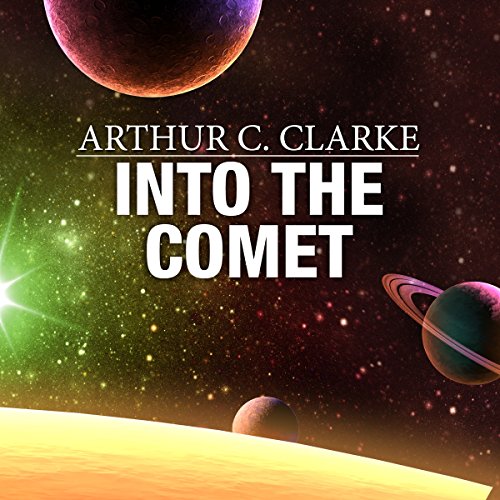
The first, Arthur C. Clarke’s “Into the Comet”, opens on a science ship in despair. The Challenger was commissioned to investigate Randall’s Comet, a long-period comet that is only visible from Earth every hundred thousand years. The ship’s mission is to study the comet’s composition — its tail, but if possible, the nucleus itself, which proves to be not so much a coherent whole but rather a gravitationally-bound cluster of icebergs with varied chemical compositions. While the Challenger is successful in its mission, something about the comet’s constitution disrupts the computer, rendering it incapable of calculating even the simplest of sums. This is a death sentence for the crew of the Challenger, as without the computer they have no way of escaping the orbit of the comet, let alone cruising back to Earth — weaving their way through various gravitational attractions. Until….George Takeo Pickett (oh, my), a reporter who serves as quartermaster for the crew to pay his keep, remembers his grandfather’s abacus. Fashioning one from parts in the ship, he begins practicing again, and pitches his idea to the skipper — save the ship through human computers! I experienced this story as an audiobook and enjoyed it throughly: the narrator, Ray Porter, does a good job of communicating the despair in Pickett’s voice as he begins his log of their doom, as well as the little tease of hope that occurs to him. There’s one other character who is voiced, and for him Porter assumes a servicable accent that made me think of Eastern Europe, perhaps Russian.
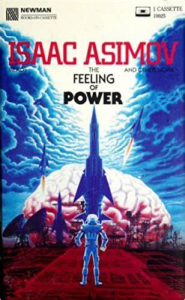
The story reminded me of one of my favorite Asimov stories, “The Feeling of Power“, published in 1958. We find ourselves in some distant future where Earth is at war with the technologically matched Denebians: it’s a long-term, rather like the Great War in which every upgrade in missiles and computers is matched by the other side. But a lowly technician with an interest in the history of computing, having studied how early computers were fashioned, has reinvented something long lost to humanity: Math. He can add up sums in his head! Multiply them, too, for what is addition but many rounds of addition? And he’s working on division. When he shows off his invented skill of “graphitics”, one of his supervisors immediately realizes the potential. Why, computer-controlled missiles rely on computers so massive that they’re inefficient, especially given how expensive they are. But a missile controlled by a man, directly? It could be made ever so much cheaper! Unleash a load of them before the Denebians catch on to graphitics, and the war could be over! This one has aged poorly given miniaturization, though there’s still a moral component to appreciate within the story (I didn’t mention it given the potential for spoilers) as well as the idea behind the title: the feeling of power. The military men in this story resent how dependent they are on the machines: one declares that graphitics is a means of freeing ourselves from the machines. How utterly, utterly relevant that is in our day where people use Google Maps to get themselves across their hometowns! In the name of convenience we’ve surrendered agency and become lesser creatures as a consequence. I enjoyed revisiting this one and am glad that the Clarke title brought it back to mind.
Nine times seven, thought Shuman with deep satisfaction, is sixty-three, and I don’t need a computer to tell me so. The computer is in my own head. And it was amazing the feeling of power that gave him.
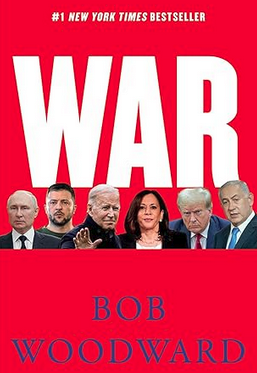
WHAT have you finish reading recently? War, Bob Woodward, focusing on Biden, Afghanistan, Ukraine, and Israel.
WHAT are you reading now? The Summer Before the War, Helen Simonson. Bit of light historical fiction set prior to The Great War. I’m also reading Congress for Dummies, a dated (2002) guide to Congress’s inner workings.
WHAT are you reading next? I’d say Chernobyl’s Wild Kingdom, but it won’t be in for another week or so. I’ll see if the Nixon biography is work committing to.
War takes us into the Biden White House and its foreign policy challenges. Biden had no shortage of heavy issues coming into office amid a pandemic, but the changing global scene would create far more. Woodward’s narrative sews together a multitude of conversations between Biden, his officers, and their counterparts in Ukraine, Russia, Israel, and so on, but lacks what I would expect from someone with Woodward’s name cachet: independent analysis and original content.
While the outbreak of the Russo-Ukraine war takes center stage, Trump is always on the sidelines – or yelling through the back curtain. Trump, to his credit, signed orders to withdraw the US military from Afghanistan by May 2021: Biden, to his credit, honored that treaty and finally ended the Forever War. Woodward doesn’t dwell on this much at all, which disappointed my hopes of learning if the withdrawal debacle owed to a lack of planning during the Trump administration, or poor planning and execution during the Biden administration. Instead, the gathering storm clouds over the Russo-Ukrainian border soon attract all attention. Although the Biden White House urged Zelensky to take the Russian threat seriously, the TV-politician turned real-politician ignored them, and was soon in the fight of his life. Biden was adamant about not repeating the mistake of his predecessors and thrusting American troops into harm’s way across the globe. (Unmentioned is the fact that war with Russia, a nuclear power and formerly the heart of a global empire, is rather different than war with desert warlords.) Woodward’s account has Biden trying to support Ukraine as much as possible without triggering Putin into drastic action, as well as defending Israel while at the same time trying to restrain Bibi from doing something crazy like nuking Gaza or bombing Tehran. The narratives of both of these are frequently interrupted by Woodward quickly panning the camera to Trump, usually saying something outrageous: only one time does this have relevance to the story, when Trump is essentially controlling the Republican legislative response to a Biden proposal in Congress. As the book starts winding down, Woodward looks at Biden’s flagging energy and mental readiness, and salutes him as someone who bowed to the facts rather than brushed them off. The book is written not just as a history of Biden’s foreign policy, but a condemnation of Trump in general, complete with a half-page dedicated to denouncing him with no connection to the narrative at all.
Given Woodward’s reputation, I was wholly underwhelmed by this title and wonder if his other volumes are similar – a coasting on his reputation achieved from the Nixon days. As far as the content presented goes, it’s fine: Woodward knows how to write, and I liked getting to “witness” these conversations between statesmen and officials as they try to find the best response in the crisis at hand, though given the lack of footnotes I’m hesitant to trust those elements that were not public statements and the like. Biden comes off as level-headed and pragmatic, except when he’s vigorously swearing at Putin and Bibi. What’s missing on Woodward’s part is any criticism: he simply relates what he’s told, and doesn’t push back or dig in to anything. We’re told that there had been conflict in Ukraine since 2014, when Putin invaded Crimea: why did he do that? Was there something like a coup that directly threatened Russia’s legal assets in Crimea? He dismisses the claims of neo-Nazism in Ukraine on the grounds that Zelensky is Jewish, as if that makes the Azov battalion and the Right Sector nonexistent. This isn’t journalism, it’s just parrotry. I liked the inside-the-keyhole look, but Woodward does not impress. I can see reading some of his earlier works, though, to see if this quality is consistent or just the sign of an aging author phoning it in a la John Grisham.
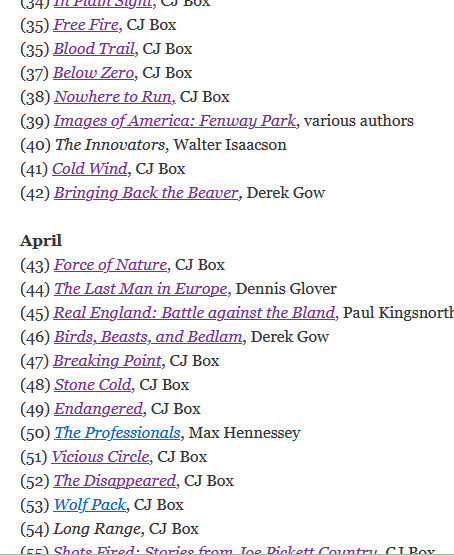
Today’s treble T is our summer booklists, which prompts me to first take a look back at my spring list. Boy, did I not do well: to borrow from baseball, I only hit .400. (Actually, in baseball that would be terrific batting average.) Of the spring list, I read Star Trek: Asylum, Real England, Ty Cobb, and “more CJ Box”. Boy, did I read more CJ Box!
Today’s tease:
Biden had cut short his family vacation in Nantucket to plead his case to Obama directly. “Listen to me, boss,” Biden said. “Maybe I’ve been around this town for too long, but one thing I know is when these generals are trying to box in a new president.” He leaned in toward Obama and stage-whispered, “Don’t let them jam you.” (Bob Woodward, WAR.)
(1) One of Us: Nixon and the American Dream. I’ve never read a biography of Nixon before, and bought this when I was in a mood. Unfortunately, it happened to be the victim of flying coffee violence while in my car, but I think my physical copy is still readable.
(2) Chernobyl’s Wild Kingdom: Life Inside the Dead Zone. A look at how nature has responded and changed to the absence of human and presence of radioactive activity around Chernobyl.
(3) War, Bob Woodward. A history of the Biden presidency’s attempts to manage DC’s response to the Russo-Ukrainian war, and mideast bloodbaths from the Afghan pullout to the Hamas obscenity and the resulting invasion of Gaza. This one is in progress, and will be my second Woodward: I know I read Fear in October 2018 but it doesn’t appear on the blog, not even in a short-round. I’m 70% of the way through this one, so it’s a bit of a lock-in.
(4) Treacherous Alliance: The Secret Dealings of Israel, Iran, and the United States, Trita Parsi. I’ve owned this on Kindle for a while but have yet to read it: given that a hot war has broken out, it seems time to finally take it on. I’ve read Parsi before, in Losing an Enemy.
(5) Star Trek Strange New Worlds: Toward the Light, James Swallow. Another Strange New Worlds title to keep me from withdrawal until season 3 begins airing in July….
(6) Back of Beyond, CJ Box. He has a smaller non-Pickett series that I might look into.
(7) Content, Cory Doctorow. A collection of essays on copyright, intellectual property, etc. This is a pet topic of Doctorow’s, one he has explored in both essays and fiction.
(8) The House Divided. This is just one to finish: it’s about the origins of the first Congressional baseball game.
(9) The Genetic Book of the Dead: A Darwinian Reverie, Richard Dawkins. I’m looking forward to this one because the premise sounds a bit like Ghosts of Evolution: he’s looking at the way various creatures’ phenotypes testify to the environment that molded them, even when they’ve been displaced from that environment by ecological changes and so on. (Ghosts remains one of my favorite science books, ever, examining broken ecological relationships — like trees that produce food for giant ground sloths who are no longer there to eat them.)
(10) The British are Coming — maybe ? I usually do an American revolution nod in late June or early July, but it’s a big ol’ book.


 Reading Freely
