COVID Reviews #3: Romans, Dogs, and Saudis

I don’t know if anyone misses my usual chatty, sometimes florid reviews, but they’re impossible to do on a phone. More mini-reviews it is!

Continuing my onslaught of the TBR pile, I finished Lives of Famous Romans, by Olivia Coolridge. This was a library discard, and contains twelve mini-biographies of various Roman leaders, chiefly political figures like Augustus, Marcus Aurelius, and Diocletian. There are some surprises in here, however: Cicero, Horace, and Virgil are the non-rulers among their ranks. I greatly enjoyed the tenor of the sketches, though I was familiar with most of the subjects already, save Horace.
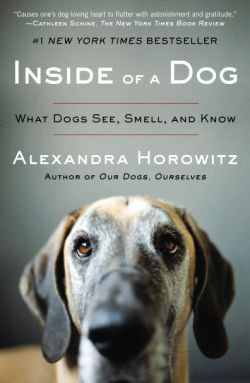


Next up, and most appropriate considering I’m taking care of 4 dogs and 4 cats in quarantine, was Alexandra Horowitz’s Inside a Dog, a thoughtful consideration of what it’s like to be a dog. Horowitz invites us to step into a dog’s umwelt, to consider what it’s like to perceive the world from their angle — largely through the nose. Although that might sound a little silly, Horowitz offers serious food for thought by reviewing the natural history of canine evolution, noting that dogs are animals with an asterisk; they are truly domesticated in that their natural habitat is among humans: left to themselves, they are sloppy hunters, having exchanged strong pack dynamics and a wolf’s keen intelligence for social intelligence, instead…a special kind of social intelligence, the kind that allows them to read human behavior better than even our closest primate relatives. Horowitz asks her readers to try to understand dog behavior according to a dog’s nature — to consider the importance of smell to their existence, for instance, and to not be so eager to try to make them furry little humans, constantly plunged into paths and closed off from the world through little canine shoes. As a lifelong dog lover, I was delighted by this one — as was the dog lover who recommended it to me in the first place.

Most recently, I finished the thoroughly depressing Black Wave, a history of how Saudi and Iranian rivalry for influence as global leaders of Islam has sown chaos throughout the middle east. Ghattas opens in the fateful year of 1979, when cross-ideological revolution against the Shah resulted in victory in the streets for religious reactionaries. At the same time, extremists in Saudi-controlled Arbia committed an act of terrorism and sacrilege by taking over the Grand Mosque in Mecca, turning it into a battleground and humiliating the spawn of Saud. Having only recently taken over the country, the Saud family were roundly condemned for having failed to better protect the central sites of Islam. Already dependent on religious zealotry to provide support of their regime, the Saudis doubled down on it and began promoting a narrow view of Islam across the middle east, just as the new powers in Iran were also trying to export their revolution into places like Pakistan and Egypt. Although their primary noxious influence came from petrodollars, the Saudis were also able to exercise influence through economic prowess: as people flocked to the Gulf to take advantage of the growing oil-driven economy, they absorbed Saudi standards and took them home. Culture throughout the middle east became increasingly vitriolic, hostile, and puritanical, as people tried to fit themselves into ever-smaller groups and attacking with ever-great ferocity those outside the groups. People who grew up in Pakistan, Afghanistan, Egypt, and Iran before 1979 were astonished at how rapidly their countries changed around them, turning into warzones filled with acrimony. This is a thoroughly depressing book, though Gattas gamely tries to offer the reader hope: not only is there constant, rising resistance, but people are tired of fighting. She also believes that some countries like Iran have too strong a culture to be defeated by a few narrow-minded old men.

Coming next week…English history, German history, ancient Mesopotamian history? We’ll see…
Posted in history, Reviews | Tagged , , , , , , , | 4 Comments

Scaling Mount Doom: September 2020

Beginning last month, I decided to start doing a monthly ‘face-the-verdict’ post  to help me stay focused on my TBR takedown, and the related goal of further minimizing my book collection. This month bears witness to the fact that I’m in COVID quarantine…

TBR Books Read in September (Previous month: 8 titles)

The Coddling of the American Mind, Greg Lukianoff and Jonathan Haidt. Purchased in 2019.
The Vanishing American Adult, Ben Sasse. Purchased in 2019.
The School Revolution, Ron Paul. Gift from a friend in 2018.
A Thousand Splendid Suns, Khaled Hosseini.  Acquired from library booksale in 2019.
Star Trek Vanguard: What Judgments Come, Dayton Ward &  Kevin Dilmore. Purchased March 2018.
And the Mountains Echoed, Khaled Hosseini
Enemy at the Gate: Hapsburgs, Ottomans, and the Battle for Europe, Roger Crowley. Purchased September 2017.
How Alexander Hamilton Screwed up America, Brion McClanahan
Lives of Famous Romans, Olivia Coolridge
The Demon’s Brood: A History of the Plantagenet Dynasty, Desmond Seward

TBR Books Scheduled for October:

Ring of Steel: Germany and Austria-Hungary in World War 1, Alexander Watson. 
The German War: A Nation under Arms
 , Nicholas Stargardt. Purchased September 2017.

Reward Books Purchased:
Inside a Dog: What Dogs See, Smell, and Know, Alexandra Horowitz

Posted in General | Tagged | 5 Comments

COVID Reviews #2: Afghans and Turks and Austrians, oh my!

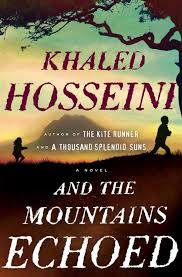
Khaled Hosseini’s third book is also his most unusual. His previous two books followed friendships which which were forged, broken, and tested over the years as Afghanistan reeled from one chaotic event to another. And the Mountains Echoed is more about family relationships, and instead of following a couple of characters, we are introduced to a larger ensemble, introduced in a series of interlaced stories, with an overall structure reminiscent of an onion, if that’s not too much of a cliche. Each story at first appears to stand on its own, but characters introduced in one story will appear more prominently in another, and the more one reads the more interconnections appear, building a larger tale — one told across the world, from Afghanistan to France and the United States. Although there is tragedy here, Mountains Echoed is practically G-rated compared to all the brutality and heartache of Hosseini’s previous works. (I say “practically” — yes, there’s a brother and sister tragically separated, and stories of depression, suicide, and unrequited love, but there’s also lots of self-sacrifice and nobility and such, and not a trace of rape or beatings.)

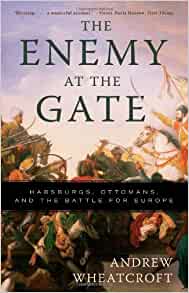
In advance of October, I read Enemy at the Gate, a history of the Turks’ last attempt to invade Europe. Andrew Wheatcroft opens by reviewing the history of Ottoman expansion, and the divergent evolution of its military to those of the Austrian empire’s. Although Ottoman forces were formidable, technical advances in the west, combined with the tighter control and organization of western forces, meant that the much larger Ottoman force had in Vienna a tough nut to crack. Its attack was reduced to a prolonged siege, one Wheatcroft compares to Stalingrad, until at least the Poles attacked and relieved the Austrians. The history then follows the allied ‘reconquest’ of Hungary, and the attempt to drive the Turks out of Europe entirely. That proved impossible even after the Ottomans fell apart after WW1. The book is more about the war in general, and less about the siege specifically. It’s fine reading, but I’d expected more detail about the battle itself.

Posted in historical fiction, history, Reviews | Tagged , , , , | 2 Comments

Top Ten Favorite Quotes

Top ten favorite quotations from books is a…daunting challenge,  to say the least. I’ve been reading purposefully since 2006,  and have encountering a great many challenging or insightful words since then. I am sorry that these all run together,   but WordPress has proven….obstinate.

  1. “I went into the woods because I wished to live deliberately, to front only the essential facts of life, and see if I could not learn what it had to teach, and not, when I came to die, discover that I had not lived. I did not wish to live what was not life, living is so dear; nor did I wish to practice resignation, unless it was quite necessary. I wanted to live deep and suck out all the marrow of life, to live so sturdily and Spartan-like as to put to rout all that was not life, to cut a broad swath and shave close, to drive life into a corner, and reduce it to is lowest terms.”  – Henry David Thoreau, Walden
  2. “I have made a ceaseless effort not to ridicule, not to bewail, not to scorn human actions, but to understand them.” – Spinoza, as quoted in Why People Believe Weird Things, Michael Shermer
  3. “One of the things [Uncle Alex] found objectionable about human beings was that they so rarely noticed it when they were happy. He himself did his best to acknowledge it when times were sweet. We could be drinking lemonade in the shade of an apple tree in the summertime, and Uncle Alex would interrupt the conversation to say, ‘If this isn’t nice, what is?’
    “So I hope that you will do the same for the rest of your lives. When things are going sweetly and peacefully, please pause a moment, and then say out loud, ‘If this isn’t nice, what is?’”  – Kurt Vonnegut
  4. “It’s always so easy to avoid other people’s vices, isn’t it?” – Star Wars: Yoda, Dark Rendezvous. Laugh at the source, but the insight is undeniable.   The same thought appears in the New Testament.
  5. “If only it were all so simple! If only there were evil people somewhere insidiously committing evil deeds, and it were necessary only to separate them from the rest of us and destroy them. But the line dividing good and evil cuts through the heart of every human being. And who is willing to destroy a piece of his own heart?” – Aleksandr Solzhenitsyn
  6. “No longer talk about the kind of man a good man ought to be, but be one.” – Marcus Aurelius,  The Meditations.
  7. “And this I believe: that the free, exploring mind of the individual human is the most valuable thing in all the world. And this I would fight for: the freedom of the mind to take any direction it wishes, undirected. And this I must fight against: any idea, religion, or government which limits or destroys the individual. This is what I am and what I am about. I can understand why a system built on a pattern must try to destroy the free mind, for it is the one thing which can by inspection destroy such a system. Surely I can understand this, and I hate it and I will fight against it to preserve the one thing that separates us from the uncreative beasts. If the glory can be killed, we are lost.” – John Steinbeck, East of Eden
  8. “The most dangerous thing you can do is to take any one impulse of your own nature and set it up as the thing you ought to follow at all costs. There’s not one of them which won’t make us into devils if we set it up as an absolute guide. You might think love of humanity in general was safe, but it isn’t. If you leave out justice you’ll find yourself breaking agreements and faking evidence in trials ‘for the sake of humanity’ and become in the end a cruel and treacherous man.”  – C.S. Lewis,  Mere Christianity.
  9. Know then thyself, presume not God to scan;
    The proper study of Mankind is Man.[8]
    Plac’d on this isthmus of a middle state,
    A being darkly wise, and rudely great:
    With too much knowledge for the Sceptic side,
    With too much weakness for the Stoic’s pride,
    He hangs between; in doubt to act, or rest,
    In doubt to deem himself a God, or Beast;
    In doubt his Mind or Body to prefer,
    Born but to die, and reas’ning but to err;
    Alike in ignorance, his reason such,
    Whether he thinks too little, or too much:
    Chaos of Thought and Passion, all confus’d;
    Still by himself, abus’d, or disabus’d;
    Created half to rise, and half to fall;
    Great lord of all things, yet a prey to all;
    Sole judge of Truth, in endless Error hurl’d:
    The glory, jest, and riddle of the world!
    –  Alexander Pope, “Essay on Man”. Quoted in The Ascent of Science,  Brian Silver.  One of  the first bits of verse I ever memorized.
  10. “He tried to explain and to convince. He knew, while he spoke, that it was useless, because his words sounded if they were hitting a vacuum. There was no such person as Mrs. Wayne Wilmot; there was only a shell containing the opinions of her friends. the picture post cards she had seen, the novels of country squires she had read; it was this that he had to address, this immateriality which could not hear him or answer, deaf and impersonal like a wad of cotton.” – The Fountainhead, Ayn Rand
Posted in General | 5 Comments

Of Putin, Hamilton, wars, and corona

I entered quarantine on Tuesday, immediately after having my COVID test done. Since then my physical condition has improved (coughing is minimal, energy levels are much better) although until I test negative I’m still locked away from the public. I’ve been reading nonstop since I entered quarantine, and have knocked a few titles off my list. If I come out of quarantine on October 10th as I hope, I may have done serious damage to my TBR in the meantime! A couple of titles will get independent reviews

First up was How Alexander Hamilton Screwed Up America, which is a history of how Hamilton, Judge Marshall, and a few others’ linked policies greatly strengthened the power of the central state over any meaningful opposition. Truth be told, it was incredibly difficult to concentrate on legal cases when I was still reeling from the news that I was COVID positive, so I didn’t take a lot of this book beyond what I already knew. I may revisit it in future.

More interesting was The Putin Diaries, one of my reward books from August. The book consists of interview transcripts between Oliver Stone and Vladimir Putin, who has governed Russia since 1999, either as president or as a force behind the ‘official’ president. I must confess that I find Putin darkly fascinating; while his contemporaries in the United States and Europe stumble around getting themselves stuck in decades-long wars and debt traps, Putin has been steadily and consistently solidifying his own power and Russia’s foreign influence nearly every year he’s been in office. This quiet, details-oriented professional stands in stark contrast to DC’s celebrity-kings. I don’t like him, but I admire his competence, just as I do Otto von Bismarck’s. I bought this volume to perhaps learn more about what makes him tick. Oliver Stone is a curious interviewer, one whose hostility toward DC is such that Putin regards him warily — not wanting to be dragged into “anti-Americanism”. Putin communicates his disappointment that regardless of the noises various presidents make about Russian resets, the DC establishment has a Russian fixation that derails any hint at progress. Even when Russia was helping DC in the aftermath of 9/11 to move into Afghanistan, Putin claims that DC also treacherously began promoting terrorist organization ins Chechnya. I was impressed by Putin’s repeated observation that DC’s bureaucracy is far more powerful than its presidents, and his opinion that changing the president has little real effect. This is something I wish more Americans understood — the DC machine has inertia of its own. There’s a lot for an American audience to consider in a book like this, though I was not impressed by Stone as an interviewer: he’s candid to the point of vulgarity, and almost seemed childish.

Other reviews will follow this week for Enemy at the Gates as well as And the Mountains Echoed.

Posted in Politics and Civic Interest, Reviews | Tagged , , , , , | 12 Comments

Corona diary with extra corona

This update is a bit different because I’m typing on my phone. I’m making arrangements now for a 2 week quarantine. Unfortunately, I have the plague. It’s a mild thing — I would not have thought to test for it did I not work in a public place. But a cough on Monday and extreme fatigue were enough to worry my coworkers. I never had fever or any “flu like symptoms ” My cough has now subsided but the tiredness is still with me. This may be good news for the TBR, as I have lots of books to read while not working. It just remains to be seen if I can concentrate…I’ve been taking lots of naps! Be well, everyone.

Posted in General | Tagged | 7 Comments

Top Ten Books on my Fall TBR

This week for Top Ten Tuesday, we’re sharing our fall reading lists!   In my case, it’s a literal fall TBR: I’m currently diligently working on my Pile of Doom, complete with scheduled titles and the like,  with other materials mixed in.  

  1. Something by Stephen King. I haven’t decided yet; both It and Pet Semetary are two of his more well-known titles which I’ve not yet experienced. 
  1. Good Reasons for Bad Feelings: Insights from the Frontier of Evolutionary Psychiatry,  Randolph Nesse. TBR title 
  1. Enemy at the Gate, a history of the Battle of Vienna, in which Ottoman expansion into Europe was checked by the Austrians.    TBR title. 
  1. Ring of Steel, or The German War. These are similar titles: one covers the Great War from the Austro-German perspective; the other is a history of WW2 focusing on the German homefront.  Both are TBR titles. 
  1. War Lord, Bernard Cornwell. To be released in November…possibly the last in the Saxon Stories series?  
  1. A Bright Future: How Some Nations Have Solved Climate Change,  Joshua Goldstein. TBR title. 
  1. Atomic Awakening: A New Look at the History and Future of Nuclear Energy, James Mahaffey. TBR title.  
  1. Command and Control: Nuclear Weapons and the Illusion of Safety, Eric Schlosser.  TBR title on the history of near-nuclear incidents between  DC and Moscow. 
  1. Firefly: Generations.  Another of those Firefly novels.  This one is a preorder to be released in November.  
  2. Dorothy and Jack: The Transforming Friendship of Dorothy Sayers & C.S. Lewis. This one is more debatable…I may save it for next year’s Read of England, but it’s also a possible for the week of November 22, as a kind of nod to Lewis’ death.
Posted in General | 9 Comments

The Forest Unseen

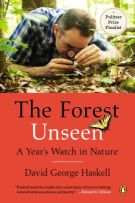
In his Becoming Wild, Carl Safina remarked, “How long and rich a morning can be if you bring yourself fully to it. Come to a decent place. Bring nothing to tempt your attention away. Immerse in the timelessness of reality. Attention paid is repaid with interest.” The Forest Unseen proves how accurate Safina truly was. It’s the diary of a biologist who chose a square meter of wilderness in the Tennessee hills, and sat for an hour or more each day, over the course of a year — and reflecting on what this square meter had to teach. Each day’s meditation brings to the reader fresh and varied explorations into the goings-on of the natural world: a consideration of the symbiotic relationship expressed by lichen, for instance, themselves a joint creation between bacteria & fungi, the study of flower reproduction or an examination of ant politics. The story delivered is one of gradual progress and constant change, as Haskell watches the ground dance with the seasons. Although the bulk of the work is solidly in the area of biology or ecology, the writing is more florid than technical, and contains many beautiful passages. This title should be of great interest to anyone who enjoys nature writing.

Some quotes:

“To love nature and to hate humanity is illogical. Humanity is part of the whole. To truly love the world is also to love human ingenuity and playfulness. Nature does not need to be cleansed of human artifacts to be beautiful or coherent. Yes, we should be less greedy, untidy, wasteful, and shortsighted. But let us not turn responsibility into self-hatred. Our biggest failing is, after all, the lack of compassion for the world. Including ourselves.”

“The unique flashing sequence of each [firefly] species usually keeps males and females of different species apart. Just as we have no interest in the sexual signals of gorillas, fireflies ignore flashes from species other than their own. But Photuris females mimic the answering signals of other species, drawing in hopeful but hapless females, and then seizing and devouring them.”

“At least half a tree’s contribution to the fabric of life comes after its death, so one measure of the vitality of a forest ecosystem is the density of tree carcasses. You’re in a great forest if you cannot pick out a straight-line path through fallen limbs and trunks. A bare forest floor is a sign of ill health.”

“The earth’s slow movements seem to exist in another realm, separated from life by a wide chasms of time and physical scale. This is challenge enough for our minds. But the most unfathomable truth about the chasm is that there is a thread across, a thin connection from life’s moment-by-moment to the next impossible longevity of stone. This thread is woven by life’s persistent fecundity. Tiny strands of heredity join mother to child and combine to stretch back billions of years. The strands spool year by year, sometimes branching into new lines, sometimes ending forever. So far, diversification within the thread has kept pace with extinction, and the mortal biological fleas on the immortal stony gods have brought a contingent immortality of their own. But every strand in the rope is a race between procreation and death. Life’s generative force has been strong enough to win this race year by year for millennia, but final victory is never guaranteed.”

Posted in Reviews, science | Tagged , , | Leave a comment

What Judgments Come

Star Trek Vanguard: What Judgments Come
© 2011 Dayton Ward & Kevin Dilmore
354 pages

For three years, Vanguard Station’s mission of facilitating the exploration and colonization of the Taurus Reach has been sidetracked by its covert attempts to come to grips with the remains of an ancient, unimaginably powerful civilization once anchored there. That search has been met with setbacks and costly disasters, not to mention frequent run-ins with the Klingons, who believe the Reach may have weapons for the taking. Compromises have been made – -too many, for some — and things are starting to come to a head. An attempt by Starfleet to communicate with an entity encased in a crystaline artificat sees a proud ship mortally wounded, and a monster unleased on the stars…

It’s been over eight years since I last read from the Vanguard series, as this book hadn’t yet been released once I was caught up. Vanguard proved itself very early as a compelling character drama with an interesting mystery at hand, solidly grounded in early Original Series lore. One can hear the bridge ambiance, see the sets and bright costumes. That’s still largely true seven books in, but I’ve found my interest in the super-civilization to have waned consistently as we find out more about them, to the point that I largely read this for the characters. The two most prominent here are Diego Reyes, who sacrificed his career to throw light on some of the excesses and moral compromises of the secret project, and T’Pyrnn, a Vulcan intelligence officer who helps her former boss Reyes begin fishing for more intel abroad an Orion gaming ship.(I’m glad to see that T’Pyrnn finally got her ex-boyfriend’s katra out of her head: he’d been hanging up there for years, driving her insane and making her occasional romances super awkward.) There are many others, of course, but Quinn and Pennington — the HanSolo & maverick reporter duo who featured in the early books — are largely background here. One thread to pay attention to is the crew of the USS Defiant, as this book leads into “The Tholian Web” TOS episode in which the Defiant is trapped by some strange Tholian matrix that phases it out of existence — or, pushes it into the Mirror Universe, if we’re to believe Enterprise. Also of interest are the Federation, Romulan, and Klingon diplomats trying to establish more amicable relations from a pilot project: The “Planet of Galactic Peace”. (If you’ve seen Final Frontier, it’s the deserted hellhole that David Warren is stuck on.)

Although my interest in the story as a whole has waned over the years, I can’t help but anticipate what David Mack will bring in Storming Heaven: he has way of making finales absolutely epic.


Posted in Reviews | Tagged , , , | 4 Comments

Becoming Wild

Becoming Wild: How Animal Cultures Raise Families, Create Beauty, and Achieve Peace
© 2020 Carl Safina
375 pages

In Becoming Wild, ecologist Carl Safina recounts his time spent with field scientists studying cetaceans, macaws, and chimpanzees, to share insights and speculation about the most under-appreciated aspect of animal life on earth: culture. Not only do many animal populations appear to have sharply-defined conceptions of belonging to a particular group — one that distinguishes itself with unique ‘accents’ — but this clannishiness can drive speciation, dividing populations into increasingly distinct subspecies. What’s more, the unique knowledge and habits of a given population mean socialization is as vital for chimpanzees or macaws as it is for humans: bear cubs are taught their diets, and primates their predators, the same way humans learn their letters. Although Becoming often meanders off-topic, it never fails to be fascinating — nor could it, given its primary subjects.

We begin with sperm whales, who lives in elaborate watery clans and only mate within them. The large groups are divided into smaller and smaller subsets, until one arrives at the intimate family circle — and each layer of this social onion declares itself with unique verbal codes, distinct expressions of the clicking ‘language’ that sperm whales use to communicate. Each group, each clan has its own clicking ‘tags’ that identify it to the others; different clans of whales avoid contact with one another. Linguistic differentiation between populations within a species is extremely common, across the spectrum of animal life — and it’s often associated with subspeciation. Different whale populations, despite sharing the same genetics, will develop unique subcultures and specializations, never tapping into foodstuffs that other populations rely on as staples. Animal cultures can effectively create social islands in which the subspecies develop physical as well as cultural differences from one another — and if that trend continues long enough, eventually the accumulated physical differences are enough to make cross-group breeding an impossibility. Et voila, a new species!

Not only do many animals have a knowledge of the group they belong to, one that alters what they eat and who they mate and where they live, but they actively depend on that group’s knowledge to sustain them. Birds learn most of their repertoire of songs and alarms from their families: without them, they can only do the equivalent of bird-babbling and grunting. Individuals within a group acquire knowledge unique to them, or hit upon a way of obtaining food. If the knowledge-bearing individuals within a group are lost, very often successful behavior can simply disappear from a group. That can lead to disaster: during African droughts, for instance, it is the long memory of elephant matriarchs that allows them to lead the family to distant oases. Another instance of this that Safina shares is a pack of wolves which had found a tactic to counter prey which had a nasty habit of retreating uphill, into terrain the wolves couldn’t navigate: when some of the older wolves were killed, the younger ones hadn’t yet learned the trick, and that particular prey went unexploited in the future. If enough members of a group prematurely perish without passing on their acquired knowledge of the land, the group itself will wither.

Safina’s approach in Becoming Wild isn’t simply to recap what he’s learned, but to share the journey; some chapters are diary-like. Much of the book is arguably off topic from the concept of animal acculturation, though if one has an interest in animal behavior, particularly social dynamics, it’s certainly not time wasted: I was never bored for a moment when reading this work. Not only is the subject itself absolutely fascinating, but Safina often waxes lyrical. Regardless, there are focus problems: the section on macaws is more on the concept of beauty itself than the promotion of it through sexual selection. Safina’s discussion there is absolutely enjoyable to consider in its own right, as were the sections on how baboons have adapted to exploiting research camps and the like — but I sometimes wondered when we were getting back to animal culture.

Although not without its quirks, Becoming Wild succeeds in opening a lay reader’s eyes to the importance of animal ‘culture’ across the world — and the emphasis that puts on taking conservation & animal preservation more seriously

Posted in Reviews, science | Tagged , , , | 6 Comments