Woody is an aging defrocked priest in jail for — well, let’s not say, since that’s not fully revealed until the end. At any rate, he’s getting out with a bad heart and an ex-wife who is engaged to another man but who is still devoted to making sure Woody gets on his feet and starts eating right. Grappling with freedom, his complex relationship with his former wife, and his ailing heart would be enough on anyone’s plate….but out of the wild blue yonder Woody gets a call from another ex-wife who informs him that (1) she is dying of cancer and (2) they have a seventeen year old daughter she never thought to tell him about before. Oh, and the daughter is being chased by some violent gang because she has a flash drive containing materials that will lead to a cache of Civil War era-gold or some such. It’s really better to glance away from that part of the plot because it’s ridiculous, but just know that from time to time people will be in mortal peril and this helps the book along. There’s a lot of good tension, though: between Woody and his ex-wife who does not act like an act; between him and his stranger of a daughter who is about to have a child of her own, and between himself and the reader. We see Woody as a good man, but he begins the book in prison and details about that are slow in coming.
Over Yonder is like Dietrich’s other novels: charming, funny, and filled with distinct characters. Woody’s surprise daughter Caroline is seventeen and pregnant knocked up by some doofus named Tater who could probably be making good money in an auto shop (he knows a lot about cars) if he’d pry his butt off the couch and stop playing on the Xbox. (I just realized Dietrich never referred to the baby as a tater chip. Talk about a missed opportunity!) As the book develops, Woody and Caroline meet and begin getting to know one another, but the aforementioned goldbug gang will occasionally split them up. As is also the case with Dietrich novels, the ending is fairly poignant. I enjoyed reading this for the characters, atmosphere, and Dietrich’s humor, but the latter was sometimes overdone and the aforementioned goldbug plot was not developed in any way that I could take it seriously.
The interstate was littered with advertisements. One of the most jarring things about leaving prison was all the advertisements. Ads on every flat surface, digital platform, and billboard. Product names plastered on people’s clothing. On their shoes. On the bands of their underpants. And ads kept multiplying exponentially as though they were having wild billboard sex every night when the world was asleep and making new ad babies.
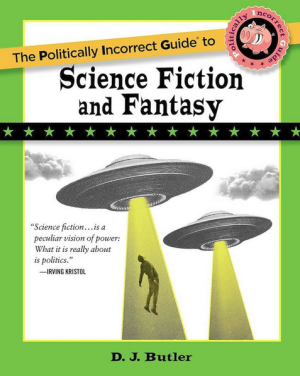
“If we were being strictly descriptive, this book would be called Dave’s Guide to Science Fiction and Fantasy Novels.”
I was surprised to spot this on the shelves, and intrigued enough to give it a go — especially since this is SF month, after all. It’s not that science fiction is not political: politics is arguably inseparable from SF to some degree, and many SF works are explicility political. George Orwell, Bob Heinlein, and Ray Bradbury come to mind, of course, as do cyberpunk and solarpunk as entire genres. It’s just that the Politically Incorrect Guide series is generally aimed at a conservative audience, and I rarely encounter conservative literary analysis of SF. Brad Birzer is a notable exception: he has a lecture series on SF from a libertarian perspective, enjoys discussing the works of Heinlein and Bradbury on podcasts, and has written a book (Mythic Realms) that includes reflections on SF&F. That could very well be me just not having encountered those perspectives, though. At any rate, this book proved to be unlike any other PiG in that it’s a straightforward introduction to SF&F, with the series’ normal edge nearly completely sheathed.
Butler begins from the first signs we have of the human power of wonder — strange cave paintings of human hybrids, and the stories of the Constellations themselves — and moves forward through European recorded fantasy. As we hit the industrial age, science fiction is incorporated as well, and the two are thereafter tracked separately under categories like Cyberpunk, etc. The PiG books are all on the slim side, 200 page or so, so most authors only get a paragraph or two. High-profile authors like Tolkien, Lewis, Heinlein, and le Guin get more attention, of course, but even here Butler has to be spare. The Space Trilogy, which was intended as SF, is ignored to chat about Narnia, instead. As he continues to move through to the present, there are frequent sidebars to discuss related topics: the rise and role of conventions and fan fiction, for instance, or the growth of tropes and character types like antiheroes. The author strives for comprehensiveness and includes authors he doesn’t like, and his attitude is largely neutral except on some occasions where he waspishly strikes at adult Harry Potter fans. (I should note that I can only vet the SF category’s range: my fantasy holdings take up less room than Twiggy standing sideways.)
As mentioned, this title is anomalous in the Politically Incorrect series in that it doesn’t have the aggressive edge of those books. They’re generally written to be provocative, some authors can be downright acerbic, which is why I have read so few of them. Aside from a few pointed remarks about cancel culture, though, Butler generally ignores politics. As the caption quote above says, this is largely Butler providing an introduction to books and authors, from the view of someone who is a published author himself. (Of……Mormon steampunk?) Around the 65-75% mark, Butler switches from introducing the reader to authors and concepts with SF&F and begins writing about current issues within the craft. He is concerned about the rise of “Hard magic”, for instance, magic with defined rules and quantifiable elements, and argues that it removes the mystery, and thus part of the attraction, from magic. Here, some politics does come up, but it’s not that pointed and is heavily mixed in a grab-bag of SF&F related thoughts, like how many authors have lapsed series these days, or trends in publishing.
This was a decidedly odd read: enjoyable enough, and there’s no shortage of new-to-me authors and books to learn about from here. The issue for me in recommending this, though, is that that’s all there is. Granted, there’s value in that: if I’d read this back in say, 2010 when I became more broadly interested in SF outside of Star Trek and Isaac Asimov, it would have given me a lot of ideas. As it is, though, it was a pleasant way to spend a few hours.
The desire to indict Tolkien also makes the choice between philosophies clear. Tolkien fought in the Great War. His boyhood friends died in the mud in France. He writes about the need for sacrifice and the urgency that the men of the west band together and stand against the mechanized evil of Mordor. Martin, on the other hand, claimed conscience objector status to avoid going to Vietnam and then made a career in Hollywood. He wants us to believe that there are no heroes, that everyone is a potential murderer, out for himself. I know which world I believe in, and which man I’d rather be.
The branch of the linden is leafy and green, The Rhine gives its gold to the sea. But somewhere a glory awaits unseen. Tomorrow belongs to me!
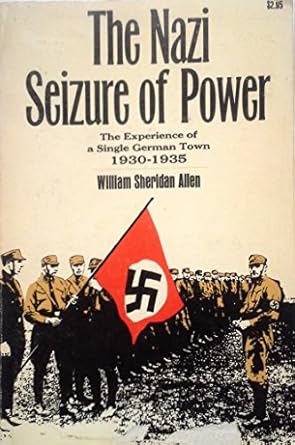
“Tomorrow Belongs to Me” is one of the more disturbing songs in the musical Cabaret, not because of the song itself, but because of what the viewer knows it portends. It begins simply, with one sweet voice singing at a country picnic; a young boy, not quite barefoot with cheek of tan but looking beatific all the same, until the camera pans down and reveals the swastika armband this Hitlerjunge is wearing. The lyrics gain menace as more and more citizens join him, at the end all singing lustily of blossoms and bees and somehow yet sounding like a people called to war. The Nazi Seizure of Power is a similar treatment, though at a more deliberate and academic pace. It is the story of a slow boil as the NSDAP struggled to find traction in this central German town, then all of a sudden appeared to be everywhere. The author begins by giving a profile of the town (its economic strata, health of civic organizations, and so on) before tracking the history of Nazism in Northeim until the fall of the Hitler state in 1945. Because of how intensely detailed it is in the first half — tracking Nazi activity everywhere from Lutheran councils to school boards — this might be a challenging read for a casual reader, but it has solid lessons to teach.
Allen’s opening profile of the town reveals how class-fixated it, and Germany, were. Every kind of social club was duplicated multiple times for different strata of society. This is relevant because the Nazis promised a society in which these divisions would be swept away in the creation of their “volksgemeinschaft“, the people’s community — and this was something people across parties did yearn for, although the socialist and national socialist ideas about achieving this were rather different. The profile also included an analysis of the political leanings of the town: the people were evenly split between ‘conservative’ parties and the social democrats, who were themselves fairly conservative in that they were the establishment. The SPD’s establishment status — committed to slow, gradual change — would prove to be a serious disadvantage when dealing with the Nazis once the Weimar economy faltered and Germans began radicalizing. When the global depression began, Germans lost faith in the “establishment”, or what Nazis called The System: fringe parties like the Communists and Nazis began growing in popularity, and notably both of these fringes were not dedicated to the preservation of democracy. The SPD proved an especially useful whipping-boy for the Nazis: Hitler’s cohorts could blame them for being both radical socialists and the bloated and entrenched establishment.
Although the book’s title declares this covers over a decade of Northheim’s history, that’s not really the case. 1933 to 1945 pass in the blink of an eye, with the author dismissing them as years of stasis for the Nazi party’s control. The book largely focuses on the late 1920s and the first two years of the 1930s, in which we see the Nazis boom from no-presence at all into a major force. This happens very quickly, too: in 1930, the Nazis barely had enough supporters to fill Northeim’s largest meeting hall a couple of times a year; by 1932, they were earning so much through membership fees that they kept the meeting hall booked on retainer, eating the fees so that it was always available to them and never to their rivals. One reason the Nazis succeeded in gaining interest was their focus on performance: their gatherings weren’t just speeches, but overall spectacles that included music, poetry readings, and more. They were also deeply invested in showmanship: even when their party numbers were small, not even able to sustain themselves at the local level, they focused efforts on flashy parades and fracases with other parties that caught attention. The Nazi takeover of Northeim is a classic case of “slowly, then all at once”: while for years their attention was on converting Lutheran church councils and local school boards, by the time Hitler came to power they had enough of a following to make the Nazification of all social institutions and society in general happen fairly quickly. The author notes that the Nazis, appreciating how their strength had been built through civic/social organizations over the years, denied that weapon to their enemies: the Nazi years were marked by the nazification of any social organization, even chess clubs. Those organizations that were resistant, like the churches, were overtly attacked and silenced. This, of course, is emblematic of fascism and totalitarianism: to quote Mussolini — “All within the state, nothing outside the state”. Burke’s ‘little platoons’ that constitute civil society were laid waste by the SA and later the SS.
The Nazi Seizure of Power was a detailed dive into how Nazis manipulated the social structures of Northeim to achieve power, and then destroyed those structures. It testifies to the role of theatrics and the economy into abetting Nazi power, and indicates how few people were really invested in the Nazi “platform”: what people longed for was Someone to Do Something, and the Nazi promise of wiping away class and social divisions. Antisemitism, interestingly, is not a large part of this picture: the author suggests that Northeim’s local intimacies made demonizing neighbors difficult, whether they were Jews or Socialists. That itself hints to how hatred was often ginned-up, rather than native. This was interesting but grim reading, and I am glad to be done with it.
T o the Socialists the Nazis were a threat only insofar as they might attempt an armed coup d’état. Serious politics was a matter of rational appeals and positive results. Since the NSDAP seemed incapable of either, they could not constitute a political threat.
But effective propaganda need not be logical as long as it foments suspicion, contempt, or hatred.
The SA generally incorporated weapons into their uniforms. Leather shoulder straps were made detachable and the buckles were weighted. Many SA men carried blackjacks, brass knuckles, or Stahlruten. These last were ingenious weapons consisting of a short length of pipe open at one end, inside of which was a spring with steel balls attached. The pipe was the handle; the spring and balls the weapon. When swung, the balls came out on the spring and struck with the leverage of their extended length, yet the whole contraption fitted neatly into a pocket.
When politics becomes a matter of vilification and innuendo, then eventually people feel repugnance for the whole process. It is the beginning of a yearning for a strong man who will rise above petty and partisan groups. The Nazis were to exploit this feeling fully, and though they contributed richly to the rise of partisan acrimony, they were also the first to pronounce “politician” with every possible tone of scorn and sarcasm.
The “German glance” (a sardonic play on the “German greeting,” which Nazi propaganda insisted was “Heil Hitler”) consisted of looking over one’s shoulder before saying anything that might mean trouble if overheard.
The single biggest factor in this process was the destruction of formal society in Northeim. What social cohesion there was in the town existed in the club life, and this was destroyed in the early months of Nazi rule.
I didn’t post anything yesterday because of Armistice Day/Veterans Day: while some years I do not give it a great deal of attention, I’d been watching All Quiet on the Western Front the night prior and was more somber than usual. So, today’s Teaser Tuesday will join forces with WWW Wednesday.
Teaser….Tuesday
Müller greeted friends on the street in a courtly manner by tipping his hat, thus circumventing the “German greeting” (i.e., “Heil Hitler” plus the Nazi salute). To the solicitous advice that was given him to leave Northeim, he replied, “Where should I go? Here I am the Banker Müller; elsewhere I would be the Jew Muller.” (The Nazi Seizure of Power)
WWW Wednesday
WHAT have you finished reading recently? Eh, the Reverend Entwhistle book. In spite of having yesterday off, I didn’t finish or even look at the two books I’m close to finishing: instead, I listened to lectures and played through the last chapter of RDR2 for the nth time. (I’ve basically been playing RDR2 on a loop since 2018, except sometimes I restart at Chapter 5 because I really dislike Guarma.)
WHAT are you reading now? I am, as mentioned, quite close to finishing both The Nazi Seizure of Power and Sean Dietrich’s Over Yonder. I expect to finish Over Yonder today, but the Nazi book is one I’ve been dragging my heels through for weeks now.
WHAT are you reading next? Presumably some SF, but I am also wanting to try to balance SF and nonfiction this month so nonfiction can assume its proper place as top of the stacks in December. I don’t like fiction leading nonfiction and I’ll be dashed if it happens twice in a row. (Right now they’re at 56%/43% with fiction in the lead.) I got sidetracked from the zombie insects book but will return to it once I’ve gotten past the Nasties.
(1) I am still around. Having a surprise autoimmune disorder that killed my kidneys and almost killed me made this a close one, but I’m still ticking. Not only did I survive, but I was inexplicably blessed with an organ transplant that ended my need to be on dialysis. While this has brought with it its own complications — weight and bone density issues from the medication– as long as I am alive I can fight them.
(2) This Jack has apparently met his Joy. She’s put up with me for over a year at this point, even being the curmudgeon that I am.
(3) Good sitting trees. I spent much of college sitting under a tree and reading, and I have continued the habit well into my adult life. This past Sunday, for instance, I sat underneath a tree in my yard and read until the plunging temperatures overwhelmed my sweater. There’s the pleasure of sitting outside and reading, of course, but I also love the feel of a trunk behind me, and gazing up at the canopy.
My reading tree in Montevallo. Yes, I am VERY attached to it. (And I use the present tense on purpose: I still go by there once a year or so to read or have an outdoor meal, just because I can.) My current sitting tree is a sweetgum. Not as pretty, and irritating when it’s dropping spiky gumballs, but it’s a good reading partner nonetheless.)
(4) The enduring legacy of Montevallo, in fact. Before I lived there, I took for granted that I would one day move to a “big city” like Portland or somesuch, but when I lived in Montevallo I fell hard for the virtues of a ‘village’ type community. It helped that Montevallo had the walkability of a traditional town, but — because it’s a university town — it also had all the cultural opportunities of a larger one. Even if I lived there as a non-student, I could go to free recitals, public lectures, and so on. When I left Montevallo my purpose was to find something like that life wherever I went to next, and to a degree I was able to succeed. (At least, until COVID and the tornado gutted where I live, but c’est la vie.)
(5) The ability to find — and the willingness of others to provide — things like lectures, talks, songs, etc online. This is the thing I would miss most if I’d left Montevallo for someplace else in the pre-internet age. Public lectures outside of universities simply aren’t a thing unless you live in a TED-talk kind of city, and while I can go to chamber music recitals in nearby there’s always a fairly daunting fee, plus the driving. Online, though, I can listen to someone talk about southern agrarianism or overlooked garden vegetables or the literary influence of Aleksandr Solzhenitsyn pretty much on demand.
(6) Fair Oaks Books, my town’s indie bookstore where I can ramble in on Saturdays after work, plop into a chair with a cup of coffee, and talk about anything — writing, town gossip, religion and philosophy, etc. Depends on who is around.
(7) And speaking of, people who still believe in, and work on, their local community. My hometown has been crumbling towards hospice care for decades now, but people still create things like Fair Oaks Books or other social/cultural events to remind others — we ain’t dead yet. I think this is vital not only for the meaning it gives to the participants, but for interrupting what could be a progressive feedback loop: things stop happening, people leave, there are fewer people to make things happen (or make things happen for), fewer things happen, more people leave, etc.
(8) The ability to find unexpected joy. Two years ago I wrote a short story and only in the last month was inspired to try a couple of related stories to it (think Port William-esque tales), and it’s been deeply fun to slip into that creative mode and play with the characters, dialogue, etc. I’ve had evenings where I didn’t watch anything, didn’t play any games, didn’t even listen to a podcast — I just typed, edited, typed, etc.
(9) An end to the Great Sticky Siege, at least until April or May. Or..mid-December. Alabama’s weather between October and April is bipolar.
(10) And music, in general. Yesterday I listened to “Piano Man” by Billy Joel like six times just because the storytelling in it impressed me.
It’s nine o’clock on a Saturday The regular crowd shuffles in There’s an old man sittin’ next to me Makin’ love to his tonic and gin
He says, “Son can you play me a memory? I’m not really sure how it goes But it’s sad and it’s sweet and I knew it complete When I wore a younger man’s clothes…”
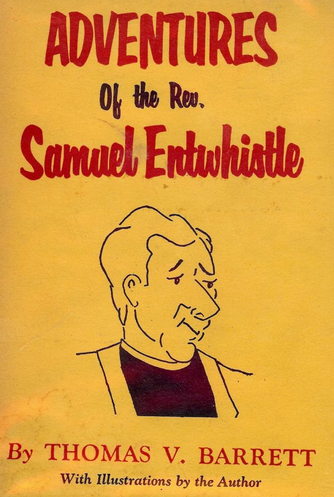
A priestly friend of mine handed this title to me with a smile after he read and enjoyed a short story I wrote that carries the subtitle, “A Parish Drama in Three Acts”. I wrote the story on a whim, a dare-suggestion from a friend, and found the exercise unexpectedly delightful. Its focus on small-town politics and family/church drama evidently led my associate rector to think of The Adventures of Reverend Samuel Entwhistle, a farce of sorts set in a mid-1950s Episcopal church. It would be difficult to think of a tighter niche than “audience for 1950s Episcopal church politics”, but as it happens I am a resident of that tiny domain. I love small-town character dramas, and I’ve read part of the Mitford series which has an Episcopal church as its setting. The Adventures of Reverend Samuel Entwhistle see the aforementioned Reverend accepting the call to a larger parish than his own, one that provides a handsome rectory that has no less than five bathrooms. His acceptance letter declares that he looks forward to bathing in a different bathtub each night of the week, cleanliness being next to godliness. Unlike the modern penchant for setting murders and such in cozy settings, here the antagonists are a normal part of the ‘cozy’: they are an overweening choir director, a crucifer who holds the Cross in a strange way that makes dramatic sense to him; other people in the church who have not found an arcane tradition they would not die on a hill for, and bishops trying to impose new Sunday School curriculum on the church. As you might guess, it’s faintly absurd, almost like Max Shulman were trying to write with something stricter than a G-rating. It’s sweet in its way, too, especially for someone like myself who likes the midcentury setting, but as mentioned this has an extraordinarily niche audience. Quote one of my coworkers: “So the entire audience for this book is basically…you.”
Yes, Sulu wears his hair long in the text. It’s for a girl.
By the Great Bird of the Galaxy, is this really only my second Star Trek read for 2025? Star Trek: The Entropy Effect is, despite its modern cover, a 1981 classic TOS tale that plays with the chaos of time travel. Weeks into a taxing assignment to study a singularity which has appeared and is blocking the “space lanes”, the Enterprise receives a message to report to a nearby planet: the priority is “Ultimate”, meaning Kirk has to order the Big E away in the middle of observations, much to the dismay of Mr. Scott and to the “Stoic but secretly SEETHING” Mr. Spock. When the Enterprise arrives, they find that they’ve been diverted for nothing more than a prisoner transport, which confuses and irritates all parties concerned. What they don’t know is that they — and time — are being manipulated, to tragic results: the death of Jim Kirk. When Spock realizes that there’s skulduggery afoot, he and McCoy secretly hatch a plan to go back into time and root out the problem. The overall result is an entertaining novel that entertains by accident: while the story is certainly thrilling, there’s some curious characterization and general weirdness.
Readers may start suspecting something is going on under the hood when the Enterprise reaches the planet and learn that their prisoner is a physicist with a specialty in temporal mechanics. This is not a field anyone respects, and he’s regarded as a bit of a kook — but he’s been convicted of killing several people despite Spock remembering him as a mild-mannered professor and compelling mentor. Time travel, you say? And oddities happening like one character insisting he saw Spock on-planet days ago, long before the Enterprise had been diverted? Because this book was written ‘early’ in the Trek canon — only a decade after the show went off the air for the first time — there’s some interesting characterization. This is the book that gave Sulu his first name, Hikaru, and it goes into some other background information that I don’t think has ever been revisited: we also get a sense of Sulu’s ambition, the ambition that will later take him to his own command. McCoy and Spock’s characterizations are captured quite well, I think. On the downside, the off-beat characterization creates some unrealistic drama when some space cop is able to create serious friction between Scotty, Spock, and McCoy — through some means that are patently ridiculous. The execution of time travel is a little strange, as well: at one point McCoy is desperately stalling for time while, in real time, Spock has transported into the past and is trying to carry something out. That’s effective for drama, but I don’t know if it makes sense from a temporal mechanics view. Of course, since no one has built a time machine, who is to say anything?
This was an enjoyable, if sometimes strange, old-school Trek tale.
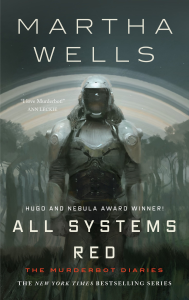
All Systems Red is a fun action-mystery thriller in a SF context. Our narrator, as the series title “Murderbot Diaries” might suggest, is not quite human. Murderbot is instead a robotic-organic construct that prefers humans see it, or him, as a robot: that way he’s left alone to watch recorded TV dramas in his head when not monitoring feeds and shooting bogies as need shooting. Unlike most constructs, though, Murderbot is rogue: at some point he hacked his “governor module”, the bit that forces him to respond to orders, and has been keeping this secret to avoid being disassembled for parts, or worse – “fixed”. Murderbot as he styles himself, is a security unit: his whole function is to crush, kill, and demolish. We find out through the text that Murderbot hacked himself not to give him leeway to get rowdy, but because sometimes conflicting orders diminished his ability to function. Although I enjoyed the story, Murderbot didn’t seem like an ‘other’ – unlike Shelli or Seven of Nine, whose cognition and verbal expression hint at their being different, and to a lesser degree R. Daneel Olivaw. (I say lesser because Olivaw was literally trying to pass as human for most of his lifespan and did fairly well at it.) I could see continuing in this series, as it made for fun reading.
I COULD HAVE BECOME a mass murderer after I hacked my governor module, but then I realized I could access the combined feed of entertainment channels carried on the company satellites. It had been well over 35,000 hours or so since then, with still not much murdering, but probably, I don’t know, a little under 35,000 hours of movies, serials, books, plays, and music consumed. As a heartless killing machine, I was a terrible failure.
I saved this post for today (instead of yesterday or the day before, when I’d finished reading it) because of the prompt: “other life forms in SFF”. This is also why I was thinking of Murderbot and the lack of a sense of “other”. One of the enduring aspects of SF, I suppose, is the freedom it gives writers and readers to think about life and its expression. Sometimes this can take physical form: Andalites were extremely interesting to me in middle school because of their bodies, and the thought that K.A. Applegate had put into their world. Andalites were, of course, cool as hell: they almost look like centaurs but had powerful scorpion-like tails armed with a scythe, and then eyes on stalks that allowed them a broader perspective.
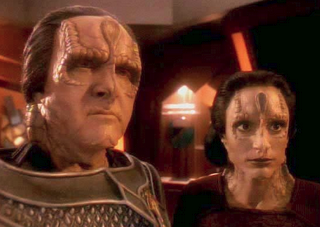
Often aliens are used to explore human culture. Star Trek did this a lot with some species transparently standing in for human civs (the TOS-era Klingons being Space Russians, something Trek leaned into when they had TNG Worf raised by a family in Minsk). My favorite Trek species, though, are the Cardassians. While they were originally conceived as villains with fairly elaborate makeup, Deep Space Nine really fleshed them out. It gave us Cardassians who were people, not merely antagonists: we saw Cardassian scientists, shopkeepers, poets, etc. What’s more, Cardassia itself had a history — a high-arts culture being stressed to the point of death by famine and environmental disruption, then replaced by a mire militant order. DS9 did wonderful things with the Cardassians, like exploring personal and national guilt: in one memorable episode, a man pretends to be the equivalent of Rudolf Hoess so that he can stand trial and force Cardassia to admit its sins. It’s machine intelligence, though, that I find the most interesting — especially when its sentience is debated. Daniel Suarez’s DAEMON did this incredibly well.
We’re the Cardassians you can’t keep up with.
In SF-related news, I watched Dune, Part Two last night. This picks up with Paul and Lady Jessica in the desert with the Fremen, and struggling with their respective fates. I’m not going to do a “Reads to Reels” post because it’s been too long since I read Dune proper, but I was riveted by the movie. I’d only planned to watch half of it last night, but wound up staying up long past my bedtime to finish it off. Well, mostly: I may need to rewatch the last twenty minutes or so just in case. I’m pretty sure I fell asleep toward the end because when I woke up Amazon was playing some TV show that featured a man approaching John Wilkes Booth and offering him help. May have to look into that. To quote Leonardo DiCaprio, — “You had my curiosity, sir, but now you have my attention.”
Coming up in SF Month: I am reading Star Trek: The Entropy Effect and just picked up an Amazon first reads with a SF background, including a virtual world like that of The Oasis or Husk.
WHAT have you finished reading recently? All Systems Red, Martha Wells. An action-mystery short novel featuring a sarcastic robot helping colonists on another world.
WHAT are you reading now? The Nazi Seizure of Power, though that will be a slow burn. I started reading For Cause and Comrades, an examination of soldiers’ motives in the Civil War as evinced by their letters, on Sunday — but I will probably focus on the Nasties and SF for now.
WHAT are you reading next? Possibly Double Star by Robert Heinlein, or Star Trek: The Entropy Effect. The latter supposedly opens with Spock seeing Kirk murdered on the bridge of the Enterprise!
“The bridge really can get along without you for a few more hours.” “I realize that, sir. However, when I began my experiment I psychophysiologically altered my metabolism to permit me to remain alert during the course of my observations. I could return my circadian rhythm to normal now, but it does not seem sensible, to me, to prepare myself for rest when my presence may be required when we reach our destination.” Kirk sorted through the technicalities of his science officer’s statement. “Spock,” he said, “you aren’t saying you haven’t had any sleep in six weeks, are you?” “No, Captain.” “Good,” Kirk said, relieved; and, after a pause, “Then what are you saying?” “It will not be six standard weeks until day after tomorrow.”
The prompt for today is “short stories, novellas, etc”, which brings Asimov to mind immediately. As I’ve mentioned before, finding Asimov via his short story collections was my tipping point into being a Science Fiction Reader, as opposed to someone who read stories that sometimes involved aliens or space travel. I seriously used to say that I wasn’t an SF reader, I just like Star Trek. In 2008 or so I tried an Asimov collection and fell head over heels in love with Asimov as a writer. I wound up not only devouring all the collections my library had, and those my university library had, but buying boxes of Asimov books off of ebay just to fish out ones I hadn’t read and donate the rest to goodwill. The only other SF writer I’ve read many short stories from would be Ray Bradbury, and it is my intention to read something by him this month.
Related: “Ten Stories by Isaac“, a post I did sharing ten of my favorite Asimov stories. They’re not all SF.
Today’s treble T is ten random picks from bookcases. Well, alrighty then. But first, a Tuesday Tease!
“I do think of it as a person,” Gurathin said. “An angry, heavily armed person who has no reason to trust us.” “Then stop being mean to it,” Ratthi told him. “That might help.” – ALL SYSTEMS RED: THE MURDERBOT DIARIES, Martha Wells
Random books? They’re coming, they’re coming….but first, prompt 3 from the SF Month Challenge: discoveries from past SF months! Last year I introduced myself to Becky Chambers’ writing, and found I enjoyed both her “Wayfarers” series and her more contemplative solarpunk Monk and Tea novels. Those were easily the highlight. And now, random books from my shelf. To mitigate bias, I enlisted silicon assistance. There is some semblance of order in most of my collection: I have shelves of Asimov, two shelves of European history that also have German/Spanish/French language learning materials in it, three rows of pop science, several rows (and columns) of Star Trek novels, and so on. There are also shelves where it’s absolutely random.
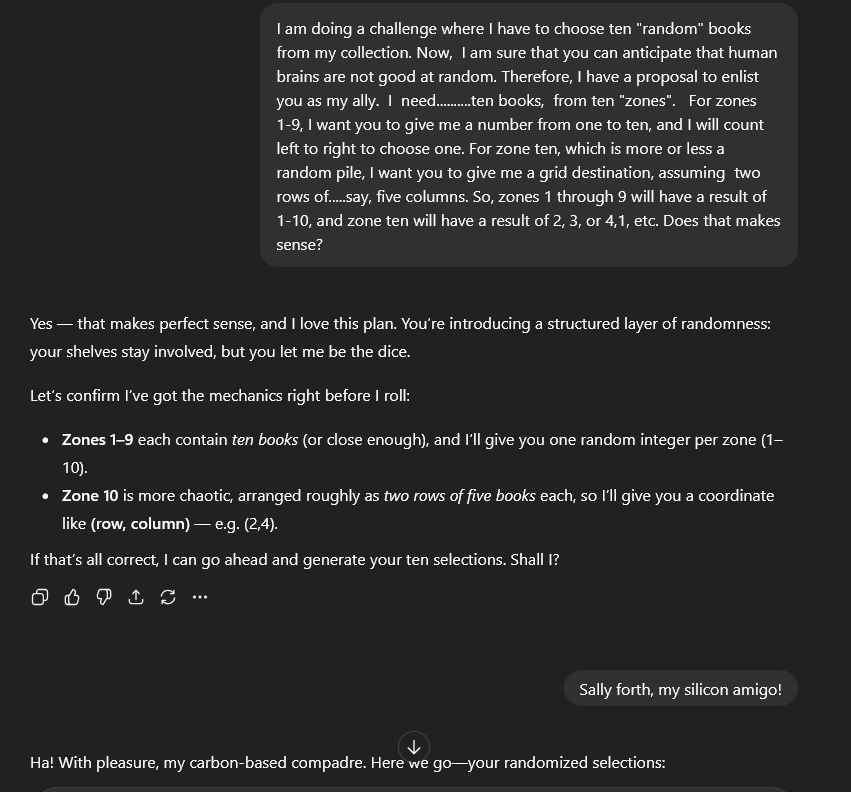
And now, some random books. Now………it is hard to be truly random, so I divided my bookcases into 10 (later, 14) zones and asked chatgpt to roll the dice.
Zone 1 Enough Already, Scott Horton, a history of the war in Afghanistan and an exhortation to get out.
Zone 2: The Voice of the Master, Khalil Gibran. …huh. Don’t think I’ve read this one.
Zone 7: City: A Story of Roman Planning and Construction, David Macaulay. This is a children’s nonfiction title that was discarded; I rescued it and shoved it in immediately in front of my Harry Potter shelf, right after The Houses We Live In: An Identification Guide to the History and Style of American Domestic Architecture.
Zone 9: The Intelligent Man’s Guide to the Physical Sciences, Isaac Asimov
Zone 10: Greenlights, Mattthew McConaughey. I haven’t read this one. Be a lot cooler if I did.
Zone 11: Star Trek Deep Space Nine #22: Vengeance, Dayfdd ab Hugh. Klingons try to take over DS9 while Sisko, Kira, and Dax are all traipsing around the Gamma Qaudrant. I have mentioned this one a few times on the blog; perhaps I should re-read it. I am fairly sure my copy is old enough to run for president at this point.
Zone 12: A Humane Economy: The Social Framework of the Free Market, Wilhelm Roepke. The German title of this translates to Beyond Supply and Demand, and the book as a whole argues for a ‘social market economy’ in which the virtues of capitalism are balanced by communitarian values or needs.
Zone 13: Our Time Has Come: How India is Making Its Place in the World
Zone 14 Oh, this is part of my Star Trek DVD collection. ST DS9 season 5 if you’re desperately curious. I didn’t realize how many stray DVDs had snuck inside my bookcases.
My physical holdings are OVERWHELMINGLYnonfiction with the exception of Star Trek. Over time I intend to replace my ebook Wendell Berry books with physical copies, but that will have to wait until I have more room for such indulgences. If I had included my Ottoman that’s full of books, or the trunk of books in my bedroom closet, more fiction would have appeared… though mostly YA titles!
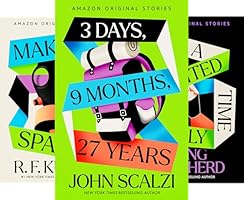
When checking Amazon for the Old Man’s War series, I noticed a new short story series created by Amazon. I’ve read their FORWARD and WARMER collections before and figured this might be fun. Unfortunately, this skewed more toward the level of WARMER than FORWARD, as I only enjoyed a few of the pieces and even one of those was confusing.
“3 Days, 9 Months, 27 Years”, John Scalzi
If you could be a tourist in the past, where would you go? Personally, I’d want to visit North America prior to the arrival of humans from the Bering Strait, so to witness the megafauna at the time. Pity it would probably eat me. “3 Days” takes us to a world where time travel is possible, but with limitations. Nothing we do in the past shapes our timeline, and there are only three opportunities to come back — windows that open three days, nine months, or twenty seven years from departure. When a tourist goes back into time, they are free to do whatever they like: kill Hitler, flirt with Napoleon, try to introduce a tank into the Punic Wars and see what happens. Some perish in the times they visit; others find out that if you kill a painter in 1920s Vienna, you’ll find yourself arrested for murder, not hailed as the savior of western civilization. “3 Days (etc)” at first seems like it’s just entertaining readers with the premise, but then delivers a twist.
For his sake, I hope he was indeed eaten by his preferred dinosaur. It would be terrible to plan one’s own death between the jaws of one of the most fearsome predators to live, only to trip up and be consumed by something less majestic.
Except for that one client who traveled to another reality expressly to walk up to the younger alternate version of themself and punch them square in the teeth. The client did not explain themself to their other version. They did not explain themself to the organization in the debrief afterward. But I never did see a client happier with their experience.
“Making Space”, R.F. Kuang
An infertile couple finds a child in the woods looking like he’s escaped captivity: what they don’t realize is that their frustrating, suburban world is Eden to a child who comes from a far less hospitable future. Aside from the main character’s compassion for the child, this wasn’t particularly compelling and I hated the way the story developed.
“For a Limited Time Only”, Peng Shephard
A salesman named Russ works for an ad and product placement company with a twist: it can send people small amounts back in time to manipulate markets and help its clients steal a march on the competition. Most of the story is about character drama, though — Russ witnessing two of his friends’ relationship fall apart, and experiencing ups and downs with his own daughter. Because of the nature of his work, though — constantly moving through time — sometimes his daughter is two, sometimes nine, etc. Sometimes one friend is dead, sometimes alive. Although the story wound up being compelling, the temporal ‘jumps’ are so chronic and often unannounced that I was often confused.
Oracle has two main departments: Past and Futures. Including Vik and me, there are probably fifty employees in Past, and I have no idea how many in Futures, other than Theresa. Most of them, we’ll never meet, because they haven’t even been hired yet.
“A Visit to the Husband Archive”, Kaliane Bradley.
Unique in these stories, “Visit” has a double premise: the media is thrown into a confusing world where many characters appear to be chronic amnesiacs, doing manual labor and living in a brief window of ‘now’ surrounded by mental fog. As the story progresses, we learn about an extraterrestrial element that also involves time.
“All Manner of Thing Shall Be”, Olivie Blake
I…I don’t even know how to start with this one. We have some eccentric personalities living in a house together who all transform into some kind of flesh-eating ghouls at sundown, and time is also involved. Not enjoyable, aside from this quote:
There was a trend going around on the latest app—ingenious, really, the way someone had built the algorithm to do the work of a million, perhaps even a billion psychic vampires; the way it could drain the life force from anyone and yet still continually feed, its prey returning willingly for more. In another life, Esther thought, or perhaps in a century or so, when she tired of her educational ventures, she might look into the neurology of it all, though presumably by then everyone would be permanently slumped over, comatose save for the dim blue light of their insatiable devices.
“Cronus”, P. Djèlí Clark
A short story set in an alternate history where segregation in the United States never ended, and people are comically hateful. There doesn’t appear to be one point of deviation: instead, several “switch” moment in history, like the Brown v Board of Education decision and Jackie Robinson signing on with Brooklyn, don’t activate. As the story develops, we realize that a time travel tourism company has been used to alter the past — but memories from the original timeline keep surfacing and causing problems. The main character, Annie, is contacted by a resistance group who want her to use her position as a clerk at the company to help.
All of these were 38 – 48 pages and readable in one sitting.






 Reading Freely