
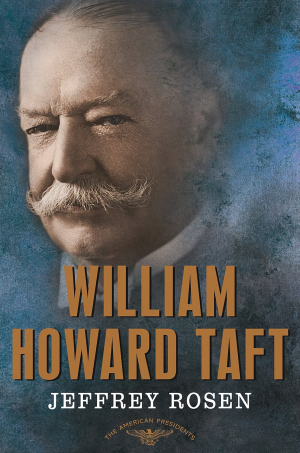
Early on in the American republic, the office of president was referred to as the chief magistrate; William Howard Taft must have taken that on as a challenge, because after serving as President, he later became the Chief Justice of the Supreme Court. Taft is not a name known to most Americans today, unless it’s for fat jokes (he was a hefty boy, struggling with weight all his life and generally ranging from 270 to 340 in his adult life), but like Cleveland he was the last of his kind — a president who truly believed in his role as a protector of the Constitution. For Taft, who loved the law more than politics, who had been aspiring toward the Supreme Court since his 30s, the Constitution was sacrosanct. Fittingly, then, this biography is only half-over when Taft surrenders the One Ring to Woodrow Wilson: the rest is taken up with Taft as Chief Justice, since Warren Harding offered him the seat for the third and final time.
One thing I’m noticing about the American Presidents series is that authors are sometimes chosen for a unique vantage point — a surgeon writing about Garfield, who was killed by surgeons, for instance. Jeffrey Rosen is a lawyer and legal scholar who approaches Taft from a lawyer’s eye, and as such his childhood is almost entirely omitted save for learning that he was an overhealthy baby (by which we mean a porker) and that he was an accomplished student despite having attendance issues. Young Taft started in politics early, developing a contempt for corruption and a healthy respect for the horrors of mob violence. He became a man who put great stock by the rule of law, which would make him a cautious but superbly Constitutional executive: unfortunately for his close friendship with Teddy Roosevelt, it would also make him in Teddy’s eyes a dismal successor. Taft and Teddy agreed on some abstract things, like the need for the government to keep corporations from becoming overweening in themselves — but whereas Taft wanted to continually use constitutional powers to keep the corpos from growing large, Teddy wanted to expand the government so that it could keep pace with the corporations. Teddy was so irritated at Taft wanting to retroactively make Roosevelt policies lawful, and then moving cautiously in office, that he challenged Taft for election. This led to the triumph of god-king Wilson and ruptured their friendship. They barely reconciled before Roosevelt’s death, but not to the degree that Adams and Jefferson did in the “You were my brother, Anakin! I loved you!” sense.
There is more to Taft, however, than his presidency. His extreme interest in lawful constitutions and even temper made him an excellent civil governor of the Philippines when McKinley began the age of American Empire by planting the Flag all over creation. He worked with Filipinos to create a government that largely reflected the Bill of Rights, though not entirely: Americans did not view Filipinos as quite up to the labor of being self-governing, and so suffrage and gun ownership were both restricted. That said, Taft’s sincerity in creating a just state for the Philippines was such that when he was finally recalled to the states — after turning down Supreme Court appointments twice, despite his interest in the seats — the Filipinos cried out, “Queremos Taft!”. After his presidency, Taft finally achieved what he wanted: Chief Justice of the US of A. Having long idolized Judge Marshall, Taft became his first true successor — radically reforming the court and leading the charge to evacuate it from the Senate’s basement and create its own Temple of Justice, the present SCOTUS building. His love for the court and justice was such that decisions tended toward unanimity — 70-80% of the time. Today the average lingers around 30%. He greatly enhanced the Supreme Court and federal courts overall with an eye towards institutional integrity, independence, and efficacy.
I found Taft a very appetizing figure, a man who believed the Law transcends the government, and who took Constitutional limits seriously; he happily exercised his veto when he thought Congress was violating the Constitution, regardless of their good intentions. (They overrode the veto a few times, but it’s the thought that counts.) Unfortunately, this book was incredibly short, barely over a hundred pages: the rest were notes. I may have to read The Bully Pulpit, on his and Roosevelt’s relationship, to get closer to the man. (But….not immediately. I’ve got books on hand for Carter, the Harrisons, and Coolidge. September is going to be a “concentrate all firepower on the Presidential starship!” kind of month.)
Related:
Taft 2012: a speculative novel in which Taft, who mysteriously disappeared after his POTUS term, wakes up on the White House lawn during the Obama administration.
Quotations
Taft was always an excellent dancer and sometimes waltzed alone on the White House veranda.
Nellie especially remembered Will in a burlesque of The Sleeping Beauty, where he played the title role.
Their first lovers’ quarrel, remarkably, was on a constitutional question —Nellie pressed her policy views on abolitionism, and Will opposed her on constitutional grounds—and his early missives read less like billets-doux than judicial opinions. “I am prepared to submit a few questions of this tenor to the high court of friendship wherein let Mr. Justice Taft and Miss Justice Herron to determine such questions,”34 he wrote playfully. (Will was seeking Nellie’s advice about whether it was ethical of him to have voted for a friend’s father who sought a judgeship.
Why, I am not the man you want,” Taft declared. “To begin with, I have
never approved of keeping the Philippines.”
“You don’t want them any less than I do,” McKinley replied, “but we have got them and in dealing with them I think I can trust the man who didn’t want them better than I can the man who did.“If only there were three of you!” Roosevelt added flatteringly. “Then I would have put one of you on the Supreme Court … one of you in Root’s place as secretary of war, when he goes out; and one of you permanently governor of the Philippines.”
Later that year, Taft and Nellie joined the Roosevelts for an intimate dinner at the White House, after which Roosevelt threw himself into a chair in the library and closed his eyes.
“I am the seventh son of a seventh daughter and I have clairvoyant powers,” he intoned melodramatically. “There is something hanging over his head. I cannot make out what it is.… At one time it looks like the Presidency, then again it looks like the chief justiceship.”
“Make it the presidency,” said Mrs. Taft.
“Make it the chief justiceship,” said Mr. Taft.Taft insisted, “We have a government of limited power under the Constitution, and we have got to work out our problems on the basis of law. Now, if that is reactionary, then I am a reactionary.”
“Next to my wife and children,” the Court “is the nearest thing to my heart
in life,”he wrote. “The truth is,” he observed in 1925, “I don’t remember I ever was president.”Taft’s judicial presidency was less successful than his presidential chief justiceship because, in attempting to govern the United States in the early twentieth century along the lines that the Framers clearly preferred, Taft was unable to grapple with forces that the Framers would have abhorred— including the democratization of politics and the increasing power of political parties. By creating an executive with energy, to use Hamilton’s term, the Framers left the office open to alterations that ran against their basic conceptions of how the entire federal government should operate.
Today, however, as new populist forces in America and around the world threaten principles of constitutionalism, limited government, democratic deliberation, checks and balances, and the rule of law, Taft’s conception of a vigorous but constrained presidency checked by similarly vigorous but constrained courts and Congress looks increasingly appealing. Taft would have been distressed by the spectacle of tweeting presidents and representatives: like Madison in Federalist 10, he believed that direct communication between representatives and their constituents was the democratic vice most to be avoided, since it promoted faction and discouraged reasoned deliberation.


Can’t have many more left to do… can you? [lol]
Less than 10!
Specifically:
– William Henry Harrison
– his grandson Benjamin Harrison
– Polk
– Calvin Coolidge
– McKinley
– Hoover
– FDR (No Ordinary Time was really on his WW2 admin)
– LBJ
I’ll see if I can get back into my Prime Minister’s bios next year. I have a general book looking at most of the PMs I grew up with (starting with Harold Wilson) which I think will be a good way of getting back into it…
I imagine with PMs you’d want to winnow out the ones who weren’t in office very long or didn’t do anything — I originally ignored Harrison because he died so early into his admin but am now doing him for completions sake.
Churchill (understandably) gets a LOT of attention from historians, but I want, at least initially, to focus on the *post*-war PMs starting with Clement Attlee. Harold Wilson (and to a lessor extent Edward Heath) interest me a *great* deal mostly because they were PMs when I really started noticing the world around me more. There is a series of short books on all of the major PMs going back a LONG way that I might dip into. The 19th century giants of politics (Palmerston, Disraeli etc..) definitely need some of my focus!
To be honest the only postwar PM I could name (between Churchill and Blair) is Thatcher. I’ve done fairly well keeping up with PMs since I got interested in world affairs in the early-mid 2000s. Once impressed a history professor who asked, rhetorically, if anyone could name the leaders of France, Britain, or Germany…and I knew all three. XD Mostly because of listening to BBC world news via NPR.