
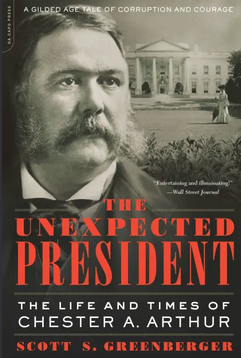
This president reading project has been interesting so far, making me more fully aware of how complex some of the personalities to inhabit the White House have been. Chester A. Arthur, a man I formerly knew only for his muttonchops, has a dramatic story all of his own—that of a corrupt political operator who, forced into the ultimate in political responsibility, rose to the challenge.
Born the son of a stern preacher, Arthur was drawn toward the law and achieved success as a Union quartermaster during the Civil War—navigating his “little rebel wife’s” family ties to the South. After the war, he became interested in politics—but politics of the day was below-the-belt action. In New York, the spoils system reigned supreme: not only were all government jobs thought the property of the reigning party, those who got the jobs were expected to reward The Party by kicking up tribute. While Arthur had begun as an honest lawyer—one attacking segregation, in fact—the success he sought in politics meant becoming a machine creature, aided by everyone from party operatives to President Grant.
The highlight of his Machine career was serving as the Customs Collector in New York, controlling over a thousand jobs and bringing in 75% of the federal government’s custom revenue. When President Hayes began making changes to civil service laws, restricting its tribute system, Arthur and others patently refused to cooperate. Arthur was so thoroughly a servant of the Machine that many Republicans were disgusted by his being named as vice president—but the GOP leadership thought it a necessary evil to make sure the New York Machine didn’t go into action against their man, the reform-minded James Garfield. Still worse: after being named the candidate, and then becoming vice president, Arthur continued publicly deferring to the Machine boss Roscoe Conkling (what a wonderful villain name). Then, inexplicably, President James Garfield was shot only a few months into his term. “I AM THE STALWART OF STALWARTS! ARTHUR IS PRESIDENT NOW!” the would-be assassin proclaimed. Under such an air of suspicion and ignominy, Arthur was pressed into the public eye.
It took months for Garfield to perish at the hands of his doctors, and in the interim, Arthur shocked everyone by acting… presidential. He suspended his hard-drinking and partying; he attended the family of the stricken president. He did due diligence, ensuring Congress appointed a president pro tempore to fill his place if something happened. After Garfield died and Arthur became president in his own right, he astonished the nation by pushing toward civil service reform and exercising the presidential veto in a way that won him no friends anywhere—like sending back a bill to exclude Chinese immigration for twenty years as a treaty violation. While a large part of this, presumably, was his desire to free himself of suspicion—he had to fight the Machine to prove he had not prospered from a man’s murder to do the Machine’s bidding—Arthur had a secret. He was dying of Bright’s disease, and while he had no idea how long he had, he could not ignore the march of mortality taking him ever closer to the river Styx. After decades prospering from grift and dirty politics, Arthur now had a chance to prove before man and God what kind of man he could be—and like another Arthur, he turned into a good one.
While Arthur’s transformation is a huge part of what makes this biography work, the author makes it all the more compelling by including Arthur’s literary relationship with Julia Sand, a woman who lived as an invalid and who, for whatever reason, took on Arthur as a special project—sending him letter after letter to admonish him, to challenge him, to encourage him to greatness. The letters were not known to history for most of the 20th century, and Greenberger incorporates them heavily. They add a fascinating element to this story, because while we don’t have much of the correspondence—just the letters he received—we know Arthur responded to her in at least one way: he visited her on her sickbed. She was too intimidated by all the family around her to speak to Arthur as candidly as she did in her letters, but I found this era of Arthur’s life unique. Sand’s words to Arthur were so compelling that some of them made their way into Mrs. Garfield’s mouth in the recent miniseries. In the one corner, Arthur had the baggage of an entire life lived in politics—histories with men who felt he now owed them something, habits of thinking and acting that were now beneath the dignity of his office; in the other, his own troubled conscience and one woman writing, pleading, urging his better angels to come forward.
What a piece of work is man, and especially Chester A. Arthur. I suspect I will want to revisit him.
What’s next for Hail to the Chief? I am steadily working on Truman by David McCullough, and entertaining the idea of doing a Harrison double feature. William Henry Harrison died a month into office (giving Tyler a chance to establish a precedent by saying “Look at me! I’m the President now”), and Benjamin Harrison has the distinction of sandwiched by Grover Clevelands — serving between his two terms.
Quotations
“Arthur took the helm [as New York Customs Collector] the day after New Yorkers celebrated Thanksgiving. He had much to be thankful for: his loyalty and striving had landed him the most lucrative job in the entire federal government. In addition to his regular salary, Arthur received a cut of the fines and forfeitures levied by frequently overzealous customs inspectors. In total, he grossed more than $50,000 a year (about $1 million in today’s dollars)—more than cabinet members, Supreme Court justices, the vice president, or Grant himself.”
“You are free—free to be as able & as honorable as any man who ever filled the presidential chair. Your past—you know best what it has been. You have lived for worldly things. Fairly or unfairly, you have won them. You are rich, powerful—tomorrow, perhaps, you will be President. And what is it all worth? Are you peaceful—are you happy? What if a few days hence the hand of the next unsatisfied ruffian should lay you low & you should drag through months of weary suffering in the White House, knowing that all over the land not a prayer was uttered in your behalf, not a tear shed, that the great American people was glad to be rid of you—would not worldly honors seem rather empty then? Rise to the emergency. Disappoint our fears. Force the nation to have faith in you. Show from the first that you have none but the purest aims. It may be difficult at once to inspire confidence, but persevere. In time—when you have given reason for it—the country will love & trust you. Your name is now on the annals of history, You cannot slink back into obscurity, if you would. A hundred years hence, school boys will recite your name in the list of Presidents and tell of your administration. And what shall posterity say? It is for you to choose whether your record shall be written in black or in gold.” – Julia Sand, letter to Vice-President Arthur
“But I do not like to think of men as blocks of marble, things that may be cut down in the finishing, but cannot be made to expand. I prefer to think of them as things with infinite powers of growth.” – Julia Sand, letter to President Arthur
“I long ago determined to do what was at hand as well as I might, and let each day be complete for itself. Then I am prepared for whatever happens. Such a course may not bring many of the joys of anticipation, but it certainly entails none of the sorrows of disappointment.” – Chester A. Arthur
“Fame is a bubble, and broken is but suds.” – Chester A. Arthur


