
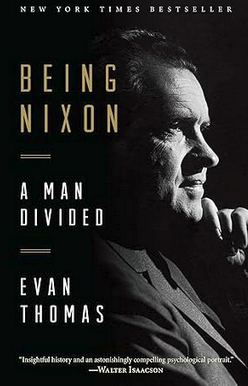
Last year I nearly did a deep dive into all things Nixon: exactly a year later, he beckoned me to follow him, and this time I did. What is it about Nixon? One book I’ve read recently, and I can’t tell you which because I’ve been grazing so many, said that Nixon’s life would make for a perfect novel with its levels of drama and tragedy. Imagine a man reelected overwhelmingly – carrying all but one state, a singular feat matched only by Reagan some years later – and then within a couple of years, leaving DC in ignominy. I’m not sure where my fascination with Nixon began – perhaps it owes to my contrarian streak and wanting to find something redeemable in him just because he’s disliked, or perhaps I saw something in all those presidential books I read back in 2023 (on the President’s Club, on life in the White House, etc) that intrigued me. At any rate, the more I read about about RN, the more interesting the man gets.
Being Nixon is a biography, but it’s one that looks intently at Nixon’s interior life, his character and personality. The conventional view of Nixon is that of a dark-jowled old man, glowering from his office and making plots from behind the Wilson desk. Nixon was more than that, though: he was a man who jumped up and down in his chair while immersed in a good movie, who roared with delight at baseball games, who entertained at parties by playing lively tunes on the piano. He was, oddly, an introvert who was nonetheless drawn toward a career that almost demanded extroversion. He could be painfully shy and conflict-avoidant, making him an odd duck at parties – unless he felt comfortable with the people he was with, at which point he came alive. He also came alive when discussing policy, particularly foreign policy. It was arguably his greatest talent, and one he exercised as vice president, president, and former president: no other chief executive of the US had made as many foreign trips as Nixon overseas.He had such a grasp on Russia and China – their nature, their interests – that even on the day before he died, he and President Clinton were conversing on Russia policy.
Being Nixon accomplishes the feat of providing both a detailed political biography – Nixon’s rise to power, being sidelined by the Kennedys, quarreling with Kissinger et. al over Vietnam policy – while at the same time studying the man himself. Nixon came from poverty and struggle: he had a thirst to prove himself. A dauntingly hard worker, the higher he climbed the further he wanted to go: he didn’t simply want to be president, he wanted to be a statesman who contributed to a new order – a global Metternich, if you will. And he did enormous things, good and ill – improving relations with the Soviet Union, opening them up with Red China. He wasn’t a Wilsonian idealist, though, but more of a pragmatist – and while he started politics clean, after he’d been in the game for a while he started seeing how others twisted the rules. That pragmatism then drifted to a willingness to engage in fighting dirty, especially after the 1960 election where he was beaten using stuffed ballot poxes and similar tricks. This openness to the dark grew when he became convinced that his office was being spied on and information was being leaked out. (He was right on both counts, though the revelation that the DoD was spying on him wasn’t public when this book was published.) His desire to get the goods on the adversary created an atmosphere in the Oval Office that tacitly encouraged things like the break-in, even if Nixon was not aware of that particular plan. Where he erred, of course, was participating in an attempt to squelch the story – painfully ironic considering that he said of Alger Hiss, when taking the communist down, that his lying and coverup had been what exposed his original crime.
This is a deep, dense book that I enjoyed taking my time with over the last two weeks; it’s been my first full review of Nixon’s life and career, and I loved the way it tried to get to know the man himself, because he was a tempest in himself, whose rise and fall and refusal to quit and self-sabotage are a tale worthy of Tolstoy or Shakespeare.
Quotations
Nixon resisted. “I can’t fire men simply because of the appearance of guilt. I have to have proof of their guilt.”
Peterson ‘straightened’, Nixon recalled, and said, “What you have just said, Mr. President, speaks very well of you as a man. It does not speak well of you as a President.”
Governor Wilson borrowed a favorite Nixon line from Sophocles: “One must wait until the evening to see how splendid the day has been. Clinton said, “May the day of judging President Nixon on anything less than his entire life and career come to a close.”
A Manichaean divide between light and dark is useful in religion and literature and possibly political science, but it is a device, a construct. There was only one Nixon. In Nixon the light and dark straints are intricably intertwined, impossible to disentangled. They fed each other. Nixon’s strengths were his weaknesses, and vice versa. The device that propelled him also crippled him. The underdog’s sensitivity that made him farsighted also blinded him. He wanted to show that he was hard because he felt soft. He learned to be popular because he felt rejected. He was the lonely everyman to the end.
It is one of the mysteries — and glories — of human nature that sinners can become saints. But only in prayers of another world are saints truly cleansed of sin. Often the more convincing moralists are the very ones who feel the temptation to sin most strongly. Some turn out to be hypocrites, but that does not mean their sermons are hollow. Very few, if any, great men or women are pure of heart, but inner torment and even a touch of wickedness can be catalysts to greatness.
Nixon was no saint. But the fears and insecurities that led him into sinfulness s also gave him the drive to push past self-doubt, to pretend to be cheerful, to dare to be brave, to see, often through sadly not always, the light in the dark.

 Reading Freely
Nixon was *definitely* ‘interesting’… Can’t argue with that! I might read about him later in the year, or if my random dice throw intervenes @ some point… [muses]
Did you ever go for that “Man against the World” book you were pondering last year when I posted a Nixon review?
The two I have (both unread!) are:
One Man Against the World – The Tragedy of Richard Nixon by Tim Weiner
Frost – Nixon by David Frost
The David Frost book is about the (in)famous 1977 series of interviews he did with a sometimes VERY forthright Nixon….
I just started watching the Frost/Nixon movie….in it, Nixon is sold on the idea because Frost is described as a tabloid host who just asks softball questions, and he needs money to pay his lawyers. According to IN THE ARENA, he was being buried in lawsuits.