
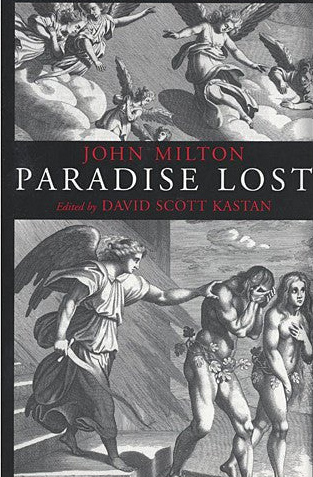
Like Dante’s Divine Comedy, Milton’s Paradise Lost is a key bit of Christian literature which has shaped people’s understanding of Bible stories in an indirect way; that is, Milton and Dante’s interpretation of Biblical events and places has become our understanding of said events and places, even though they’re extra-biblical. I’ve frequently encountered choice quotes from it over the years and have wanted to properly dig in to it. I should note that this will be a mixed-media review: while I did read the physical book, I also listened to the BBC-4 dramatization of it which gave certain characters powerful expression (Ian McDiarmid as Satan is perfect casting) and others….not. Jesus and Adam sounded rather dainty. God, thankfully, is not: as a matter of fact, when I was lying in bed and listening, I could definitely see his lines being delivered by Aslan.)
Paradise Lost is an English poem which recounts both Satan’s exile from Heaven and Man’s fall from Grace. As we learn, the two are related: the book opens with Satan’s rebellion against the Son, and his and his followers’ subsequent falling from Heaven into Hell, where Satan vows to make a kingdom. The creation of Earth allows him opportunity for greater empire, and the temptation is particularly sweet given that God has created new creatures in His own image, creatures whose fall Satan would dearly loved to effect. Although the Son volunteers to leave heaven to frustrate Satan’s plans, readers are subsequently treated to Satan’s frustrated attempts to get into the garden, finally having to possess the body of a snake — a hateful choice, but one made in spite — in order to access the couple. Milton’s narrative adds a lot to the story, because the archangel Raphael explicitly goes to the garden, tells him the account of Creation, and warns Adam that there’s something rotten in the state of Eden. (Then they discuss heliocentrism, which frankly I was not expecting, but Milton evidently met Galileo.) Alas, Eve has the idea of splitting up to get more done, and Satan is able to use his ability to “speak” as a serpent to convince her — amid enormous flattery — that eating of the Tree of the Knowledge of Good and Evil will similarly uplift her. (Given that I first experienced this while listening to McDiarmid, I couldn’t help but think of Palpatine’s similar seduction of Anakin into the Dark Side with the “Have you heard the tale of Darth Plageius the Wise?” scene.) Then she and Adam prove that codependency has a long pedigree and go down together rather than be separated.
This was an impressive work: Milton’s reputation as as an English stylist is well deserved. There were numerous phrases like “devils to adore for deities” that I immediately had to scribble down and think about. Having read CS Lewis’ Preface to Paradise Lost, I knew already Milton is slightly heterodox, especially in his views on the Trinity: I thought it was interesting that he never refers to Jesus, but rather The Son, placing emphasis on that character’s subordinate relationship to The Father. That connects directly to the text, because Satan is resentful that another creature besides himself is being exalted. Ultimately, Satan’s observation that “myself am hell” proves true: his self-obsession drives him from being chief of the angels to being a petty and spiteful spirit possessing a snake crawling in the dirt.
This is also a challenging book to read for a modern reader, rather like Dante, because there’s a lot of culture we may not be familiar with: Milton drinks deeply from classical culture, with allusions a-plenty, and properly understanding what’s going on relies on knowledge of that (or at least, annotations) and some help with medieval cosmology, as there are lots of astrological connections as well. I wound up making use of three versions of the book to find annotations sufficient, and listened to a lecture from Tony Esolen to boot. (He can perform large portions of the poem from memory, and I say perform rather than recite for a reason.) I definitely enjoyed this, but I think the BBC adaptation went a long way to giving it more life: even when I was reading sections rather than listening to them, I could hear Palpatine-Satan.

 Reading Freely