
I should preface this review with a bit of biography; some who have been reading me for a while are already familiar with it, and others have gotten bits of it, because I’ve grown more comfortable sharing over the years. I grew up in an extremely religious Pentecostal sect; left it somewhere between age 20 & 21; was a zealous secular humanist for 3-4 years, became obsessed with meaning and living a ‘good life’, and by age 27 was a practicing Christian within the Episcopal tradition. I have remained there since, though in practice and belief I am now much closer to a traditional Catholic than your average Episcopalian, pope aside. Given this, I am sure a reader might understand why I might find a man writing about his conversion from practical agnosticism to Christianity somewhat interesting.
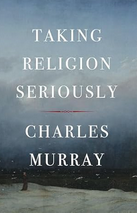
Taking Religion Seriously is a chronicle of Murray’s journey from effective agnosticism to a tacit embrace of Christianity — tacit because he believes in it, but not in a ‘set the world on fire’ kind of way. His is an intellectual, reading journey: he shares the books he’s read that have shaped this thinking, and cautions readers that he is no authority. He simply asks that readers consider his history of thought, look at the books he’s read, and draw their own conclusions. (He believes he has found ‘evidence that demands a verdict’, you might say.) His early story is like many: he was raised in belief and came from it in college, thinking that intelligent people simply didn’t take religious claims seriously. From here, the story is a little more complex: Murray writes that it’s very easy for us to impose a tidy narrative after the fact, when changes in beliefs as lived are in fact much more messy. Having changed worldviews at least twice in my several decades on this Earth, I can readily agree with that — because I have tried first to explain my departure from Pentecostalism to secularism to family and friends, and then to explain my departure from secularism to belief to myself.
Murray opens with scientific concerns, particularly the peculiar fitness that our universe has for life, and the improbability of physical laws not only allowing for a stable universe, but one stable enough to engender life. He is also skeptical of strict materialism, arguing that studies into psychic abilities, near-death experiences, and ‘terminal lucidity'( a new term for me, I will admit) indicate that there is more to a human being — to any one given person — than simply brain activity. He then begins transitioning into other arguments, like Lewis’ argument from moral law, and interesting textual studies of the Gospels that argue for their being attempts to capture historical fact, not simply tell an enchanting story. He shares arguments he’s read that the synoptic Gospels were written earlier than 20th century scholarship has admitted, and introduces a new-to-me concept called “undesigned coincidences” in which minor details from one account support details from another account — like Jesus giving disciples nicknames in one Gospel that seem random until details from another Gospel are taken into account. In concluding, he recaps what he’s written and tries to anticipate some criticism like ‘God of the gaps’ being applied to his first chapter.
I found this a very interesting book, but I have to admit that reading it as a believer was an odd experience. It felt like Murray had put the cart before the horse, that Jesus didn’t matter so much as textual studies and the limits of scientific enterprise. This may owe to the way I came round to accepting Christianity, which was highly personal and admittedly subjective, but just as real to me as the wet and crashing waves of the ocean that have mesmerized me in the past. My reading of this makes me believe that Murray takes seriously the existence of souls, and of a transcendent moral order that nearly all human cultures have perceived and created religions around. I can even believe he believes in the Gospel accounts, miracles included — but at the same time, his approach to Jesus feels like approaching a museum exhibit or something. There’s reverence, but no connection and no presence.
This was an interesting work, one honestly written, I think. It’s not a conversion story per se, but a straightforward account of a man whose reading journey led him to live up to the title — to take religion seriously. He does not say if he has incorporated things like religious praxis in his life, though his wife is a devout Quaker and watching her spiritual growth over the decades they’ve been together was one motivation for him in investigating religion’s claims more seriously. He was seeing something in her he could not dismiss, even if his own faith remains — as he says ‘arid’. It’s his honesty that gives this book a unique appeal, I think. I imagine its ideal audience is Christians who are uneasy about factual claims of the faith, or perhaps people who are spiritual seekers and are curious. As much as I appreciated Murray’s views on the historicity of the Gospels, some of which were new approaches to me, I couldn’t escape the sense that all this was just air without having had a serious religious encounter. Perhaps it’s appropriate that Murray uses the absurd and flaccid “BCE/CE” convention for his dates: he has not had a road-to-Damascus moment that divides his life into two parts — before Christ and in the year of our Lord.
Quotations
I blame it on Beethoven, who was the exemplar of the rebellious, ill-tempered genius who breaks old rules and is contemptuous of his audience’s preferences. He acted as if he were God’s gift to humanity. As it happens, he was. The problem is that subsequent generations of artists who weren’t gifts from God emulated him.
Undesigned coincidences correspond to what happens in real life when different eyewitnesses describe an event. If the witnesses are concentrating on reporting what they recall rather than constructing a story, they will often give a detail that seems inexplicable on its own but makes sense when put alongside the testimony of another witness who reported another, complementary detail. Thus, for example, Mark (3:17) mentions parenthetically that Jesus nicknamed the brothers James and John “Sons of Thunder”—an odd choice for a nickname. But not so odd when you read Luke (9:52–56), which records an incident in which a village of Samaritans refuses to receive Jesus. James and John ask Jesus, “Lord, do you want us to command fire to come down from heaven and consume them?” Mark records that Jesus gave them a nickname (I like to think of Jesus laughing when he did it), and Luke coincidentally gives the reason for it.

 Reading Freely
Interesting. ‘Technically’ I’m a Roman Catholic or at least my parents (both technically Catholics) had me christened at an early age – along with my brother and sister (who I clearly remember *walked* to her christening). But I never grew up in a Catholic household, never went to church and never attended Catholic school – in fact my parents insisted that we all go to CofE schools so I had very little contact with religion growing up.
Eventually I went from casual non-believer to active non-believer (college again!) before calming down as I grew older/more ‘mature’. I was always up for a debate but even that faded eventually once I clued in to the fact that its all pretty much opinion any way. These days I’m far more interested in *why* people believe certain things and far less interested in *what* people believe.
I’d certainly disagree with this author on the so-called ‘fine tuning’ argument. That’s a wrong end of the telescope problem. Same with the so-called ‘out of body’ experiences which (IMO) point to people’s misunderstanding of how brains work. But then again I am a DEEP sceptic about *lots* of things!
An individuals journey towards or away from any kind of belief system whilst interesting is usually intensely personal, but it does give an interesting insight into their character and the ‘human condition’ in general.
Part of his writing in that first part comes from this book:
https://www.goodreads.com/book/show/81884.Just_Six_Numbers
It’s not one I’ve read, though I think I’ve seen allusions to it. I could read about this high-level cosmology and physics twenty years ago, but now when people mention quarks and branes my brain just starts running away in a panic. By wrong end of the telescope, I imagine you’re thinking of something like Douglas’ puddle analogy?
Essentially that the Universe is not fine tuned for US but that WE are fine tuned for IT – so I *think* that’s the puddle analogy…..
If certain conditions were different in the physical universe then atoms couldn’t exist etc… AND? It just means either we got ‘lucky’ or that there are multiple universes.. some of which are life positive and most aren’t. That doesn’t mean that anything – including us – is ‘special’ in any way. That’s just typical human arrogance putting us at the centre of things – which we’re most certainly NOT. Its a BIG universe out there and, to be honest, at that scale we just don’t register…. and personally I’m fine with that.
Oh, and did I mention that I’m a Materialist too… [grin]
That’s the problem with physics — once the rules are established, we can follow things easily. But when we get into why certain forces have the properties they do, etc, it gets usettling. I rather miss living in Mr. Newton’s simple universe.
Oh, *most* of the time we’re fully Newtonian. Its only when we get super small or super fast that things get…. ‘interesting’…! I really like the idea that fundamental things are really bizarre. Not exactly sure why, but it really amuses me.
But I’m more than happy that we live in a (somewhat) strange Universe and that there’s much about it we don’t understand and, no doubt, a bit that we’ve got wrong or misunderstood. It gives me interesting and mind-bending books to look forward to reading.
Personally I find the whole thing comforting – the sheer SIZE of the Universe (although I’m with Prof Cox and like to confine myself to our galaxy as its **highly** unlikely we’ll ever leave it) as well as the STRANGENESS of things. Its also great FUN!
I’d be more apt to listen to him if the title was “Taking God Seriously”, or even better “Taking Jesus Seriously”. Those monks who immolated themselves took religion VERY seriously. Doesn’t make them right though. Being sincere isn’t nearly enough.
So I was very glad to hear your thoughts on this overall.
Its kind of like Scott Adams recently. He died but before he did he intellectually said he was believing in Jesus, just in case. It was obvious he didn’t believe that Jesus was his Lord and Savior, but was simply hedging his bets. I can’t say that explicitly about Murray here, but I am really getting that same feeling.
Adams’ proclamation almost bordered on cynical pragmatism in the Pascal sense, I think, but he was not an unserious man. Murray is very serious, too, but he wasn’t –feeling– anything.