
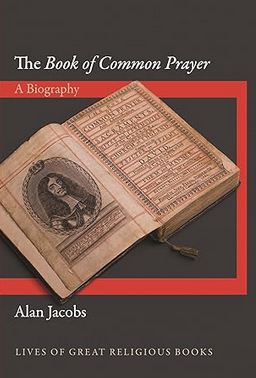
The Book of Common Prayer is the heart of the Anglican communion, and for my money contains some of English’s best phrasing outside Shakespeare and the Bible. Since 2011, its liturgy has been part of my life, its phrases embedded in my memory. I’ve long wanted to read this history, and recently writing a short story in which words from the liturgy — “Lift up your hearts” — play a significant role made me pick it up and read, to borrow from St. Augustine’s “Tolle! Lege!” Although I found it fascinating early on, when the history of the BCP is bound up with the breakway of the Church of England and its struggles to find footing as monarchs with varying theological views kept dying and changing the rules, it largely stays focused on the original British BCP until the last few score pages of the book, at which point different versions have multiplied with such fecundity, and Anglicanism has fallen so much in influence, that it hardly seems to be a point. What I will remember it for is the chaos of the BCP’s struggle to establish itself — not simply because Mary disrupted the protestantification of the Church of England, but because Henry, Cramner, Edward, and Elizabeth had wildly different interpretations of Protestantism and what they wanted the Church of England to be. It also made me curious about medieval English Christianity in general: Jacobs claims that sermons were rare and that Communion was a rariety, making me wonder what people did when they came to church. Jacobs indicates that laypeople just said their private prayers while the priest observed some service appointed in the missal. I suspect I would need to read Duffy’s oft-quoted Stripping of the Altars, which appraises medieval English religious practice and the coming of the Reformation, for a fuller story. This book is of interest, I think, but I suspect its audience is niche.
Quotes
The historian Peter Brown has pointed out that the cult of the saints arose in a Roman culture in which ordinary people could do little to remedy any injustice they might suffer, or to clear themselves of any charges of wrongdoing. They needed friends in high places. If a local patrician could befriend them, then they had a chance of receiving justice or at least escaping punishment. “It is this hope of amnesty,” Brown writes, “that pushed the saint to the foreground as patronus.”
The regular prayers of monks and nuns are best understood as attempts by the church to assign some of its members to do what the disciples could not do: to stay awake and pray with the Lord. There is therefore a close link between the monastic hours and the sufferings of Good Friday. In their ideal form, as established by St. Benedict of Nursia in the sixth century, they are conducted every three hours and are named as follows: Matins (midnight); Lauds (3 a.m., or, more commonly, dawn); Prime (6 a.m.); Terce (9 a.m.); Sext (noon); Nones (3 p.m.); Vespers (6 p.m.); Compline (9 p.m.).
But thousands of English Christians read their prayer books and used them faithfully for private as well as public worship. The same cadences they whispered to themselves when alone, or read silently, or read aloud in the presence of their household, also accompanied them to church. It was therefore through public rites and private devotions alike that the book’s language “entered and possessed their minds.” The beauty of that language, together with its great debts to more ancient forms of worship—Lewis rightly notes that Cranmer and the other makers of the prayer book “wished their book to be praised not for original genius but for catholicity and antiquity”—made the book venerable in but a few generations.
When, in 1637, James tried to impose on the Church of Scotland a version of the Book of Common Prayer that closely resembled the 1549 book in its embrace of traditionalism, riots broke out. The most famous tale of the conflict involves one Jenny Geddes, who, when a minister began saying the Communion service in Edinburgh’s St. Giles Cathedral, threw a stool at the man and shouted, “Daur ye say Mass in my lug?” Presumably this story got around quickly, because when Bishop Whitford of Brechin read his first service from the prayer book he did so with two loaded pistols placed on the desk before him, in plain sight of the restive congregation.
Once more we see a sixteenth-century pattern repeating itself: as the ascent of Queen Mary had sent many evangelicals fleeing to the Continent with their prayer books, so now a large body of Royalist Anglicans took their books with them to France, where they continued to pray according to the now-familiar rites, but in exile. As Horton Davies has pointed out, this proved to be a vital moment in the prayer book’s history: during this period—variously called the Interregnum, the Commonwealth, or the Protectorate—“the Prayer Book had become the symbol of a secret, exciting, and prohibited worship (like the Mass for the English Recusants), and, even more significantly, the symbol of loyalty to a suffering church. Even in palmier days, it was never to lose this profound respect; as if it was necessary for it to have been prohibited for it to be fully appreciated.”
Among the more striking new prayers in the 1662 book are the “Forms of Prayer to be Used at Sea,” an indication of England’s ever-increasing sense of itself as a maritime power around the world. These include prayers “to be also used in her Majesty’s Navy every day”—one of which begins, “O eternal Lord God, who alone spreadest out the heavens, and rulest the raging of the sea”—and prayers for particular circumstances, including one for success in naval battle and two for salvation from storms: “Look down, we beseech thee, and hear us, calling out of the depth of misery, and out of the jaws of this death, which is ready now to swallow us up: Save, Lord, or else we perish.” These are accompanied by brief, one-sentence prayers to be used in occasions of great urgency, when the crew cannot gather to pray corporately, and psalms appointed for “Thanksgiving after a Storm.” To read these prayers is to be immersed in a drama, almost as happens to the reader of Patrick O’Brian’s novels about the Royal Navy during the Napoleonic Wars—novels in which we hear these prayers said many times, with fervor corresponding to the demands of the moment, or lack thereof.
For him, and for many who have felt themselves at the mercy of chaotic forces from within or without, the style of the prayer book has healing powers. It provides equitable balance when we ourselves have none.

 Reading Freely
Note to self:
Duffy
Stripping of the altars
Check!
It’s a chunkster! I borrowed it once from my university library but lost the research mood I was in before I got fully into it. I remember learning about mystery plays and other more vernacular kinds of worship.
We talking 1k kind of chunkster?
Yep. Just confirmed on amazon and it’s approximately 1200 pages.
Whooo!
It’s definitely an interesting and TURBULENT period in English history….! I’ve read several books that put forward the idea that only a small percentage of the English (and them mostly at the ‘higher’ end) gave much more than lip service to religion. Of course before the Reformation any sermons would have been in Latin, so most people would have had VERY little idea of what was being said. I do find it fascinating that there was a strong movement NOT to translate the Bible and other religious texts into the vernacular so that (especially) the common people *couldn’t* understand things. Knowledge is Power and all that jazz….
Oh, not *completely* off topic…. Andrew Ziminski who wrote ‘The Stone Mason – A History of Building Britain’ has a new book out: ‘Church Going: A Stonemason’s Guide to the Churches of the British Isles’. It came out in paperback about a month ago. Now added to my Wish List!
Ooh, interesting! I need to finish that one first, though.
Jacobs mentions that sermons were in English. I doubt that ordinary village priests would be so fluent in Latin that they could compose sermons if they WANTED to. But there’s a point made by Jacobs when the BCP was being pushed into more ‘modern’ English, against resistance. Some people prefer the more formal language because its strangeness gives it a seperation, and therefore a kind of power — a recognition that this moment in our life is not like ordinary moments. Personally I still frequently prefer the language of the KJV to the RSV, and when I’m reading for service I have to be mindful about letting my memory take over.
“laypeople just said their private prayers while the priest observed some service appointed in the missal”: interesting!