
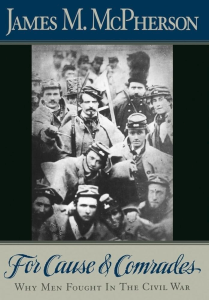
The moment I saw this book at a university booksale I knew I wanted it, because in the second story of that same library I’d researched my senior seminar paper to earn my BA in history. For Cause and Comrades dives into the letters of Union and Confederate combatants to explore what led them to fight and what kept them fighting after things grew miserable. (I’d done the same with Civil War songbooks to explore how they expressed motives and the experience of war.) James McPherson is best known for his Battle Cry of Freedom, a Pulitzer prizewinning history of the Civil War, and is generally regarded as the most preeminent of ACW scholars. Between the topic and the author, I knew to brace for a good read and was not disappointed.
McPherson writes at the beginning that he chose to focus on letters, not memoirs, because memoirs were often written decades after the events themselves, where memories could become pliable and made to fit feel-good narratives. While letters could also be performative – as men tried to reassure themselves and their wives and family at home that their boy was OK on the front – McPherson found them to be surprisingly raw and honest much of the time.
It’s worth noting, as McPherson does, that men of the 19th century lived in a much different culture than we did: it was more idealistic and romantic, and ideas like duty, valour, and honor had meaning that our cynical modern age frequent dismiss as sentiment. This is important to keep in mind, especially as it informs how Union and Confederate soldiers were fighting for “Cause”. The Union in 1861 was not even a century old; soldiers who fought for its preservation, or to help establish their own Confederacy, could have had grandparents who remembered a time before its existence. This made it especially precious to soldiers who believed the American experiment was still quite young and in need of protection – but at the same time, less important to Confederate soldiers for whom it was a political abstraction and not their “country”, proper. Many of the soldiers’ letters here testify to not believing in secession, but nonetheless defending it because Lincoln was invading their home. (General Robert E. Lee also fell into this camp, and it’s expressed in the film The Blue and the Gray when a Southern journalist who despises slavery and secession both winds up taking up arms at the end when the Yankee army is burning their way through his home county.)
McPherson’s shared letters and comments do not shy away from the fact that “cause” for both Union and Confederate soldiers was complex. Most Union soldiers were not fighting to exterminate slavery: at the beginning of the war, only 3-10% of letters (varying on region) expressed that thought, and in early 1863 many Union soldiers expressed bitterness that Lincoln was trying to turn it into a war to free blacks – though they used less polite terms. One of the more disturbing things I learned from David Williams’ A People’s History of the Civil War is that racism was not only pervasive across the entire United States, but even present with some abolitionists – and that’s evinced here. As the war progressed, though, and as Union soldiers waded further into the South and saw how slavery stagnated the economy and dehumanized both whites and blacks — and as they realized every runaway slave meant sapping the Confederate war effort – the number of Union soldiers writing against slavery increased.
On the Southern side, there were soldiers fighting for the institution of slavery, although far less than a modern reader would expect. This owes in large part to the fact that most southerners were not slave-holders, though many non-slaveholders did fight to defend slavery purely for the disruption widespread emancipation would cause. These letters concern both the practical economic effects, as well as social fears, particularly being “lowered” to the level of a slave. A poor tenant farmer or struggling freeholder might not ever have any status in society, but at least he wasn’t a “Negro”. Far more pervasive was the conviction that Southerners were fighting for “Their country” – be that Virginia or Texas, or the South in general. The fervor that Southerners had for their states was sometimes a cause for desertion: after Arkansas fell to Yankee armies, Arkansans fighting in Tennessee wondered why they were still in this thing for. (Nevermind Franklin’s adage about hanging together or hanging separately.)
On that note, McPherson notes that soldiers in units formed tight bonds with one another that often sustained them even when they’d stopped believing in causes. Part of this may be tied to the culture of the era, in which honor was taken far more seriously than now, but I don’t think it’s all of the story. Soldiers in the Civil War refused promotions to different units and continued fighting after their first term was up for the same reason soldiers in Afghanistan and Iraq continued to “re-up” even if they hated the wars and the land and the people they were fighting in and for – because their brothers were there, and they would not desert them. Considering that volunteer regiments tended to be highly localized, this makes sense – but men also formed strong bonds with strangers. When regiments were shattered by massive battles, though, a soldier who found all of his friends dead might be so overwhelmed he didn’t see any purpose in holding on.
Despite its size, this is a book rich with insight. It doesn’t skew toward anyone’s preferred narrative of the war, because the variety of quoted letters is enough to give any tidy stories pause for thought. McPherson is present as an editor and narrator, but if his thumb was heavier in some aspects or another I didn’t notice. A book like this – and other works like The Life of Billy Yank, or the Life of Johnny Reb – are valuable because they allow us to break through the staid paintings of narrative and see the subjects come alive and speak for themselves.

 Reading Freely
It’s always interesting to see history through the words of people who lived it, isn’t it? The idea that the Civil War was simply about slavery seems to be becoming embedded now, but no war is ever just about one thing. Same thing has happened here with WW2 being ‘about’ fighting the Nazis because they were inherently evil – that’s become a kind of distillation or simplification of the whole complicated thing.
That’s what made reading “Black Edelweiss” so chilling a few years back. Seeing Hitler’s attraction to a perfectly normal, middle-class family drives home Solzhenitsyn’s remark that “If only it were so simple! […] but the line between good and evil runs between every human heart”, etc.