
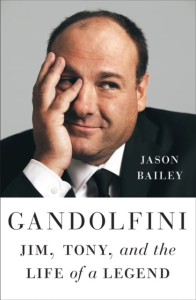
Like many, I was awed by James Gandolfini’s performance throughout The Sopranos, which made him an actor whose presence guarantees I’ll watch any movie he’s in. Gandolfini is a professional biography of an actor whose charisma and commitment to his work made nearly everything he was in exceptional. (The less said about Surviving Christmas, the better.) After the book begins by slightly skimming over Gandolfini’s childhood spent in a working-class Italian neighborhood in Jersey, Jason Bailey shifts to his subject’s growth as an actor, production by production, drawing heavily on interviews with both Gandolfini himself as well as those of his friends and peers.
Although Gandolfini was resistant to playing mobsters, two of his early breakout roles saw him feature as charming-but-menacing figures that were excellent practice for the character who would overshadow the actor for most of his life. He developed a speciality as a character actor, someone whose intensity could be brought in to “crush” a handful of scenes and add a strong seasoning to whatever movie he was in. Although he struggled with memorizing lines, his deep investment into developing characters and performing them – the persons, not merely the lines – opened the door to future projects. It was The Sopranos, though, that took him from “solid acting talent” to celebrity. The success of The Sopranos took the entire cast by surprise, as it completely disrupted their lives. Drea de Matteo, the young woman who played Adriana, suddenly had to be escorted through airports by security in a cart, or otherwise be mobbed by fans. Gandolfini was remarkably resistant to celebrity, though: he was grounded in Jersey’s working class, and despite taking advantage of his sudden ability to get last minute reservations at any restaurant he wanted, fame never went to his head. When he celebrated his 50th birthday party, the party included a few of his fellow actors, yes, but also a lot of people from the old neighborhood.
Tony Soprano dominates the midsection of this book, as he dominated Gandolfini’s life during the production years and continued to follow the actor in his remaining working years. Gandolfini’s research and intensity meant that even as he continued to breathe more and more life into the complicated gangster that Tony was also pushing his way into Gandolfini’s life. The actor would seek relief from the sheer emotional darkness through drinking and partying, sometimes not being able to work the next day, and this was habitual enough that his friends and family attempted to throw an intervention for him. It didn’t help that he was undergoing a divorce around the same time that Tony would, and Gandolfini began wondering if the showwriters weren’t mining his own personal misery to add fuel to the show.
His seriousness and intensity as an actor are remarked on throughout the book, but so is his warmth and generosity. He frequently treated the cast and crew to dinner at week’s end, and when the Sopranos wrapped up filming he dispensed nearly a half-million dollars in gifts. He’d been similarly generous during an actors’ strike, giving the cast money in gratitude for their support. He’s frequently noted here for his consideration of other actors, including young actors — helping coach those new to the stage, and always checking his acting peers to see if the take had worked for them. It didn’t matter if he’d been at work for over 10 hours, doing take after take: he wanted other actors to know that their art was collaborative – despite the fact that no one will argue Tony Soprano was the heart of The Sopranos and its success.
After The Sopranos wrapped, Gandolfini moved on to other projects, from serious dramas to rom-coms like Enough Said. When former cast members met him, they remarked on how dramatically he had changed: without having to channel Tony all the time, without living in the anxious, violent, and cruel don’s skin: it was if a cloud had lifted. He was also able to explore a bit, profesionally: he found he liked doing nonfiction documentaries, especially those focused on members of the US military who were dealing with physical and mental trauma from the terror war. Unfortunately, his post-Sopranos life would not be long: he died in June 2013 of a heart attack, one presumably brought on by weight, past stress, and past substance abuse.
As a fan of both The Sopranos and Gandolfini in general, I loved this book. As with Kaplan’s biography of Sinatra, it doesn’t ignore his weaknesses as a human – his own temper, his excesses – but it puts the man’s virtues and talent center-stage. I must note that it’s added several titles to my to-watch list – from his early stuff like Get Shorty to his later work like The Taking of Pelham 123.
Related:
Woke up this Morning: The Oral History of The Sopranos. Michael Imperioli and Steve Schirippa
Quotes:
Jim had built an entire character for Bear that he came out of the South,” Patty Woo says, laughing. “None of this was ever discussed. None of this was in the plot. But for Jim, it was important. And then he had to work on his Southern accent, and it became an issue—he got himself a coach, because Jim, from New Jersey, does not have access to an au then tic Southern accent. And now he’s killing himself to be au then tic to it!
Gandolfini despaired, “Oh my God, Roberto, I’m gonna be unemployed in less than a year. Who the hell is going to see a television show about Mafiosos in Jersey?”
He does much of his best acting with his eyes, carefully choosing when to bore them into a potential enemy, when to lower the hoods of his eyelids to shield his real feelings, and when to let them pierce one of his underlings so they know he means business.
“If there’s one thing I hate, it’s an actor getting up on a soapbox,” he told Matt Zoller Seitz, before chuckling and miming a “scratch that” motion. “Hey, forget I said that. If you print me saying that, it’s me getting up on a soapbox.”
Gandolfini’s take on Tony:
What you see in Tony is that a life of materialism, of constantly feeding on the world, leads to nothing but emptiness. Someone like Paulie Walnuts has his way of life and he is what he is. He can be happy. But Tony is smart enough to know that there should be more, a bigger picture. He sees through all the bullshit around him. So he’s empty. That’s what eats at him: Why can’t I be happy?
Most intriguingly, he met with brass at NBC to discuss joining the cast of its hit The Office when star Steve Carell departed in its seventh season. At the time, trades reported that Gandolfini “wasn’t interested”; years later, on an episode of the podcast Talking Sopranos, Steve Schirripa revealed that they got as far as an offer from NBC of $4 million per season, but, according to Schirripa, “HBO paid him $3 million not to do it.”

 Reading Freely