
Today’s prompt from Long and Short Reviews is “Favorite Quotes from Books“, which is ridiculously unfair. I am a quote-hoard. But while I despair of winnowing out ten standouts from my collection, here’s the WWW.
WHAT have you finished reading recently? An Audible presentation of The Lion, the Witch, and the Wardrobe, and Benjamin Franklin: An American Life by Walter Isaacson
WHAT are you reading now? The Swamp Fox, a history of Francis Marion’s irregular warfare against the Brits during the Revolutionary War.
WHAT are you reading next? Declaration: The Nine Tumultuous Weeks When America Became Independent, May 1-July 4, 1776, William Hogeland. This is an interesting period because the colonies made themselves legally independent by creating their own State constitutions, well before a formal Declaration was issued by the 2nd Continental Congress.
And now…..favorite quotes from books.
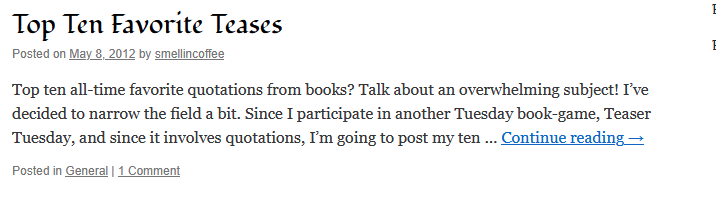
Oh, hey, I could totally cheat! But no, I’m not going to. I will, however, look back at that list to see how many of the items have stuck in my head for 13+ years. (I know one of them has, because searching for the exact quote was how I got that result.) Unfortunately, Top Ten Tuesday did a similar topic back in March with “Things Characters Said”, and a lot of my favorites are on that list. SO, I am going to restrict myself to nonfiction quotes. (We also did “Thoughtful Quotes” back in March, but a few of my very favorites are there so I’m not going to exempt them. Oh, and look, another Top Ten post on quotes! )
Neighborhoods like Georgetown or Beacon Hill are walking neighborhoods. It is not necessary to hop in the car to get an ice cream cone or a bottle of aspirin. You walk to a store — enjoying the felicities of the street as you go — and you are able to see other people along the way. You may even have a conversation with a stranger. This is called meeting people, the quintessential urban pleasure. (Or else it is called a mugging, the quintessential urban calamity.).
The Geography of Nowhere: the Rise and Fall of America’s Man-Made Landscape; James Howard Kunstler)“I explained — with the excessive exposition of a man spending a lonely week at the airport — that I was looking for the sort of books in which a genial voice expresses emotions that the reader has long felt but never before really understood; those that convey the secret, everyday things that society at large prefers to leave unsaid; those that make one feel somehow less alone and strange.
Manishankar wondered if I might like a magazine instead.” (A Week at the Airport, Alain de Botton. One reason I like this quote so much is that de Botton is that voice for me.)Who should ‘run’ America? No one. Or 250 million single individuals. Every man a king, every woman a queen, as the martyr Huey Long once sang. […] As Americans from Emerson to Mencken have known, following leaders is a fool’s game. Only when we restore to Americans their birthright — local self-government in prideful communities that respect the liberties of every dentist and Baptist and socialist and lesbian and hermit and auto parts dealer — will we remember what it means to be an American, first.” (America First, Bill Kauffman)
If only it were all so simple! If only there were evil people…and it were necessary only to separate them from the rest of us and destroy them. But the line dividing good and evil cuts through the heart of every human being. And who is willing to destroy a piece of his own heart?” – Aleksandr Solzhenitsyn, Gulag Archipelago
“I went into the woods because I wished to live deliberately, to front only the essential facts of life, and see if I could not learn what it had to teach, and not, when I came to die, discover that I had not lived. I did not wish to live what was not life, living is so dear; nor did I wish to practice resignation, unless it was quite necessary. I wanted to live deep and suck out all the marrow of life, to live so sturdily and Spartan-like as to put to rout all that was not life, to cut a broad swath and shave close, to drive life into a corner, and reduce it to is lowest terms.” – Henry David Thoreau, Walden
If any man feels that the world is too complex and its evil is too big to cope with, let him remember that it is too big to drown in a glass of whiskey. – Ayn Rand, Philosophy: Who Needs It?
The most dangerous thing you can do is to take any one impulse of your own nature and set it up as the thing you ought to follow at all costs. There’s not one of them which won’t make us into devils if we set it up as an absolute guide. You might think love of humanity in general was safe, but it isn’t. If you leave out justice you’ll find yourself breaking agreements and faking evidence in trials ‘for the sake of humanity’ and become in the end a cruel and treacherous man.” – C.S. Lewis, Mere Christianity.
To love at all is to be vulnerable. Love anything and your heart will be wrung and possibly broken. If you want to make sure of keeping it intact you must give it to no one, not even an animal. Wrap it carefully round with hobbies and little luxuries; avoid all entanglements. Lock it up safe in the casket or coffin of your selfishness. But in that casket, safe, dark, motionless, airless, it will change. It will not be broken; it will become unbreakable, impenetrable, irredeemable. To love is to be vulnerable. –C.S. Lewis, The Four Loves
But I had a good uncle, my late Uncle Alex. He was my father’s kid brother, a childless graduate of Harvard who was an honest life-insurance salesman in Indianapolis. He was well-read and wise. And his principal complaint about other human beings was that they so seldom noticed it when they were happy. So when we were drinking lemonade under an apple tree in the summer, say, and talking lazily about this and that, almost buzzing like honeybees, Uncle Alex would suddenly interrupt the agreeable blather to exclaim, ‘If this isn’t nice, I don’t know what is.” – Kurt Vonnegut, A Man Without a Country
Be not unhappy, or discouraged, or dissatisfied, if you do not succeed in acting always by the right principles; but when you have failed, try again, and be content if most of your acts are consistent with man’s nature. Love that to which you return; do not return to philosophy as if she were a schoolmaster, but behave like those who have sore eyes and apply a bit of sponge or an egg, or like another who applied a plaster of a water lotion. For thus you will not fail to obey reason, and will find rest in it. And remember that philosophy requires only the things which your nature requires. – Marcus Aurelius, the Meditations
But when I am in an airport, that most harried image of the eternal tarmac of Hell, crowded without community, noisy without celebration, technologically sophisticated without beauty, and see people engaged in loud conversations not with one another but with a business partner in Chicago or a spouse and children far away, I see not freedom but confinement. And above them all, as if to remind us of our unhappy state, blare the everlasting televisions, telling us What Has Just Happened and What it Means, and preventing us from ever experiencing a moment not of loneliness but of solitude, not of idleness but of peace. It too is a tool of the Anticulture. For culture by its nature is conservative. It remembers, it reveres, it gives thanks, and it cherishes. A farmer tilling the land his father tilled, whistling an air from of old, in the shadow of the church where his people heard the word of God and let it take root in their hearts—that is a man of culture. He might live only fifty years, but he lives them in an expanse of centuries; indeed, under the eye of eternity. How thin and paltry our four score and ten seem by comparison! For we are imprisoned in irreverence. Our preachers are neither the birds nor the old pastor peering over Holy Writ, but the nagging, needling, desire-pricking, noisome voice of the mass educator, or of the headline, or of the television, which could never have won our attention without encouraging in us amnesia, indifference, petulance, and scorn, all destroyers of culture. – Anthony Esolen, from a First Things article I can no longer find. Phooey.)
(I know this is eleven but I couldn’t decide between my CS Lewis quotes. Oh, and here’s a bonus from Jack!)
“[My father] relied wholly on his tongue as an instrument of domestic discipline. And here that fatal bent toward dramatization and rhetoric produced a pathetic yet comic result. When he opened his mouth to reprove us he no doubt intended a short well-chosen appeal to our common sense and conscience. But alas, he had been a public speaker long before he became a father. Words came to him and intoxicated him as they came. What actually happened was that a small boy who had walked on damp grass in his slippers or left the bathroom in a pickle found himself attacked with something like Cicero on Cataline, or Burke on Warren Hastings; simile piled on simile, rhetorical question on rhetorical question, the flash of an orator’s eye and the thundercloud of an orator’s brow, the gestures, the cadences, the pauses. […] While he spoke, he forgot not only the offense, but the capacities of his audience. All the resources of his immense vocabulary were poured forth. I can still remember such words as ‘abominable”, “sophisticated”, and “surreptitious”. You will not get the full flavor unless you know an angry Irishman’s energy in explosive consonants and the rich growl of his r’s.”
C.S. Lewis, p. 23, “Surprised By Joy”.

 Reading Freely
I have a piece of paper on my fridge with, ‘If this isn’t nice then I don’t know what is’ on my fridge. It makes me feel happy just to read it.
That’s a wonderful way to be reminded of it!
These are great! I especially like the quote by Ayn Rand.
Lewis was such a thoughtful writer.
Yes! Always a pleasure to spend ‘time’ with him.
Lewis was such a thoughtful writer.
Lewis was such a thoughtful writer.
Wonderful audiobooks!
Last book I finished: Angelhunting, by Ji Hong Sayo
Am reading: Artificial Wisdom, by Thomas R. Weaver
Am listening to: The Golden Ball, by Agatha Christie
Next: Voici demain, by Valentin Musso
Oof, that Bill Kaufmann quote hurts. These are all fantastic though, I need to up my nonfiction game, I think.
Here is my post.
This is an awesome selection! Well worth the time to read. I forget just how lovely CS Lewis’ writing really was.
Nice selection. I especially like the Lewis quote, “Love anything and your heart will be wrung.”
PK
These are such wonderful, thought-provoking quotes, Stephen. Love the C.S. Lewis one. Thanks for visiting my blog.