
Today’s short story is a pair of stories, chosen because they share a common theme.

The first, Arthur C. Clarke’s “Into the Comet”, opens on a science ship in despair. The Challenger was commissioned to investigate Randall’s Comet, a long-period comet that is only visible from Earth every hundred thousand years. The ship’s mission is to study the comet’s composition — its tail, but if possible, the nucleus itself, which proves to be not so much a coherent whole but rather a gravitationally-bound cluster of icebergs with varied chemical compositions. While the Challenger is successful in its mission, something about the comet’s constitution disrupts the computer, rendering it incapable of calculating even the simplest of sums. This is a death sentence for the crew of the Challenger, as without the computer they have no way of escaping the orbit of the comet, let alone cruising back to Earth — weaving their way through various gravitational attractions. Until….George Takeo Pickett (oh, my), a reporter who serves as quartermaster for the crew to pay his keep, remembers his grandfather’s abacus. Fashioning one from parts in the ship, he begins practicing again, and pitches his idea to the skipper — save the ship through human computers! I experienced this story as an audiobook and enjoyed it throughly: the narrator, Ray Porter, does a good job of communicating the despair in Pickett’s voice as he begins his log of their doom, as well as the little tease of hope that occurs to him. There’s one other character who is voiced, and for him Porter assumes a servicable accent that made me think of Eastern Europe, perhaps Russian.
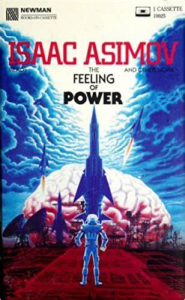
The story reminded me of one of my favorite Asimov stories, “The Feeling of Power“, published in 1958. We find ourselves in some distant future where Earth is at war with the technologically matched Denebians: it’s a long-term, rather like the Great War in which every upgrade in missiles and computers is matched by the other side. But a lowly technician with an interest in the history of computing, having studied how early computers were fashioned, has reinvented something long lost to humanity: Math. He can add up sums in his head! Multiply them, too, for what is addition but many rounds of addition? And he’s working on division. When he shows off his invented skill of “graphitics”, one of his supervisors immediately realizes the potential. Why, computer-controlled missiles rely on computers so massive that they’re inefficient, especially given how expensive they are. But a missile controlled by a man, directly? It could be made ever so much cheaper! Unleash a load of them before the Denebians catch on to graphitics, and the war could be over! This one has aged poorly given miniaturization, though there’s still a moral component to appreciate within the story (I didn’t mention it given the potential for spoilers) as well as the idea behind the title: the feeling of power. The military men in this story resent how dependent they are on the machines: one declares that graphitics is a means of freeing ourselves from the machines. How utterly, utterly relevant that is in our day where people use Google Maps to get themselves across their hometowns! In the name of convenience we’ve surrendered agency and become lesser creatures as a consequence. I enjoyed revisiting this one and am glad that the Clarke title brought it back to mind.
Nine times seven, thought Shuman with deep satisfaction, is sixty-three, and I don’t need a computer to tell me so. The computer is in my own head. And it was amazing the feeling of power that gave him.

 Reading Freely
I remember reading E E ‘Doc’ Smith stories (written in the 1930’s) where ‘computers’ were people doing sums (with slide-rules I think). Of course, back then, computers had been people… but it felt *weird* reading things like that in the 70’s and 80’s.
I *just* missed the slide-rule era. We used log tables in school… then they went and invented hand-held calculators and all than training went to waste!!
I missed both of those, since calculators — even the ones for advanced math — were the norm by the time I got to school. We were still taught how to do long division & multiplication tables, though.
The generational differences are funny: my supervisor was once annoyed that there weren’t calaculators at every staff desk, and I was thinking….not only do computers have Calculator apps, not only can we do basic calculations in a browser window (unless AI is butting in with some random interpretation ), but we’re all carrying phones with calc apps!
Before I got my promotion & moved here I was sent on a 2 week training course for SSADM and Programming (in COBOL). When I sat down at the PC for my COBOL lessons I raised my hand to say that my mouse was missing… only to be told that it didn’t HAVE one and we would be using keyboards only…. [lol]
I still chuckle over the shock some people had @ our new office building where *every* desk had a computer. Some people were horrified whilst others thought it was heaven… It was (often but not always) FUN living through a time when things were changing SO fast.
What was your history of getting used to computers? In the early 1990s there were Apples of some kind in my sixth-grade classroom, but I don’t think I ever tried to use one until more 97, 98. My friends had Windows systems and they taught me how to use them mouse to do things, and in ’98 I took a Windows 95 class and have used a PC pretty much every day since.
Oh man, tell me about people using googlemaps in areas they should know. One guy I work with just uses his phone for navigation every time he gets in the work van. He just shuts his brain off 😦
Going WAY back (late 1970’s) I was, briefly, in Computer Club @ school where we sent off punch cards – I kid you not – to be run on a mainframe and we’d go through the print outs each week to see what mistakes we’d made.
Early 80’s I had a Sinclair Spectrum – the only ‘computer’ I could afford – and played games on it between overheats. I also taught myself BASIC to ‘fix’ some of the programmes I had installed on it plus doing some very basic animation.
Computers were rare beasts when I started work in the late 80’s in London so I didn’t use them very much and then only really for spreadsheets. It was only when I moved to my new job here that I started using them every day for all sorts of things. I was also friends with the Head of IT (it was a VERY small team I was part of at the time) so managed to long-term ‘borrow’ a 386SX with a 40Mb hard drive until I finally purchased one of my own.
So, I’ve been a daily user of PCs since around 1994. I’ve been on LOADS of Microsoft training courses, spent a few years in IT Support, even ‘taught’ people the basics of using IT for a while…
Oh, and (as I’ve mentioned before) I’ve been a gamer since 1974 when I was introduced to ‘Pong’ on a school trip to the French Alps…
Are you still used to working within the command line? It’s something I practice, in part because I enjoy it, in part because it’s better for some things — batch-moving files with the same type, for instance — and because it makes people think I’m a wizard. XD
An older friend of mine got his start in batch programming. The funny thing is he’s checked out of IT since the late 1990s — his family only recently got him to use a smartphone!
Oh, I haven’t done anything like that for *decades*… I did used to enjoy writing programmes & debugging but I’m really not a Geek/Nerd in that direction (unlike some of my friends who LIVE for that shit!). In another life, maybe….
It IS funny when you know just enough that you can pretend to KNOW what you’re doing and see people’s jaws drop when you fix something in seconds that they can’t even articulate because you’ve seen it 100 times already.
Computers were an optional class at my school in the 1980s. I didn’t take it (or typing) because I didn’t want to be a secretary (taking dictation from a man) and I couldn’t see any other future from taking either class!
It sounds as if both authors recognised the importance of learning to read and basic math.
Thanks for the link to the Isimov short story, I’m going to read it now.
Considering how prominent a role women played in early computer science, I’m sorry to hear they had such a reputation in the eighties!
I grew up in a farming region that was then (and still is amongst some parts of the older generation) fairly conservative about men and women’s roles. Interestingly, this wasn’t linked to religion, instead it’s a lack of awareness of the world having changed. It’s probably the same in rural areas all over the world where people live their lives in one place and don’t continue their educations.
It’s amazing now that I look back that my school offered computer classes alongside courses designed for boys who were expected become farmers and girls expected to become farmer’s wives.
Pingback: What I Read in 2025 | Reading Freely