
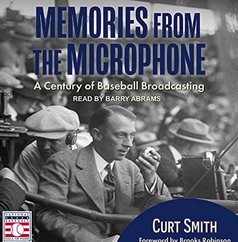
Memories from the Microphone is a history of baseball broadcasting that begins with primitive radio and follows broadcasting into the maturation of radio and television networks. In this, it’s also a partial history of how radio and television developed as media, from local stations and personalities to big networks and corporate deals. It’s roughly, but not strictly, chronological. Smith’s approach is to highlight a few announcers in a given decade, but follow their history well beyond the chapter’s titled limits, so we’re constantly getting stories from across three decades in any given chapter, but moving steadily forward on average. I listened to the audioversion, read by Barry Abrams, and enjoyed it on the whole — though as with most baseball books, I prefer the earlier content to the more contemporary.
Memories is interesting as a baseball history because while the sport’s stars definitely feature, the stars here are the radio announcers and later TV personalities. (The exception is when some ballplayers transition into being announcers, the biggest example being Dizzy Dean.) The early chapters were especially fascinating to me because they involved a lot of ‘announcing by wire’: radio broadcasters would receive news updates via telegraphy, and then use that information to pretend they were announcing the game live. Presumably some listeners knew that their Birmingham radio station certainly wasn’t broadcasting from say, Fenway Park, but some announcers would create sound effects to try to create the sense that they were. Because telegraphy could be interrupted, at least one station made a habit of broadcasting from an inning behind to mitigate that risk. Ronald Reagan, when left hanging during a broadcast, decided to ad-lib, creating fictitious foul balls and field interruptions for six minutes until updates started pouring back in. In these early chapters we also get a sense of radio as an emerging medium, as announcers realized that they were not simply dispensers of facts, but had to be performers: some created excitable vocal styles, inventing words like BLAMMO! to capture and hold the audience’s attention. Others would invent a persona to inhabit while they were alive: Dizzy Dean flanderized himself to a degree, laying on his Arkansas hick-ness as thick as molasses and creating folksy mispronunciations and expressions to charm the listening audience. (When questioned about his syntax, he replied: “They’re taxing that, too?!”) Once, purely to demonstrate this, he announced in his normal voice for a few minutes, then said “That’s enough of that” and “slud” back into his radio persona. Dean would also sing on mic, using the “Wabash Cannonball: to liven up dead air. He wasn’t the only singing announcer, but in the narrator’s voice he’s definitely the most memorable.
For some reason, I thought this would incorporate recordings from across the 20th century. It doesn’t, but narrator Barry Abrams does impersonations of some of baseball’s more impassioned voices, including one of a young Ronald Reagan from the 1930s announcing games. His voice was easy to listen to, and I enjoyed the variety: there are enough interviews and reenactments peppered in so that it never sounded dull. The only blip, audio-wise, is that as with all other Audible productions, the narrators read everything, including things that interrupt the flow of the narrative. This is most egregious in Ready Player One, when Wheaton was forced to read out scoreboards line-by-line, but here it mostly takes shape in parenthetical remarks, which are especially disruptive when Abrams is in the middle of an excited impersonation/reenactment. The remarks are never given in the same voice as the announcement, so what happens is deliveries like this: THE GIANTS WIN! THE GIANTS WIN THE NL (National League) PENNANT! It’s emotion, emotion, then a screeching halt into flat voice, then suddenly whiplash as we go back into emotion. This wasn’t chronic, but it was regular enough to be annoying.
This was a fun approach to the history of baseball that also served up some broadcasting history as well. Although the constant chronological mixing called for better editing, I didn’t find it as bothersome in the hearing as print readers did. It may be a consequence of growing up listening to southern storytellers, who often stagger drunkenly through timelines and sometimes into different stories altogether as the spirit moves. Although Abrams also did the audio for Smith’s The Presidents and the Pastime, a study of American presidents and baseball (something that pops up here a time or two, with Reagan, FDR, and JFK), I’m going to get the print edition of that to see if there’s a marked difference in how strong the narration is.
Related:
Baseball Forever!, a collection of 50 radio highlights across the decades, taken from one man’s private collection that began in the 1940s. I listened to it last year and was able to connect some of the recordings to Abrams’ recreations here.
Hello, Everybody! The Dawn of American Radio, Anthony Rudel

 Reading Freely
This book sounds quite interesting. I still remember my parents watching the Chicago Cubs in the fifties and sixties, with the games announced by Jack Brickhouse, who became famous in the Chicago area. His regular “Hey! Hey!” after a home run became one of his signature lines.
Ohh, that features! Along with other catchphrases –‘Look at THAT!” “It’s going…..going…..GONE!!”
Pingback: The Presidents and the Pastime | Reading Freely