
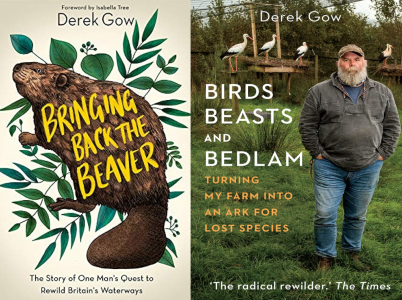
While scouting for science books that could also fit into Read of England a few weeks back, I saw Brining Back the Beaver and was instantly on board. I like beavers, though I’m not entirely sure why: perhaps it was some children’s fiction I read with a beaver character. At any rate, I was excited to learn about attempts to bring back beavers to Great Britain and the restorative potential they have for the landscape and waterways. Bringing Back the Beaver proved to be chaotic, though, a mix of memoir and diatribe that struck me as quite disorganized, though I found Gow’s passion attractive and enjoyed his insight as to what beavers can contribute to the ecosystem. A recurring theme as Gow tracts his and other’s attempts to bring back beavers is his frustration with the slow pace of bureaucracy, with a ‘better to ask forgiveness than permission’ mentality resulting.
The success of Bringing Back the Beaver resulted in Birds, Beasts, and Bedlam, a mix of biography and memoir. Gow’s attempts at rewilding parts of Britain are not merely professional, but personal. He has spent his entire life working with animals, even keeping his own sheep as a teenager, and in his later years he began converting a cattle farm into a rewilding experiment . This book begins as biography before transitioning to his accounts of learning about different threatened British species and his attempts to create homes for them, often being attacked by the animals in the process. One of his colleagues once had two badgers lock on to either of his arms! In addition to creating habitat for creatures like water voles and Scottish wildcats (which, confusingly, look like regular cats to me), he also introduces some Heck cattle, which grew as a breed in the 1930s as two German brothers wanted to re-create something like the wild Aurochs that once roamed Europe. Interestingly, Brexit appears to have created a more legally favorable atmosphere for rewilding than before.
Both books are slim and largely entertaining: Gow’s nature-writing is enjoyable, but his spleen-venting not so much. It’s possible to rant in an eloquent fashion — Wendell Berry, Ed Abbey, and Paul Kingsnorth have all done it — but Gow’s writing gets more staccato when he’s in rant mode.
Quotes::
He was one of a tiny group of folk worldwide unfortunate enough to have ever been bitten by a sloth.
‘How did it happen?’ you would ask.
‘Very slowly,’ he’d reply.During their mating season in late spring when they gather in shallow water bodies to breed, the tiny pugnacious males with their creamy brown throat sacs ascend reed stems or low scrub growth to scream through the night at their rivals. So irate do they become, like bilious back-benchers all port flushed and pompous, that you feel when they are fully wound up, they could quite easily explode.
Maybe sometimes they do.
Alone in the dark with a light popping sound.I was on my knees when [the wildcat] ran right out from under a rock and into the net. It turned, wriggled out once again, and, without thinking, I caught hold of its broad, furry tail and held on.
Bad things always happen in slow motion.


These sound like interesting reads in some ways but I can’t say that I’m interested in reading the rant-y parts. I do find Beavers very interesting though! And lol bitten by a sloth? That’s kind of hilarious but also scary, what do you have to do to anger a sloth? Sorry I haven’t been around much lately, my blog stuff has been all discombobulated and I feel like I haven’t visited yours in so long!
I think it must’ve been deliberate, like he WANTED to be able to say he’d managed to get bitten!